


A security researcher recently decompiled the Trump administration’s new official White House app and found a collection of troubling features buried beneath its polished patriotic branding. The app, which was initially marketed as offering Americans “unparalleled access” to the administration, reportedly includes code capable of bypassing cookie consent notices and login walls, location-tracking infrastructure tied to third-party services, and externally loaded code that security experts criticize as risky for an official government platform. The app also includes overtly political features, including a one-tap mechanism to send prewritten praise directly to President Trump.
The story immediately ricocheted across social media. Critics call the app dystopian. Supporters dismiss the backlash as another round of anti-Trump hysteria. Yet the most important question raised by the controversy may not be whether every allegation about the app proves true. The more important question is why an official White House app feels less like a neutral civic tool and more like an extension of a political movement’s media operation.
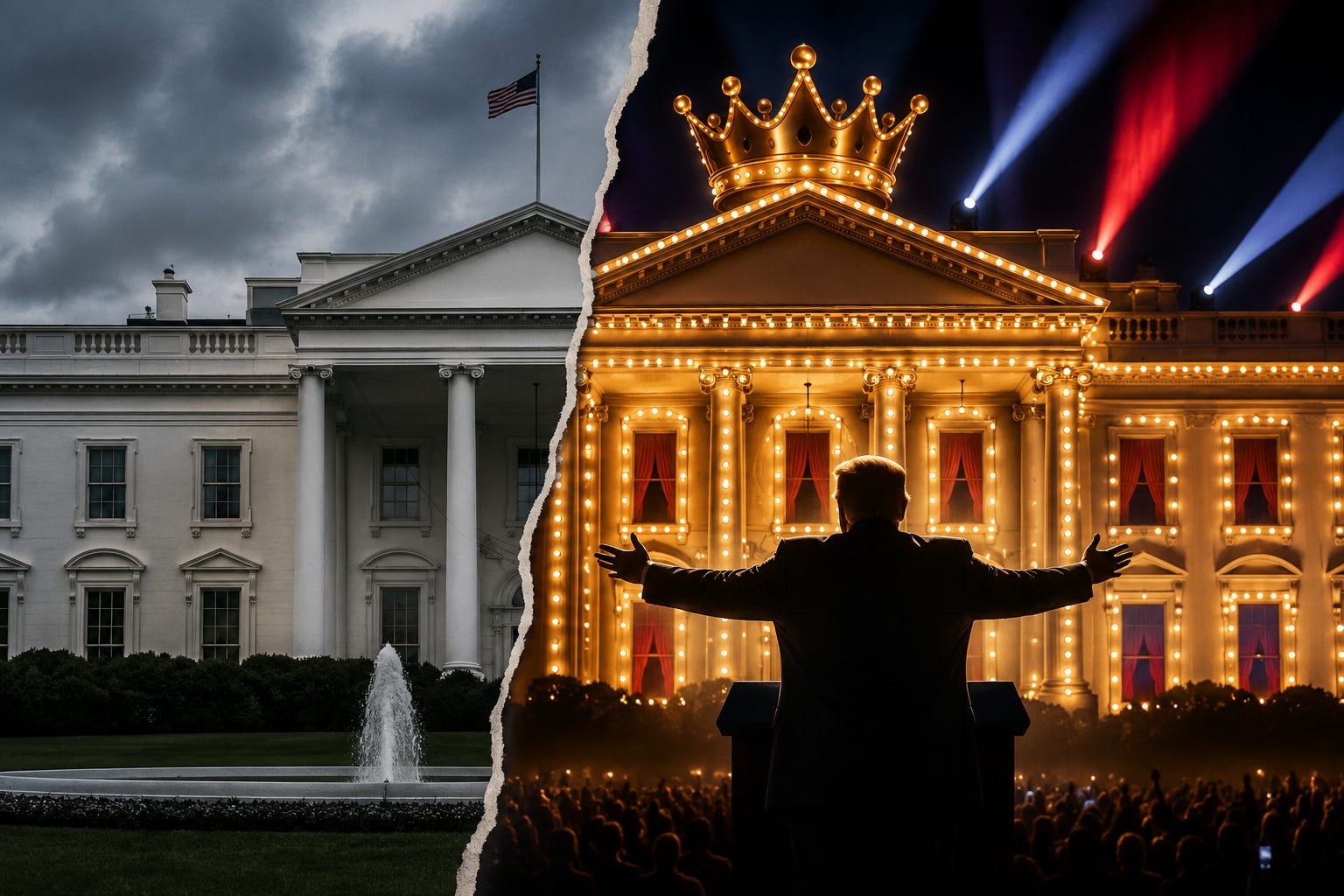
The app is not an isolated oddity. It is the latest and perhaps most vivid example of a broader transformation in American political culture, one in which the presidency increasingly behaves less like a constitutional institution and more like a permanent political brand.
Support independent media that follows the power.
The Coffman Chronicle is built to track who holds power, who abuses it, who profits from it, and who pays the price.
Paid supporters get full Tony Michaels Podcast episodes, deeper transcript analysis, paid columns, archives, and the reporting framework behind the show.
If you believe independent media has to survive outside billionaire platforms, corporate media, and party-approved gatekeepers, become a paid supporter today.
What Researchers Actually Found
To be clear, some of the most alarming claims surrounding the app remain disputed. Researchers who examined the software found location-tracking capabilities embedded within the app’s code. However, there is no definitive public evidence that the app is actively conducting covert background surveillance on users to date. Mobile operating systems generally require permissions for location access, and some analysts have argued that portions of the code may simply reflect commonly used software development tools rather than active spying functionality.
Other aspects of the app are far less ambiguous. Researchers documented that the application uses third-party services such as OneSignal for notifications and analytics, Mailchimp for email infrastructure, and other outside commercial tools. The app also reportedly manipulates web pages opened through its internal browser by stripping away cookie consent banners, privacy notices, and certain login prompts. Security researchers criticize the decision to load executable code from an external GitHub Pages account, warning that such practices can create unnecessary supply chain vulnerabilities. In plain English, that means a weakness in a third-party service could expose users to malicious code without the federal government directly controlling the underlying infrastructure.
None of these issues necessarily transforms the White House app into some grand surveillance scheme. However, they do reveal something arguably more troubling. An official government application intended for broad public use appears to have been built with the logic and aesthetics of a modern political media product rather than the restrained standards citizens should expect from the executive branch of the United States government.
Federal Employees Are Not Political Props
That concern only deepened when reports emerged that federal agencies were being directed to install the app on government-issued devices. Federal employees are not campaign volunteers, nor are they members of a presidential fan club. The federal workforce includes Democrats, Republicans, independents, and people with no political affiliation at all. Career civil servants swear loyalty to the Constitution and the laws of the United States, not to a single leader.
That distinction once formed a central part of America’s civic culture. Increasingly, it feels like a relic.
The United States has always had partisan presidents. Administrations have advocated for their policies and framed their accomplishments in favorable terms. However, there was historically a clear distinction between campaign rhetoric and official government communication. White House websites and agency statements generally adopted a procedural and institutional tone, even when advancing highly ideological agendas.
The White House Used to Sound Like a Government
Previous administrations announced executive actions with language that sounded administrative rather than theatrical. Presidents signed orders “directing federal agencies,” “establishing offices,” or “declaring national emergencies.” The wording often sounded dry because government documents are, by nature, supposed to be somewhat dry. They become part of the permanent federal record. Historians, courts, journalists, foreign governments, and future generations all rely upon those records to understand how the country governed itself.
The contrast with much of today’s official presidential communication is difficult to ignore. Recent White House announcements have carried titles such as “Restoring Truth and Sanity to American History,” “Unleashing Prosperity Through Deregulation,” and the almost surreal “Makes America’s Showers Great Again.” The issue is not simply that these phrases sound partisan. The issue is that they sound like campaign slogans and culture war branding inserted directly into the official voice of the American presidency.
The shift may appear superficial at first glance. It is not.
Language shapes institutional identity. Citizens learn what government is, in part, through how it speaks. For generations, Americans were accustomed to official communications that sought to make it seem as though the presidency represented the entire nation, even as it pursued partisan goals. The current style increasingly frames governance itself as a form of tribal combat. Official channels routinely adopt the emotional cadence of social media feuds, partisan grievance politics, and perpetual cultural warfare.
Governance Has Become Performance
The result is a presidency that often feels less like a constitutional office and more like an ongoing performance.
Modern political incentives have accelerated that transformation. American campaigns are extraordinarily long, extraordinarily expensive, and increasingly driven by celebrity culture and algorithmic media dynamics. Politicians are rewarded for virality, emotional intensity, and audience engagement. Outrage travels farther online than competence, while branding outperforms restraint. The line between campaigning and governing has steadily eroded as politicians maintain permanent campaign-style media operations long after elections end.
The shift extends beyond press releases and executive order titles. Official White House and agency social media accounts increasingly speak in the language of online tribal conflict rather than public administration. Posts routinely frame political disagreements as existential battles between patriots and enemies, often adopting the emotional tone of campaign surrogates or partisan influencers rather than institutional representatives of the federal government.
Official government accounts carry the authority of the state itself. Citizens expect campaign accounts to attack opponents and rally supporters. The White House and federal agencies traditionally occupied a different role. Their communications were expected, at least aspirationally, to reflect that government institutions serve the entire public, including people who politically oppose the current administration.
Often, the President sets the tone for what is acceptable within government communication. When the one leading the nation is the loudest online and public voice expressing grievance and using charged language, the entire tone of the government begins to change.
The presidency occupies a unique role in American life because the president functions simultaneously as head of government, head of state, party leader, and symbolic national representative. Like it or not, the official voice of the White House often becomes the perceived voice of the nation itself. WhiteHouse.gov is not merely another partisan website floating through the digital landscape. It is one of the most recognizable symbols of American governance in the world.
Foreign governments read these statements. International journalists consult them. Historians will dissect them decades from now. Schoolchildren will eventually encounter these records while studying this era of American history.
The Presidency Belongs to the Republic
That reality makes the degradation of official language feel far more significant than ordinary political messaging. Citizens expect campaigns to be emotional, tribal, and performative. Campaigns are competitions. Governance is supposed to be stewardship.
A healthy democratic republic depends upon citizens believing that institutions belong to everyone, including people who voted for the losing side. The presidency was never intended to become a one-man show built around personal branding and emotional spectacle. Presidents are temporary stewards of constitutional institutions. They inherit offices that existed before them and will continue after they leave.
The most unsettling aspect of the White House app controversy is not merely the possibility of sloppy software practices or aggressive political messaging. It is what the app symbolizes. The application feels entirely consistent with a broader political culture in which official governmental institutions increasingly present themselves less as instruments of public service and more as extensions of a leader’s personal movement.
Norms once constrained some of these impulses, even when laws did not. The Constitution cannot possibly codify every expectation necessary for democratic stability. American governance long depended upon unwritten understandings that separated campaign apparatuses from state institutions and distinguished personal loyalty from constitutional duty. Those norms mattered precisely because they reinforced the idea that the government belonged to the republic rather than to whichever faction temporarily controlled it.
Many of those restraints now appear badly weakened.
Americans can disagree passionately about policy. They can disagree about immigration, taxes, regulation, foreign affairs, and the size of government itself. Democratic politics will always involve conflict. However, official institutions should still aspire to speak in a voice larger than any one faction or personality.
Campaign however you want. Fight hard for your agenda. Build coalitions and rally supporters. That is politics.
Yet once sworn into office, a president inherits responsibility for more than a personal brand. He becomes the steward of institutions that belong to more than 330 million people.
The presidency is not supposed to be a Broadway production. It is supposed to be constitutional stewardship.
Is it too much to ask that they act like it?
If you believe the presidency should serve the republic rather than a personal brand, subscribe to support independent progressive commentary grounded in democratic institutions, constitutional stewardship, and the public good. We do not chase outrage for clicks. We examine the patterns shaping American governance and explain why they matter.
Sources:
“New White House App Delivers Unparalleled Access to the Trump Administration,” The White House, March 27, 2026.
“The White House. Right in your pocket.” The White House, March/April 2026.
“The White House” app listing Google Play
“I Decompiled The New White House App,” Thereallo.dev, March 28, 2026.
“Security Analysis of the Official White House iOS App,” Atomic Computer, March 27, 2026.
“The White House app’s propaganda is the least alarming thing about it,” Techdirt, March 30, 2026.
“The White House is ordering agencies to place its new app on all employees’ government phones,” Government Executive, May 22, 2026.
“Is White House requiring its app to be installed on federal workers’ government phones?” Snopes, May 28, 2026.
“Restoring Truth and Sanity to American History,” The White House, March 27, 2025.
“Unleashing Prosperity Through Deregulation,” The White House. January 31, 2025.
“Fact Sheet: President Donald J. Trump Makes America’s Showers Great Again,” The White House, April 9, 2025.
“President Trump Signs an Executive Order Ending the Biden-Era War on Showers!” The White House, April 9, 2025.
“Executive Order Establishing Office of Homeland Security,” George W. Bush White House Archives, October 8, 2001.
“Fact Sheet: President Obama Signs Executive Order; White House Announces New Steps to Improve Federal Programs by Leveraging Research Insights,” Obama White House Archives, September 15, 2015.
“Executive Order 13589 — Promoting Efficient Spending,” Obama White House Archives, November 9, 2011.
“New Executive Order on Bio-Based Products and Bioenergy”, Clinton White House Archives, August 12, 1999.
Of course it’s “branded” that’s how piggy makes money.
The Orange Man and his sycophant executive staff/ administration heads have debased the efficacy of the. offices they hold and continue their corruption crusade against Americans! Our next president is going to need a mighty big shovel with a strong, ethical, and honest team of heavy lifters to rid our nation of the waste trail this current ShitShow Administration will leave behind.
We, the People must continue to stand up and speak out against the corruption and anti-american acts the Drumpster has committed which are criminal and are incongruent with our Constitution and Rule of Law…. including Jan, 2020 insurrection against Congress, and the many illegal international grift-laden deals he has made with foreign entities, which have ignored international law, caused the deaths of thousands of innocent lives, and violated US treaties. These all sum up to treason against We , the People!