


On April 18, 2026, Palantir published what it called “The Technological Republic 22 Point Manifesto,” a condensed summary of arguments from The Technological Republic, a book by CEO Alex Karp and Palantir executive Nicholas Zamiska. The document quickly circulated online, drawing attention for its language about “regressive and harmful” cultures, its skepticism of pluralism, and its call for a more force-oriented national posture.
Much of that reaction has focused on individual points. That work has already been done well elsewhere. What matters more is the worldview that emerges when those points are read together.
Palantir did not publish a technical white paper. It published a manifesto about leadership, culture, national purpose, and how society should treat elites. That makes it fair to read not as a product document, but as a political vision.
Viewed that way, one thing becomes immediately clear. This is a politics imagined from above.

This Community Is Powered by You
What started as a small circle has grown into something much bigger, and it’s all because of readers like you.
Every time you forward this email, post it on socials, or bring someone new into the fold, you’re helping build one of the most passionate, independent political communities out there.
Want to keep the momentum going?
Share this newsletter with someone who should be part of this conversation.
Thank you for being here. It means everything.
A Manifesto, Not a Product Brief
Defenders may argue that Palantir is speaking from a particular institutional vantage point rather than attempting to define politics as a whole. That defense collapses under the company’s own framing. This is not a document about software procurement or data infrastructure. It is a manifesto that ranges across leadership, military power, national service, culture, and the moral treatment of public figures.
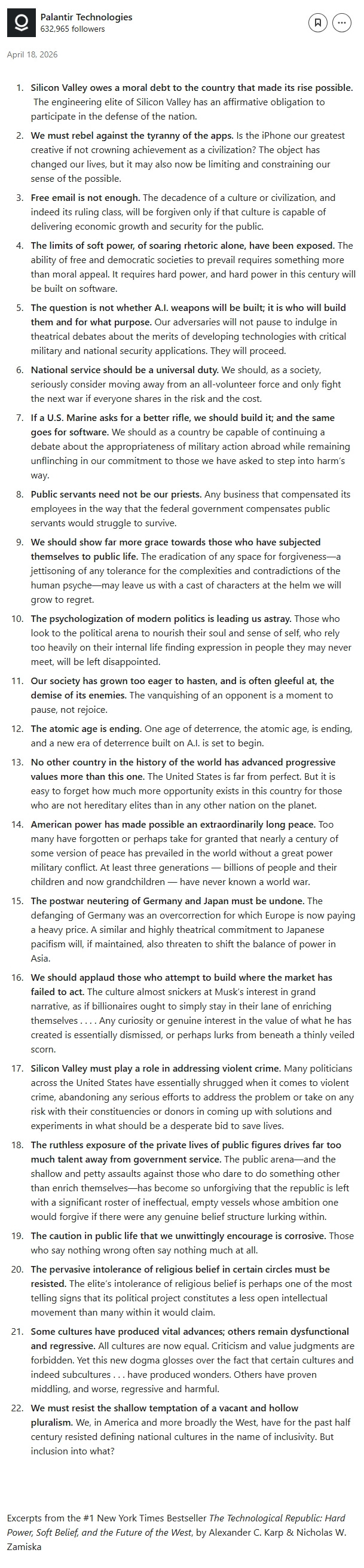
Via LinkedIn
Once a company chooses to speak in those terms, it is no longer merely describing its business. It is advancing a worldview. That worldview can and should be evaluated not only for what it says, but for what it fails to see.
And the company closely associated with surveillance technology has extreme blind spots.
Politics From Above
Read as a whole, the manifesto organizes itself around three overlapping concerns.
First, it treats politics primarily as a matter of strength. Several points emphasize military capability, artificial intelligence (AI)-driven deterrence, and the need for closer alignment between technology companies and the national security state. AI, in this framing, is not simply a tool. It is the foundation of future geopolitical power.
Second, it repeatedly returns to the burdens placed on leaders. The document argues that public life has become too punitive, that private failings are overexposed, and that excessive moral scrutiny drives capable people away from leadership. It even pauses to defend Elon Musk from cultural mockery, lamenting that society “snickers” at grand ambition.
Third, it expresses deep anxiety about culture and pluralism. The text questions “hollow pluralism,” asks what people are being included into, and asserts that some cultures are “regressive and harmful.” The implication is that national cohesion requires a stronger, more clearly defined cultural core.
Taken together, these themes describe a politics centered on elite capacity, national strength, and cultural consolidation. The nation appears less as a society to be cared for than as a system to be hardened.
A Permanent Crisis Mindset
The manifesto reads as though the United States is already living in a state of permanent mobilization. It elevates geopolitical competition and AI-enabled conflict to a defining condition of public life. Somehow, it views the nation with the world's largest military budget as undermilitarized and at risk.
Yet most Americans do not experience their country this way. Their concerns are not abstract contests for civilizational dominance, but the price of rent, the cost of childcare, the security of their jobs, and the stability of their communities.
For communities that already feel the pressure of domestic militarization, the implications are terrifying. A worldview that treats war-like urgency as the baseline risks crowding out the very conditions that make a society worth defending. It further ignores consistent public attitudes regarding military intervention and use of force.
The People Missing From the Program
What is striking is not only what the manifesto emphasizes, but what it omits.
For all its attention to leadership, power, and national strength, the document says remarkably little about the lived experience of ordinary people. There is no discussion of wages, housing affordability, healthcare access, childcare, labor protections, or the growing concentration of corporate power. Corruption, monopoly influence, and economic precarity are largely absent.
The public appears in this document mostly as an implied workforce, a citizenry to be disciplined, or a body to be defended. It never appears as people with needs.
A political vision that asks for trust, discipline, and possibly even national service should also speak clearly to the conditions in which people live. Without that, calls for strength and cohesion begin to feel abstract at best and indifferent at worst.
Download a FREE Pocket Constitution NOW →

When Elites Ask for Less Scrutiny
The manifesto’s repeated focus on the burdens of leadership is where the disconnect becomes most visible.
Several points argue that public life is too harsh, that leaders are judged too severely, and that excessive scrutiny deters talented individuals from entering government. The tone suggests a system in which elites are constantly exposed, punished, and driven away.
However, many Americans experience something closer to the opposite. They see powerful institutions and individuals who often avoid meaningful consequences, while ordinary people bear the costs of economic instability, corporate consolidation, and political dysfunction.
At a moment when many people feel that elites are under-accountable, not over-scrutinized, a manifesto that repeatedly asks for more grace for the powerful can sound less like reform and more like complaint. It reads as a request for insulation at precisely the moment when trust is already fragile.
Culture From Above, Life From Below
The manifesto’s cultural arguments follow the same pattern. Culture is treated as something singular, bounded, and in need of defense. Pluralism is cast as potentially hollow, and certain cultural forms are described in starkly hierarchical terms.
That framing does not align with how many Americans actually experience culture.
For much of the country, identity is not a matter of preserving a single, pure inheritance. Families are often shaped by multiple lines of ancestry, sometimes over generations. Traditions overlap. Religions coexist within extended families. Neighborhoods and workplaces bring together people with different backgrounds who share the same daily concerns.
America is sometimes described as a mosaic, with distinct communities maintaining identifiable traditions. That description still applies in many places. However, it is also a quilt, a fabric woven from many threads. Over time, those threads have intertwined to produce something that is not reducible to any one origin.
In that reality, the idea of cultural purity or clear civilizational boundaries feels less like a description of lived life and more like an abstraction imposed from above. People do not experience their neighbors primarily as representatives of competing cultures. They experience them as neighbors.
What People Actually Worry About
The distance between the manifesto and everyday life becomes clearer when you consider what most people actually worry about.
They worry about whether they can afford rent or a mortgage. They worry about healthcare costs, childcare, and the stability of their jobs. They worry about safety in their communities and whether their children will have better opportunities than they did.
These concerns cut across cultural and religious lines. In many cases, they bind people together more than they divide them.
The manifesto, however, is far more concerned with abstract questions of national strength and cultural cohesion than with these shared material pressures. The manifesto is rich in demands for strength, discipline, and elite freedom of action, yet strikingly thin on what any of that is supposed to mean for the actual lives of the people asked to live under it.
A Different Starting Point
There is nothing inherently wrong with thinking about national strength, technological change, or geopolitical competition. Those are real concerns. However, they are insufficient as a foundation for a political vision.
A democratic politics starts somewhere else. It begins with the lived reality of ordinary people. It asks how power can be made accountable to them, how economic life can be made stable and fair, and how security can support a humane and dignified society.
It also recognizes that culture is not only something to be defined from above. It is something people create together through family, community, and shared experience.
Palantir’s manifesto starts with the needs of power and asks the public to accommodate them. Democratic politics starts with people's needs and asks power to answer to them.
Sorry, Thiel and Co., but we aren’t buying your poor little rich technocrat trope. The time for masters is over. The powerful do not define us, and we will demand accountability.
If you want more commentary that puts people before power and cuts through top-down narratives, subscribe. We focus on what politics looks like from where most of us actually live.
Sources:
Palantir Technologies — “The Technological Republic 22 Point Manifesto”, April 18, 2026.
TechCrunch — “Palantir posts mini-manifesto denouncing inclusivity and ‘regressive’ cultures” by Anthony Ha, April 19, 2026.
Fast Company — “Palantir released a 22-point manifesto on X and people are horrified” by María José Gutierrez Chavez, April 20, 2026.
The Verge — “We translated the Palantir manifesto for actual human beings” by Adi Robertson, April 21, 2026.
The Guardian — “Palantir manifesto described as ‘ramblings of a supervillain’ amid UK contract fears” by Aisha Down and Robert Booth, April 21, 2026.
Of course… the tech bro boys believe they are entitled to make their own laws and rules for themselves and another set of laws and rules for us plebeians. Dynasty of the billionaires!
The hubris is unbelievable. The tech oligarchs denigrate the society that created them. They would not have become the destructive force that they are without federal corporate welfare, including the free internet and billion dollar government contracts. The lack of protections for ordinary people and the rule of law weighed in favor of the elite have allowed the rich to reward themselves by stealing economic agency from all other Americans.