


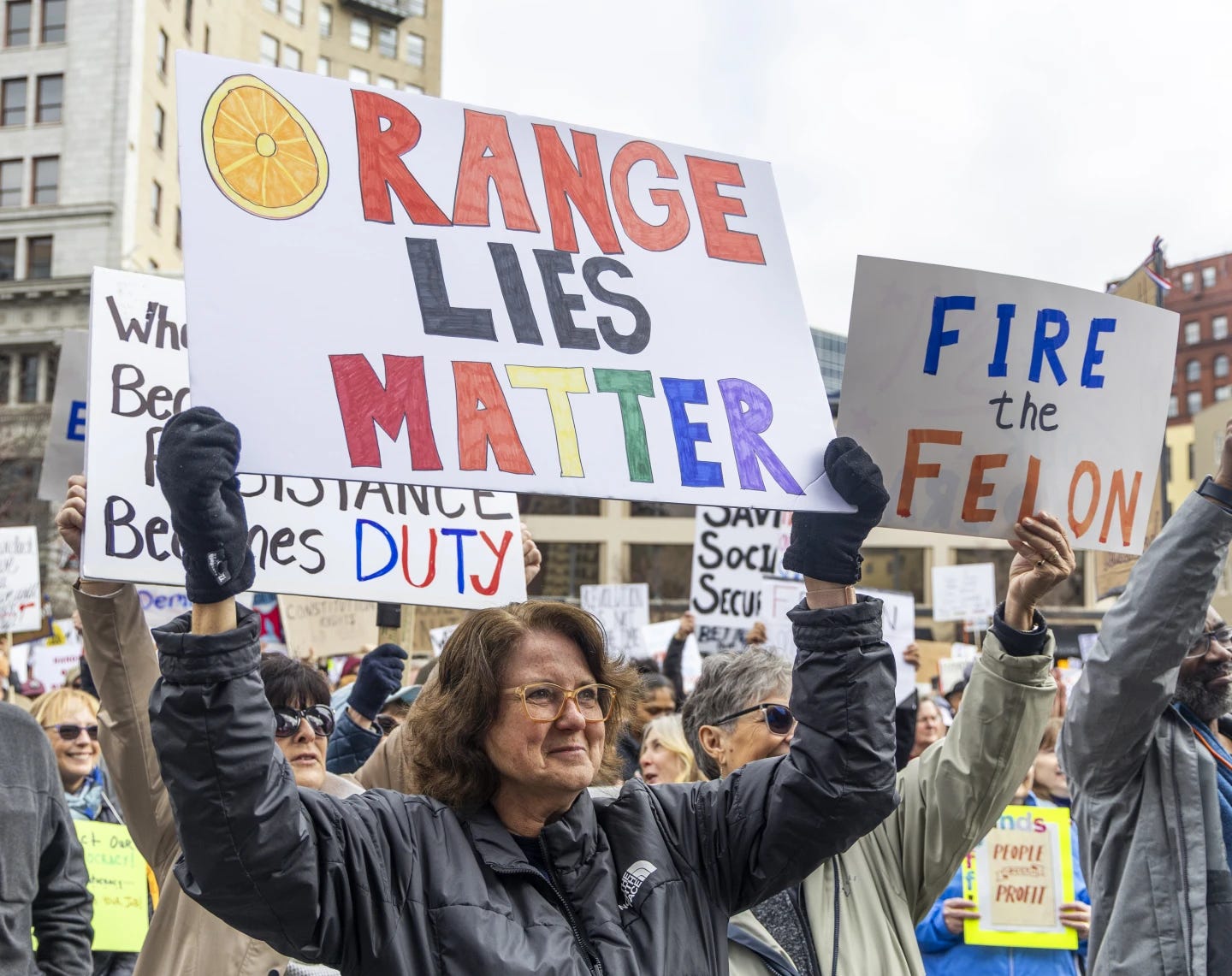
On April 5, 2025, America’s streets filled with dissent. From New York to Los Angeles, from small Midwestern towns to sprawling college campuses, more than 1,200 “Hands Off” rallies were held across the country. In Washington, D.C., organizers estimated 100,000 people packed the Mall. Across more than 1,000 cities, families, veterans, students, and workers turned out, making it one of the largest coordinated protest actions in modern U.S. history.
This was the protest you weren’t meant to see.
And yet, if you flipped on the nightly news, you might have thought nothing happened. CNN and MSNBC mentioned the protests only in passing. Fox News dismissed them as fringe theatrics. The New York Times ran a striking front-page photo but no feature story. The Wall Street Journal buried it inside. A Dallas newspaper editor even admitted later that they “didn’t realize the protest was going on” as it filled their own downtown.
This wasn’t just oversight. It was one of the most underreported stories of 2025, and that silence was not an accident.
Stay Informed. Stay Loud.
Subscribe to The Coffman Chronicle for no-BS political analysis, action guides, and daily truth bombs you won’t get from corporate media.
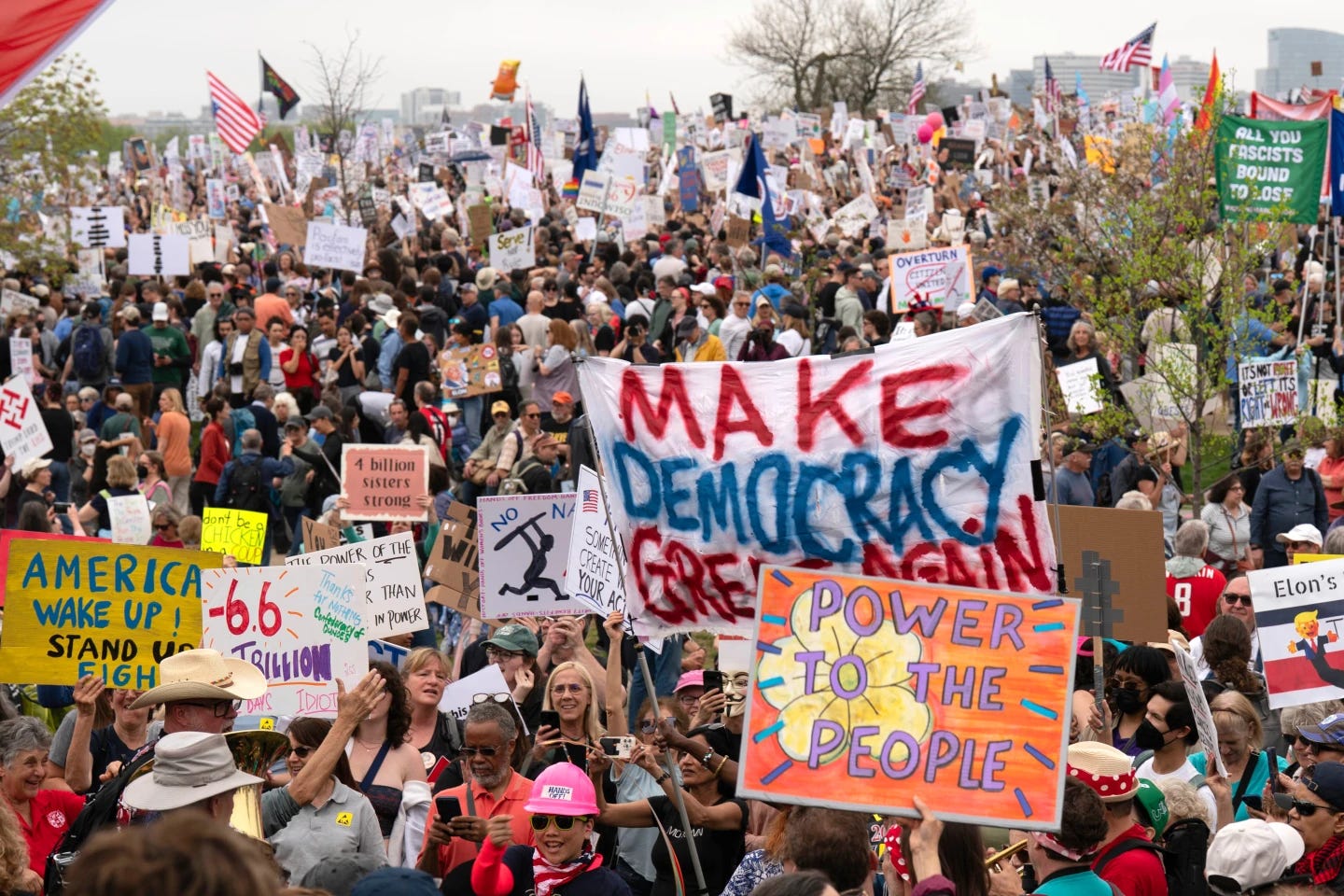
(Photos credit AP)
The Scale of Resistance
The scale of April 5th tells a very different story than the media silence suggested. What unfolded that day wasn’t a handful of scattered rallies. It was a national wave of dissent. Demonstrations spanned every corner of the country, uniting groups that rarely share the same stage.
Students marched alongside veterans. Union members locked arms with climate activists. Disability rights advocates joined immigrant families holding handmade signs. Teachers carried banners reading “Hands Off Our Classrooms,” while workers in hard hats waved flags demanding economic justice. Parents pushed strollers through the crowds, showing that this was not just a youth movement, but a family affair.
In Washington, D.C., the turnout alone — 100,000 on the Mall — rivaled some of the largest demonstrations of the past decade. Local outlets across the country captured moments the national networks ignored: in cities from Des Moines to Denver, marches stretched for blocks. In small towns, courthouse steps filled with retirees, farmers, and nurses. The breadth and diversity of the protests told a simple truth: this was not fringe, not isolated, not dying.
If the so-called “resistance” were really finished, as so many pundits claimed, April 5th could never have happened. The movement’s presence in the streets proved otherwise.
The Media Blackout
And yet, despite the sheer size and scope of April 5th, you wouldn’t know it from watching the news. Networks treated one of the largest coordinated protest days in U.S. history as an afterthought. CNN and MSNBC gave it a few passing mentions before moving on. Fox News mocked the demonstrations as “fringe theatrics” and focused instead on White House talking points.
Print outlets weren’t much better.
Compare that to how the Tea Party was covered in 2009: relatively small rallies were amplified wall-to-wall, shaping a national narrative of rising grassroots power. By contrast, April 5th was downplayed, minimized, or ignored.
This wasn’t a coincidence. It was a blackout. A movement that filled the streets coast to coast was rendered invisible to millions watching from home. And invisibility has consequences.
Why Silence Matters
Silence isn’t neutral. When mass protests happen and the cameras look away, the result is more than a missed headline. It’s a distortion of reality. Visibility fuels movements. Invisibility suffocates them.
History proves the point. The Civil Rights marches in Selma were not the first time Black activists faced down police batons, dogs, and tear gas, but they were among the first to be broadcast into living rooms across America. Television coverage of “Bloody Sunday” in March 1965 shocked the conscience of a nation and forced Congress to move on the Voting Rights Act. The Vietnam War followed a similar arc: protests grew for years, but it wasn’t until television news showed students clashing with National Guardsmen and returning veterans throwing their medals onto the Capitol steps that public opinion shifted decisively.
April 5th had the numbers, the diversity, and the momentum, but without national coverage, millions of Americans were left thinking nothing happened. That’s how silence becomes a tactic. By starving movements of oxygen, the powerful prevent casual observers from realizing just how widespread resistance really is.
The blackout didn’t just undercut April 5th. It was designed to weaken what comes next.
The 3.5% Rule
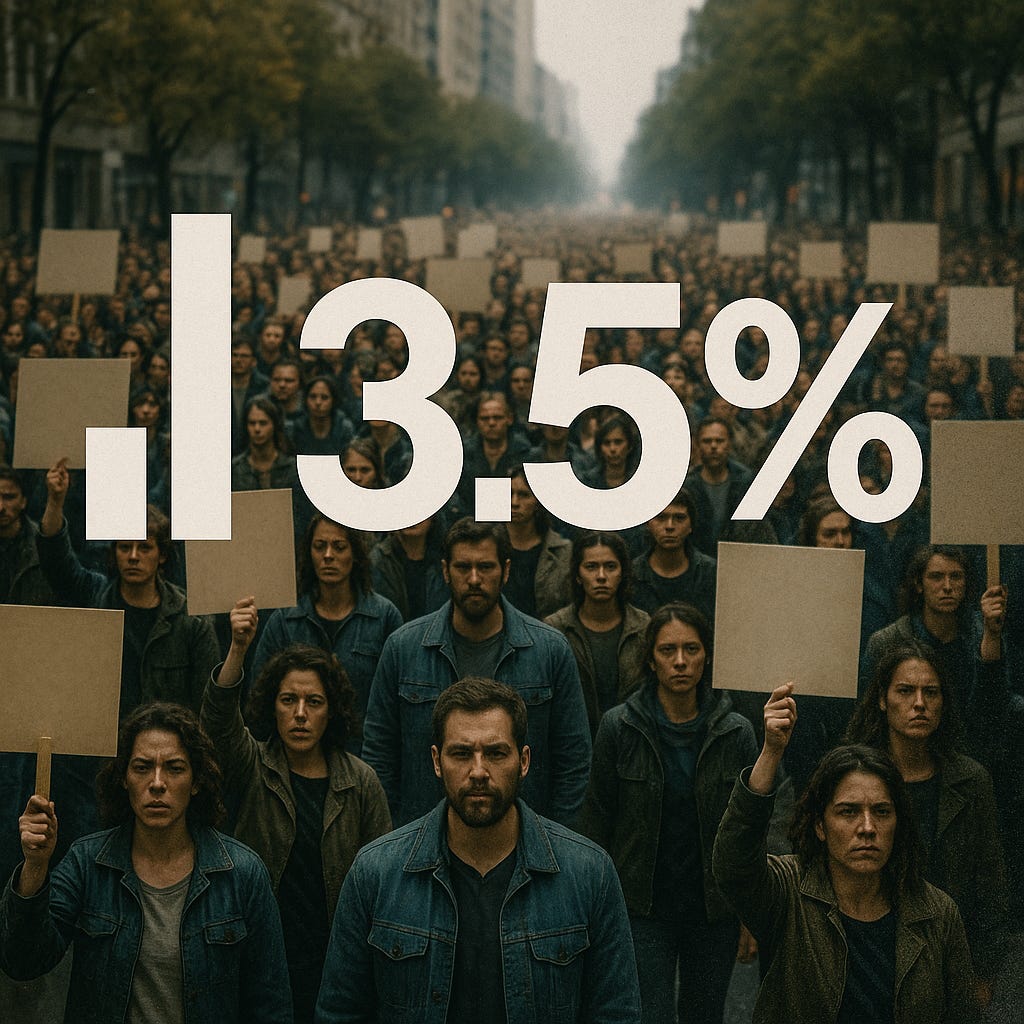
We’ve talked about this before in other articles, but it’s worth bringing back here because it frames exactly why April 5th — and the silence around it — matters. Political scientist Erica Chenoweth’s research found that no sustained nonviolent movement with active participation from roughly 3.5% of a population has ever failed to bring change.
That threshold isn’t magic, but it’s a reminder: history turns when relatively small slices of society are visibly and persistently engaged. By that math, it doesn’t take 170 million Americans in the streets to shift the balance; only a fraction of that number, if they sustain pressure, can alter the course of government.
Now think about April 5th. With protests across more than 1,000 cities and turnouts in the hundreds of thousands — with organizers claiming millions nationally — the resistance may already be moving toward that crucial tipping point. And that is precisely why the blackout matters.
The one thing that could stop a movement from reaching 3.5% is that the public never realizes how close it already is.
And if April 5 were just a blip, maybe the silence could be dismissed. But it wasn’t.
The Resistance Didn’t Stop on April 5
April 5th wasn’t a one-day flare-up. It was a spark that lit a much larger fire. If the movement were really dying, the streets would have emptied after that weekend. Instead, they filled again. And again.
On June 14, 2025, the “No Kings” protests swept across the nation. Organizers said more than 2,000 cities and towns took part, with millions of participants nationwide. In the Bay Area alone, tens of thousands marched in San Francisco, Oakland, Palo Alto, and beyond. In Los Angeles, clashes broke out as police fired tear gas and made arrests.
It wasn’t just the big cities. In upstate New York, over a hundred residents at a retirement community carried signs reading “No Kings” and “Hands Off Social Security”. In Alton, Illinois, about a thousand people — veterans, families, civic leaders — rallied downtown, tying economic justice and democratic freedoms together.
Taken together, it was one of the largest coordinated protest days in U.S. history. And yet, just like April 5, national coverage was brief and often relegated to wire copy.
And those weren’t the only actions. Protest researchers tracked 2,085 demonstrations in February 2025 alone, more than double the number recorded in February 2017, at the height of the Trump resistance during his first term. Near nightly protests are taking place in D.C. and Los Angeles. Across the country, people are taking to the streets in towns of every size on a daily basis. From campus encampments to labor solidarity rallies, immigrant-rights marches to digital sit-ins, the resistance has been alive and growing.
The only thing missing is the coverage.
Which is exactly the point. This isn’t about the protests being small — they aren’t. It’s about keeping them invisible. April 5 and June 14 prove the resistance is real, multiracial, multigenerational, and nationwide. The blackout since proves the establishment doesn’t want you to see it.
Call to Action – Breaking the Silence Machine
If the past few months have proven anything, it’s this: the resistance isn’t dead. It’s being buried alive under silence. And if the cameras won’t cover it, then it’s on us to make the resistance impossible to ignore.
Here’s how we do it:
1. Document everything.
If you march, bring your phone. Take photos, shoot video, record chants. Post them where people can see, and use hashtags that connect local actions to the national movement. Visibility matters, and every image chips away at the blackout.
2. Amplify independent media.
Corporate outlets may look away, but grassroots journalism and platforms like Substack, podcasts, and independent YouTube channels are carrying the stories forward. Support them. Share their work. Subscribe, comment, and boost until these voices drown out the silence.
3. Connect protests to power.
Flood the Capitol switchboard at (202) 224-3121. Call your representatives. Demand hearings on authoritarian overreach, demand protections for voting rights, and demand oversight of agencies weaponized against the public. Organizers can’t carry this alone. Lawmakers need to feel the pressure, too.
4. Build the networks that last.
Every march, every rally, every sit-in should be more than a moment. It should be a contact list. Exchange numbers, emails, or encrypted app handles. The strength of a movement is in its persistence.
5. Don’t buy the myth of isolation.
If you’ve been told you’re alone, you’re not. If you’ve been told the resistance is finished, it’s not. The evidence is in the streets — from April 5 to June 14 and beyond. What’s missing is the amplification. That part is up to us. SHOW UP. Labor Day will feature many “festivals” for you to join.
Because history tells us it only takes 3.5% of a population to change everything. What history doesn’t tell us is how long it will take the rest of us to realize: the resistance is already here.
Stay Informed. Stay Loud.
Subscribe to The Coffman Chronicle for no-BS political analysis, action guides, and daily truth bombs you won’t get from corporate media.
Bibliography:
"Heard the resistance was dead? You’ve been reading too much." The Washington Post, April 18, 2025.
"The anti-Trump resistance begins to wake in earnest." The Washington Post, February 26, 2025.
"The energy at the ‘No Kings’ protest felt different. The tide is turning." The Washington Post, June 16, 2025.
"‘No Kings’ rallies draw big crowds to protest Trump and his policies." The Washington Post, June 14, 2025.
“The Democrats who will save us are not the ones in office.” The Washington Post, May 8, 2025.
"Nationwide 'Good Trouble' anti-Trump protests pay tribute to John Lewis." The Washington Post, July 17, 2025.
"D.C. protesters try a different tactic for spreading their message: Umbrellas." The Washington Post, July 17, 2025.
"What’s really going on in D.C.? What you see depends on who’s filming." The Washington Post, August 24, 2025.
Taking part or watching from the sidelines? Livestream it, on X, Facebook, Twitch, YouTube, wherever you can, however you can. Broadcast it to the world.
Thank you ! Your article gives me hope !