


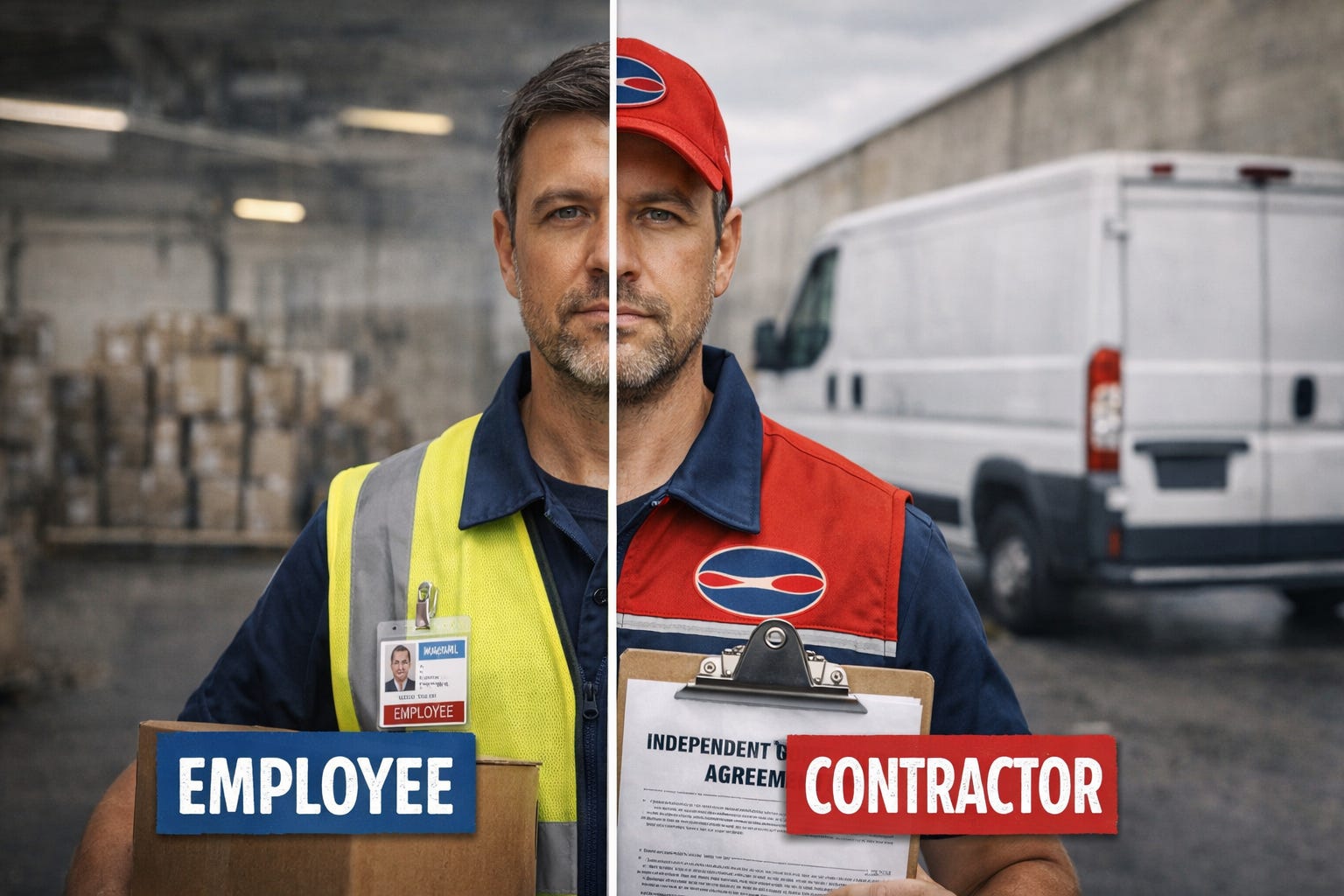
A person can drive the company’s route, wear the company’s logo, follow the company’s schedule, and still be told they are not really an employee when it is time to pay overtime. That is the quiet injustice at the center of one of the Trump administration’s latest labor moves, a proposed Department of Labor rule that would rescind the 2024 independent-contractor standard and replace it with a more employer-friendly approach. Reuters reports the change would especially benefit industries such as trucking, healthcare, retail, and app-based services that already rely heavily on contractor labor.
Imagine a home-care aide driving from house to house, caring for elderly patients on a company’s schedule, using a company’s system, depending on that work to pay rent, groceries, and gas, and then being told she is not really an employee when she asks about overtime. That is the kind of gray-zone labor relationship this fight is really about. The administration’s proposed rollback would matter most in select sectors where contractor models are already common, and labor costs are under constant pressure.
In Washington, this will be described as a technical rewrite. In real life, it is a fight over who counts as a worker when rights are on the line. That difference is not semantic. Employees are generally covered by federal minimum-wage and overtime protections; independent contractors often are not. The Labor Department’s own materials say the proposed rule would use an “economic reality” test to determine whether a worker is truly in business for themself or economically dependent on an employer, which is the core divide between contractor and employee status.
This Community Is Powered by You
What started as a small circle has grown into something much bigger, and it’s all because of readers like you.
Every time you forward this email, post it on socials, or bring someone new into the fold, you’re helping build one of the most passionate, independent political communities out there.
Want to keep the momentum going?
Share this newsletter with someone who should be part of this conversation.
Thank you for being here. It means everything.
The Rule Change Hiding Behind the Legal Language
What changed here is not the basic legal question but the framework the government wants to use to answer it. On February 26, 2026, the Labor Department said the proposal would replace the 2024 rule with a more streamlined analysis that places greater weight on two core factors: the company’s control over the work and the worker’s opportunity for profit or loss. The department presents that as clarification and a return to a standard more closely aligned with prior court precedent. Critics see something more consequential: a narrower lens that can make it easier for employers to classify workers as contractors rather than employees. Predictably, business groups long opposed the 2024 rule and support this rollback.
That is why this story matters beyond labor-law specialists. When the legal test shifts, the consequences do not stay trapped in the Federal Register. They show up in ordinary life. A classification decision can determine whether a worker is entitled to overtime, whether they have the leverage to challenge unpaid hours, and whether a company can exercise day-to-day control while denying day-to-day responsibility. Employees can be substantially more expensive for businesses than contractors because they come with wage-and-hour obligations and other costs. That cost difference is exactly why contractor status is so valuable to corporations and why the legal definition matters so much to workers.
How a Classification Fight Becomes a Kitchen-Table Crisis
For someone living paycheck to paycheck, that distinction is not theoretical. It can mean the difference between being paid for every hour and simply being told that long days are part of the deal. It can mean absorbing gas, maintenance, equipment, and downtime that would otherwise fall more squarely on an employer. It can mean being tightly managed in practice while being told, on paper, that you are independent. The rule may be written in legal language, but the result is simple enough: more of the risk lands on the worker, and more of the savings stay with the company. This is why the change matters so much in labor-intensive sectors already built around contractor arrangements.
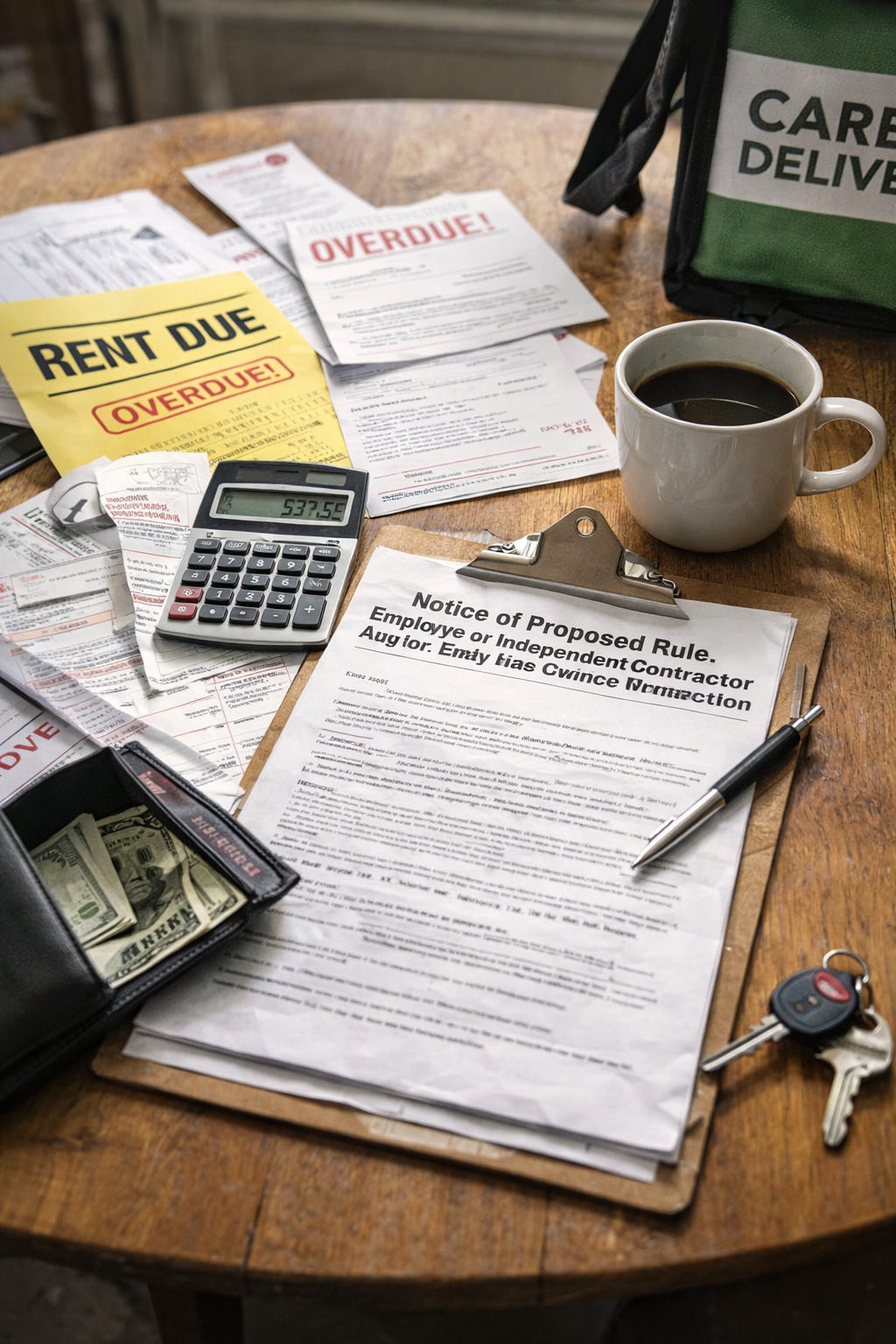
The industries most likely to feel this first are the ones already organized around that tension. Reuters specifically identifies trucking, healthcare, retail, and app-based services as the main beneficiaries of the proposed rollback. That means this is not only a story about one kind of gig driver. It is also about truckers, home-care workers, delivery workers, and others whose jobs often sit in the gray zone between formal independence and real dependence. In each case, the same question hangs over the work: how much control can a company exercise before it must also accept the responsibilities that come with that control?
The Politics of “Flexibility”
This is where the language starts doing political work. In employer-friendly labor policy, “flexibility” sounds modern, efficient, even liberating. However, flexibility for a corporation often means something very different for the person doing the job. A driver may get the language of independence while covering the cost of fuel and vehicle wear and tear. A home-care worker may have nominal autonomy while still relying on a single company or platform for income. A trucker may be told they are running their own business while operating inside a system that tightly shapes routes, timing, and compensation. The Labor Department says the key question is whether someone is in business for themself or economically dependent on an employer. The concern is that many workers live in the gray area where firms want the obedience of an employee and the cheaper obligations of a contractor.
That concern gets stronger when this proposal is placed in context. Taken alone, the rule could be dismissed as one more technical labor-law revision. Taken with the administration’s other labor moves, it starts to look like part of a broader pattern. Reuters reports that on the same day the Labor Department moved to roll back the independent-contractor rule, the National Labor Relations Board reinstated a narrower Trump1.0-era joint-employer standard that makes it harder in many cases to hold larger companies responsible for workers employed through contractors or franchise structures. These are not identical questions, but they point in the same direction: more distance between corporate power and corporate obligation.
A Broader Pattern of Corporate Relief and Worker Risk
This reveals how policy values are chosen. The contractor proposal asks how easy it should be to classify someone outside of employee status in the first place. The joint-employer rule asks how easy it should be for a large company to say that workers inside its economic orbit are someone else’s responsibility. In both cases, the effect is to create more room for employers to benefit from labor without fully bearing the obligations that labor usually triggers. Supporters call that clarity. Workers often experience it as a maze.
To be fair, the strongest case for the administration’s move is not absurd. The Labor Department says it is trying to distinguish real employees from genuine independent contractors and align the standard more closely with precedent. That argument carries weight in situations where workers truly do set their own terms, take on multiple clients, invest in their own operations, and function like actual small businesses. Reuters reports supporters say the broader 2024 rule created uncertainty and threatened the flexibility many contractors prefer. That deserves to be taken seriously. Not every nontraditional work arrangement is abusive, and not every person who wants independence wants to be folded into a traditional employment model.
The Real Question Is Who Gets the Escape Hatch
However, that is also why the real question is not whether genuine contractors should exist. Of course they should. The real question is whether this proposal carefully protects true independence or widens the escape hatch for companies that want to call people contractors while still controlling much of the relationship. Critics argue that this is exactly what happens when rules are simplified around factors that businesses are best positioned to shape and document. Worker advocates say repealing the 2024 rule will make misclassification easier, especially in sectors already engineered around low-obligation labor models. In that view, a “clarified” rule can become a cleaner defense for the same old practice: employee-like control without employee-like responsibility.
This proposal would not automatically rewrite every worker-classification rule in America. The Labor Department’s FAQ says the rulemaking would revise the analysis used under the Fair Labor Standards Act, the Family and Medical Leave Act, and the Migrant and Seasonal Agricultural Worker Protection Act, but it would have no effect on other federal, state, or local laws that use different standards. That means the danger is real, but also specific. The administration is trying to tilt a major part of federal labor law in a more employer-friendly direction, not erase every competing standard everywhere at once.
Why Quiet Labor Rules Matter More Than Loud Worker Rhetoric
The timing matters too. This is still a proposed rule, not a final one. The proposal opened a 60-day public comment period after publication, and the Department of Labor says the rulemaking would revise its employee-versus-contractor analysis under the FLSA, FMLA, and MSPA, while not overriding other laws that use different standards. That means the fight is happening now, at the stage where technical language gets normalized before most workers even realize the rules are shifting beneath them.
That is why quiet labor rules matter more than loud worker rhetoric. Politicians can spend years praising workers as the backbone of America. The real test is the rulebook. When the rulebook is rewritten to make it easier for corporations to maintain control over employment while shedding more of their obligations, the speeches start to sound like camouflage.
The Question Buried Inside the Proposal
So here is the question buried inside all the legal language: if someone works like an employee, is controlled like an employee, and depends on that job like an employee, how easy should it be for a company to say they are something else? For workers already living close to the edge, this will not feel like a clarification. It will feel like one more decision made far away, in careful bureaucratic language, that leaves them with more risk and leaves the people profiting from their labor with less responsibility.
Support Independent Media-The Coffman Chronicle
If this kind of reporting matters to you, support it.
The Coffman Chronicle exists to dig into the stories buried under legal language, political spin, and corporate-friendly talking points, then bring them back to the kitchen table where their real consequences can be seen. That takes time, research, and the freedom to keep following the facts wherever they lead.
If you can afford to become a paid subscriber, it helps keep this work independent, sharp, and accountable to readers rather than to power.
And if you cannot, reading, sharing, and spreading the work still matters more than you know.
Sources:
Federal Register, “Employee or Independent Contractor Status Under the Fair Labor Standards Act, Family and Medical Leave Act, and Migrant and Seasonal Agricultural Worker Protection Act,” February 27, 2026.
Reuters, “NLRB Resurrects Rule from Trump’s First Term Limiting ‘Joint Employment’,” February 26, 2026.
Reuters, “Trump Administration Moves to Nix Biden-Era Limits on Independent Contractors,” February 26, 2026.
U.S. Department of Labor, “Notice of Proposed Rule: Employee or Independent Contractor Status Under the Fair Labor Standards Act, Family and Medical Leave Act, and Migrant and Seasonal Agricultural Worker Protection Act, RIN 1235-AA46.” Accessed March 22, 2026.
U.S. Department of Labor, “Questions and Answers - NPRM: Employee or Independent Contractor Status Under the FLSA, FMLA, and MSPA.” Accessed March 22, 2026.
U.S. Department of Labor, “US Department of Labor Proposes Rule Clarifying Employee, Independent Contractor Status under Federal Wage and Hour Laws,” February 26, 2026.
Remember Gandhi:
"Even the most powerful cannot rule without the cooperation of the ruled."
One corporation buys a smaller one. They strip the company of anything valuable, real estate, pension funds accrued vacation and retirement benefits and then declare bankruptcy. Now we qre being forced to become "private contractors". no benefits, no job security, lower wages.