


President Donald Trump’s latest executive order on artificial intelligence has generated predictable reactions. Supporters describe it as a measured effort to improve cybersecurity and maintain American leadership in a rapidly evolving field, while critics warn that it represents another step toward deeper government involvement in private AI development.
The order itself deserves attention, but the larger story is not a single executive action, nor is it the technical details of cybersecurity testing for advanced AI models.
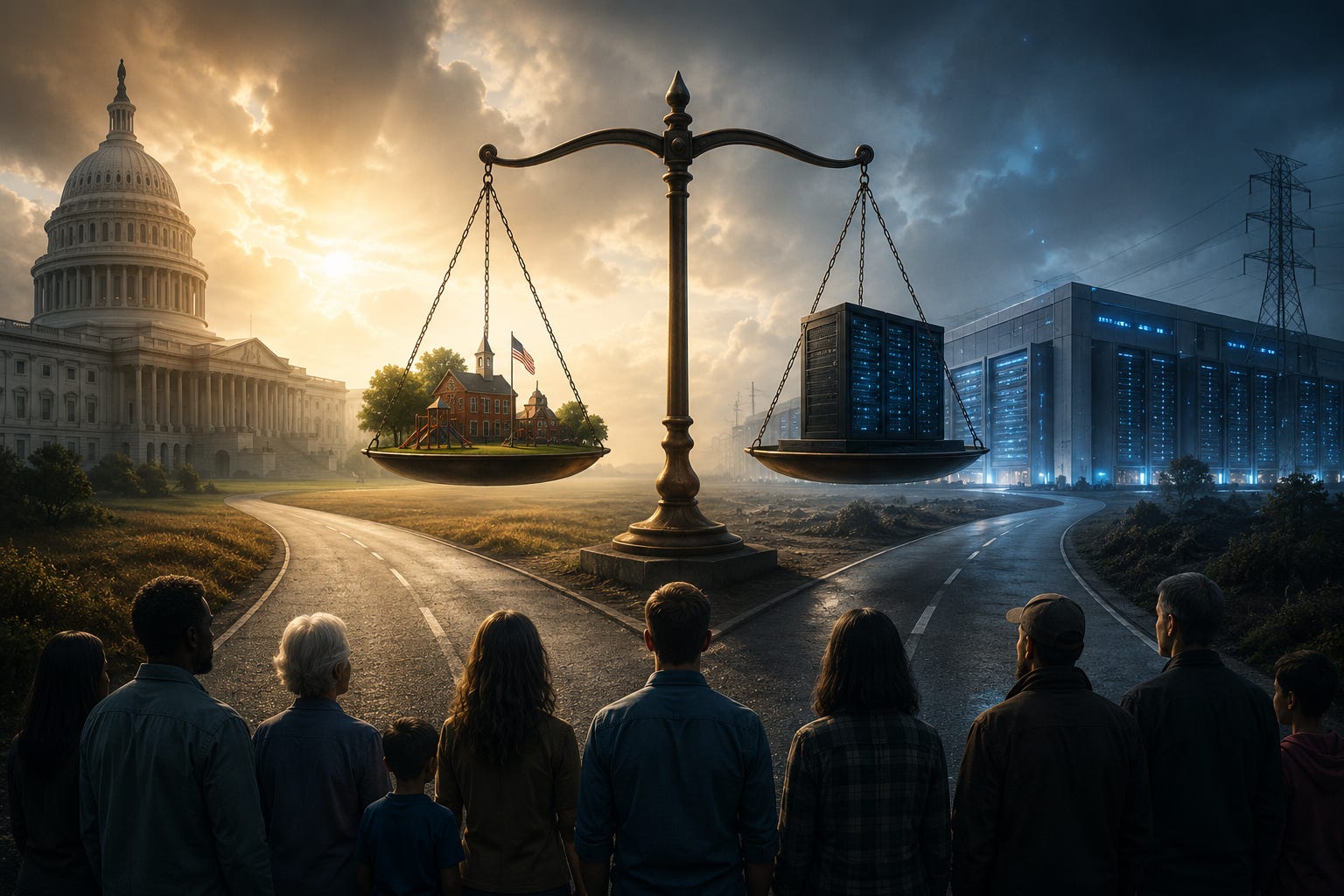
The broader question is why artificial intelligence has become such a significant federal priority at a moment when Americans continue to face rising costs, strained public services, and an increasingly familiar message from policymakers that difficult budget choices must be made.
Support independent media that follows the power.
The Coffman Chronicle is built to track who holds power, who abuses it, who profits from it, and who pays the price.
Paid supporters get full Tony Michaels Podcast episodes, deeper transcript analysis, paid columns, archives, and the reporting framework behind the show.
If you believe independent media has to survive outside billionaire platforms, corporate media, and party-approved gatekeepers, become a paid supporter today.
What the Executive Order Actually Does
On June 2, 2026, Trump signed an executive order titled “Promoting Advanced Artificial Intelligence Innovation and Security”, establishing a voluntary federal cybersecurity review process for certain advanced AI models. Companies developing qualifying models may choose to submit them for testing before release. Federal agencies have also been directed to develop benchmarks to identify systems with significant cyber capabilities and to establish a clearinghouse to share relevant information.
To be clear, the order is narrower than some online commentary has suggested. It does not create a mandatory licensing system, nor does it require federal approval before a company can release an AI model. It also does not grant the government automatic rights to use private systems, nor does it create new procurement authority for federal agencies.
Viewed on its own, the order is largely a cybersecurity initiative. The administration argues that advanced AI systems may eventually create new risks related to cyberattacks, fraud, and digital security. Voluntary testing, supporters argue, is a reasonable way to identify vulnerabilities before they become larger problems.
Reasonable people can disagree about the value of such a program and whether this is primarily a responsibility of the companies that create technology rather than federal agencies funded by taxpayer dollars. The more important point is that this executive order did not emerge in isolation.
Part of a Larger Push
Since returning to office, Trump has made artificial intelligence a recurring focus of executive action, including major players in multiple high-level events and conversations, and pushing for accelerated AI development.
The administration revoked President Biden’s AI executive order nearly immediately and replaced it with a framework centered on American leadership and innovation. Subsequent actions have emphasized accelerating AI development, expanding supporting infrastructure, and reducing what the administration views as barriers to growth. On multiple occasions, including in a section later removed from the One Big Beautiful Bill, federal officials have signaled opposition to state-level AI regulations, arguing that a patchwork of rules could undermine national competitiveness.
Viewed together, these actions reveal a consistent philosophy. The administration sees artificial intelligence not merely as another emerging technology, but as a strategic national priority.
That is not particularly unusual. Governments have long supported industries they believe will shape the future. Railroads, aviation, telecommunications, semiconductors, and countless other sectors have benefited from public investment, favorable policies, and government support at various points in American history.
The question is not whether the government should care about emerging technology, but why this particular priority appears to command such urgency while other public needs are routinely described as unaffordable.
Who Decides What Deserves Public Investment?
Americans have spent years hearing that difficult choices are unavoidable. Government waste, fraud, and the deficit are frequently cited when social programs face reductions. Communities are told that housing shortages cannot be solved overnight. Infrastructure projects are delayed, and public agencies are expected to do more with fewer resources. Citizens seeking help are chided for believing the government can fund every priority. More often, they are outright demonized as freeloaders or as people looking for a handout.
That makes the current enthusiasm surrounding artificial intelligence particularly striking. When AI enters the conversation, the language changes. Tax incentives become investments. Public-private partnerships are now engines of innovation. Infrastructure expansion is a national imperative. Policymakers warn that the United States cannot afford to fall behind competitors abroad.
Increasingly, when it serves the ordinary citizen, there is no funding, but when it serves industry or corporations, we cannot spend fast enough. Tax incentives reflect a priority. Infrastructure projects represent a decision. Federal initiatives direct attention, resources, and political capital toward one objective rather than another.
Citizens are entitled to ask why those choices rarely benefit them.
Why should public resources be directed toward accelerating AI development rather than expanding housing availability, strengthening healthcare access, modernizing aging infrastructure, or addressing other needs that already affect millions of Americans?
That is not an argument against technology. It is an argument for democratic accountability.
The same elected officials who preach about fiscal restraint and limited government are increasingly comfortable using public policy to accelerate the development of a private industry expected to generate substantial future profits. While many Americans continue to experience the consequences of austerity-minded policies in their daily lives, they are being asked to fund a profitable future for someone else.
The debate is not really about whether AI, but instead about who gets to decide which future receives public support, and whether the public has a meaningful voice in that decision before commitments are made.
Who Benefits and Who Pays?
Questions about public investment should inevitably lead to questions about public benefit. In fact, they should begin there.
Earlier this month, Senator Bernie Sanders proposed an American AI Sovereign Wealth Fund that would acquire substantial ownership stakes in major AI companies. He argued that if artificial intelligence generates enormous wealth, taxpayers should share in the rewards rather than watching the benefits flow exclusively to investors and executives.
The proposal reflects a growing recognition that AI is not simply another consumer product. National investment has already begun. Under those circumstances, it is reasonable to ask what the public receives in return.
Sanders offers one answer. If taxpayers help support the development of transformative technologies, taxpayers should share in the profits.
There is logic to that position. Americans have seen previous technological revolutions generate extraordinary private fortunes. Artificial intelligence could very well become another example.
However, ownership addresses only part of the equation. Ownership can mean profit, but it can also mean risk. Much of the discussion surrounding AI assumes that the technology will ultimately deliver on its most ambitious promises. There will almost certainly be profits to be made. History, however, suggests that projected and realized benefits are not always the same.
Technological revolutions create winners and losers. Some investments exceed expectations, while others fall short. Markets become overheated, and bubbles form. Experts have warned about a potential “dotcom” style bubble within the field of AI in the near future. Business models change, and infrastructure that once seemed indispensable can become obsolete more quickly than anticipated.
Reality is nearly always more complicated than the projections. If taxpayers help finance infrastructure expansion through tax incentives, favorable development agreements, utility investments, or other forms of public support, who bears the costs if the anticipated returns fail to materialize? If communities devote scarce water resources to large-scale data center development, who absorbs the consequences if those facilities are later downsized or abandoned? If electric grids are expanded to accommodate rapidly growing AI demand, who pays for those investments over the long term?
Those questions receive far less attention than discussions about market capitalization, investment opportunities, and future economic growth. The public conversation often focuses on who profits from technological change. History suggests we should pay equal attention to who pays for it. Who suffers when there is water scarcity? Who is impacted by energy-generating pollution? How much land becomes unavailable for farming or housing due to data center needs?
Any investment worthy of public support should be able to withstand scrutiny not only of its potential rewards but also of its risks, costs, and trade-offs.
Those questions become even more important when the same public being asked to support future technological development is simultaneously being told that many existing needs must wait because resources are limited. There’s always money for industry and war, but there seems to be any for healthcare, housing, or education.
We Are Supposed to Learn From the Past
Supporters of aggressive AI development frame the debate as a choice between progress and resistance, as though caution itself is a liability, particularly if competing nations are moving more quickly. History offers a more nuanced lesson.
The United States has experienced multiple technological revolutions. Railroads transformed transportation and commerce. Electrification changed daily life. Telecommunications connected the country in ways previous generations could scarcely imagine. The internet reshaped nearly every aspect of modern society.
Few Americans would argue that any of those developments should have been abandoned. The more useful question is whether they could have been implemented more thoughtfully.
Consider railroads. The federal government provided enormous support through land grants and favorable policies that helped connect the country and accelerate economic growth. The benefits were real and lasting. So were the costs.
Railroads created immense private fortunes. They influenced the development of entire regions and shaped transportation decisions that still affect the country today. How many communities were divided by tracks? What impact did coal and steam power have on air quality? How many rail yards and tracks are abandoned today, perhaps in your community? At any point, other than by train-hopping, could the average person whose tax dollars made that infrastructure possible just climb aboard and use the services of the transportation they helped build?
Communities often have little leverage once critical infrastructure is in place. By the time concerns about monopoly power and public accountability become impossible to ignore, the industry has already become indispensable.
This is not to say that railroads were a mistake, but rather to illustrate that public benefit and a fair public bargain are not necessarily the same thing.
Railroads are one example. There are countless more.
Innovation is often presented as a story of winners. In reality, it is also a story of tradeoffs. Who pays for infrastructure? Who gets to use it? Who bears environmental costs? Who assumes the risk when projections prove overly optimistic? Who captures the gains when those projections are correct?
Those questions determine whether technological progress benefits society broadly or primarily those positioned to profit from it.
Americans frequently hear that history demands bold action. History teaches another lesson as well.
We are supposed to learn from the past so we can do better the next time. The choice is whether to approach a potentially transformative technology with the benefit of historical experience or to repeat familiar mistakes and hope for a better outcome.
Getting It Right Matters More Than Getting There First
No discussion of artificial intelligence can avoid the argument that has become the industry’s most effective political tool. China. Supporters of rapid AI expansion routinely warn that the United States is locked in a technological race. Regulations, environmental reviews, state-level restrictions, and lengthy public debates are often portrayed as obstacles that could allow geopolitical competitors to gain an advantage.
Competition between major powers is a legitimate concern, and artificial intelligence may have significant implications for economic productivity, military capabilities, scientific research, and national security.
However, that is one element. It is far from the only one that matters.
Too often, the existence of a race is treated as a justification for bypassing difficult questions. Citizens are told that deliberation takes too long. States are told that regulatory experimentation creates uncertainty. Communities are encouraged to accept infrastructure projects because the stakes are simply too high to wait.
The logic is familiar. Crisis, competition, and limited time often justify moving faster. History suggests that haste carries its own risks.
Many of the most consequential decisions made by governments and industries were justified as urgent responses to competitive pressures. Some proved successful. Others produced costs that became apparent only years later. Environmental damage, infrastructure challenges, market concentration, and unintended consequences rarely receive the same attention as promises of future growth during the early stages of a technological boom.
The twentieth century offers several examples of how competition can compress decision-making. The race to develop nuclear weapons during World War II was driven by fears that a rival power might get there first. The urgency was understandable, yet the decades that followed revealed consequences that extended far beyond the immediate strategic objective. Nuclear testing exposed military personnel and civilians to harmful radiation. Entire communities were affected by contamination. Environmental damage persisted for generations. Many of those costs received far less attention during the race itself than they did afterward. Many have still not been addressed. Because of the nature of radioactive materials, most will outlive us all.
The space race provides a less destructive but equally instructive example. Competition with the Soviet Union accelerated technological innovation and culminated in one of humanity’s greatest achievements. It also involved enormous expenditures, significant risks, and the loss of human life. The goal was not simply to reach the Moon. The challenge was to do so safely, reliably, and in a way that justified the investment.
The lesson is not that these efforts should never have occurred, but that urgency does not eliminate tradeoffs. It merely makes them easier to overlook.
The more consequential a technology becomes, the more important it is that decisions surrounding its development receive broad scrutiny. Questions involving energy consumption, water resources, land use, environmental impacts, labor markets, privacy, and public investment deserve serious debate precisely because the stakes are so high.
There is a tremendous difference between rejecting innovation and insisting that it proceed responsibly. Obstruction and oversight are not the same thing. We are not advocating for paralysis but rather deliberation.
A country does not demonstrate confidence in its institutions by bypassing them whenever a promising technology emerges. It trusts them to evaluate competing priorities, weigh risks against rewards, and determine which investments best serve the public interest.
Anything worth doing is worth doing with due consideration and correctly, not merely expediently. Being first may win a race. Building something that lasts requires a different set of priorities. Investing in something consequential demands an examination of priorities and impacts.
Those principles apply whether the subject is artificial intelligence, energy policy, transportation infrastructure, healthcare reform, or any other decision capable of affecting millions of lives. The objective should not be to arrive first. The objective should be to arrive with purpose, accountability, and a clear understanding of the costs and benefits involved.
That requires something increasingly treated as a luxury in modern politics. Time. It also requires public input. We should have a say in how our tax dollars, our land, our water, and our air are used. WE set the priorities.
Artificial intelligence may prove every bit as transformative as its advocates believe. That possibility makes public participation more important, not less. The future is not something that should simply happen to us. In a representative republic, it is supposed to be something we help shape, not something we endure.
The future should not be something we simply endure. Subscribe to support independent journalism that examines who benefits, who pays, and who gets to decide the policies shaping our communities and our country.
Sources:
The White House, “Promoting Advanced Artificial Intelligence Innovation and Security,” June 2, 2026
The White House, “Fact Sheet: President Donald J. Trump Promotes Advanced Artificial Intelligence Innovation and Security,” June 2, 2026
Reuters, “Trump administration to ask US AI firms to voluntarily submit models for cybersecurity tests,” June 2, 2026
The White House, “Initial Rescissions Of Harmful Executive Orders And Actions,” January 20, 2025
The White House, “Removing Barriers to American Leadership in Artificial Intelligence,” January 23, 2025
Reuters, “Trump orders AI action plan and more work erasing Biden’s AI efforts,” January 23, 2025
The White House, “Ensuring a National Policy Framework for Artificial Intelligence,” December 11, 2025
AP News, “Donald Trump, Bernie Sanders and Sam Altman are all talking about public ownership in AI,” June 6, 2026
The Guardian, “Bernie Sanders’ AI sovereign wealth fund plan is good. But we think this is better,” June 8, 2026
Sen. Bernie Sanders, “NEWS: Sanders, Ocasio-Cortez Announce AI Data Center Moratorium Act,” March 25, 2026
U.S. Department of Energy, “DOE Releases New Report Evaluating Increase in Electricity Demand from Data Centers,” December 20, 2024
The Guardian, “Majority of US’s new AI datacenters to be built on drought-hit land,” June 8, 2026
National Archives, “Interstate Commerce Act (1887),” February 8, 2022
University of Colorado Law Review, “The Legal History of Federally Granted Railroad Rights-of-Way and the Myth of Congress’s 1871 Shift,” 2011
The cost/benefit ratio always comes out inverted with respect to the public in a fascist government, whether it be the railroads, the Industrial Revolution, the use of much of our scientific research, the Internet and AI. We can argue day and night about who owns what and who pays for that. We can debate AI job losses, modernization of society, and AI misuse all day and all night. But to get down to brass tacks we need to take a hard long look at the characters who brought us to this point… Musk, Theil, Luckey, Altman, Zuckerberg etc. Ask yourself-what motivates these dudes… then you will begin to see the real problems with AI.
When Trump boasts of increasing his family wealth through bit coin investment, or when he accepts an aircraft gift from a gulf state he sends a loud message that corrupt influence does not apply to him. The results of the January 6 Committee were ignored. His actions and language are clear that he believes he is "above" other Americans and rule of law does not apply to him. I blame the Democratic Party for allowing such lawless conduct. I understand that my vote as a citizen can stop this nightmare POTUS, but shouldn't there be a process by the hundreds of attorneys in the Democratic Party to challenge and oppose such sweeping graft?