


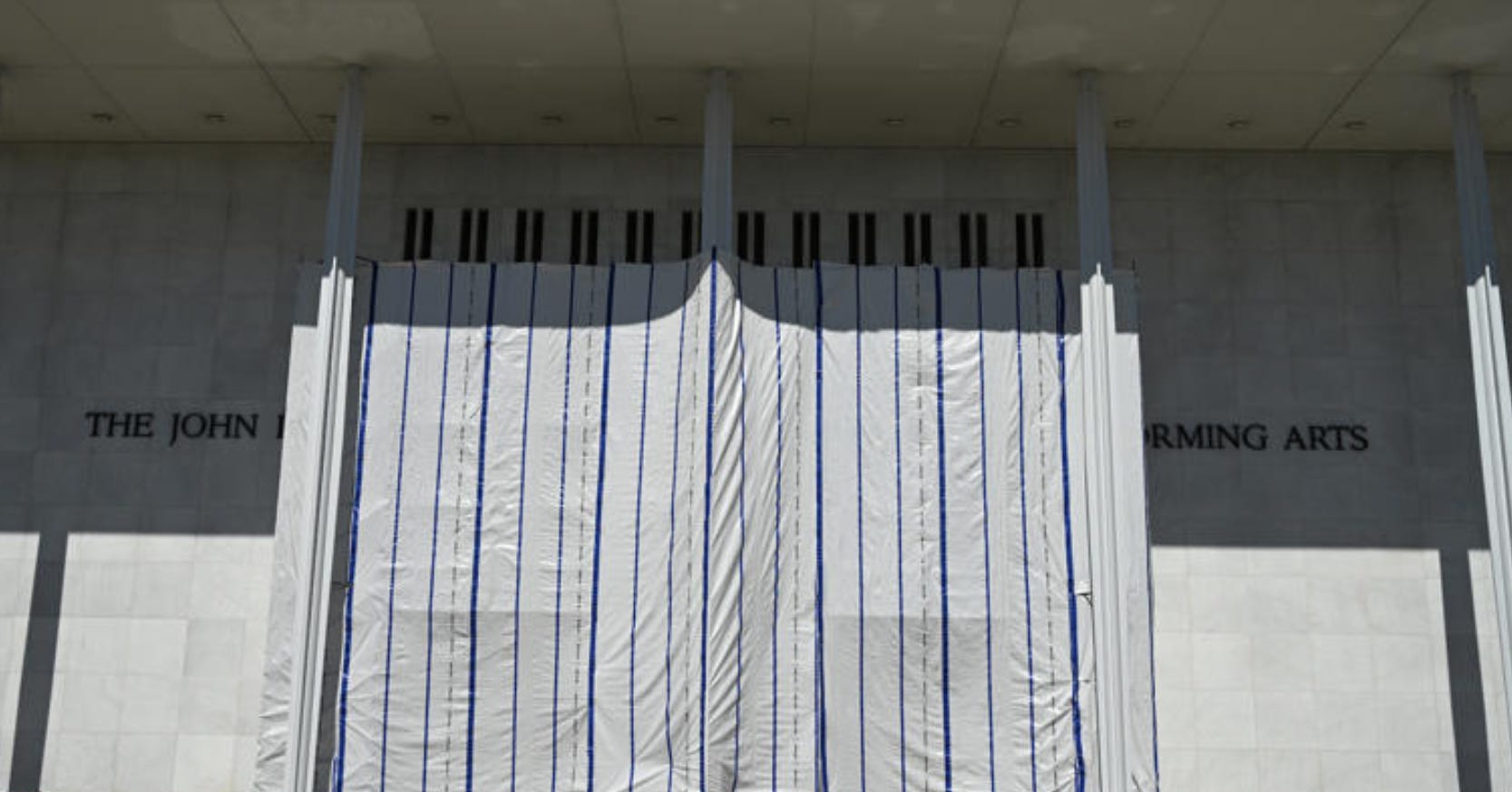
Donald Trump’s name is reportedly gone from the Kennedy Center, but the public still cannot see where it once hung.
After a federal court ruled that Trump’s board had claimed authority that Congress never gave it, workers removed the letters from the façade. The building remains covered by scaffolding and a tarp. Kennedy Center officials may have legitimate repairs to complete, and there is no public evidence that Trump personally ordered the covering left in place to hide his defeat. Whatever the private explanation, however, the tarp serves a useful political function. It keeps the country from seeing what happened when the law told the president no.
Presidents lose court cases. That is not weakness. It is constitutional government working as designed. The weakness appears when a president who has built his identity around dominance cannot comfortably allow the public to see that he was checked.
Our first Kennedy Center article examined how concentrated power captured a public institution and tried to turn it into a monument to the man controlling it. This story is about what happened after that power failed. Trump’s name came down, Congress’s law remained in effect, and an independent court proved that the president did not have the final word.
The tarp is not the defeat. It is the tell.
Support independent media that follows the power.
The Coffman Chronicle is built to track who holds power, who abuses it, who profits from it, and who pays the price.
Paid supporters get full Tony Michaels Podcast episodes, deeper transcript analysis, paid columns, archives, and the reporting framework behind the show.
If you believe independent media has to survive outside billionaire platforms, corporate media, and party-approved gatekeepers, become a paid supporter today.
We Already Know How the Name Got There
We covered the Kennedy Center takeover in a previous article. Trump reshaped its leadership, loyalists gained control of the board, and the institution began to behave less like a public trust and more like an extension of the president’s personal brand. The board then placed Trump’s name on a memorial whose legal identity had been established by Congress.
A federal judge ruled that the board lacked authority to change the name Congress had given the institution. The letters did not come down because Trump changed his mind or because the board reconsidered. They came down because the law forced an institution controlled by the president to surrender something it had tried to give him.

We know how the name got onto the building. The new question is why the result still appears too dangerous to display.
Losing in Court Is Not Weakness
Presidents lose court cases under Republican and Democratic administrations because the presidency is only one part of the constitutional system. Courts review executive actions, interpret statutes, and sometimes conclude that a president or the officials serving him went too far. That is not humiliation. That is the system.
A confident president can absorb that result. He can acknowledge that the court ruled, the government complied, and the country moved forward. Accepting a lawful limit does not weaken the presidency. It demonstrates that the office remains within constitutional government rather than standing above it.
Trump has built a different political image. His authority depends heavily on the performance of permanent dominance. He wins, his opponents lose, institutions bend, and resistance is portrayed as futile. Under that model, a visible defeat becomes evidence that the performance has limits.
An uncovered Kennedy Center would tell that story without a speech. Trump wanted his name on the building. Officials loyal to him put it there. Congress’s law stood in the way, a court enforced that law, and the letters came down.
Losing in court is not weakness. Being unable to let the country see that you lost is.
The Strongman Needs an Unbroken Scoreboard
Strongman politics depends on creating the impression that resistance is pointless. The leader must appear too dominant to challenge and too powerful for institutions to restrain.
He does not have to win every fight. He only has to keep every loss from looking final. Setbacks must be blamed on enemies, buried beneath spectacle, or presented as temporary. The public must never be allowed to believe that the leader can be stopped through ordinary constitutional means.
An uncovered Kennedy Center would show that Congress’s law still carried authority, a federal court enforced it, and a public institution controlled by Trump’s allies still had to obey. The machinery of government did not bend simply because the president wanted it to.
Concentrated power relies heavily on perception. Once people see that a leader can be resisted, the appearance of inevitability begins to crack. The ruling serves as evidence that the president is not the government, that loyalty is not law, and that public institutions belong to something larger than one man.
The missing letters would reveal what the performance of dominance cannot comfortably admit: institutions can still say no.
The Grocery-Aisle Tantrum
Imagine Trump throwing a fit in the grocery aisle after being told he could not have what he wanted. The comparison works because the dispute is so petty on its surface. The president wanted his name on the building. The law said the board could not give it to him. The letters came down, and now the place where they hung remains covered.
However, presidents are not toddlers, public institutions are not toys, and federal law is not an arbitrary rule imposed by an impatient parent. The joke becomes less funny when an institution appears organized around satisfying one man’s wishes and managing his reaction when those wishes are denied.
That is where vanity becomes concentrated power. Trump did not attach his own name to the Kennedy Center. Officials operating a public institution did it for him, using its credibility, staff, property, and authority to turn his personal desire into an official act.
We do not know that Trump ordered the tarp left in place. The broader pattern does not depend on proving a private tantrum. His preference became the board’s priority, Congress’s law was treated as negotiable, and compliance came only after the legal avenues for resistance narrowed.
The problem is not merely that Trump looks like a toddler throwing a fit in the grocery aisle. The problem is that the whole store has been reorganized around managing the toddler’s reaction.
A tantrum is embarrassing. A public institution built to accommodate it is a warning.
Compliance Without Acceptance
The Kennedy Center complied with the court’s order. Trump’s name came down. However, compliance is not the same as acceptance.
Compliance means removing the letters because a judge required it. Acceptance means recognizing that the board never possessed the authority it claimed and that the legal boundary was legitimate. One is obedience after defeat. The other is respect for the constitutional order that produced it.
Trump’s political style rarely treats legal limits that way. Courts, statutes, and independent institutions are often portrayed as hostile forces that interfere with the leader’s rightful power. A ruling against him becomes evidence of persecution rather than proof that the presidency has boundaries.
The court did not order Trump’s name removed to embarrass him. The law existed for a simple reason: public institutions are governed by public authority, not by personal preference. Congress created the Kennedy Center as a memorial and gave it a legal identity. Control over its leadership did not create ownership, and the board’s loyalty did not create powers Congress had never granted.
There is no shame in being subject to law. The shame would be building a government in which one man’s desire mattered more than the law itself.
The Constitution did not humiliate Trump. It reminded him that the government does not belong to him.
Let the Public See the Loss
The public does not need the Kennedy Center uncovered so the country can celebrate Trump’s embarrassment. The point is not humiliation. The point is visibility.
Democratic government depends on more than laws written in books and rulings stored in court files. People need to see that those limits have real consequences. They need evidence that a president can demand something, surround himself with loyal officials, push an institution beyond its authority, and still be stopped.
An uncovered façade would provide that evidence in the simplest possible way. Trump’s name would be gone. Kennedy’s would remain. The building would stand as a public memorial governed by law rather than as a trophy controlled by the president.
Trump understands the value of the visual better than most politicians. A giant name above an entrance communicates ownership, authority, and permanence before anyone reads a legal argument. Its removal communicates something equally powerful.
The president can still be told no.
When the repair work is finished, the covering should come down without delay. Trump’s name was removed because presidential control over a board did not give that board the power to rewrite an act of Congress. That is not a defeat the country needs to conceal. It is proof that the president remains subject to something larger than his will.
Take down the tarp. Let the American people see what it looks like when concentrated power is told no.
Support Independent Media
The Kennedy Center belongs to the public, not to any president or political faction. When the repair work is finished, the tarp should come down, and the country should be allowed to see that the law is upheld.
Share this article with someone who needs the reminder that concentrated power is not permanent, public institutions are not personal property, and the president can still be told no.
Support the Coffman Chronicle if you believe the Constitution only works when the public is willing to defend the limits it places on power.
Sources:
Beatty v. Trump. No. 1:25-cv-4480 (CRC). Memorandum opinion. U.S. District Court for the District of Columbia, May 29, 2026. Justia.
Edwards, Jonathan. “Trump’s Name Is Off the Kennedy Center, but a Tarp Is Hiding the Proof.” Washington Post, June 15, 2026.
Floca, Charles Matthew. “Declaration of Charles Matthew (‘Matt’) Floca.” Beatty v. Trump, Civil Action No. 25-4480 (CRC), Document 59-1. U.S. District Court for the District of Columbia. Filed June 13, 2026. CourtListener.
Legal Information Institute. “20 U.S. Code § 76j—Duties of Board.” Cornell Law School.
Rosen, Jacob, Melissa Quinn, and Joe Walsh. “Judge Blocks Closure of Kennedy Center and Orders Removal of Trump’s Name.” CBS News, updated May 30, 2026.
Sloan, Steven. “Trump’s Name Is Gone from the Kennedy Center’s Facade after Court Rulings.” Associated Press, June 13, 2026.
Watson, Kathryn, and Joe Walsh. “Trump’s Name Has Been Removed from the Kennedy Center, a Court Filing Says, as Tarp Remains Up.” CBS News, updated June 13, 2026.
Whittington, Jc, Gershon Peaks, and Blake Brittain. “Trump’s Name Removed from Kennedy Center in Predawn Operation.” Reuters, updated June 13, 2026.
I'll believe the name is gone when the tarp comes down. Unfortunately, I doubt that it will happen until this regime is toppled.
In my opinion Trump plastering his image and name on buildings is what you see in countries like North Korea or red China. And, the images often show him looking down and glowering at the public. This is done perhaps to show us that he’s the big boss watching over us. And, Trump is watching over us just like he did with his Epstein girls.