


It’s been a sweltering summer in Texas, and not just from the heat.
On July 21, 2025, Governor Greg Abbott convened the first special legislative session in response to deadly Central Texas flooding and a push to redraw congressional maps mid‑decade. But within days, more than 50 House Democrats fled the state, denying Republicans the quorum needed to advance redistricting plans, effectively halting both disaster relief and legislative business.
Two weeks later, on August 15, as the first special session was formally ended without resolution, Abbott immediately called a second special session to begin at noon that same day. Yet despite the urgency, the legislature remained gridlocked, with Democrats still absent and the state’s $24 billion Rainy Day Fund untouched, even as flood-ravaged communities waited for help.
Texans watched roads wash out, hospitals shutter, and schools deteriorate, not because the money didn’t exist, but because their leaders refused to spend it. And this isn’t an accident. It’s deliberate, a template. Texas isn’t failing. It’s operating exactly as intended.
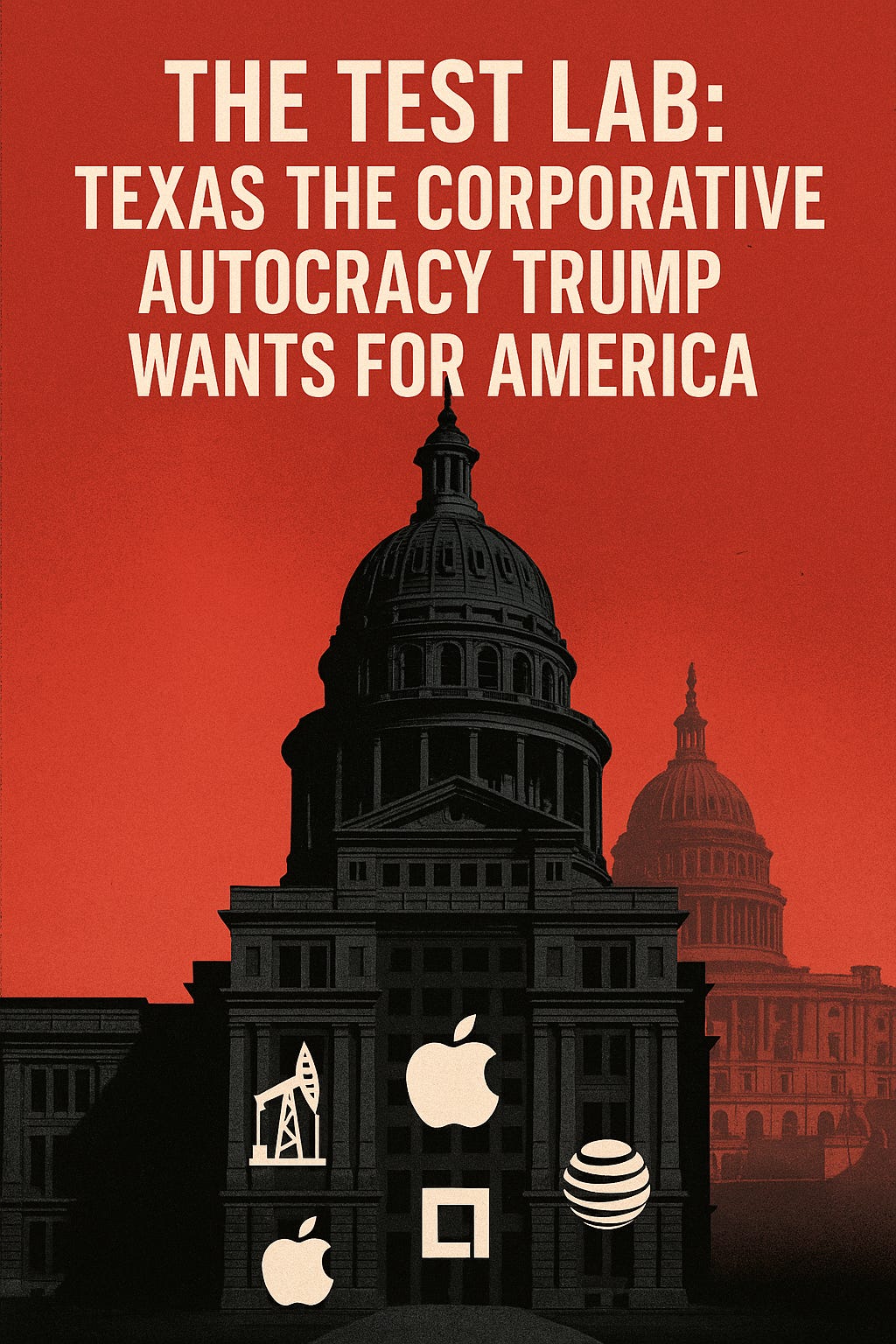
Texas isn’t just a state anymore. It’s a test lab for how to run a government like a corporation, hollow out democracy, and centralize power under the guise of rugged individualism. It’s a live‑action simulation of what the Trump‑aligned GOP wants for the nation.
Here, public self-reliance is deployed to excuse public abandonment. The language of "small government" is wielded to empower an increasingly authoritarian executive. And the state’s staggering fiscal reserves aren't used to save lives. They’re displayed to conceal neglect.
This isn’t a bug in the system. It’s the blueprint.
Stay Informed. Stay Loud.
Subscribe to The Coffman Chronicle for no-BS political analysis, action guides, and daily truth bombs you won’t get from corporate media.
The Myth of Independence
Texas sells itself as the lone star of self-reliance, a state too proud for handouts and too tough for government interference. It’s a narrative that drips from campaign ads and statehouse speeches, always one bootstep away from folklore. The numbers, however, tell a very different story.
Texas receives over $100 billion in federal funding every year, ranking among the top three states in total aid. That includes money for highways, healthcare, education, disaster relief, and infrastructure. The state is one of FEMA’s biggest beneficiaries, having collected more than $7.2 billion over the past decade alone for floods, freezes, fires, and hurricanes.
And yet, Texas continues to reject billions more, most notably by refusing to expand Medicaid. That decision alone has left hundreds of thousands uninsured and forfeited billions in federal matching funds each year. Hospitals in rural counties have shut down. Emergency rooms in major cities overflow. Pregnant women die from preventable complications. The state ranks dead last in the percentage of residents with health insurance.
But ask Austin’s leadership why they don’t take the money, and the answer is always the same: “Texans take care of their own.”
Except they don’t. Or rather, their government doesn’t. While the rhetoric is about independence, the reality is about control. Refusing federal funds isn’t about sovereignty so much as keeping services weak and social investments low. It’s about maintaining the fiction that if the state doesn’t spend, then the state isn’t responsible.
Meanwhile, the Rainy Day Fund, now swollen to over $24 billion, sits unused. Yet communities flood, families evacuate, roads crumble, and teachers flee. Still, the surplus is held up not as a resource, but as a symbol: a vault full of proof that the state can help, but it chooses not to.
The point isn’t to govern. The point is to dominate and to do it with clean hands.
The Corporate State
Texas doesn’t function like a state. It functions like a corporation with a captive population.
There’s no income tax, no meaningful corporate tax, and a limited and regressive sales tax. And yet — somehow — the state manages to generate enough revenue to sit on billions in cash. However, it is not because it has found some magical libertarian formula, but instead because it operates like a business: offload the costs, hoard the profits, and avoid the responsibility.
The Rainy Day Fund, the largest in the nation, works less like an emergency reserve and more like a political share buyback, an impressive-looking pile of wealth that pleases anti-tax donors, calms credit rating agencies, and helps keep the executive branch insulated from popular pressure. It’s not there to be spent. It’s there to prove they don’t have to spend.
At the same time, the state has turned much of its infrastructure, especially roads, into pay-to-use systems. With no state income tax to fund transportation at scale, Texas leans heavily on toll roads, particularly in and around urban centers. Want to get to the airport? That’s a toll. Live in the suburbs and commute to work? Toll. Get stuck in traffic and use the express lane? Toll.
For working-class Texans, these aren’t just nuisances; they’re economic penalties. When you’re poor in Texas, even getting to work can feel like a fee for existing.
And yet, in wealthier enclaves or corporate zones, the state finds ways to build new highways, court high-tech investors, and offer tax breaks to companies worth billions. Because when Texas governs, it doesn’t ask: What do the people need? It asks: What would a profitable business do?
See our recent reporting on the power of corporations here:

And the answer is always the same:
Cut costs (defund public services)
Outsource risk (privatize, deregulate)
Maximize reserves (Rainy Day optics)
Control labor (suppress teachers, nurses, unions)
Appease investors (corporate tax breaks, culture war red meat)
It’s governance as balance-sheet management, a politics of austerity masquerading as fiscal prudence, all while Texans foot the bill, every single day.
Executive Power, Democratic Collapse
In a state that prides itself on limited government, Texas is quietly becoming one of the most executive-dominated political systems in the country.
When the regular legislative session ended in May, Governor Greg Abbott simply kept the game going, issuing back-to-back special sessions on redistricting and disaster response, and threatening fines or arrests for lawmakers who didn’t show up. When House Democrats walked out in protest over extreme gerrymandering efforts, Abbott treated it not as political dissent but as defiance. His response wasn’t negotiation, but escalation.
For more context, including the unusual structure and schedule of the Texas legislature, see our reporting here:


This is no longer governance by compromise. It’s governance by coercion.
Abbott has now called two special sessions in under a month. He has the constitutional authority to call as many as he likes, all the way until January 2027 if he chooses. The legislature only meets in regular session once every two years for 140 days. The rest of the time, the governor is in charge.
And he’s using that power to do more than just redraw maps. He’s dictating priorities, sidelining debate, and punishing dissent. This is governance by declaration, a CEO model in a political system that still pretends to be a republic.
Meanwhile, the Republican-controlled legislature functions more like a board of directors than a coequal branch. They pass what they’re told, block what they’re instructed to, and leave the hard decisions to the governor’s office, especially when it comes to actually spending money.
Even when disaster hits, such as the devastating floods that killed more than a dozen Texans this summer, the legislature can't or won’t act independently. No Rainy Day Fund release or emergency appropriations. Just more sessions, standoffs, and performance.
And beneath it all is the slow-motion collapse of democratic norms. The checks are vanishing. The balance is gone.
This isn’t just about Abbott. It’s a test case. Texas is a demonstration, a proof of concept.
Low Taxes, Low Expectations: What Life Really Looks Like in Texas
The Texas model promises economic freedom, limited government, and personal responsibility. But when you trace the outcomes, a starkly different picture emerges—one marred by deep inequality, institutional neglect, and public services stretched beyond functionality.
What "Low Taxes" Truly Deliver:
The highest uninsured rate in the nation: As of 2023, 21.6% of Texans aged 19–64 lacked health insurance, the worst adult coverage rate in America. For children, the state fares no better: nearly 12% of Texas kids are uninsured, also the highest rate nationally.
Maternal mortality is surging: Texas’s maternal death rate climbed from 17.0 per 100,000 live births in 2018 to 27.7 in 2020. Black women in Texas die at rates more than twice those of white women.
Teen pregnancy remains dangerously high: Texas continues to rank among the worst in the country, and it has the highest rate of repeat teen births nationwide, a devastating cycle fueled by limited sex education and restricted access to contraception.
Poverty remains entrenched: With an official poverty rate of 12.9%, Texas continues to exceed the national average, with rural counties facing even deeper hardship.
Severe inequality: Texas’s Gini coefficient sits around 0.4753, placing it among the most unequal states in America. The top 5% earn 14 times more than the bottom 20%, and 66 Texas billionaires hold more wealth than the bottom 70% of residents combined.
A misleading median income: The state’s median household income is reported at $75,780 (2023), but that figure is skewed by ultra-high earners. For many Texans, especially in rural or working-class communities, incomes fall closer to $30K–$40K, barely enough to cover rent, transportation, and healthcare.
Life expectancy is sliding: Once near the national average, Texas’ life expectancy has dropped to 75.4 years, placing it 31st among U.S. states. Disparities are severe. In some rural areas, wealthier men live over a decade longer than their poorer neighbors.
Why It Matters
This is not progress. It’s a low-service economy built on the backs of everyday Texans:
They work full-time and still lack health coverage.
They lose loved ones to preventable maternal deaths.
Their children face higher odds of becoming parents before adulthood.
Their incomes stagnate while billionaires multiply.
Their life expectancy declines while politicians brag about budget surpluses.
Texas doesn’t tax prosperity into being. It starves prosperity into inequality.
The Trump Template: Texas as a National Warning
Texas isn’t an outlier. It’s a preview.
What’s unfolding in Austin — unchecked executive power, political gridlock, hoarded wealth, and institutionalized inequality — is not just a state-level tragedy. It’s the live beta test of a broader authoritarian-corporate model that Donald Trump and his allies are desperate to scale nationwide.
It’s no accident that Texas fuses performative cruelty with policy austerity, or that its governor rules by emergency session, while public schools crumble and hospital doors close. Nor is it a coincidence that billionaires and corporations are shielded from taxation, while working families pay daily tolls just to commute to jobs that don’t cover basic living costs.
Because the point isn’t to fix the system. The point is to own it and then hollow it out.
Texas is not just a red state out of step with the coasts. It is the prototype of a post-democratic America, where corporate power and executive authority merge into a single system, a place Peter Thiel would invest in and Russell Vought would script as the future.
Why is this happening in the Lone Star State? Texas is still being governed under a state constitution written in 1876, during the post-Reconstruction backlash. Next year marks its 150th anniversary, and that document, designed for a sparsely populated frontier state of under 2 million people, is now used to manage a sprawling, urbanized, 30-million-person mega-state. The structure can’t hold. The people at the top know it.
They aren’t trying to modernize Texas. They’re trying to freeze it in place, lock in minority rule through redistricting, and build a permanent structure of corporate sovereignty backed by cultural obedience and voter suppression.
That’s what Trumpism looks like in practice — not chaos, but calculated governance that redistributes power upward, punishes dissent, and wraps itself in the language of liberty while choking off democracy at the root.
So if you want to understand where this country could be headed, don’t look to Washington.
Look to Texas. That’s where the future is being test-driven. Unless it’s stopped, that’s the factory model for America.
Stay Informed. Stay Loud.
Subscribe to The Coffman Chronicle for no-BS political analysis, action guides, and daily truth bombs you won’t get from corporate media.
Bibliography:
Center on Budget and Policy Priorities. “How State Tax Policies Can Stop Increasing Inequality and Start Reducing It.” CBPP, October 4, 2023.
“Texas Is the Tale of Two Economies.” Every Texan, March 14, 2024.
“Texas Has One of the Worst Quality of Life Rankings in the Nation, CNBC Finds.” San Antonio Express-News, July 2024.
“New Census Data Shows Increasing Economic Inequality.” Every Texan, September 15, 2022.
“Here’s How Much Income Puts You in the Top 1% in Texas.” Houston Chronicle, March 5, 2025.
“Texas Health Care Is Unaffordable, Leaving Millions Uninsured.” Houston Chronicle, June 20, 2025.
“Texas Named One of the Worst States to Live In.” InnovationMap Houston, July 2024.
National Center for Health Statistics. “Teen Birth Rates by State.” NCHS Stats, 2023.
“Health Care in the Texas Triangles.” MyPlainview.com, April 3, 2025.
“Texas Tops Nation in Rate of Uninsured Children.” Public Health Watch, February 26, 2025.
“Texas Among States with Biggest Drops in Life Expectancy, Study Finds.” San Antonio Current, October 2, 2024.
“Texas Struggles with Teenage Pregnancy and High Repeat Births.” Texas Tribune, February 21, 2022.
Texas Women’s Healthcare Coalition. “Texas Maternal Health Crisis.” Texas WHC, 2024.
“Texas Median Household Income.” USAFacts.org, 2023.
Texas A&M University System. “Measuring Quality of Life: Where Does Texas Rank?” TAMUS Data Science, May 15, 2023.
“Texas sues Biden administration to limit teenage access to birth control.” The Guardian, July 26, 2024.
“Your Longevity Gap Is Biggest If You Live Here.” Time, April 10, 2016.
“Annual Survey of State and Local Government Finances.” Census.gov, 2023.
“List of U.S. States and Territories by Life Expectancy.” Wikipedia.
“Teen Pregnancy Rates by State 2024.” WorldPopulationReview.com, 2024.
This is recommended for reading by everyone in a red state. Texas is used as an example of what a nation would look like under an authoritarian, simply because it is nearly there now.
Running a country like a business is bound for failure. And knowing that t-Rump is the bankruptcy king this doesn't bode well for the US.