


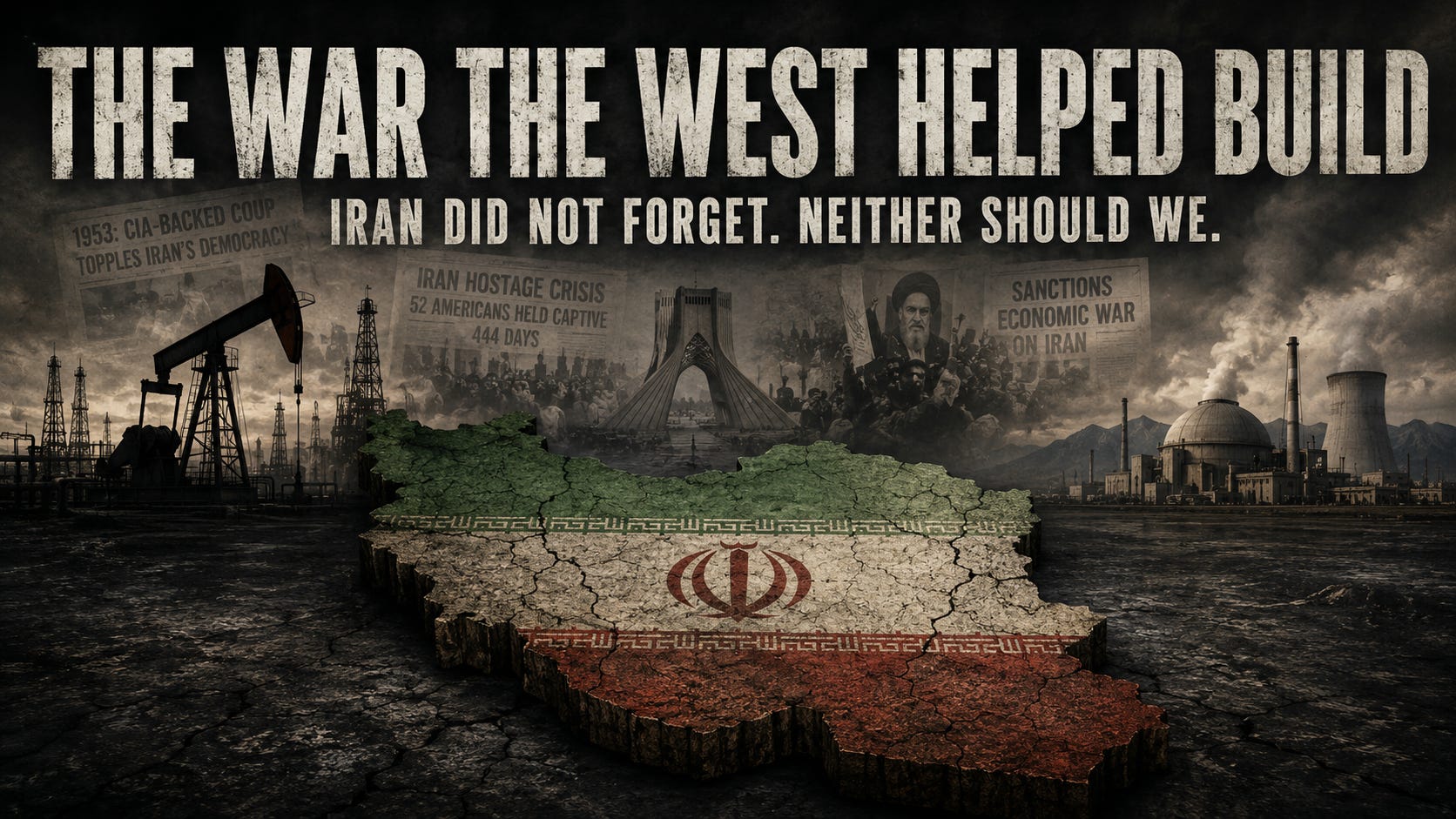
The War Did Not Begin With the Bombs
By the time the bombs began falling, Americans had already been handed the explanation. Iran was dangerous. Its nuclear program had moved closer to weapons capability. Its missiles threatened Israel, American troops, and the wider region. Its government armed militant groups, repressed its own people, and had spent decades describing the United States as an enemy. Military action, we were told, had become necessary because every other option had failed.
Some of that danger was real. The Islamic Republic has threatened its neighbors, supported groups that attacked civilians, imprisoned dissidents, and used the history of foreign interference to justify concentrated power at home. The Iranian people are not their government, and that government does not become innocent merely because Western powers wronged Iran before, but the public was still being shown the final explosion without being shown who built the fuse.
This conflict did not begin with one missile, one nuclear facility, or one president. It did not begin with the 1979 hostage crisis, Donald Trump’s withdrawal from the nuclear agreement, or the first direct exchange between Iran and Israel. It began much earlier, when powerful countries looked at Iran and saw territory to divide, oil to control, and a government to manage.
Britain and Russia divided influence inside Iran. Britain and the Soviet Union later invaded it. When Iran tried to control its own oil, Britain and the United States helped remove its prime minister. Washington then armed the shah and called his authoritarian rule stability because it protected Western interests.
Iranian anger accumulated through occupation, a coup, dictatorship, war, sanctions, covert operations, assassinations, and military pressure. Again and again, foreign powers treated Iranian sovereignty as conditional. Again and again, the backlash was presented as proof that Iran required still more control from outside.
Iran’s rulers then used that history against their own people. They labeled dissent foreign betrayal, crushed women demanding freedom, armed militant groups, and projected power through weaker countries. Their conduct gave Western and Israeli leaders new reasons to escalate.
The pattern fed itself. Foreign interference strengthened Iranian distrust. Iranian hardliners used that distrust to gather power, and their repression and aggression strengthened the argument for more sanctions, covert action, and military force.
The question is not whether Iran’s government is good. It is not. Nor is the question whether Israel and the United States faced real threats. They did. The question is who kept claiming the authority to decide Iran’s future, and what happened each time ordinary people were expected to live with the answer.
The bombs may be new. The belief that Iran can be controlled from outside Iran is not.
Support independent media that follows the power.
The Coffman Chronicle is built to track who holds power, who abuses it, who profits from it, and who pays the price.
Paid supporters get full Tony Michaels Podcast episodes, deeper transcript analysis, paid columns, archives, and the reporting framework behind the show.
If you believe independent media has to survive outside billionaire platforms, corporate media, and party-approved gatekeepers, become a paid supporter today.
Oil Made Sovereignty a Test
Iran was an old civilization with its own political institutions and national identity. The empires surrounding it often behaved as though that sovereignty mattered less than its location.
In 1907, Britain and Russia divided Persia into spheres of influence without Iranian consent. Oil made the habit more profitable. A concession granted in 1901 gave British investor William Knox D’Arcy enormous rights to search for and develop oil across much of Iran. The company that became the Anglo-Persian Oil Company grew into a pillar of British power, and the British government acquired a controlling interest. Iran possessed the resource, but Britain controlled much of its value.
In 1941, Britain and the Soviet Union invaded Iran to protect oil supplies and establish a transport route for the Allied war effort. Reza Shah was forced to abdicate, and his son, Mohammad Reza Pahlavi, took the throne. The Allies had military reasons, but Iranians still watched foreign armies enter their country, remove their ruler, and reorganize political power according to outside needs.
The lesson was clear: Iranian independence would be honored when convenient and overridden when powerful governments decided otherwise. Oil brought that question to a breaking point.
Mohammad Mossadegh became prime minister in 1951 after Parliament approved the nationalization of the Anglo-Iranian Oil Company. A constitutional nationalist rather than a revolutionary cleric, Mossadegh believed Parliament should rule, the monarchy should be limited, and Iran should control the wealth beneath its soil.
Britain responded with an oil boycott, frozen assets, blocked exports, and international pressure. Iranian revenue collapsed. Workers lost jobs. Economic hardship grew. The pressure was directed at the government, but it reached it through the public.
American officials initially attempted mediation. Under Dwight Eisenhower, Cold War fears changed the calculation. Washington worried that instability might strengthen Iran’s communist Tudeh Party and create an opening for Soviet influence.
Mossadegh was not a Soviet agent. He was an Iranian nationalist trying to reduce foreign control. British economic interests and American strategic fears nevertheless converged on the same conclusion: Iran’s political process had produced an outcome powerful governments would not accept. The question was no longer whether Iran could nationalize one company. It was whether an Iranian government could make a sovereign choice when that choice imposed costs on stronger countries.
The answer Britain and the United States prepared to give was no.
The Coup and the Stability Built Around the Shah
In August 1953, Britain and the United States moved from pressuring Iran’s government to helping remove it. The CIA and British intelligence worked with Iranian politicians, military officers, royalists, religious figures, newspaper contacts, paid agents, and others who opposed Mossadegh for their own reasons. Propaganda, street action, and military support helped bring down his government and return the shah to power.
Mossadegh had domestic opponents, and Iranian institutions were divided. Outside powers did not create every division, but they exploited them to produce the government they preferred.
The coup did not overthrow a flawless democracy. Mossadegh governed amid a constitutional crisis and made decisions that remain debated. None of that erases the decisive fact: foreign governments intervened to determine the outcome of Iran’s political struggle.
Sovereignty does not belong only to nations that govern perfectly. If powerful countries may remove another government whenever they distrust its direction, independence exists only with their permission.
The coup strengthened the shah and weakened the possibility that Iranian nationalism, constitutional government, and control over natural resources could develop together. It also damaged the credibility of Western democratic language. The United States could speak about liberty, but many Iranians remembered that Washington helped restore a monarch when their political institutions challenged Western power. That memory did not make the 1979 revolution inevitable or excuse the hostage crisis and theocracy that followed, but it did change how later American actions would be understood.
A medical visit by the Shah would not look merely humanitarian. An embassy would not seem simply diplomatic. Sanctions would not appear solely economic. Calls for regime change would not sound abstract. Each would arrive carrying the memory of 1953.
After the coup, Washington treated the shah as the source of Iranian stability. He opposed communism, guarded the Persian Gulf, maintained relations with Israel, and bought enormous quantities of American weapons. The United States saw an ally. Many Iranians saw a ruler whose survival had been secured with foreign help.
The shah’s government built roads, schools, industries, and public-health systems. The White Revolution redistributed some land, expanded education, and gave women the right to vote. However, modernization from above did not create political freedom below. The shah concentrated power around himself. Opposition parties were weakened or eliminated. Critics faced censorship, surveillance, imprisonment, exile, and torture. SAVAK, developed with American and Israeli assistance, became one of the country’s most feared institutions.
Western governments knew the shah was authoritarian. They also knew he was useful. Oil revenue and American support expanded his ambitions, but rapid modernization produced inflation, inequality, corruption, and social disruption. Religious leaders opposed secularization and Western ties. Leftists opposed inequality and American influence. Nationalists remembered Mossadegh. Liberals wanted constitutional government. Workers and students challenged repression.
They did not share one vision of Iran’s future, but they shared an enemy. Western support helped the shah suppress those disagreements rather than resolve them politically. When lawful opposition is closed, disagreement moves into mosques, universities, labor networks, exile communities, and revolutionary organizations.
When Jimmy Carter called Iran an “island of stability” in 1977, the deeper failure lay not in a single bad prediction. Washington had defined stability by what the shah delivered to the West rather than by whether he retained the trust of his people.
Revolution, Hostages, and Permanent Hostility
By 1978, the Shah still possessed the army, police, oil revenue, and American support. What he was losing was the country. Protests spread, workers struck, and universities became centers of dissent. Funerals for demonstrators killed by the government became new demonstrations.
The opposition included religious conservatives, constitutional liberals, nationalists, Marxists, students, merchants, workers, clerics, and families angry about corruption and repression. They agreed about what had to end. They did not agree about what should replace it.
Ayatollah Ruhollah Khomeini connected opposition to the Shah with opposition to foreign domination. His message reached far beyond those who shared his religious program. The shah left Iran in January 1979. Khomeini returned in February, and the monarchy collapsed. For many Iranians, it felt like national liberation. However, the revolution did not remain the property of everyone who made it. Khomeini and his allies built institutions under clerical control. Former allies were marginalized, imprisoned, executed, or driven into exile. The new constitution placed ultimate authority in the supreme leader and empowered institutions that the public could not freely remove.
Women who joined the revolution soon confronted compulsory religious rules. Secular activists, liberals, leftists, minorities, journalists, and rival religious voices discovered that opposition to the shah had not guaranteed them a place in the new Iran. The revolution broke one concentration of power and created another.
The history of interference gave the new regime a weapon. Every rival could be accused of serving the United States. Every protest could be described as another foreign plot.
Then the shah was admitted to the United States for medical treatment in October 1979. Many Americans saw a humanitarian decision. Many Iranians saw the opening move of another restoration.
On November 4, Iranian students seized the American Embassy in Tehran. Although some captives were released earlier, 52 Americans remained hostage for 444 days. The seizure was not justice. The hostages had not overthrown Mossadegh, run SAVAK, or determined American policy. They were individuals held as instruments in a struggle they did not control. History explains why the embassy became a target. It does not excuse what happened to the people inside it.
Khomeini endorsed the occupation. The crisis strengthened hardliners and destroyed much of the remaining space for officials seeking normal diplomacy. It also transformed American memory. Night after night, Americans saw blindfolded captives and crowds outside the embassy. Iran became not a country with a complicated history of oil, dictatorship, revolution, and foreign intervention, but the country that took Americans hostage.
Iranians saw 1953. Americans saw 1979. Each country began telling its story from the moment it was wronged.
Carter froze Iranian assets, broke diplomatic relations, and authorized a rescue attempt. The operation failed in the desert, killing eight American service members. The hostages were released on January 20, 1981. Their captivity ended through negotiation, but normal relations never returned. Sanctions and emergency powers became durable features of American policy. The Islamic Republic made opposition to the United States part of its identity.
The hostages were freed. Neither country freed itself from the crisis.
When Iraq Invaded, the West Chose Which Aggression It Could Tolerate
On September 22, 1980, Saddam Hussein invaded Iran. The invasion gave Iran’s rulers an external enemy capable of uniting a country still fighting over its revolution. Political rivals were suppressed, and a real foreign threat strengthened concentrated power at home.
At first, the United States formally declared neutrality. In practice, Iran was sanctioned and cut off from weapons and spare parts bought under the Shah, while Iraq retained access to arms suppliers, credit, technology, and diplomatic relationships. Saddam started the war, but Iran was increasingly treated as the greater long-term danger.
By 1982, Iranian forces had largely recovered the lost territory, and Saddam sought an end to the war. Iran’s rulers chose to continue. Iran was no longer fighting only to expel an invader. Its forces crossed into Iraq, and Khomeini’s government pursued punishment, regime change, and revolutionary influence.
Iran had been attacked. Its rulers then made choices that prolonged the killing.
As Iran gained momentum, the United States and several other governments moved more openly toward Iraq. Washington restored diplomatic relations and provided intelligence and other assistance. France supplied weapons. The Soviet Union supplied much of Saddam’s arsenal. Companies across several countries sold equipment, technology, and chemical precursors.
Their motives differed. The practical result was the same. The country that invaded Iran received enough outside support to avoid defeat. That support continued even after the United States and other governments received evidence that Iraq was using chemical weapons against Iranian troops and Kurdish civilians. Saddam nevertheless remained a leader they believed they could work with.
The lesson for Iranians was devastating. Their country had been invaded, their soldiers gassed. The government responsible still received weapons, intelligence, credit, and diplomatic support from governments claiming to defend the international order.
Then came Iran-Contra. While the Reagan administration publicly treated Iran as an enemy, officials secretly facilitated weapons sales to Tehran and diverted proceeds to support the Contras in Nicaragua after Congress restricted that assistance. Iran became an enemy and a customer inside the same operation. The scandal exposed an executive branch conducting one policy in public and another in secret while maneuvering around Congress.
By the late 1980s, American naval forces were operating directly inside the conflict. On July 3, 1988, the USS Vincennes shot down Iran Air Flight 655, killing all 290 people aboard. The United States described the destruction of the civilian aircraft as a tragic error during a tense confrontation. Many Iranians saw a passenger plane destroyed by the navy of a country already assisting their enemy. The passengers had not chosen the war. They became another group forced to pay for decisions made above them.
The war ended weeks later after nearly eight years of killing. Hundreds of thousands were dead, and many more were wounded, displaced, traumatized, or exposed to chemical weapons.
Saddam and the Islamic Republic remained in power. Iran emerged convinced that international rules would not protect it. Its leaders invested more heavily in missiles, irregular warfare, regional partners, and the ability to impose costs without matching the conventional power of the United States or Israel.
Those policies later threatened civilians and destabilized neighboring countries. They did not develop outside history. When Iran was invaded, powerful governments did not ask only who had crossed the border. They asked which side they could afford to let win.
Sanctions, Lost Openings, and the Invasion That Strengthened Iran
The Iran–Iraq War ended, but pressure surrounding Iran became permanent. Presidents and Congress added sanctions tied to terrorism, oil, banking, missiles, the Revolutionary Guard, human-rights abuses, and eventually the nuclear program. Many had legitimate targets. The problem was that their collective purpose became difficult to define.
Were sanctions intended to force negotiations, contain Iranian power, protect Israel, change the regime’s behavior, or collapse the regime itself? The answer shifted. Sanctions became easier to impose than to remove. Punishment had a political constituency. Peace required an argument.
The United States used access to its economy and financial system to determine how much oil Iran could sell, which banks could process its money, and which companies could trade with it.
Sanctions were presented as an alternative to war. They still reached the government through the public. Currency weakened. Imports became more expensive. Businesses lost credit and equipment. Workers lost jobs. Food and medicine could be legally exempt yet effectively blocked when banks and shippers refused to process transactions.
The Islamic Republic also produced suffering through corruption, mismanagement, repression, military spending, and politically connected institutions. Iranian leaders blamed outsiders for failures they helped create. American leaders blamed Tehran for the pain American policy was designed to intensify.
Sanctions could also strengthen the institutions they were meant to weaken. The Revolutionary Guard was better positioned than ordinary businesses to control black markets and sanctions evasion.
Still, diplomatic openings appeared. Mohammad Khatami’s election in 1997 revealed a constituency for reform and engagement. He did not control the supreme leader, security services, judiciary, or other unelected institutions, but he demonstrated that Iran was not one political mind.
The Clinton administration responded cautiously, and Secretary of State Madeleine Albright acknowledged the American role in the 1953 coup. Recognition was important, but it did not produce reconciliation.
Iranian conservatives attacked reform as foreign infiltration. Newspapers were closed and activists arrested. American officials cited repression as evidence that reform could not transform the state.
After September 11, Iran and the United States found a shared interest against the Taliban. Iranian officials assisted efforts concerning Afghanistan and supported negotiations that produced a new Afghan government. The cooperation proved that permanent hostility was political, not inevitable.
Then George W. Bush placed Iran in an “axis of evil.” The speech reflected real concerns about armed groups and weapons programs, but it also gave Iranian hardliners the evidence they wanted: cooperation with Washington did not produce security.
A year later, the United States invaded Iraq. Washington removed Saddam Hussein, Iran’s principal regional counterweight, and then dismantled much of the Iraqi state. Iran was positioned to benefit. Tehran had long maintained relationships with Iraqi Shiite parties, clerics, opposition leaders, and armed groups. After Saddam fell, Iranian influence expanded through politics, trade, intelligence, militias, and the new Iraqi state. Iran did not control every Shiite leader or militia, but it had access.
Washington saw Tehran exploiting chaos. Tehran saw American forces occupying countries on both its eastern and western borders. Iran’s response was not purely defensive. The Revolutionary Guard supported groups that attacked rivals, contributed to sectarian violence, and killed American troops.
Iran had condemned foreign governments for manipulating weaker countries. Now it was building power through weaker countries of its own. The victim of interference had become an interfering power.
The invasion also reinforced the argument inside Tehran that weakness invited regime change. The United States had overthrown a neighboring government partly over weapons claims that proved false.
Washington did not invade Iraq to strengthen Iran. It just became one of the clearest results.
The Nuclear Fight and the Exit Diplomacy Created
Iran’s nuclear program began under the Shah, when Iran was an American ally. The United States helped introduce nuclear technology, supplied a research reactor, and discussed assisting a civilian nuclear industry. Nuclear technology under the Shah was treated as modernization.
Under the Islamic Republic, it became a threat. The difference was not merely hypocrisy. The Islamic Republic had taken hostages, armed militant groups, threatened Israel, concealed nuclear activities, and given other countries reasons to distrust its intentions.
Iran nevertheless saw a familiar pattern. Outside powers had decided which rulers, oil arrangements, and military balances were acceptable. Now they were deciding which scientific capabilities Iran could possess. Iran had joined the Nuclear Non-Proliferation Treaty, accepting inspections and a prohibition on nuclear weapons while retaining the right to peaceful nuclear energy. Its leaders invoked that right to defend uranium enrichment. The argument had legal force, but it depended on the trust Iran helped destroy.
Undisclosed facilities became public in 2002. Inspectors uncovered undeclared activities and materials. Iran restricted cooperation and developed enrichment capabilities, thereby narrowing the gap between civilian activity and weapons-grade material.
A civilian program, uranium enrichment, enough material for a bomb, a workable weapon, and a delivery system are connected stages, but they are not identical. Those distinctions do not eliminate danger. They define it.
Israel had real reasons for concern. Iran armed groups near its borders, developed missiles, used threatening rhetoric, and made opposition to Israel central to its regional identity.
Israel’s response was still a choice. Its strategy included sabotage, cyberattacks, assassinations, attacks on Iranian personnel abroad, and threats of preventive war. These operations may have delayed parts of the program. They also strengthened Tehran’s claim that outside powers intended to decide which Iranian scientists and facilities could exist. Pressure produced secrecy. Secrecy produced more pressure.
Yet diplomacy eventually interrupted the cycle. The 2015 Joint Comprehensive Plan of Action did not require trust. It imposed measurable limits.
Iran reduced its enriched-uranium stockpile, restricted enrichment levels and centrifuges, redesigned the Arak reactor, and accepted expanded monitoring. In exchange, the United States, Europe, and the United Nations lifted or suspended nuclear-related sanctions. The agreement did not end Iran’s missiles, armed networks, repression, or hostility toward Israel, but it did address the dispute most likely to produce catastrophic war.
Critics had legitimate concerns. Some restrictions would expire. Enforcement was essential. Iran might use economic relief to strengthen military institutions. Israel feared that the agreement would delay rather than eliminate the danger.
However, the alternative was not a magically disarmed Iran. It was, instead, fewer limits, fewer inspectors, more enrichment, and a shorter road to war. The agreement’s strength was not trust. It reduced the need for trust.
Congress reviewed the deal but failed to create a durable national framework around it. The agreement remained tied to one president and one party, making it vulnerable in the next election.
For a brief period, the most dangerous part of Iran’s nuclear program was managed through inspections rather than airstrikes. The exit was narrow and fragile, but it was open.
Maximum Pressure Closed the Exit
In May 2018, Donald Trump withdrew the United States from the nuclear agreement and restored sanctions. He argued that the deal did not permanently eliminate enrichment, ignored ballistic missiles, left Iranian regional power intact, and included restrictions that would expire.
While those were real limitations, the United States did not leave after proving Iran had built a bomb under the agreement’s cover. It abandoned functioning limits and inspections because the president believed greater pressure would produce a better deal. No replacement was ready, and no stronger coalition had been assembled around one.
The administration targeted Iran's oil, banking, shipping, and industrial sectors, as well as officials and institutions. It used access to the American financial system to threaten foreign companies that continued doing business with Iran.
The demands extended beyond the nuclear issue to missiles, regional allies, and Iran’s broader security strategy. Some changes would have made the region safer. Together, the demands approached strategic capitulation.
Maximum pressure produced pressure. Iran’s economy contracted, oil revenue fell, inflation deepened, and once again, ordinary people paid more. It did not produce the promised agreement.
It also weakened Iranians who had argued that negotiation could bring lasting relief. Hardliners could point to the withdrawal and ask why Iran should surrender more when Washington had already abandoned the agreement.
Iran then chose to reduce compliance. It expanded enrichment, installed more advanced centrifuges, accumulated more material, and restricted monitoring.
The United States abandoned limits in pursuit of pressure. Iran answered pressure by abandoning limits. Washington cited the expanding program as proof that the original deal had been inadequate. The policy began producing the very danger it claimed to eliminate.
The confrontation spread through attacks on tankers, oil infrastructure, drones, American personnel, and regional bases. In January 2020, the United States killed Qassem Soleimani near Baghdad’s airport. Soleimani commanded the Quds Force and helped build the network through which Iran projected power. Forces connected to that network had killed Americans and civilians.
Killing him was still a presidential decision carrying the risk of war. Congress had not declared war on Iran or specifically authorized a campaign against senior Iranian leaders. Lawmakers debated the evidence and authority only after the strike had occurred, Iran had promised retaliation, and American troops were waiting for missiles.
The larger war did not begin then, but the machinery remained ready.
When Joe Biden entered office, restoring the nuclear agreement proved harder than leaving it. Iran wanted sanctions relief and protection from another American withdrawal. Washington wanted Iran to reverse its nuclear advances first. Neither side rebuilt the exit.
The Shadow War Became Open War
By October 2023, Iran and Israel had already been fighting an undeclared shadow war. Iran supported Hezbollah, Palestinian armed groups, Iraqi and Syrian militias, and the Houthis. These organizations had their own histories, grievances, and leaders, but Iranian money, weapons, training, and technology increased their ability to wage war.
Strategic depth for Iran meant insecurity elsewhere. Lebanese civilians lived beside Hezbollah’s military infrastructure. Iraqis lived among militias whose loyalties competed with their state. Syrians and Yemenis watched foreign governments and armed movements use their countries as regional battlefields.
Iran had condemned foreign governments for interfering in the affairs of weaker countries, and it was now projecting power through weaker countries of its own.
Israel saw an armed ring forming around it. Hezbollah possessed a vast arsenal. Hamas controlled Gaza. Iranian-supported forces operated in Syria. Missiles and drones could arrive from several directions.
While that fear was real, Israel’s response—sabotage, assassination, airstrikes, and preventive force—was also a choice. On October 7, 2023, Hamas-led fighters attacked southern Israel, killed civilians and soldiers, and took hostages into Gaza. The attack was an atrocity. Palestinian suffering did not justify murdering and abducting civilians. Iranian support helped make Hamas more capable. Hamas still made its own decision.
Israel responded with a campaign that devastated Gaza, killed large numbers of civilians, displaced families, and destroyed much of the territory’s civilian infrastructure. Hamas fought from within a densely populated territory. Israel remains responsible for how it used force.
The conflict spread through Lebanon, Syria, Iraq, Yemen, the Red Sea, and American military positions. In April 2024, Israel struck a building associated with Iran’s diplomatic compound in Damascus, killing senior Iranian military personnel. Iran responded with a large direct missile-and-drone attack from its own territory.
A boundary had been crossed. Future leaders would no longer have to decide whether to attack one another’s territory for the first time. They would decide how much further to go.
The exchanges accelerated. Israel weakened Hezbollah and attacked Iranian targets. As Iran’s regional deterrent deteriorated, Tehran relied more heavily on missiles and nuclear capacity, while Israel became more determined to prevent Iran from gaining a stronger deterrent.
In June 2025, Israel launched major strikes on Iranian nuclear and military sites. Iran retaliated. The United States then struck Fordow, Natanz, and Isfahan. Facilities that had once been restricted under an international agreement and monitored by inspectors were attacked by air.
The sequence completed the maximum-pressure failure. The United States left an agreement constraining Iran’s nuclear program. Iran expanded that program. Israel attacked it. The United States joined the attack. Iran chose nuclear escalation. Israel chose preventive war. The United States chose to abandon an agreement and later bomb facilities that the agreement had limited.
The fighting paused, but the underlying machinery remained intact.
On February 28, 2026, the United States and Israel launched a broad, coordinated attack on Iran. The opening strikes killed Supreme Leader Ali Khamenei and senior military leaders. Iran retaliated against Israel, American forces, and other regional targets, expanding the conflict across the Persian Gulf and through armed networks built over decades.
The governments had spent years claiming each escalation was necessary to prevent a larger war. Preventive strikes, proxy attacks, assassinations, sanctions, missile launches, and military deployments had now become that larger war.
Israel did not invent the threat it faced. Iran had armed groups that attacked Israelis, developed missiles, advanced its nuclear capacity, and made hostility toward Israel part of state policy.
Iran did not invent the threat it faced either. Israel had assassinated Iranian officials and scientists, sabotaged facilities, attacked nuclear sites, and demonstrated a willingness to use force before Iran possessed the weapon Israel feared.
The United States did not stand outside the cycle. It armed and defended Israel, built much of the sanctions architecture, abandoned the nuclear agreement, killed Soleimani, attacked IAEA-monitored facilities, and joined the open war.
These facts do not make every actor equally responsible. They make each actor responsible for their own choices. Every government called its escalation defensive. Every government treated the response as proof that the escalation had been necessary.
An early-April ceasefire halted direct exchanges between American and Iranian forces, but it did not settle the broader regional conflict. In mid-June, the United States and Iran signed an interim memorandum intended to preserve the ceasefire and open negotiations over nuclear inspections, sanctions relief, oil sales, shipping through the Strait of Hormuz, and a more durable settlement.
That diplomatic opening does not erase the war or prove that the conflict has been resolved. A ceasefire is not reconciliation, and an interim memorandum is not yet a lasting peace, but the return to negotiation confirms something this history has shown before: even governments that insist only force will work eventually return to inspections, agreements, conditions, and reciprocal concessions when the cost of war becomes too high.
The question is why the public had to endure another war before those tools became serious again.
Iran’s Rulers Used the Wound
The history of foreign interference is real. Iran’s rulers simply learned how to use it.
The 1953 coup, each new sanction, each assassination, every covert operation, and every threat of regime change gave the Islamic Republic evidence it could hold before the public. Every genuine outside danger made invented conspiracies easier to believe.
A journalist exposing corruption could be called a foreign agent. A worker demanding wages could be accused of weakening the country. A woman resisting compulsory veiling could be portrayed as carrying Western culture into Iran. A student demanding freedom could be described as part of another coup.
Iran is a country and a people. The Islamic Republic is a political system. Criticism of the system is not a betrayal of the country. Women asserting control over their bodies are not inviting foreign occupation. Families seeking answers after state violence are not agents of Israel or the United States. Yet the Islamic Republic repeatedly claimed that protecting its authority was the same as protecting Iran.
The uprising after Mahsa Amini’s death in morality police custody in 2022 exposed the divide between the country and the government, claiming to speak for it. “Woman, Life, Freedom” came from people living under the Islamic Republic. The government answered with lethal force, arrests, censorship, torture, and executions. Officials again portrayed domestic opposition as foreign manipulation.
Outside governments supported protesters, but they did not create the grievances. The Islamic Republic did not need the CIA to produce women angry about compulsory veiling or families grieving people killed by the state.
Direct war gave the regime an even stronger excuse. Espionage and foreign attack were no longer theoretical. Officials and scientists had been assassinated, military facilities attacked, and the country bombed. An authoritarian government could use that real danger to sweep broadly against dissidents, journalists, minorities, lawyers, and critics.
However, a nation does not become free merely because the government repressing it is also under attack. Iranian civilians should not have to choose between being bombed by outside powers and imprisoned by their own rulers. Washington invokes Iranian dissidents to justify pressure. Tehran invokes Western pressure to justify crushing dissidents. The people are treated as tools in someone else’s argument.
The Islamic Republic was not wrong to say that foreign governments wanted to influence Iran. It was wrong that this gave the Islamic Republic the right to own Iran. Sovereignty belongs to the people, not merely to the state that controls them.
Congress Paved the Road and Refused to Post a Destination
By the time the conflict became open war, Congress could not claim that Iran policy had escaped its control. Congress passed sanctions, restricted trade, funded American forces, armed allies, supported Israel, reviewed the nuclear agreement, and gave presidents the architecture needed to threaten, retaliate, and strike.
Congress was not powerless. It used power selectively. Lawmakers were willing to vote for pressure. They were less willing to define what pressure was meant to accomplish.
Was the objective preventing a nuclear weapon, ending support for armed groups, containing Iranian influence, defending Israel, changing the regime’s behavior, or collapsing the Islamic Republic? Members could support the same sanction while imagining different destinations. Pressure allowed them to postpone the disagreement.
Congress could punish Iran without defining what Iran would have to do for the punishment to end. If Iran resisted, more pressure could be demanded. If it negotiated, lawmakers could say pressure was working and should remain. If talks failed, the failure could be cited as proof Iran never intended to compromise. The policy became easier to expand than to evaluate.
Congress also funded bases, ships, aircraft, missile defenses, intelligence operations, troop deployments, and weapons transfers throughout the region. Appropriations are power. A military cannot deploy without money. A weapons system cannot be transferred without legal authority. A regional posture does not sustain itself through presidential speeches alone. Congress helped build the machine.
When the United States joined Israel’s February 28, 2026, attack, Congress had neither declared war on Iran nor enacted a specific authorization for that campaign. The administration defended the operation as an exercise of presidential authority and collective self-defense. Lawmakers introduced repeated War Powers measures, but Congress did not authorize the war or compel its termination.
After the early-April ceasefire, the administration argued that direct hostilities had ended for purposes of the War Powers Resolution’s deadline. Opponents disputed that interpretation while the broader regional conflict and American military involvement continued. Congress was again arguing over the boundary after the president had already determined the facts on the ground.
When presidents used the machinery Congress had built, lawmakers often behaved as though their role was to comment afterward. That is smaller than the authority the Constitution gives them. Congress has the power to declare war, regulate foreign commerce, control appropriations, raise armed forces, write military rules, and investigate executive action. Those powers are how the public is supposed to participate in decisions that may cost lives, money, security, and peace.
When Congress provides the forces, funds, sanctions, and commitments necessary for escalation but refuses to define when they may be used, it transfers the decision. The president receives the ability to act. The public receives the consequences.
The surrender happens in pieces: one sanctions law, one weapons sale, one deployment, one emergency declaration, one strike described as defensive, one briefing, and one hearing after the operation. No single vote appears to authorize permanent war. Together, the votes construct nearly everything permanent war requires.
The killing of Soleimani demonstrated the pattern. Congress debated intelligence and authority after the strike, with American troops awaiting retaliation. The people’s branch debated the constitutional boundary after the executive branch had crossed the operational one.
Congress also failed to make diplomacy durable. It reviewed the nuclear agreement but never developed a bipartisan framework to preserve, revise, or replace it.
One president negotiated the exit. Another closed it.
The legislature treated sanctions, weapons, deployments, Israeli policy, nuclear negotiations, and individual strikes as separate questions. They entered the same history. Congress legislated the pieces without forcing an accounting of the whole.
What would success look like? What would cause sanctions to end? Where did defending Israel stop and joining a preventive war begin? If the objective was regime change, when would Congress tell the public? Open war revealed the cost of avoiding those questions.
Congress built a pressure system with no agreed release valve. It made punishment more durable, made military force available, and made presidential escalation easier. It did not make peace durable.
The more dangerous the threat, the more important it is that one president does not control the entire decision. Speed belongs to the executive. Legitimacy requires public deliberation.
Congress did not merely fail to stop the road to war. It paved much of the road and refused to post a destination.
Ordinary People Paid for the Pattern
This history is usually told through rulers, generals, intelligence chiefs, and diplomats. Then the consequences disappear into words such as pressure, deterrence, stability, retaliation, and collateral damage. Those words make policy sound as though it happens only between institutions.
It does not.
Iranian workers lived under British control of the oil industry. Political prisoners lived inside the stability Washington praised. American diplomats spent 444 days as hostages. Young Iranians and Iraqis disappeared into battlefields and chemical attacks. The 290 passengers of Iran Air Flight 655 died in a war they did not control.
Sanctions delivered pain through smaller doors. Medicine became harder to obtain. Businesses closed. Paychecks lost value. Families postponed medical care, education, marriages, and future plans because savings no longer bought what they once could.
Iran’s government contributed through corruption, repression, military spending, and economic mismanagement. American policy added pressure deliberately.
The rulers endured. The public adjusted its life around the punishment.
Iranians demanding freedom paid again. Students were arrested, workers beaten, journalists censored. Women resisting compulsory veiling faced detention and violence. Families grieving people killed by the state were pressured to remain silent.
Then the conflict spread throughout the region. Lebanese families lived beneath the threat of war between Hezbollah and Israel. Iraqis lived among militias, foreign forces, and a state pulled between Washington and Tehran. Syrians endured Iranian intervention and Israeli attacks inside a country already devastated by civil war. Yemenis watched their country become another front in a regional struggle.
Palestinians endured occupation, blockade, displacement, and the destruction of Gaza. Israeli families endured rockets, October 7, hostage-taking, and the fear that armed organizations near their borders intended to kill them.
A Lebanese civilian is not Hezbollah. An Iranian civilian is not the Revolutionary Guard. A Palestinian child is not Hamas. An Israeli family is not the Israeli cabinet. An American service member is not the president who ordered a strike. Governments erase those distinctions when doing so makes violence easier to explain.
American troops served at bases within range of Iranian missiles and armed groups. Their families learned that a headline about a distant strike could mean a deployment, a traumatic brain injury, or a folded flag.
When presidents acted first, and Congress debated later, service members lived inside the constitutional gap. They were expected to obey before their representatives had clearly decided what the mission was.
American households also encountered the conflict at the kitchen table. War in and around the Persian Gulf can raise oil prices, reroute shipping, increase insurance and transportation costs, and push those expenses into utility bills, groceries, and household budgets. A family does not need to understand enrichment levels or missile ranges to recognize when its paycheck no longer reaches as far.
The president calls the action necessary. Markets call the result volatility. Economists call it an energy shock. The family calls it another bill.
This does not mean household costs should determine every decision involving national security. It means people deserve a role before those costs are imposed in their name.
For more than a century, power moved upward, and cost moved downward.
Foreign governments claimed authority over Iran’s territory, resources, and political future. Iran’s clerical rulers claimed authority over the speech, bodies, votes, and lives of Iranians. American presidents claimed the authority to escalate toward war before Congress or the public had settled what the country was trying to accomplish. These were different concentrations of power, but they reinforced one another.
Foreign attack helped Iranian rulers justify repression. Iranian repression and aggression helped foreign governments justify intervention. Congressional surrender gave presidents the freedom to turn the cycle into American military action.
Governments built the pattern. The people paid for it.
Iran Did Not Forget
Iran did not forget the oil concessions, occupation, coup, shah, war, chemical weapons, sanctions, or civilian aircraft falling from the sky.
Americans did not forget the embassy, hostages, Desert One, attacks on their troops, or armed groups supported by Tehran.
Israelis did not forget the threats, rockets, the October 7 massacre, or the possibility that a hostile government might acquire a nuclear weapon.
Iranians did not forget the assassinated scientists, covert operations, economic pressure, military encirclement, or bombs striking their country.
Every government carried a ledger and began reading it on the page where it had been wronged. That is how history becomes ammunition.
However, one government’s wrongdoing does not transfer innocence to another.
The coup did not justify the hostage crisis. The hostage crisis did not justify permanent economic warfare. Saddam’s invasion did not justify Iran’s decision to prolong the war. Western support for Iraq did not justify Iranian interference in weaker states. Iranian support for armed groups did not make every Israeli strike necessary. Israeli security fears did not create a blank check for assassination or preventive war. Iranian nuclear secrecy did not justify destroying verified limits without a replacement. American sanctions did not compel the Islamic Republic to repress women, imprison journalists, or kill protesters.
History does not distribute innocence. It distributes responsibility.
Britain and the United States were responsible for the coup. The shah was responsible for repression. The Islamic Republic was responsible for hostage-taking, domestic tyranny, proxy violence, and escalation. Saddam Hussein was responsible for invading Iran and using chemical weapons. Western governments were responsible for assisting or tolerating him. Israel was responsible for its covert and military choices. American presidents were responsible for the agreements they abandoned and the strikes they ordered. Congress was responsible for the laws, funds, weapons, sanctions, and authorities it supplied.
Every generation inherited the conflict. Every generation also made choices of its own. The coup was inherited by the revolutionaries. The hostages were their choice. Saddam’s invasion was imposed on Iran. Prolonging the war was a choice. American hostility was inherited by Iranian leaders. Imprisoning dissidents and arming militias were choices. Iranian threats were inherited by Israeli governments. Assassinations and preventive war were choices. Trump inherited the nuclear agreement. Abandoning it without a replacement was a choice. Congress inherited the sanctions system. Preserving it without defining its destination was a choice. The open war was not a weather event. It was made from decisions.
That leaves room for something other than fatalism.
Iran’s nuclear program needs enforceable limits and serious inspections. Its armed network has caused real harm. Israel has a right to protect its people. American troops cannot be left defenseless, but security cannot mean allowing one government to define every preventive strike as necessary. Sovereignty cannot mean allowing another government to hide dangerous work or repress its people without consequence. Solidarity with Iranians cannot mean bombing them in the hope that freedom will emerge from the wreckage. Support for Israel cannot mean transferring to its government the power to decide when the United States enters war. Opposition to the Islamic Republic cannot mean abandoning the Constitution at home.
American leaders must tell the public what they are trying to achieve. If the objective is to prevent an Iranian nuclear weapon, define the verified limits that would satisfy that objective. If the objective is to contain Iranian regional power, explain what conduct would change American policy and which sanctions could end. If the objective is defending Israel, define the difference between supporting its defense and joining a preventive war. If the objective is regime change, tell the American people what it would require, what it might unleash, and who would fight and pay for it. A policy without an honest objective cannot produce an honest peace.
Congress must decide which military actions require a vote, which funds may be used, which limits govern American involvement, and which diplomatic framework can survive changes in administration. It must stop treating peace as one president’s temporary project and war as the permanent default inherited by the next.
Congress cannot undo the coup, return the dead, erase the hostage crisis, heal chemical burns, or restore Flight 655. It can decide whether that history will continue governing the future without public consent. That decision belongs to Congress because the power belongs to the people.
Iran did not forget. Neither should we, but remembering history should do more than help governments select the grievance that justifies the next attack. It should reveal the cost of allowing interference to produce backlash, backlash to produce repression, and repression to become the argument for more intervention.
The latest bombs did not begin the story. They revealed where the story had led.
The current diplomatic opening offers another narrow exit. Whether it survives will depend on inspections, enforceable commitments, reciprocal relief, and governments willing to accept that security does not require total submission by the other side.
It will also depend on whether Congress finally claims responsibility before the next president decides that war is easier than negotiation. The next decision is whether Congress and the public will allow this destination to become permanent, or insist that power produce something other than another war.
Support Independent Media
If this history helped you see the war more clearly, please share it.
The Coffman Chronicle exists to challenge concentrated power, defend the people’s branch, and connect decisions made in Washington to the lives of the people expected to pay for them.
If you can afford to become a paid subscriber, your support helps keep this work independent and makes more reporting like this possible.
This is Rebellion from Home.
Sources:
Albright, Madeleine K. “Remarks on American-Iranian Relations.” Iran Watch. March 17, 2000.
“U.S.-Iran Deal: Read the Full Text.” Axios, June 17, 2026.
Avalon Project. “The Anglo-Russian Entente—1907.” Yale Law School.
Bush, George W. “President Delivers State of the Union Address.” White House, January 29, 2002.
Congressional Research Service. Iran: Background and U.S. Policy. Washington, DC, 2025.
Congressional Research Service. Iran’s Nuclear Program: Tehran’s Compliance with International Obligations. Washington, DC, 2025.
Congressional Research Service. “Israel-Iran Conflict, U.S. Strikes, and Ceasefire.” June 2025.
Congressional Research Service. “U.S. Sanctions on Iran.” 2025.
Congressional Research Service. “U.S. Strikes on Nuclear Sites in Iran.” June 2025. https://www.congress.gov/crs-product/IN12571.
Congressional Research Service. “War Powers Issues: U.S. Use of Military Force Against Iran.” June 23, 2025.
Encyclopaedia Britannica. “SAVAK.”
Encyclopaedia Iranica. “Anglo-Persian Oil Company.”
European External Action Service. Joint Comprehensive Plan of Action. July 14, 2015.
International Atomic Energy Agency. IAEA Verification in Iran: Joint Comprehensive Plan of Action.
“Iran, Islamic Republic of: Natanz, Esfahan and Fordow Nuclear Facilities.” International Atomic Energy Agency, June 22, 2025.
National Archives and Records Administration. “Iran-Contra Scandal.” Ronald Reagan Presidential Library.
“Documenting Iran-U.S. Relations, 1978–2015.” National Security Archive, December 19, 2019.
“Iran-Iraq War, 1980–1988.” National Security Archive, September 20, 2021.
“USS Vincennes Tragedy.” Naval History and Heritage Command, September 2018.
“U.S. Waives Iran Sanctions after Talks; Lebanon Fighting Abates.” Reuters, June 22, 2026.
“Congress Has Backed Iran War Powers Resolutions. Now What?” Reuters, June 9, 2026.
“Israel and U.S. Launched Strikes as Iranian Leader Met with Inner Circle, Sources Say.” Reuters, February 28, 2026.
“U.S. Official Says Iran War Truce ‘Terminated’ Hostilities for War Powers Deadline.” Reuters, May 1, 2026.
“U.S. Senate Narrowly Blocks New Bid to Rein In Trump War Powers.” Reuters, June 16, 2026.
“Israel and U.S. Launch Strikes on Iran.” Reuters, February 28, 2026.
“Remarks by President Trump on the Joint Comprehensive Plan of Action.” White House, May 8, 2018.
United Nations. Detailed Findings on Attacks Carried Out on and after 7 October 2023 in Israel. A/HRC/56/CRP.3. June 10, 2024.
United Nations. Detailed Findings on the Military Operations and Attacks Carried Out in the Occupied Palestinian Territory from 7 October to 31 December 2023. A/HRC/56/CRP.4. June 10, 2024.
United Nations. Report of the Independent International Fact-Finding Mission on the Islamic Republic of Iran. A/HRC/55/67. February 2, 2024.
United Nations Secretary-General. “Statement on the Attack on Diplomatic Premises of the Islamic Republic of Iran in Damascus.” April 2, 2024.
United States Congress. “S.J.Res. 104: A Joint Resolution to Direct the Removal of United States Armed Forces from Hostilities within or against the Islamic Republic of Iran That Have Not Been Authorized by Congress.” 119th Cong., 2026.
United States Department of State, Office of the Historian. “The Iranian Hostage Crisis.”
United States Department of State, Office of the Historian. Foreign Relations of the United States, Diplomatic Papers, 1941, The British Commonwealth; The Near East and Africa, vol. 3, document 405.
United States Department of State, Office of the Historian. Foreign Relations of the United States, 1952–1954, Iran, 1951–1954, 2nd ed., document 328.
United States Department of State, Office of the Historian. Foreign Relations of the United States, 1977–1980, Volume XI, Part 1: Iran—Hostage Crisis, November 1979–September 1980.
White House. “Ceasing U.S. Participation in the JCPOA and Taking Additional Action to Counter Iran’s Malign Influence and Deny Iran All Paths to a Nuclear Weapon.” May 8, 2018.
“U.S. Authorizes Iranian Oil Sales amid Talks on Final Peace Deal.” Reuters, June 22, 2026.
Correct. The trouble in Iran began with America’s regime change there in 1953. There would have never been an Islamic Revolution without that. Similarly, the US created the Taliban and ISIS, and created the ongoing unrest in the entire area by stealing land from Palestinians and giving it (for no reason) to the nation of Israel, which we created out of thin air.
Wow. This is incredible… my grandfather worked for the Sate Department USAID… I visited him in Tehran in 1968… I was fifteen years old and up to the point of the Shah and then up to the point of the 1979 Islamic terrorist attacks this is exactly what he told me. He also added that this was fueled by American fascism, a new word to me at that time so I asked him. He said it was an authoritarian regime were government slept with big business. Being young and curious I asked him what came after fascism and he told me a dictatorship. I asked him if he thought that a dictatorship would ever be established in America. My grandfather said “not in my lifetime, maybe in yours”. Thanks for the warning Pop!