


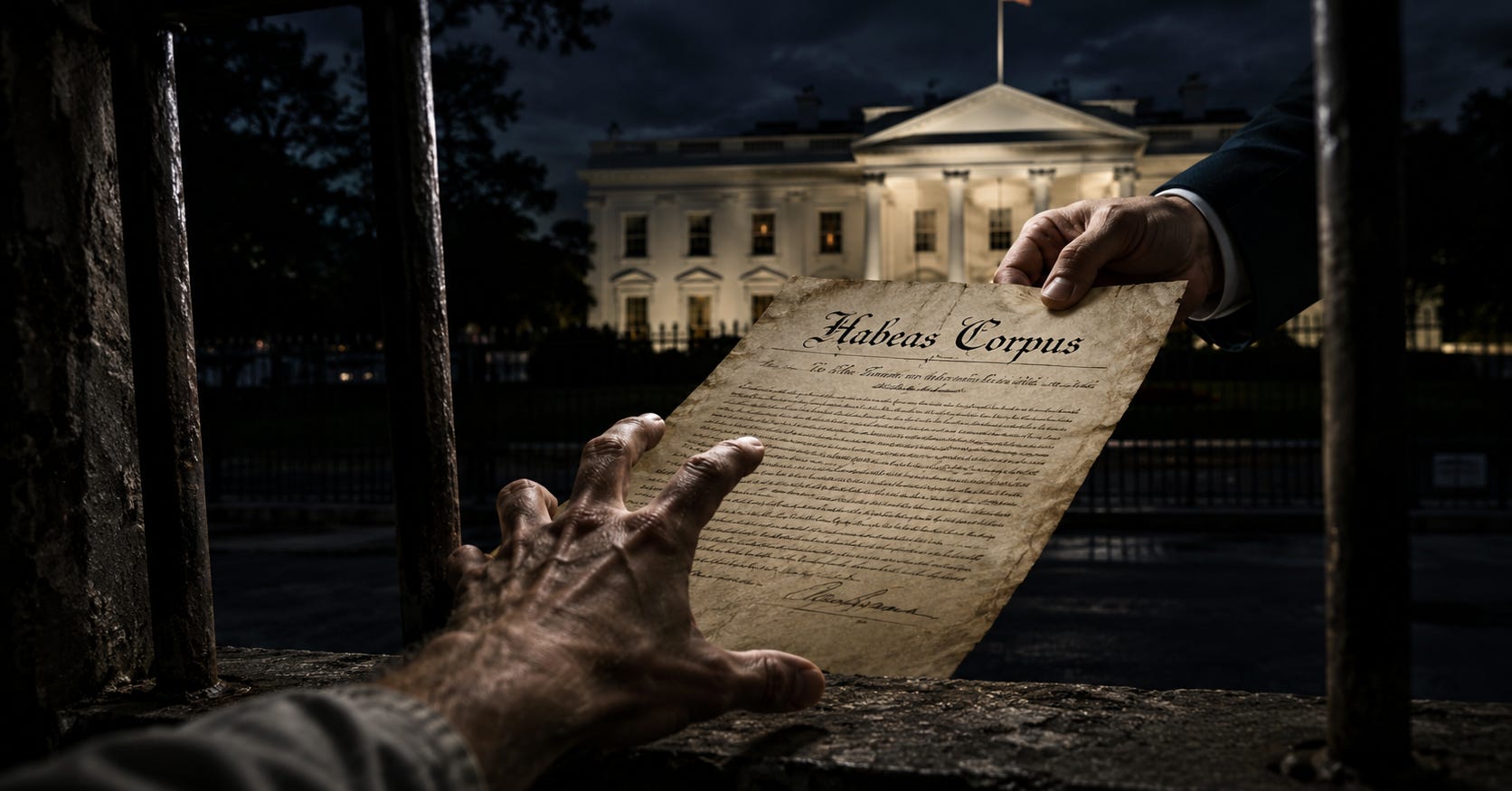
The Constitution Was Working
The Constitution was doing exactly what it was designed to do. The government detained people, claimed the power to remove them, and was forced to explain itself before a judge. People facing deportation used habeas corpus to challenge whether officials had correctly identified them, followed the law, and given them sufficient notice to defend themselves.
That was not a constitutional breakdown. It was constitutional accountability.
According to newly reported internal discussions and legal memoranda, senior Trump White House officials examined whether the president could suspend or weaken the mechanism that allowed those challenges to reach a court. Stephen Miller appears to have led the effort. Trump reportedly showed interest in Abraham Lincoln’s Civil War precedent. White House lawyers studied a power the Constitution permits only during rebellion or invasion when public safety requires it.
The administration was not confronting courts that had stopped functioning during a national collapse. It was confronting courts still capable of telling the president that speed did not erase due process and that an executive label was not proof.
The White House was not merely considering tougher immigration enforcement. It was exploring whether emergency language could weaken judicial review when it became inconvenient. Miller is the doorway, but the story is bigger than him. It is about an executive branch testing constitutional restraints while Congress failed to defend its authority with the urgency required.
Support independent media that follows the power.
The Coffman Chronicle is built to track who holds power, who abuses it, who profits from it, and who pays the price.
Paid supporters get full Tony Michaels Podcast episodes, deeper transcript analysis, paid columns, archives, and the reporting framework behind the show.
If you believe independent media has to survive outside billionaire platforms, corporate media, and party-approved gatekeepers, become a paid supporter today.
What the White House Reportedly Considered
The public already knew Miller had discussed suspending habeas corpus. The new reporting indicates that the idea went beyond rhetoric. It was studied inside the White House, reduced to legal memoranda, and serious enough to alarm Trump’s own lawyers.
On April 7, 2025, the Supreme Court ruled that people facing removal under the Alien Enemies Act must receive sufficient notice to seek habeas review. The Court did not say the government could not deport people lawfully subject to removal. It said the government could not move so quickly that a person lost the ability to challenge whether the law applied to them.
On April 29, White House staff secretary Will Scharf reportedly sent Chief of Staff Susie Wiles a confidential memorandum warning that suspension would collide with the Constitution and face grave legal obstacles.
Then, on May 9, Miller publicly confirmed that the administration was “actively looking at” suspension. He also suggested the decision could depend on whether courts did “the right thing.”
This sequence does not establish that Trump approved a final order, that suspension was imminent, or that every senior official supported Miller. Habeas corpus was not suspended.
However, this was more than a stray comment. Lawyers examined it, memoranda were written, and Trump reportedly showed interest in Lincoln’s example. Senior officials debated whether a power associated with one of the gravest emergencies in American history could overcome judicial resistance in an immigration campaign.
A constitutional power does not have to be successfully seized before Congress should care that the executive branch was testing the lock.
Make the Jailer Answer
Habeas corpus sounds like the kind of phrase lawyers use to make ordinary people stop listening. Its purpose is simple.
When the government takes away a person’s liberty, habeas corpus allows that person to demand an explanation before a judge. Officials must identify whom they are holding, name their legal authority, and defend their actions in a court that does not answer to the president.
It does not automatically free anyone. It does not erase immigration law or prevent lawful deportations. A judge may conclude that the detention and removal are legal, but the government still has to make the case.
That protection can be destroyed without a president formally announcing that habeas corpus has been suspended. A detainee can be transferred before a lawyer locates them, moved far from counsel, given notice too late to file a challenge, or removed before a court can intervene. A right that exists only after the government has placed the person beyond the court’s reach is not much of a right.
This is not an argument against enforcing immigration law. It is an argument that the government must follow the law while enforcing it. The executive branch does not get to decide that its accusation is also its proof.
Habeas corpus is individual power against concentrated government power. It gives one person, even an unpopular and politically powerless person, the ability to make the jailer answer to a judge.
The Courts Were Doing Their Job
The administration was not facing collapsed courts. It was facing judges who were asking basic questions.
Did the government identify the right person? Did the law actually apply? Was the detainee given enough notice to challenge removal? Would the government move someone beyond the court’s reach before a judge could review the case?
Those questions were not sabotage, but rather the reason an independent judiciary exists.
Miller’s suggestion that the administration’s decision could depend on whether courts did “the right thing” revealed the deeper conflict. Courts do not exist to produce the outcome the president considers right. They exist to determine whether the president and the agencies under his control have acted within the law.
A ruling against the executive is not proof that the judiciary failed. Legal review is not lawlessness, and due process does not become illegitimate because it disrupts a political timetable.
The White House reportedly considered weakening judicial review, not because the courts had stopped doing their job, but because they were still doing it.
Presidential frustration does not create an emergency. A court’s refusal to move at the speed of an administration’s agenda does not give the president new powers.
“Invasion” as a Gateway to Power
Words matter more when the Constitution attaches power to them. The Suspension Clause provides that habeas corpus may be suspended only in cases of rebellion or invasion, when public safety requires it. That makes the administration’s repeated description of migration as an “invasion” more than campaign rhetoric. The word can become an argument for authority that the president would not possess under ordinary conditions.
The pattern is familiar. A government declares an emergency, portrays legal safeguards as dangerous delays, and argues that power must move faster while answering to fewer institutions.
The habeas discussions fit a broader willingness to test emergency authority, including powers such as the Insurrection Act. That does not prove a completed plan, but it does show an administration repeatedly seeking exceptional powers when ordinary law imposes limits.
An emergency can be real. The Constitution recognizes that. However, a president cannot create extraordinary authority merely by choosing an extraordinary word.
Emergency language becomes dangerous when the person declaring the emergency also claims the power to decide which constitutional restraints survive it.
The Article I Power Congress Failed to Defend
The Suspension Clause appears in Article I. It is written as a restriction, not an express declaration that Congress alone holds the power. However, its placement, structure, history, and dominant legal interpretation point in the same direction: a president cannot decide that courts have become inconvenient and switch off judicial review.
Lincoln’s Civil War actions are often cited, but they do not create a blank check. He acted during an actual rebellion, then his unilateral authority was challenged, and Congress later authorized suspension. That disputed history cannot become a general presidential power to remove safeguards whenever review slows an administration.
A unilateral presidential suspension today would collide with the Constitution’s text, its placement in Article I, historical practice, and the overwhelming weight of legal authority. That should have triggered an institutional response from Congress.
Congress was not completely silent. Some lawmakers raised questions and challenged administration officials, but scattered comments are not the same as the people’s branch defending its constitutional territory.
Congress did not force the release of the memoranda, investigate how far the planning went, require officials to explain whether draft orders existed, or use its legislative and appropriations powers to block unilateral action.
Congress noticed the threat but failed to treat it as an institutional emergency.
The strongest reported warning came from inside Trump’s White House. That is not reassuring. The public should not depend on an internal lawyer quietly warning that a constitutional seizure would probably fail.
When Congress refuses to defend its power, it surrenders more than institutional prestige. It surrenders the people’s protection against concentrated executive authority.
The First Target Is the Easiest to Abandon
The first people placed at risk were immigrants and other noncitizens, making the proposal easier to sell because many Americans could believe the constitutional danger belonged to someone else.
However, the government’s label is not proof.
A person may dispute their identity, legal status, citizenship, alleged affiliation, or the applicability of the law to them. Those are the questions judicial review exists to answer. The government cannot label someone an illegal immigrant or a gang member and then use that same untested label as the reason no judge should hear them.
That does not mean every person facing deportation has a winning case. It means the executive branch should not be allowed to decide that its accusation settles the matter before an independent court examines it.
A suspension targeting immigrants would not automatically eliminate habeas corpus for every American, but the president would still be claiming something larger than an immigration policy: the authority to decide which people can be placed beyond meaningful judicial review.
Constitutional protections matter most when they belong to someone unpopular, powerless, or easy to ignore. The danger begins with the person the public is most willing to abandon. The precedent begins with the power the government claims while doing it.
What Congress Should Do Now
Congress does not defend the Constitution by waiting to see whether the president succeeds.
The reported discussions demand more than speeches, posts, and assurances that courts will handle it. Congress should obtain the memoranda, release what the law allows, and hold public hearings with White House, Justice Department, and Homeland Security officials. Lawmakers should determine who requested the analysis, how far it advanced, what Trump knew, and whether draft orders existed.
Congress should also investigate whether access to habeas was weakened in practice. Were detainees transferred without notice, removed before lawyers reached a court, or hidden from families and counsel? A right can be hollowed out through procedure without a formal suspension.
Congress should then draw a line in law: no president may suspend habeas corpus without express congressional authorization under the extraordinary conditions named in the Constitution. It should bar federal funds from being unilaterally suspended and require immediate reporting whenever an administration formally studies one.
Republicans should have to say whether they believe a Republican president may claim this power for himself. Democrats should have to prove that their concern extends beyond condemnation and fundraising language.
This is what Article I power is for. Hearings, subpoenas, legislation, and spending restrictions are not ceremonial tools. They exist so Congress can act before a constitutional threat becomes a completed fact.
Congress noticed the danger. Now it must show that noticing and defending are not the same thing.
The Constitution Cannot Depend on an Internal Memo
The Constitution was operating in courtrooms, forcing the executive branch to identify whom it detained, explain the law it used, and submit its accusations to an independent judge. It slowed power long enough for someone without power to be heard.
The administration encountered that restraint and began asking whether it could be removed. An internal memorandum may have helped stop or slow the idea, but the Constitution cannot depend on a single lawyer, a cautious official, or a private argument the public never sees. That is why Congress is essential.
A president should never be allowed to declare that courts have become inconvenient, call ordinary legal review an emergency, and decide for himself when the government no longer has to answer for taking away a person’s freedom.
Habeas corpus exists because liberty cannot depend on the jailer voluntarily admitting that he has gone too far. It makes the jailer answer to a judge.
Congress’s job is to make sure no president can switch off that answer simply because he does not like what the judge may say.
Support Independent Media
If this kind of independent, constitutional reporting matters to you, consider becoming a paid subscriber if you can afford to.
Paid subscriptions help keep the Coffman Chronicle free from party machines, corporate interests, and the pressure to soften the truth. They support the research, writing, and accountability work behind articles like this.
If a paid subscription is not possible, reading, sharing, and discussing the work still helps more than you know.
Sources:
A.A.R.P. v. Trump, 605 U.S. 91 (2025). Decided May 16, 2025.
Bomboy, Scott. “Four Cases When the Writ of Habeas Corpus Was Suspended.” Constitution Center, June 5, 2025.
Deese, Kaelan. “White House Lawyer Raised Alarms after Stephen Miller Floated Ending Habeas Corpus for Illegal Immigrants.” Washington Examiner, June 15, 2026.
Jennings, Elisabeth. “Early Edition: June 15, 2026.” Just Security, June 15, 2026.
Kinnard, Meg. “Kristi Noem Says Habeas Corpus Lets Trump ‘Remove People from This Country.’” Associated Press, May 20, 2025.
Library of Congress. “Suspension Clause and Writ of Habeas Corpus.” Constitution Annotated.
Trump v. J.G.G., 604 U.S. 670 (2025). Decided April 7, 2025.
U.S. Congress. House. “Suspending the Writ of Habeas Corpus.” Congressional Record 171, no. 82, May 15, 2025, H2080.
Weissert, Will. “Trump Team Mulls Suspending Habeas Corpus to Speed Deportations. Can It?” Associated Press, May 10, 2025.
Woodward, Alex. “Trump Team Wanted to Suspend Constitutional Right in Order to Deport More Immigrants, Memo Reveals.” The Independent, June 15, 2026.
Library of Congress. “Suspension Clause and Writ of Habeas Corpus.” Constitution Annotated. Article I, Section 9, Clause 2.
Lincoln, Abraham. “Abraham Lincoln to Erastus Corning and Others: Draft of Reply to Resolutions Concerning Military Arrests and Suspension of Habeas Corpus.” June 1863. Abraham Lincoln Papers, Manuscript Division, Library of Congress.
National Archives and Records Administration. “The Constitution of the United States: A Transcription.” Article I, Section 9.
Taney, Roger B. Writ of Habeas Corpus: Ex Parte Merryman. 1861. Library of Congress.
United States. “An Act Relating to Habeas Corpus, and Regulating Judicial Proceedings in Certain Cases.” March 3, 1863. 12 Stat. 755. GovInfo.
Where are the elected officials that have the balls or tits to defend the Constitution?? tRump is obviously not taking his oath seriously but neither are the people in Congress who are kissing ass so they can be one of the “chosen ones.” They certainly aren’t working for the people who elected them, they’re working for themselves. “We the People” need to wake up and elect people who are working for us, not themselves. November can’t come soon enough provided we can keep the Mango Monster and his ilk’s greasy hands out of the election. The only election fraud is the one they create themselves.
Come on. Get real. We already know that Trump wants to be dictator and he said exactly that. Dictators don’t need no habeas corpus to arrest citizens. Bondi already redefined domestic terrorists to mean that anyone who goes against Trump is UnAmerican. Most of us already know this scam and more and more voters are figuring this out. Do you think dudes like Putin and Xi mess around or bother with things like laws? If America wants a dictatorship many of us will leave rather than live under tyranny. Good luck.