


One Industry Was Paid to Leave
Within five days, the Trump administration showed Americans exactly what it means by “energy dominance.”
On June 17, the Interior Department announced an agreement to reimburse Invenergy $765 million in lease fees in exchange for surrendering four offshore-wind leases near New York, California, and Maine. The projects were still in their early stages, but the agreement removed them from America’s possible energy future. Interior said the same amount would instead be directed toward natural-gas power plants in five Midwestern states and geothermal projects in the West.
Five days later, the department proposed making it cheaper and easier for oil and gas companies to operate on federal land. The proposed rules would restore the statewide drilling-bond level from $500,000 to $25,000, shorten certain public-participation periods in oil-and-gas leasing from 90 days to ten, and roll back parts of the federal rules governing methane waste.
One industry was being paid to leave. Another was being charged less to enter.
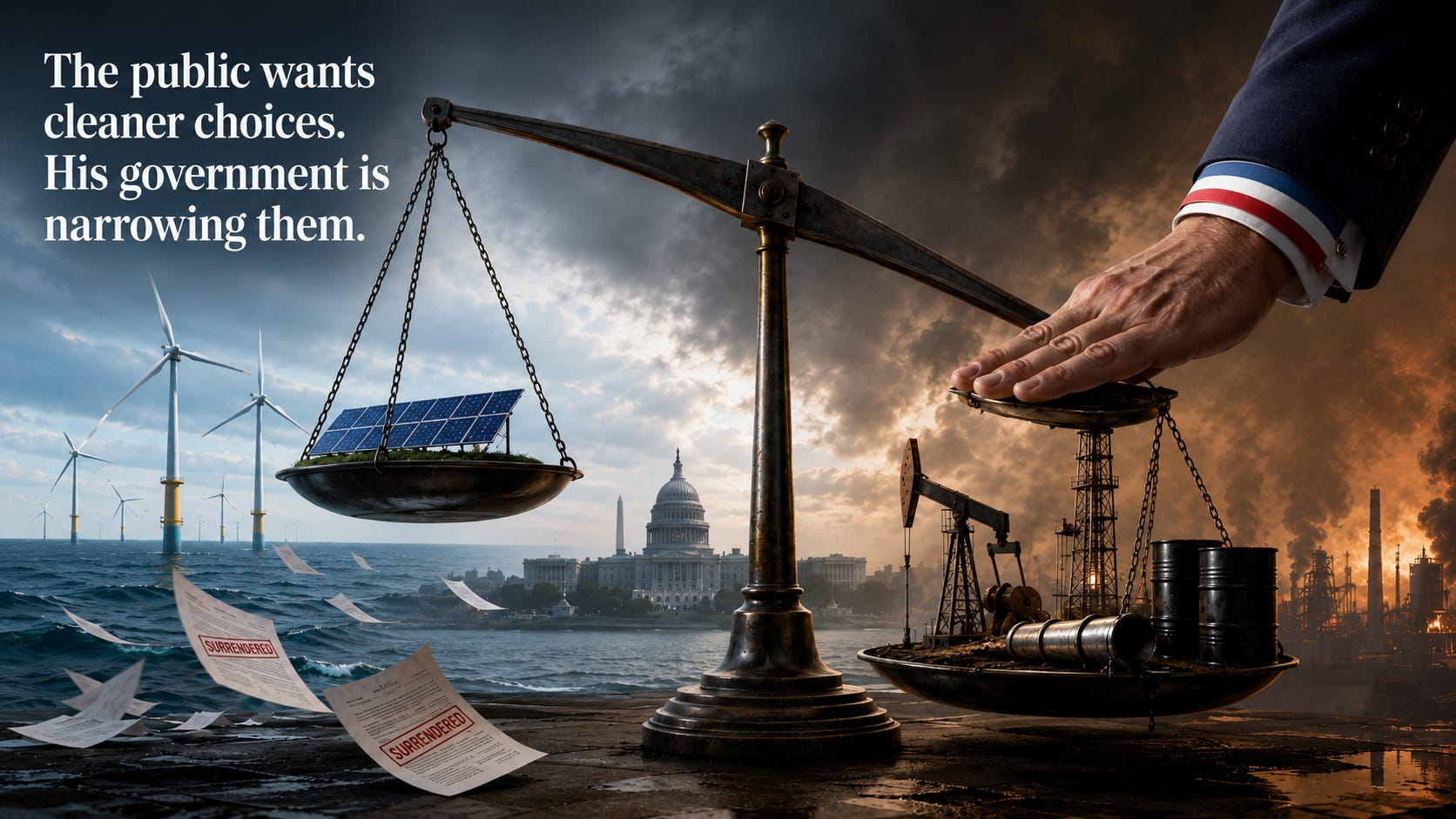
Donald Trump calls that energy dominance. But dominance is not competition, and this is not a government stepping aside so the market can decide. It is a government placing its money, regulatory authority, and political weight on one side of the scale.
An abandoned well does not become cheaper to plug because the company posts a smaller bond. Methane does not stop leaking because a rule is weakened. A family does not gain additional power to protect its land or water when a future participation period is reduced to 10 days.
The cost does not disappear. It moves from the company to the community, from the corporate balance sheet to the public cleanup bill, and from today’s political decision to tomorrow’s household burden.
Most Americans continue to say they want solar and wind expanded. They have not demanded an unreliable grid or an overnight end to fossil fuels. They are asking for more choices, cleaner options, and rules that do not change according to which industry the president prefers.
Trump is answering by reimbursing developers to surrender potential renewable projects while proposing lower obligations for oil and gas.
That is not energy freedom, but presidentially managed dependence.
Support independent media that follows the power.
The Coffman Chronicle is built to track who holds power, who abuses it, who profits from it, and who pays the price.
Paid supporters get full Tony Michaels Podcast episodes, deeper transcript analysis, paid columns, archives, and the reporting framework behind the show.
If you believe independent media has to survive outside billionaire platforms, corporate media, and party-approved gatekeepers, become a paid supporter today.
Industrial Policy in a Free-Market Costume
Trump presents his energy agenda as liberation from government interference. He promises faster approvals, fewer rules, and more freedom for American producers.
However, the government is not leaving the field. It is rearranging it.
Every major energy source operates within public decisions involving land, permits, infrastructure, tax policy, environmental standards, and access to the electric grid. There is no modern energy market untouched by government. The real question is whether the rules are applied fairly or bent toward the industries closest to political power.
Trump’s administration is terminating potential wind projects, subjecting renewable development to greater political scrutiny, and steering investment toward energy sources the president prefers. At the same time, it proposes lower costs, fewer obligations, and shorter procedures for oil and gas development.
That is not neutrality. It is industrial policy wearing a free-market costume.
Reliable power, efficient permitting, domestic production, and energy security are legitimate public goals. But those goals should produce consistent rules. A wind project should not face a political checkpoint that a drilling project is invited to bypass. Solar power should not be treated as an ideological threat while fossil-fuel development is presented as an act of patriotism.
Trump is not removing the government from the energy market. He is using the government to decide which industries receive an open door and which must pass through a political checkpoint.
That is not competition. It is favoritism backed by the power of the presidency.
What Americans Actually Want
Trump’s policy might reflect public demand if the country had clearly rejected renewable power and asked the federal government to clear the field for oil and gas.
It has not. Gallup’s March 2026 polling found that 66% of Americans wanted greater emphasis on solar power and 55% on wind. Only 37% said the same about oil, while 23% wanted greater emphasis on coal.
Pew found that 65% supported federal policies encouraging greater wind and solar production. Yale found that 68% of registered voters wanted the United States to use more renewable energy, including solar, wind, and geothermal. Fifty-six percent identified reducing air pollution as an extremely or very important reason for making that transition.
The support is neither universal nor as strong as it once was. The partisan divide has widened, and specific projects can create legitimate local arguments over land, wildlife, transmission, cost, and community benefit, but those concerns do not amount to a public demand to push solar and wind out of the market.
Americans have repeatedly said they want renewable energy expanded as part of a broader energy system. The public is asking for more choices. Trump’s administration is using federal power to narrow them.
The polling is not a mandate for an overnight revolution. It is a warning that the president’s agenda is moving further than much of the country asked him to go.
Solar and Wind Are American Energy
Trump’s rhetoric depends on a false division. Oil, gas, and coal are presented as American energy: strong, dependable, and patriotic. Solar and wind are treated as foreign intrusions or ideological experiments. However, sunlight falling on an American roof is American energy. Wind moving across an American farm is American energy. So are nuclear power, geothermal heat, hydropower, natural gas, and every other source capable of contributing to a reliable system under fair rules.
Solar and wind cannot replace every fossil fuel use tomorrow. They mainly produce electricity and compete most directly with coal and natural gas, not with most oil consumption. Petroleum provided less than 1% of American utility-scale electricity in 2025, compared with approximately 41% from natural gas and 17% from coal.
Reducing oil dependence requires more than constructing wind and solar projects. It also requires electrification, efficiency, transportation choices, storage, and a grid capable of moving more electricity where it is needed.
America still depends on fossil fuels, and workers and communities depend on the jobs, tax revenue, and infrastructure built around them. A serious transition must protect those people rather than treating them as acceptable losses.
Dependence today, however, is not a license to manufacture dependence tomorrow.
The country can maintain reliable power while building alternatives. It can protect workers while requiring companies to bear the costs they create. It can expand domestic production without treating renewable competitors as enemies of the nation.
Solar and wind are not foreign to the American energy system. They are part of the American energy future Trump is trying to narrow.
The Pollution Bill Never Disappears
Trump’s proposal would restore the statewide blanket bond available to oil-and-gas operators on federal land to $25,000, down from the current $500,000 level. On paper, that looks like a lower cost of doing business. In the ground, nothing becomes cheaper.
An abandoned well still has to be plugged, and leaking methane contained. Contaminated soil and water still have to be repaired.
The bond exists because companies are not always solvent or willing to complete the job. Some fail, reorganize, sell their interests, or disappear behind layers of subsidiaries while the well remains where it was drilled.
Reducing the bond does not erase that risk. It shifts more risk away from the company that created it and toward the public that may eventually inherit it. Trump is not eliminating the cost of pollution. He is making it easier for the company to leave before the bill arrives.
That bill may appear as a government cleanup program, contaminated groundwater, lost property value, a health problem, or another public priority delayed because money must be spent repairing private damage.
This is how concentrated power reaches the kitchen table. The company receives the lease and keeps the profit. The executive branch lowers the guarantee. The community is left wondering why private prosperity so often ends with a public cleanup invoice.
Renewable energy also entails environmental costs associated with land, wildlife, mining, manufacturing, transmission, and eventual disposal. Those industries should face honest rules and cleanup obligations, too.
Fairness does not require pretending that every industry creates identical risks. It requires making each one bear the real cost of the damage it can cause.
A government that reduces corporate responsibility is not lowering energy costs. It is hiding part of the price until someone with less power is forced to pay it.
Ten Days Is Not Meaningful Participation
The administration’s proposals themselves will receive a 60-day federal public comment period. The ten-day change concerns certain participation procedures that would govern future oil and gas leasing if the proposal becomes final.
A company seeking a lease may have spent months preparing with lawyers, engineers, consultants, and government contacts. Nearby residents may first learn what is happening after the clock has started. They must then understand technical documents, identify risks, consult experts, organize neighbors, and respond before the period closes. That is not equal participation.
A ten-day period may be convenient for the company already prepared to act. It is not meaningful participation for people who must live with the decision long after the paperwork is approved. Speed becomes a form of power when only one side is prepared to use it.
This is how democratic control can be weakened without being formally abolished. The public is told that it still has a voice. The notice is published, the right to respond survives on paper, but the procedure is compressed until that right becomes much harder to use.
Public participation is not pointless red tape. It is one of the few opportunities ordinary people may have to challenge a decision before the consequences become permanent.
The people carrying the risk should not be rushed into silence so the company can move faster.
Energy Dominance for Whom?
“Energy dominance” sounds like a promise that America will control its own future, but the phrase avoids an important question: Who gets to do the dominating?
Oil, gas, and coal are not merely fuels. They operate through systems of ownership that involve extraction, pipelines, refineries, utility agreements, and companies with sufficient capital and political access to influence the infrastructure linking the resource and the customer. Renewable energy can become concentrated, too. A giant solar installation owned by an investment fund is not automatically democratic, and a utility-scale wind project can leave its surrounding community with little control or benefit.
However, rooftop solar, community projects, rural cooperatives, storage, and microgrids can create more points of entry. They can generate power near the people who use it, strengthen resilience, and give households or communities more control over their energy choices.
They do not eliminate the need for a larger grid or major utilities. They can, however, reduce the notion that every customer must remain entirely dependent on fuel and infrastructure controlled elsewhere.
Trump’s hostility toward renewable energy is therefore larger than a disagreement over technology. His agenda protects an energy structure built around concentrated ownership and industries already skilled at turning economic power into political access.
Energy dominance sounds patriotic until the public asks who is doing the dominating. A country with more sources, more competition, and more local control is not weaker. It is harder to corner, harder to manipulate, and less dependent on decisions made by a few companies or one president.
Trump says he is defending American energy. He is also defending the concentrated power that comes with controlling it.
Reliability Is a Real Problem, Not a Fossil-Fuel Veto
Trump’s strongest argument is the one renewable-energy advocates should not wave away. The sun does not shine at night. Wind production rises and falls. Storage remains limited in many places, transmission projects take years to build, and electricity demand is growing as data centers, factories, vehicles, heating systems, and expanding communities place new pressure on the grid.
Reliability is not a fossil-fuel talking point. It is a public obligation.
A serious transition cannot rest on solar and wind alone. It requires transmission and storage, stronger connections between regional grids, efficiency, and dependable sources that can supply electricity when demand rises and renewable output falls. Nuclear power, hydropower, geothermal energy, and some natural gas will remain part of that discussion.
However, acknowledging the reliability problem does not justify using it as a veto against competition from renewables. Intermittency is an engineering challenge to solve, not an excuse to cripple the competition.
Congress and federal regulators should address transmission and storage, large new electricity loads, and the slow process of connecting generation to the grid. They should create more effective rules without silencing communities or exempting favored industries from responsibility. Reliability requires planning. It does not require permanent obedience to the industries already holding the market.
A reliable grid and a cleaner energy system are not opposing goals. The failure is that the government is refusing to do the work required to build both.
The Public Can Pay Twice
The federal government is giving up $765 million in offshore wind lease revenue in exchange for the surrender of four potential projects, while proposing to reduce the financial guarantees available to oil-and-gas operators if they fail to complete their cleanup responsibilities. That creates the possibility of a lopsided bargain.
The public can lose once when the government returns lease revenue to remove a potential competitor and again if a reduced bond fails to cover an abandoned well or another cleanup obligation.
Not every wind lease would have produced a successful project, and not every drilling company will abandon its responsibilities, but public revenue and public risk should not be redirected without public scrutiny.
Congress should determine how the reimbursement was calculated, what legal authority supports the agreement, what conditions were attached, and why surrendering those leases serves the public interest. It should also determine whether the proposed bond levels would adequately protect taxpayers if an operator fails.
The public should not be required to finance the removal of one energy source and then insure another against the cost of its own mistakes.
When the government chooses the winner, the public deserves to see the scorecard, the rules, and the bill.
Congress Should Not Be an Energy Spectator
Trump is making these decisions, but Congress helped create the space in which he can make them.
National energy policy is increasingly shaped by executive orders, agency directives, permitting decisions, lease settlements, and regulatory reversals that shift with changes in White House control. One administration encourages a project. The next obstructs it. One strengthens a safeguard. The next proposes weakening it.
That is not a stable energy strategy. It is government by presidential preference.
Congress controls federal spending and writes the laws governing public lands, pollution, interstate commerce, taxation, and energy infrastructure. It can investigate how federal revenue is used, determine whether agencies are treating competing industries fairly, and establish rules that outlast any one president.
It should demand a full accounting of the offshore wind agreements. It should examine whether the proposed drilling bonds can cover realistic reclamation costs, whether ten-day participation periods allow meaningful public involvement, and whether changes to methane rules would shift costs toward communities and taxpayers. However, hearings alone are not enough.
Congress should write durable standards for permitting, cleanup guarantees, public participation, transmission development, grid reliability, and community compensation. Those rules should be based on the risks and benefits of each project, not the president’s preference.
A president should not be allowed to write national energy policy one permit, lease, settlement, and executive order at a time. Republicans who claim to believe in free markets should explain why the government is reimbursing companies to surrender potential competitors. Democrats should do more than issue statements and post outrage. They should demand records, force hearings, propose legislation, and put members on the record.
Congress should not be an energy spectator. When Congress gives up power, the people lose power, and the industries closest to the executive branch gain it.
One Side of the Scale
Within five days, the Trump administration agreed to reimburse an energy company for surrendering offshore wind leases and proposed making federal oil and gas development cheaper and less burdensome. That sequence tells the story more clearly than any slogan.
The government was not stepping aside. It was choosing which projects should disappear, which industries should face lower obligations, and which communities could receive less time to participate.
America still needs oil, gas, and dependable electricity. Workers and communities built around those industries deserve respect, economic security, and a transition that does not discard them. Families deserve confidence that their lights will stay on and the power system will remain reliable.
None of that requires the federal government to remove renewable competitors, weaken cleanup guarantees for drillers, or compress future participation until ordinary people can barely use it.
Americans are demanding the freedom to build what comes next. That future should include reliable power, cleaner generation, stronger transmission, honest cleanup requirements, fair treatment across industries, and enough local control that communities receive more than pollution and promises.
Trump says he wants the government out of the way, but the government is not out of the way. It is standing on one side of the scale.
The question is not whether America will produce energy. It will. The question is whether the public will be allowed to choose its energy future, or whether one president and the industries closest to him will choose it for us.
Support Independent Media - The Coffman Chronicle
The Coffman Chronicle follows concentrated power to the point where it reaches your home, your rights, and your wallet.
If you can afford to become a paid subscriber, your support helps keep this work independent and gives us the time to follow the receipts. If a paid subscription is not possible, reading, sharing, and discussing this article still helps build the rebellion from home.
Sources:
Federal Energy Regulatory Commission. “FERC Launches Aggressive Targeted Action to Speed Large Load Integration.” June 18, 2026.
Gallup. “Less Support in U.S. for Solar, Wind Energy; More for Nuclear.” April 22, 2026.
Pew Research Center. “Americans’ Shifting Views on Energy Sources, Policy in 2026.” April 3, 2026.
Reuters. “US Proposes to Slash Costs for Energy Drillers on Federal Lands.” June 22, 2026.
U.S. Department of the Interior. “Interior Announces New Energy Agreement to Strengthen American Energy Security and Lower Costs.” June 17, 2026.
U.S. Department of the Interior. “Interior Department Takes Steps to Modernize Oil and Gas Leasing on Public Lands, Ensure Fair Return to Taxpayers.” July 20, 2023.
U.S. Department of the Interior. “Interior Unlocks Funds for Orphaned Well Clean Up.” May 29, 2026.
U.S. Energy Information Administration. “Electricity in the United States.”
Yale Program on Climate Change Communication. “Climate Change in the American Mind: Politics & Policy, Spring 2026.” June 2026.
Like all fascist dictatorships Trump controls the markets available to consumers, controls consumer purchases and funnels the money to his big oil donors. This is absurd and must be stopped. Senator Murphy recently outlined the hundreds of billions of dollars of this grift of public monies by Trump. Congress must act now! We all need to remember this is the last big money steal from citizens so they will just keep grifting unless we stop them. They will weaken our country and sell it to foreign investors. In particular the oil barons of the Middle East.