


He Knows Congress Has Power
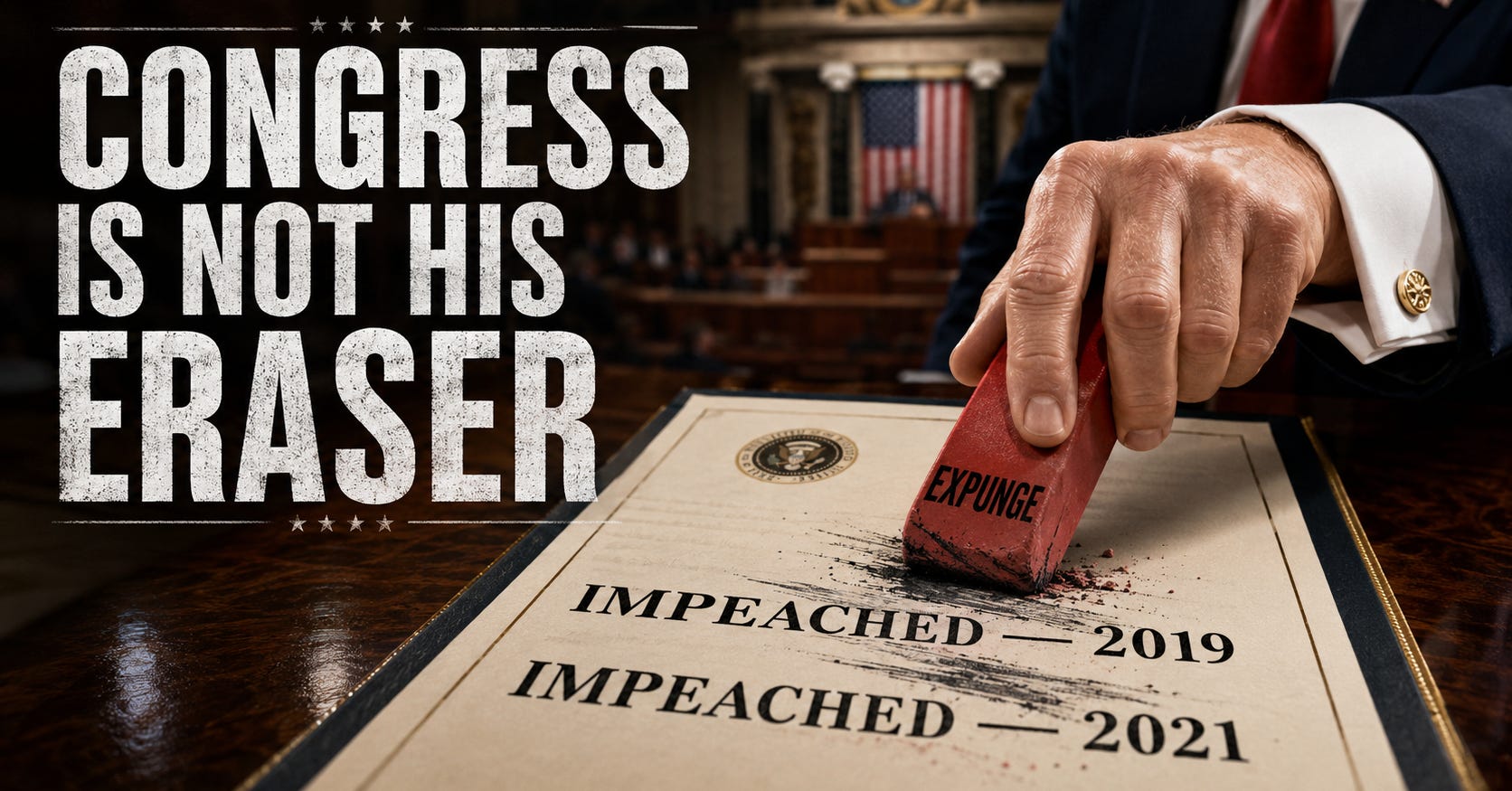
Donald Trump is asking the House of Representatives to do something no vote can actually accomplish: make his two impeachments disappear.
Trump and his allies are pressing House Republicans to advance a resolution declaring those impeachments expunged, as though the articles had never passed. The votes would still exist. The Senate trials would still exist. The congressional record would still exist. History would remain exactly where Trump left it.
However, legal reality may not be the point. A resolution from the House would give Trump an official declaration he could hold up as vindication. His allies could say Congress cleared his record, even though a later House cannot retroactively undo votes cast by an earlier one. The resolution would have little legal force, but it would let Trump borrow the House’s authority for his own political story. That is why he wants it.
Trump does not want Congress to be weak when its authority can benefit him. He wants lawmakers to find the resolution, make room on the calendar, cast the votes, and stamp the House’s name on his version of events.
Congress often claims helplessness when asked to restrain presidential power, enforce subpoenas, debate military action, oversee public money, or reclaim authority it surrendered to the executive branch. Ordinary people are told that the process is complicated, that the votes are not there, or that nothing can be done. Yet when a powerful president wants a personal favor, Congress suddenly remembers that it has hands.
Trump is not asking Congress to surrender its power. He is asking Congress to use its power on his behalf.
Will the people’s branch remember that its power belongs to the people?
Support independent media that follows the power.
The Coffman Chronicle is built to track who holds power, who abuses it, who profits from it, and who pays the price.
Paid supporters get full Tony Michaels Podcast episodes, deeper transcript analysis, paid columns, archives, and the reporting framework behind the show.
If you believe independent media has to survive outside billionaire platforms, corporate media, and party-approved gatekeepers, become a paid supporter today.
Congress Cannot Vote History Out of Existence
The word expunge does a great deal of work here. It suggests that Congress can wipe the slate clean and return Trump’s record to what it looked like before the House impeached him. That is not what a new resolution would do.
The Constitution gives the House the sole power to impeach and the Senate the sole power to conduct impeachment trials. It does not provide a process through which a later House can reverse an impeachment completed by an earlier one.
The current House may declare that it believes Trump’s impeachments were unjustified, politically motivated, or badly handled. Members may criticize the evidence, condemn the process, and defend Trump as forcefully as they choose. However, they cannot change the record.
Those events belong to the constitutional history of the country, not to whichever party happens to control the House today.
That is why the proposed resolutions rely on the phrase “as if” the articles had never passed. Those two words reveal the weakness of the exercise. Congress would not be erasing history. It would be asking the public to pretend.
The House may declare that the impeachments should not have happened, but it cannot legally declare that they did not happen.
Trump Wants More Than Political Loyalty
Republican lawmakers already defend Trump on television, at rallies, and in committee hearings. He is asking for something more valuable than another statement of support. He wants the House itself to act.
A party spokesperson can offer political messaging. A House resolution becomes an official act of a public institution. It enters the congressional record, carries the weight of a vote by elected representatives, and gives Trump a declaration bearing the name of the people’s branch.
An expungement resolution would not undo the impeachments, but it could help manufacture the appearance that Congress had cleared him. It would give his supporters language they could repeat as though the institution itself had settled the matter.
That is more than symbolism. It is symbolism wearing the seal of government.
Trump wants public time and authority spent settling a private political grievance.
He does not want a powerless House. He wants a House that becomes strong when it protects him and quiet when it might restrain him.
The People’s Branch Is Not the President’s Personal Staff
Members of Congress do not work for Donald Trump. They do not receive their authority from the White House. They are elected separately, sworn separately, and entrusted with powers the Constitution deliberately placed outside the presidency. Their job is not to carry out a president’s personal wishes. Their job is to represent the people and defend the independence of their own branch.
Party loyalty does not erase that responsibility.
Republican members are free to believe Trump’s impeachments were unjustified. They may argue that Democrats abused the process, criticize the evidence, defend his conduct, or explain why they opposed both proceedings.
However, there is a difference between defending Trump’s record and using the House to manufacture a cleaner one. An expungement resolution would turn the House from an independent branch into a vehicle for presidential vindication. Instead of checking executive power, lawmakers would be using public authority to serve the personal needs of the person who holds it.
Congress is not the president’s legal team, his public-relations office, or his personal record-cleaning service. The House belongs to the people who elected its members, including those who support Trump, those who oppose him, and those who are exhausted by watching every public institution become another stage for one man’s grievance.
A coequal branch does not prove its loyalty by rewriting its own history for the president. It proves its independence by remembering that its oath runs to the Constitution, not to the person sitting in the Oval Office.
Congress Finds Its Hands When the Powerful Want Something
Congress has spent years teaching Americans to expect less from it. When presidents stretch war powers, lawmakers say the situation is complicated. When administrations impose tariffs or invoke emergency authority, members complain about the consequences while avoiding responsibility for reclaiming the power they delegated. When executive officials resist subpoenas, congressional outrage often fades before accountability arrives.
Ordinary people hear the same explanations. The votes are not there. The process takes time. Leadership controls the schedule. The courts may have to decide.
Then a president wants his personal record polished. Suddenly, congressional action becomes easier to imagine. Resolutions are drafted. Lawyers hold discussions. Leadership considers options. Members debate how the House might place its official voice behind the president’s preferred version of events.
That contrast is the real indictment.
Congress faces narrow majorities, procedural barriers, divided government, and genuine constitutional limits. Yet those obstacles do not explain why lawmakers so often become most creative when the powerful demand action and most cautious when action would require confronting them.
A family paying higher prices may be told that Congress cannot control every tariff decision. A military family may be told that lawmakers cannot manage every overseas commitment. But when Trump asks Congress for a symbolic favor, no one begins by saying the institution is powerless. Congress finds its hands when the powerful want something, then loses them when ordinary people need help.
The issue is not that lawmakers lack authority, but rather that they are selective about when they are willing to use it, and whose interests are important enough to make them try.
The Real Test Belongs to House Republicans
Trump can ask Congress for anything, but the constitutional responsibility lies with the lawmakers who decide whether to grant it.
That is why this story cannot end solely with presidential ego. The real question is whether House Republicans see themselves as independent representatives or as instruments for carrying out Trump’s personal demands.
At the moment, the expungement effort remains a pressure campaign. No floor vote has been formally scheduled. The House has not yet taken the action Trump wants. However, the absence of a scheduled vote does not make the request meaningless. It gives Republican members time to decide what kind of institution they believe they serve.
Will they spend congressional attention and credibility trying to rewrite Trump’s record? Will they treat the House as a platform for presidential vindication? Or will they remember that Congress exists to exercise independent judgment, even when the president demanding loyalty belongs to their own party?
The test is especially revealing because the same members are often reluctant to challenge executive power when the stakes involve war, tariffs, emergency authority, public spending, or oversight. Would they show the same urgency in defending Congress’s constitutional powers? Would they move as quickly to enforce subpoenas, debate military action, or protect the public’s money?
Trump’s request is revealing. Congress’s answer will be the constitutional test.
This Is Not About Relitigating Both Impeachments
Readers do not have to agree with either impeachment to understand the danger in pretending they never happened. A person may believe one proceeding was rushed, the other was partisan, or both were constitutionally weak. Congress can debate the evidence, criticize the process, and judge previous majorities harshly. What it cannot honestly do is erase the fact that the House voted.
That principle must hold no matter which party controls the chamber. A future Democratic House should not be able to declare that a Republican Congress never exercised a constitutional power simply because the new majority rejects what happened. A Republican House should not create that precedent for Trump.
Self-government depends on an honest public record. Institutions lose credibility when they stop distinguishing between changing a judgment and changing a fact.
Congress can say an impeachment was wrong. It can call it abusive, reckless, or politically motivated. It can even apologize for it, but it should not ask the country to participate in a fiction.
You do not have to defend an impeachment to oppose pretending that it never happened. A republic cannot learn from its history if every new majority is allowed to rewrite the parts its leader finds inconvenient.
Congress’s Power Belongs to the People
Trump’s request reveals something Americans have been trained to forget: Congress still has power. Its votes create official records. Its hearings can expose misconduct. Its spending decisions can restrain presidents. Its laws can reclaim authority that earlier Congresses surrendered.
The problem is not that Congress lacks tools. The problem is that too many members act as though those tools are available only when presidents, parties, donors, or powerful interests demand their use.
If House Republicans can find time to debate whether Trump’s impeachments should be treated as though they never happened, they can find time to debate war, tariffs, emergency authority, executive overreach, and the public’s money.
Congress should not become powerful only when the powerful need a favor.
Trump is not asking Congress to surrender its power. He is asking Congress to use its power on his behalf. The people should ask why their representatives so rarely use that same power on their behalf.
History does not belong to Donald Trump. Congress does not belong to Donald Trump. The power of the people’s branch was never meant to become the personal property of the president.
Support Independent Media
The people’s branch only works when the people refuse to let it become the president’s branch.
If this article gave you a clearer understanding of what is happening, share it with someone who still believes Congress is powerless. And if you can afford to become a paid subscriber, your support helps The Coffman Chronicle keep doing this work—following the power, explaining the Constitution, and asking who government is really serving.
Sources:
Reuters. “Trump, Allies Working on Plan to Void His Impeachments, WSJ Reports.” June 11, 2026.
“H.Res. 24—Expunging the December 18, 2019, Impeachment of President Donald John Trump.” 119th Cong., 1st sess. Introduced January 9, 2025. Congress.gov.
“H.Res. 24—Expunging the December 18, 2019, Impeachment of President Donald John Trump: Actions.” 119th Cong., 1st sess. Congress.gov.
“H.Res. 25—Expunging the January 13, 2021, Impeachment of President Donald John Trump.” 119th Cong., 1st sess. Introduced January 9, 2025. Congress.gov.
“H.Res. 25—Expunging the January 13, 2021, Impeachment of President Donald John Trump: Actions.” 119th Cong., 1st sess. Congress.gov.
“H.Res. 755—Impeaching Donald John Trump, President of the United States, for High Crimes and Misdemeanors.” 116th Cong., 1st sess. Enrolled December 18, 2019. Congress.gov.
“H.Res. 24—Impeaching Donald John Trump, President of the United States, for High Crimes and Misdemeanors.” 117th Cong., 1st sess. Agreed to January 13, 2021. Congress.gov.
U.S. Congress. Library of Congress. Constitution Annotated. “Overview of Impeachment.”
U.S. Congress. Library of Congress. Constitution Annotated. “Overview of Impeachment Trials.”