


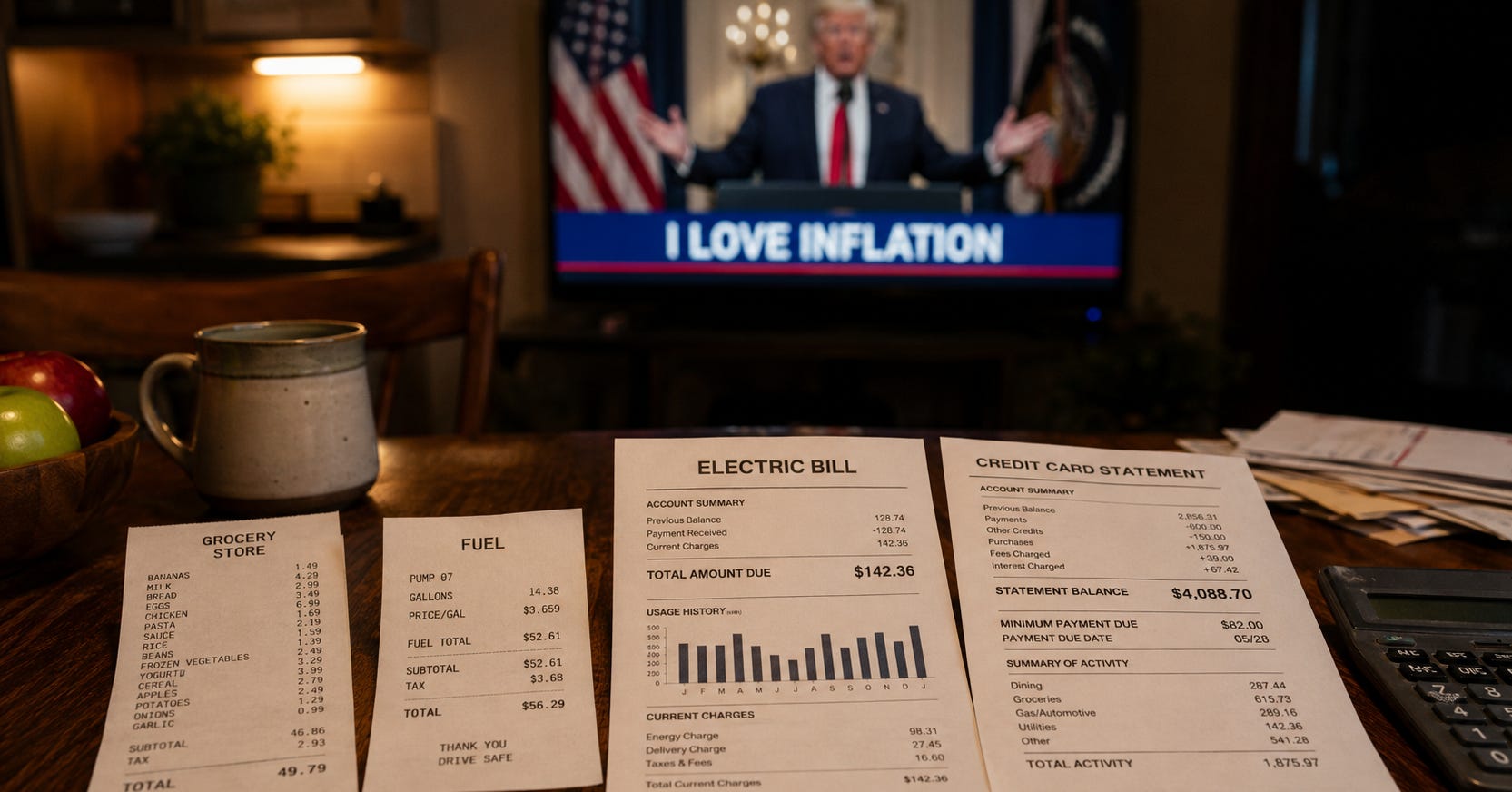
Donald Trump said he loves inflation.
That sentence should not disappear into the daily pile of strange things powerful people say. It should land like a grocery receipt on the kitchen table, like a gas pump that keeps climbing after you hoped it would stop, and like an electric bill that arrives before the paycheck has caught its breath, because inflation is not just a word when you are paying it.
For Trump, inflation can be an answer at a microphone, a number to frame, a headline to fight over, and a moment to explain away before the next question. Reuters reported that when Trump was asked about inflation rising above 4 percent, he answered, “I love the inflation,” and argued that prices would come down once the war in Iran ends.
Families do not get to move on that easily. They meet inflation in the grocery aisle, at the pump, when the utility bill arrives, when the credit card balance will not shrink, and when the raise that was supposed to help gets eaten before it reaches the kitchen table.
Trump makes viral, unhinged comments all the time. The problem is not only the words. The problem is the distance behind them. Powerful people treat household pain like a messaging problem. Working people experience it as a math problem.
The rent does not wait for context. The gas tank does not wait for a press conference. The grocery store does not lower the total because someone in Washington found a way to spin the numbers.
A president can love the story he is telling about inflation. Families have to live with the price. That is where this story begins.
Support independent media that follows the power.
The Coffman Chronicle is built to track who holds power, who abuses it, who profits from it, and who pays the price.
Paid supporters get full Tony Michaels Podcast episodes, deeper transcript analysis, paid columns, archives, and the reporting framework behind the show.
If you believe independent media has to survive outside billionaire platforms, corporate media, and party-approved gatekeepers, become a paid supporter today.
The Numbers Are Not Mysterious. They Are Painful.
The easy version of this story is that Trump said something reckless and insulting. That version is true and all too familiar, but it is too small.
The bigger issue is that he could say it so casually. For people at the top, inflation can be blamed, defended, reframed, or spun into proof that the larger plan is working. For everyone else, inflation is subtraction. It subtracts from groceries, savings, repairs, prescriptions, credit card payments, and whatever small cushion a family had left.
Washington gets time to explain. Families get due dates.
The Bureau of Labor Statistics reported that consumer prices rose 4.2% over the 12 months ending in May. Energy prices rose 23.5% over that same period, and gasoline rose 40.5%. Costs tied to transportation, housing, medical care, and other daily needs kept pressing on household budgets.
Energy costs move through everything. Gasoline is the cost of getting to work. Diesel is the cost of moving goods. Electricity is the cost of keeping the lights on. Natural gas is the fuel for heating homes, powering businesses, and keeping parts of the economy moving. When energy rises, the pressure spreads into food, delivery costs, utilities, small businesses, and the basic price of getting through the week.
Inflation is often discussed like an average, but families do not live an average life. They live their own bills. A number that looks manageable from Washington can be devastating when it lands on a household that was already stretched.
The number does not have to destroy the economy to damage a family. It only has to take away the margin they had left.
When wages do not keep up, the damage gets worse. A paycheck can look the same on paper while shrinking in real life. The hours are still worked, and the money still arrives, but more of it disappears before the family can breathe.
That is the quiet cruelty of inflation. It turns effort into less. It transforms a raise into a wash. It morphs stability into another month of juggling. People can work the same job, pull the same hours, and still lose ground because the money no longer carries them as far.
When Trump says he loves inflation, the answer from millions of households is simple. Look at the receipt.
War Does Not Stay Overseas
War does not stay overseas when the bill reaches the gas pump.
That is the part Washington loves to separate. Foreign policy is treated as one conversation, inflation as another, and household budgets as something ordinary people are supposed to figure out on their own. Families live where all of it collides.
A war can begin as a speech about strength, strategy, deterrence, or national security. Then, oil prices move. Gas prices soar. Shipping costs rise. Airline fares explode. Fertilizer costs move. Businesses pay more to transport goods, power buildings, stock shelves, and keep the doors open. Eventually, those costs fall on the people with the least ability to absorb them.
That does not mean every price increase has one cause. The real economy is messier than that. However, when a president talks about war as if the consequences will remain contained, they rarely do.
Energy is not just another line in an inflation report. It is the bloodstream of the economy. When it gets more expensive, the pressure moves through everything else.
The family filling the tank before work is not debating geopolitical theory. The small business owner paying a higher delivery bill is not grading the administration’s messaging. The parent staring at a grocery total is not comforted by the promise that prices might come down later. They are paying now.
A paycheck does not care about the excuse. It only knows what it can buy.
That is why presidential power cannot be treated like a solo performance. When one person’s decisions can ripple through oil markets, energy prices, business costs, and family budgets, the public deserves debate before the damage spreads.
That is not foreign policy staying overseas. That is power coming home as a receipt.
This Is Why the People’s Branch Exists
This is why the people’s branch exists. Congress was not created to sit in the cheap seats while a president makes decisions that can raise prices, shake markets, disrupt energy costs, and leave families paying for consequences they never got to debate. It was not created to issue statements after the fact, complain on television, or wait until the damage shows up in polling.
Congress is supposed to be where national decisions meet public accountability. War, spending, energy policy, and oversight are not abstract powers. They are household powers. They decide what gets funded, what gets ignored, who gets questioned, who gets protected, and who gets handed the bill.
When Congress does its job, a president has to explain more than the slogan. He has to explain the cost, defend the plan, answer for the risk, and face questions before the public is told to trust him and absorb the consequences later.
When Congress disappears, the president gets the decision, the camera, and the spin. Families get the receipt.
The branch closest to the people is supposed to force public debate before public cost. It should ask what a war will do to oil prices before families see the damage at the pump. It should ask what energy shocks will do to farms, small businesses, shipping, utilities, and groceries before working people are told the pain is temporary.
Congress cannot stop every global shock, but it can refuse to let one person control the story while everyone else pays the price. It can hold hearings, demand numbers, force answers, and make the administration explain what families are being asked to carry.
That is where concentrated power becomes real. A president can move markets, corporations can pass costs down, banks can charge higher interest rates, and landlords can raise rent. Congress can act shocked after the fact. Each piece has its own explanation, but the family budget receives them all at once.
Inflation takes decisions made far away and makes them intimate. The war room becomes the gas receipt. The corporate earnings call becomes the grocery total. The interest-rate debate becomes the credit card payment. The congressional failure becomes the silence that follows once the bill arrives, and nobody in power wants to own it.
If the people’s branch refuses to stand between presidential power and public cost, inflation becomes more than an economic problem. It becomes a democracy problem.
Concentrated power always finds a way to become someone else’s bill.
Congress Should Not Be a Comment Section
Trump did not run as a man who would explain inflation better. He ran as a man who would beat it. Voters were not promised a clever answer at a microphone. They were promised relief. They were told prices would come down, paychecks would stretch further, energy would get cheaper, and the people in charge would finally understand what families were paying.
Now the story has changed. Now, when inflation rises, it is temporary. When energy prices climb, there is a reason. When gasoline gets more expensive, the pain will supposedly pass. When families feel squeezed, they are told to wait for the strategy to work. When the numbers look bad, the president can still call them great.
That is not relief. That is a new excuse wearing the old promise as a disguise.
A president does not get to campaign on the grocery bill and then govern as if the grocery bill were a public-relations inconvenience.
However, Congress does not get to hide behind the quote either. Congress should not be a comment section. It should not exist to react to presidential clips, post outrage, fundraise off the latest insult, and wait for the next headline to replace the last one. That is not oversight or governing.
If inflation is being driven or worsened by war, energy disruption, executive decisions, corporate pricing, or supply shocks, Congress should be demanding answers in public. It should be asking what the administration knew, what risks it weighed, what costs it expected, and what plan it had before families were told to absorb the damage.
Republicans do not get to protect a president from scrutiny because he is their president. Democrats do not get to stop at the easy sound bite and pretend posting the quote is the same as confronting the power behind it. Both parties know how to turn pain into messaging. The question is whether either party is willing to turn pain into oversight.
The difference between outrage and oversight is simple. Outrage says, “Can you believe he said that?” Oversight says, “What did your decisions cost the people, and who benefited while they paid?” One is noise. The other is power.
Congress was not created to be the president’s audience, but to be the people’s check on power. If lawmakers cannot remember that while families are paying more for gas, groceries, utilities, credit cards, and basic survival, then they are not just failing to answer a quote. They are failing to answer the people.
Public Debate Before Public Cost
The demand here is not complicated. If the public is going to pay the cost, the public deserves a debate before the bill arrives. That means hearings before excuses. Questions before spin. Accountability before the pain gets normalized.
Congress should be asking what the war is doing to energy prices, what the administration expected would happen to oil, gas, shipping, utilities, and consumer costs, and whether families were considered when the strategy was built.
It should also inquire into what corporations are doing in this moment. A crisis can create real costs, but it can also create cover. If families and small businesses are being told to sacrifice, corporations should be asked what they are taking.
That is not anti-business, but pro-accountability.
Public debate does not solve everything. It does not magically lower prices overnight. However, silence solves nothing. Spectatorship and party loyalty solve nothing. A Congress that waits until families are already hurting has already failed the first test.
Do not ask families to respect the strategy if nobody in power will respect the cost. Do not ask workers to trust the plan if their paychecks are losing ground while leaders explain why the numbers are fine. Do not ask the public to absorb the damage quietly while those in power protect themselves from blame.
Public debate before public cost. Accountability before spin. Receipts before excuses.
He Can Love the Spin. We Live the Price.
Trump can love inflation if what he really loves is the story he thinks he can tell about it. He can love the answer, the fight with reporters, the chance to say the numbers are great, the pain is temporary, the strategy is working, and relief is coming later.
Families do not get to love inflation. They get to budget around it. They get to stretch groceries, delay repairs, carry balances, work the same hours for money that buys less, and sit at the kitchen table wondering what can be moved, skipped, postponed, or sacrificed this month.
That is the difference between power and consequence. Power gets the microphone. Consequence gets the due date.
The quote was not just an ugly sentence. It was a window into the distance between the people who explain pain and the people who live inside it. It showed how easily a president can turn household pressure into political performance while the branch closest to the people struggles to remember its own job.
The people’s branch exists for moments like this. Public costs should not arrive before public debate. Congress exists because presidents should not get to make decisions, shape the message, blame the fallout, and leave families to make the math work.
Trump said he loves inflation. The rest of the country has every right to answer from the checkout line, the gas pump, the utility bill, the credit card statement, and the paycheck that no longer stretches far enough.
The president got the sound bite. Families got the bill. Congress should stop pretending that is good enough.
Support Independent Media
If this piece hit home, share it with someone who is tired of watching powerful people turn household pain into political spin.
The Coffman Chronicle is built on a simple belief: when leaders make decisions that land on our gas pumps, grocery receipts, utility bills, and paychecks, the public deserves answers before the bill arrives.
If you can afford to become a paid subscriber, it helps keep this work independent and makes it possible to keep calling out concentrated power wherever it hides.
Sources:
“Consumer Price Index News Release: Consumer Price Index — May 2026.” U.S. Department of Labor, June 10, 2026.
“Real Earnings — May 2026.” U.S. Department of Labor, June 10, 2026.
“US Consumer Inflation Vaults Above 4% as Iran War Boosts Energy Prices.” Reuters, June 10, 2026.
“US Households, Businesses Stung by Higher Energy Prices That Have Pushed Inflation Above 4%.” Associated Press, June 10, 2026.
“‘I Love the Inflation,’ Trump Says as Prices Rise amid Iran War.” Reuters, June 10, 2026.
That’s because he never had to save up for anything, or settle for not having a necessity. He doesn’t know what it’s like not to have!
War takes it's toll on both sides. There is no winner in any conflict. The hidden costs of lives or the wrecking of lives supporting the war are tragic for all.