


Donald Trump floated putting U.S. troops on the ground in Iran like it was just another dial he could turn, a show of strength, a tougher phase, a sentence you can drop in front of cameras to sound decisive. In one reported remark, he mocked the standard presidential promise of “no boots on the ground” and indicated he does not make that promise.
However, here’s the problem. In a country like Iran, “troops on the ground” is not a phrase. It’s a trapdoor. It is the moment a war stops being something you watch on a screen and becomes something families live through, taxpayers bankroll, and future presidents inherit.
Even before any ground commitment, Reuters reported that Trump’s top national security officials went to Congress to justify the Iran campaign while leaving open the possibility of U.S. ground troops, and doing it without offering a definitive exit strategy, drawing warnings from lawmakers about stumbling into another prolonged conflict.
This is why the casualness matters. When a president talks about boots on the ground without first explaining how many, for how long, at what cost, and to what end, it isn’t “tough talk.” It’s the sound of a country walking toward a disaster without a plan.
So let’s do what Washington’s slogans never do: run the numbers, follow the consequences, and ask the questions any real plan would have to answer before a single boot touches Iranian soil.
This Community Is Powered by You
What started as a small circle has grown into something much bigger, and it’s all because of readers like you.
Every time you forward this email, post it on socials, or bring someone new into the fold, you’re helping build one of the most passionate, independent political communities out there.
Want to keep the momentum going?
Share this newsletter with someone who should be part of this conversation.
Thank you for being here. It means everything.
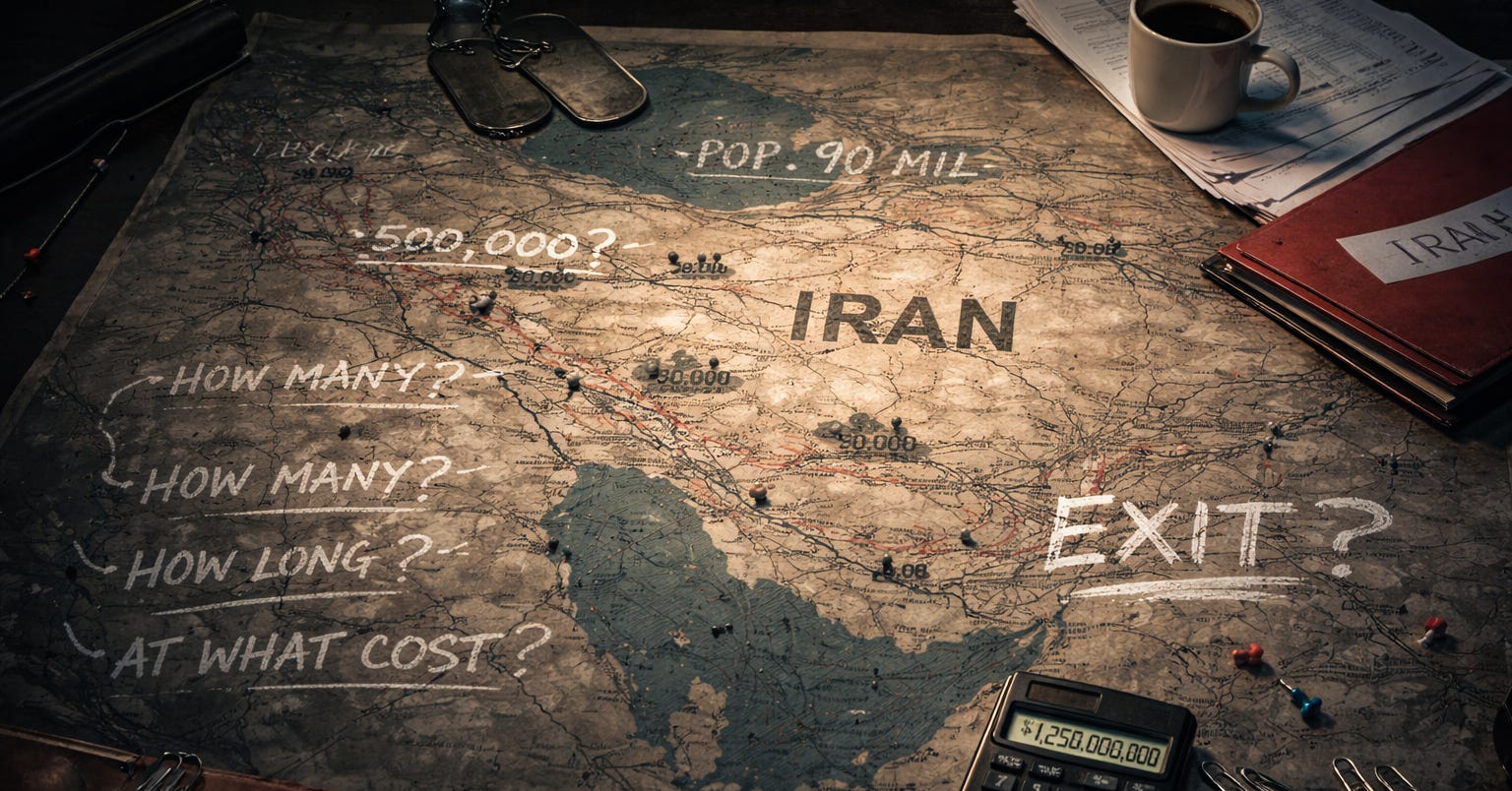
Run the numbers
Here’s the first reality check. Iran is not a small country you can talk about in “limited mission” clichés and expect the numbers to stay polite. UNFPA lists Iran’s 2025 population at 92.4 million. That matters because once a president starts floating troops on the ground, population stops being a trivia fact and starts becoming a force-requirement problem.
The force math gets absurd fast. Army University Press material on U.S. counterinsurgency doctrine cites a commonly cited planning range of about 20 to 25 security personnel per 1,000 residents. Apply that to a country of 92.4 million people, and you are no longer talking about a symbolic deployment or a short, tough-sounding phase. You are talking about numbers that land in the low millions.
At 20 per 1,000, the rough number is about 1,848,000 personnel. At 25 per 1,000, it rises to about 2,310,000. Those are not predictions. They do not mean Trump has announced a two-million-person occupation. They do mean something simpler and more devastating: once you run even the rough planning math for a country this large, the phrase “troops on the ground” stops sounding like a serious limited option and starts sounding like an admission that nobody has bothered to explain the scale.
Trump can say the reckless part in one sentence, but the data says that sentence opens onto an undertaking so vast that casual talk about it becomes its own indictment. Reuters reported that administration officials defending the Iran campaign in Congress left open the possibility of U.S. ground troops, even while failing to provide a definitive exit strategy. Pair that political vagueness with this population math, and the gap becomes impossible to ignore. The rhetoric is small, but the burden it hints at is enormous.
And that is before you even get to the next question, which is the one every ordinary family would ask first: if the numbers are this big, who exactly is supposed to supply the people, the years, and the money?
When a slogan hits the kitchen table
This is the part Washington almost never says out loud. “Troops on the ground” sounds clean on television because television never has to answer the family questions. It never has to explain how many people that really means, how long they would be there, what happens when the mission expands, or who absorbs the cost when the talking points run out before the war does.
However, ordinary people do ask those questions because they have to. If a president is serious about putting American troops into a country of more than 90 million people, then somebody should be able to explain who is going, how long they are staying, and what the public is being asked to carry. Lawmakers from both parties pressed Trump administration officials over the absence of a clear exit strategy and warned about another prolonged conflict like Iraq or Afghanistan. That matters because once members of Congress hear “no clear exit” before any ground commitment, the burden shifts to those selling escalation to explain why this would somehow stay limited.
This is where the math stops being abstract. The rough planning numbers are not just military jargon. They are a warning about scale. If even broad stabilization ratios push the conversation into the low millions, then “boots on the ground” is not a narrow tactical option. It is the front edge of a commitment large enough to touch military families, reserve components, federal budgets, and the country's political life itself. That conclusion is an inference, but it follows directly from the population size and the doctrine-based planning range.
This is the kitchen-table test that Trump’s rhetoric fails. Before anybody gets to talk tough about ground troops, they should have to answer the same questions any working family would ask before making any life-changing commitment: How many? For how long? At what cost? And what happens when the mission no longer fits within the slogan?
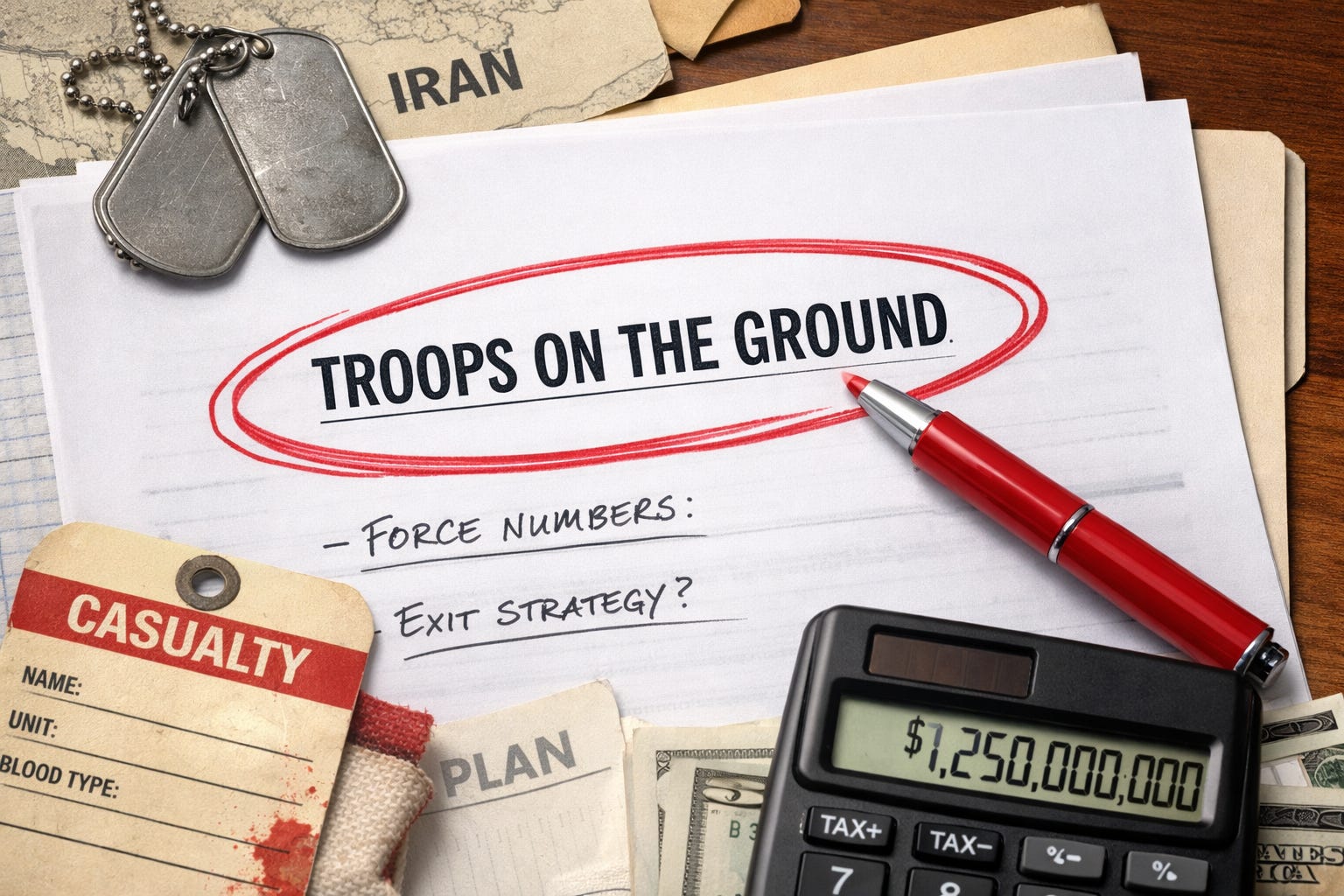
That is why the casualness is so dangerous. A phrase that sounds like strength in a speech can mean years of deployments, staggering costs, and an open-ended political burden once it reaches the real world. If no one can explain those burdens up front, then what is being offered is not strategy but salesmanship.
The first lie is that this would stay limited
“Limited” is the word leaders reach for when they want the public to stop asking follow-up questions. Limited strikes. Limited objectives. Limited time. Limited risk. It is the rhetorical bridge between a dangerous idea and a manageable headline.
Yet in a country the size of Iran, “troops on the ground” and “limited” do not belong in the same sentence for very long. Once American troops are on the ground, every predictable problem becomes a pressure to expand: force protection, securing supply lines, protecting bases, guarding infrastructure, controlling key roads, responding to attacks, preventing reprisals, and keeping a political vacuum from turning into chaos. You do not have to predict every step of a hypothetical war to understand this. You just have to recognize that ground forces create new responsibilities the moment they arrive.
That is why the lack of a clear exit strategy is not a footnote; it is the story. Trump’s national security team came to Congress to defend the Iran campaign and faced criticism over the absence of a definitive exit strategy, with lawmakers warning about sliding into another prolonged conflict. If the administration cannot clearly explain how this ends while it is still in the earlier phases, then “limited” is not a plan. It is a word meant to quiet the room.
And here is the thing about “limited” wars: they almost always become unlimited for the people asked to fight them. They become repeated deployments, expanded mission sets, rising budgets, mounting injuries, and a growing list of promises about progress that never quite arrive. That is why members of Congress invoked Iraq and Afghanistan in their warnings. They were not arguing that history repeats itself perfectly. They were pointing out that the United States has seen this movie before: escalation is easy to start, difficult to control, and politically hard to end once Americans are committed on the ground.
When Trump treats “troops on the ground” like it is just another option, the correct response is not to debate it in slogans. The correct response is to ask: What exactly is the “limited” version of ground forces in a country of more than 90 million people? How many troops is “limited”? How many years is “limited”? How many casualties is “limited”? How many billions is “limited”?
If no one can answer those questions before the first boot hits the ground, then “limited” is not a strategy. It is a sales pitch.
This is what no-plan looks like
By this point, the problem should be clear. Trump floated putting troops on the ground in Iran as if it were one more escalation option sitting on a menu. Yet once you line up the actual facts, what you see is not a credible plan waiting to be explained. You see the outline of a disaster that nobody appears willing to describe honestly.
Start with the plainest fact: Iran is a country of roughly 92.4 million people. That one number is enough to destroy the fantasy that this would be a neat or manageable ground mission. Use the broad force-planning range often cited in counterinsurgency and stabilization discussions — 20 to 25 security personnel per 1,000 residents — and the math moves into the low millions. Again, that does not mean the White House has proposed a formal occupation of that size. It means that once you test the slogan against the scale of the country, the slogan collapses. “Troops on the ground” stops sounding like resolve and starts sounding like evasion.
Then add the political fact. Administration officials defending the Iran campaign in Congress left open the possibility of U.S. ground troops while failing to offer a definitive exit strategy. A government that cannot explain how a war ends while it is still selling escalation is not displaying confidence. It is displaying the absence of a real endgame.
Now put those two things together: enormous scale and missing strategy. That combination does not equal a serious proposal. It equals danger. A country this large cannot be treated like a short chapter in a campaign speech. A ground commitment this open-ended cannot be treated like a footnote to an air war. A president who talks about boots on the ground without first telling the public how many troops, how long, and to what end is not demonstrating strength. He is demonstrating how little planning it takes to say something that other people may later be asked to die for.
That is what no-plan looks like. It looks like a slogan where the numbers should be. It looks like television bravado, where an exit strategy should be. It looks like an open question hanging over military families, budgets, Congress, and the future of the war itself. The absurdity is not just that Trump said it. The absurdity is that a phrase that carries this much possible blood and cost can still be spoken in public as though it were merely a posture.
You do not get to say “boots on the ground” without saying the rest
If a president is willing to say “troops on the ground,” then he should also have to say the rest of the sentence, the part politicians always try to skip. He should have to say how many troops he means. He should have to say how long they would stay. He should have to say what legal authority he thinks he has, what the actual end state is supposed to be, what the mission becomes when the first plan fails to hold, and what the public should expect to pay in lives, money, and years.
So far, that full sentence is missing. Lawmakers are pressing Trump administration officials over the lack of a clear exit strategy and over the risk of another “forever war.” That is not a side concern. It is the central concern. Because once troops are on the ground, the missing answers stop being theoretical. They become the terms on which families, service members, taxpayers, and future governments are forced to live.
This is where democratic accountability comes in. A president does not get to throw out a phrase that could trigger a massive ground commitment and then leave the hard parts blank. Congress does not get to nod along through the slogans and ask for the numbers later. The country has already seen what happens when leaders market escalation first and explain the mission second. By the time the details arrive, the public is no longer debating an idea. It is trying to manage a war already in motion.
That is why the demand here is simple and reasonable: if Trump wants to talk about U.S. troops on the ground in Iran, then he should be required to say the whole thing out loud. Say the troop numbers. Say the time horizon. Say the cost. Say the casualties. Say the mission. Say the exit. Say what happens if the first theory of the war falls apart in contact with reality. If nobody around him can answer those questions clearly now, then nobody has earned the right to pretend this is a serious plan.
The public is not obligated to treat dangerous vagueness as strategy, and it is not obligated to mistake a slogan for leadership just because it was delivered with confidence.
A slogan for television, a catastrophe for everyone else
Donald Trump made “troops on the ground” sound like strength. That is how the phrase is meant to work. It sounds decisive, forceful, unafraid. It fits neatly inside a clip, a headline, a speech. It gives the appearance of command without having to carry the weight of consequence.
But the data tells a different story. Put those facts together, and the picture is not one of resolve. It is one of recklessness.
That is the real lesson here. “Troops on the ground” is easy to say when somebody else is expected to supply the troops, pay the bills, absorb the casualties, and live with the aftermath. It is easy to say when the hard parts are left offstage. It is easy to say when the phrase is treated as a posture rather than a policy.
However, a country does not get to live inside slogans. Military families do not. Taxpayers do not. Congress does not. And the soldiers who would be asked to carry out such an open-ended mission certainly do not. If Trump is willing to talk about putting American troops on the ground in Iran, then the public has every right to demand the full story, not the television version.
If those questions cannot be answered clearly before the first boot ever touches Iranian soil, then the truth is simpler than the rhetoric: this is not a serious plan. It is a dangerous slogan sitting atop a potential catastrophe.
That may be the most revealing fact of all. Trump said the reckless part out loud. The numbers explain why nobody around him seems able to say the rest.
Support Independent Media: The Coffman Chronicle
Support the journalism that refuses to stop at the slogan.
If this piece made you angry, good. It should. Ordinary people are always the ones asked to bear the cost when powerful men talk tough and leave the planning to others.
That is what The Coffman Chronicle is here to do: cut through the spin, run the numbers, and follow the consequences all the way back to your kitchen table.
If you want more reporting that names the lie, shows the receipts, and says the quiet part out loud, please consider becoming a paid subscriber today.
Paid subscribers keep this work alive.
Sources:
“Trump: I Don’t Have ‘Yips’ About US Boots on the Ground but ‘Probably Don’t Need Them.’” The Times of Israel, March 2, 2026.
“Iran, Islamic Republic of Population 2025.” UNFPA.
U.S. Army University Press. Closing the Security Gap: Implementing a Theory for Security Force Assistance in Iraq. Fort Leavenworth, KS: Combat Studies Institute Press, 2019.
“Trump’s National Security Team Pushes War on Iran in Congress.” Reuters, March 3, 2026.
You can compare “boots on the ground” in Iran to Iraq and Afghanistan…but when I read this article, I keep hearing “Vietnam…Vietnam“ in my head.
I have just read the first part of this piece and am commenting on the "boots on the ground" paragraphs. If this crew of fools wants boots on the ground in Iran then I suggest they send all of ICE along with christy noem to do the day to day patrolling of the streets of Tehran. This would be a good learning experience for ice and noem both.