


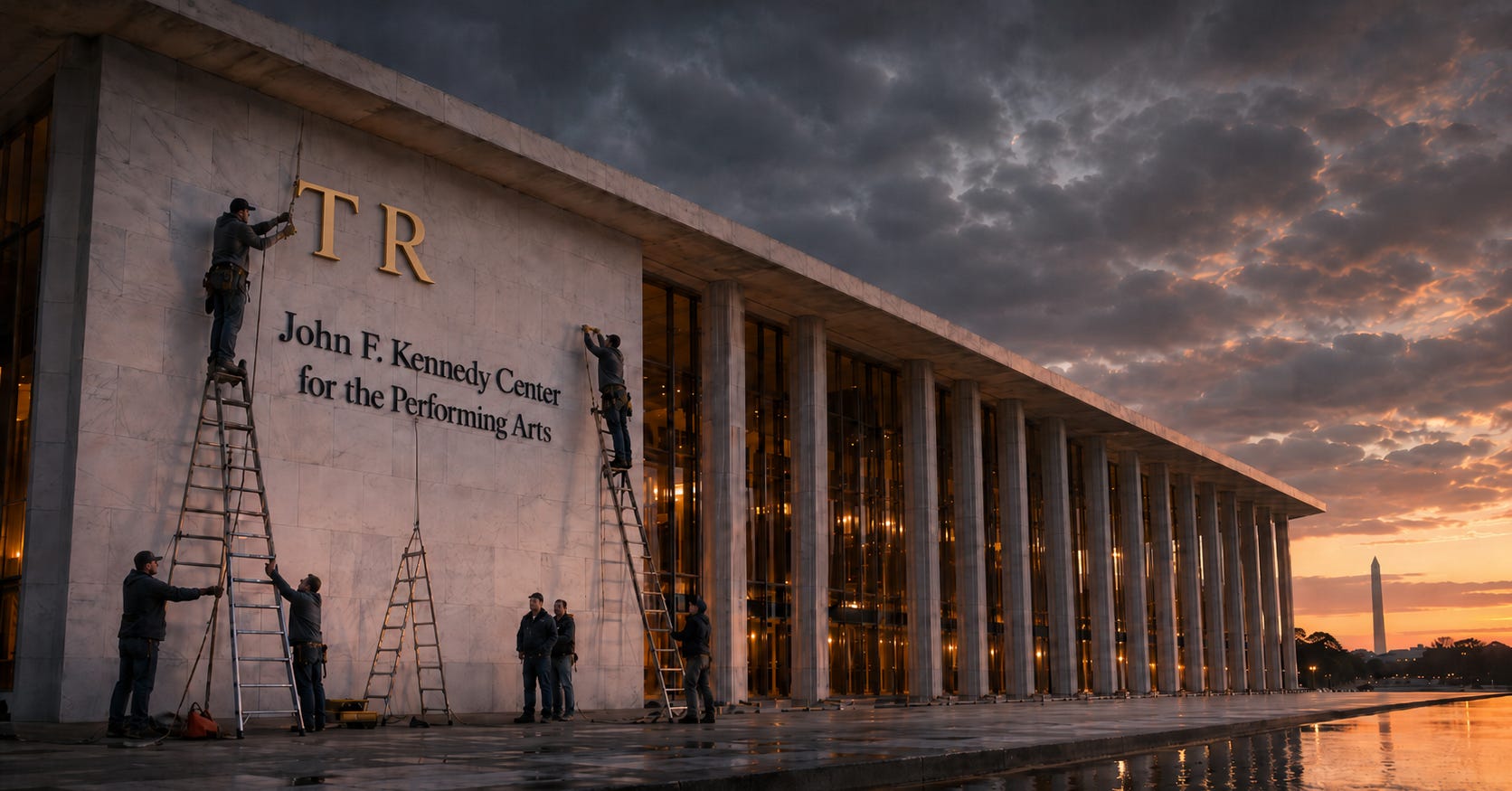
The Kennedy Center is not a hotel lobby, a campaign prop, or another blank wall for one man’s brand.
It is a public institution created by Congress, named by law, supported in part by the public, and dedicated to the memory of a president whose name belongs to American history, not to whichever politician happens to control the executive branch.
That is why the recent federal court ruling resonates beyond one building in Washington, D.C. A judge did not simply tell Donald Trump to take his name off the Kennedy Center. The court drew a line between public ownership and personal control.
Trump’s response proved the point. After the court said the Kennedy Center could not be renamed without Congress, Trump did not respond like a steward of a national institution. He attacked the ruling, claimed the building could not be properly repaired under the court’s limits, and said he wanted to transfer control back to Congress.
That is the whole story in miniature. When he thought he could control it, rename it, close it, rebuild it, and use it as a monument to himself, the Kennedy Center was worth claiming. Once a federal judge said the law still applied, Trump suddenly wanted Congress to deal with it.
That is not stewardship. That is possession.
Support independent media that follows the power.
The Coffman Chronicle is built to track who holds power, who abuses it, who profits from it, and who pays the price.
Paid supporters get full Tony Michaels Podcast episodes, deeper transcript analysis, paid columns, archives, and the reporting framework behind the show.
If you believe independent media has to survive outside billionaire platforms, corporate media, and party-approved gatekeepers, become a paid supporter today.
The Name Was Never His to Take
U.S. District Judge Christopher Cooper ruled that Trump’s name had been unlawfully added to the Kennedy Center and ordered officials to remove references to the “Trump Kennedy Center” from physical signage and official materials within 14 days. The order also covered the website and trademark efforts tied to the new name. The court further blocked the planned two-year closure of the building while making clear that legitimate repairs could still move forward.
This was not a judge saying the building must decay. Instead, it was a judge saying a president cannot use “renovation” as a magic word to shut down a public institution, remake it under his own image, and bypass the body that created it.
The Kennedy Center’s name is not a branding decision, a sponsorship plaque, or a ballroom sign. Congress created the institution and designated it as the John F. Kennedy Center for the Performing Arts. If that name is going to change, the constitutional answer is not “the president wants it.” The answer is legislation.
That is Article I. Congress writes the laws, creates federal institutions, and decides how those institutions are named, structured, funded, and governed. The executive branch administers those laws. It does not get to rewrite them through loyal boards, rushed votes, and new lettering on the front portico.
The court did not invent a new rule. It enforced an old one.
Public memory belongs to the public. In our system, the public acts through law, and for federal institutions, that means Congress.
The Takeover Happened Before the Sign Went Up
The most important part of this story is the sequence.
Under the court’s account, Trump replaced several trustees in early 2025, became a trustee himself, and the newly reconstituted board elected him chair. The board then replaced the Center’s president. In May 2025, it amended the bylaws to strip ex officio trustees of voting rights. Then, in December 2025, the board voted to rename the institution the “Trump Kennedy Center.” New lettering went up the next day.
That is the pattern. Power narrows the room before it changes the sign.
It starts with appointments, then bylaws, then voting rights, then agenda control, and then a vote. Then, finally, there was a public announcement telling everyone that the decision had already been made.
By the time most people saw Trump’s name on the building, the deeper fight had already happened inside the machinery of governance. The issue was not only the sign’s vanity but also the process that made it possible.
This is how concentrated power works when it wants to look official. It does not always begin with the most outrageous act. Instead, it begins with dry procedure. And that begins with who gets a vote, who gets muted, who gets counted, who gets treated as decorative, and who gets erased from the room.
Then the public is told to accept the finished product.
Judge Cooper’s ruling interrupted that sequence.
Joyce Beatty Used the Seat the Way It Was Supposed to Be Used
The human center of this case is Representative Joyce Beatty of Ohio. Beatty was not merely a member of Congress complaining from the sidelines. She was an ex officio trustee of the Kennedy Center because of her congressional role. That gave her a lawful place inside the institution’s governance structure. When the board moved to add Trump’s name, she challenged it.
Her lawsuit was not only about the name on the building, but also about whether ex officio trustees could be stripped of voting rights and sidelined from meaningful participation. It is important to note that the fight over the Kennedy Center was never solely about vanity. It was also about who gets counted when public power is exercised.
The court sided with Beatty on the voting-rights issue, ruling that the Kennedy Center’s organic statute does not create one class of real trustees and another class of decorative trustees. That is a big deal. Public accountability cannot be reduced to ceremonial presence. A seat without a voice is not oversight, and a trustee without meaningful power is not a trustee in any serious sense.
Beatty used her position as a constitutional lever. She forced the question back into court: can a board reshaped by a president, operating under altered bylaws, unilaterally rename a congressionally created memorial?
The answer was no. That answer validated that institutional power is not supposed to be personal property. A board seat is not a toy, a bylaw is not paperwork, and a vote is not a ritual. These are the mechanisms that determine whether public institutions remain public.
Trump’s Response Was the Confession
Trump could have responded to the ruling by saying he respected the court, disagreed with the decision, and would pursue an appeal through proper channels.
He did not. Instead, Trump attacked the ruling. He portrayed the Kennedy Center as unsafe and failing, and said the court’s decision made his renovation plans impossible. Then he announced that he wanted to transfer responsibility for the institution to Congress.
That last part is the tell. If the Kennedy Center already belonged to the public through Congress, then Trump was not “giving” Congress anything. He was acknowledging the very thing the court had just enforced. The institution was never his.
Trump’s Truth Social response is the center of the story, not as a throwaway detail, but for exposing the governing mindset. If he can dominate an institution, he claims it. If he cannot dominate it, he discards it, attacks the referee, and pretends to walk away voluntarily.
That is not how public service works. A president is supposed to care for public institutions because they belong to the country. He is not supposed to care for them only when they carry his name, flatter his donors, reward his loyalists, or serve his preferred version of history.
The court said, “You cannot rename it without Congress.” Trump answered: “Then Congress can have it.”
That is the difference between stewardship and ownership. A steward protects what belongs to the public even when he does not get credit. An owner walks away when he cannot control the sign on the door.
The Closure Fight Was About Power, Not Just Construction
Trump and his allies framed the proposed two-year closure as renovation. That sounds harmless enough. Buildings age. Repairs cost money. Anyone who has owned a home, rented an apartment, or worked in an old building knows that deferred maintenance eventually sends the bill.
However, the court did not block all repairs. It blocked the sweeping closure plan.
That distinction is clear in the Court’s ruling. The question was not whether the Kennedy Center could fix real problems. The question was whether the board could ratify a two-year shutdown after Trump had already announced it, without properly balancing the Center’s legal obligations as a performing arts venue, a public institution, and a living memorial.
A two-year closure is not a minor operational decision. It affects workers, artists, audiences, contracts, programming, public access, local businesses, and the cultural life of the capital. It also changes leverage. Once a building is closed, the people controlling the project gain enormous power over what comes back, who gets hired, what gets staged, what gets canceled, what gets renamed, and what gets quietly buried. That is why “renovation” can become a political weapon.
Concentrated power likes physical space. It wants buildings and boards. It wants permits and ceremonial rooms. It wants monuments, stages, and the symbols that tell the public who is in charge.
The Kennedy Center fight was never only about a sign. The sign was the visible part. Beneath it was a deeper effort to turn a public institution into a possession.
The court interrupted that conversion.
This Is a Kitchen-Table Story
It is easy to dismiss this as a Washington drama about elite arts, rich donors, marble buildings, and political vanity.
That would be a mistake because public institutions are kitchen-table issues. They answer a question every family understands: Who gets to take what belongs to everyone?
When a public venue closes for two years, workers lose shifts. Ushers, stagehands, maintenance crews, concession workers, security staff, and nearby businesses feel it first. Artists lose bookings. Audiences lose access. Taxpayers underwrite the repair work and then watch powerful people fight over the name on the building. Local restaurants, hotels, parking workers, and small businesses lose foot traffic. Students and community groups lose programming. The public pays for the institution, but the connected few try to control the institution. That is the kitchen-table connection, whether or not anyone at that table would ever have the opportunity to sit in Kennedy Center seats.
The Kennedy Center may be in Washington, but the principle applies to every community. Public libraries, schools, parks, courthouses, universities, museums, auditoriums, city halls, and monuments all depend on the same idea. Some things belong to the public, and public ownership requires rules stronger than one person’s ego.
When those rules are weakened, ordinary people do not gain power. They lose it.
The wealthy and connected can always find another room. They can buy another ticket or fund another private venue. They can put their names on private buildings. The public depends on institutions protected by law because law is often the only thing standing between shared civic life and private capture.
That is why this ruling matters.
Article I Populism in Real Life
This is what Article I Populism looks like in real life. It is not abstract constitutional trivia. It is the belief that when Congress gives up power, the people lose power. It is also the principle that when courts force public officials back inside the boundaries Congress wrote, the people gain breathing room.
The Kennedy Center was created through law. Its name was established by law. Its public purpose was defined through law. When Trump tried to govern it through personal or executive control, the court pointed back to Congress.
That is not judicial activism. That is the constitutional structure doing its job.
Congress wrote the law. The president was supposed to operate inside it. When that line was crossed, the court stepped in and pointed back to the people’s branch.
That is the part we cannot miss. The answer to executive overreach is not simply finding a better president. The answer is restoring Congress so presidents cannot so easily turn public institutions into personal assets in the first place.
A healthier Congress would not wait for a court to clean up the mess. It would defend the institutions it created. It would clarify governance rules and protect ex officio trustees from being sidelined. It would investigate how the board was reshaped and demand public accounting for any closure plan, renovation budget, donor influence, trademark application, or attempt to alter the Center’s mission.
That is Congress’s job. The court did its part. Now Congress has to decide whether it still remembers its own.
This Is Not About Kennedy Worship
None of this requires romanticizing John F. Kennedy, the Kennedy family, or the old bipartisan myths of Washington. Public memory should be honest. Historical figures should be examined, not embalmed. Institutions should be accessible, accountable, and open to criticism. That is not what Trump was doing.
This was not a democratic debate over how America remembers Kennedy. It was not a public process about whether the Center’s mission should evolve. It was not Congress reconsidering the law through hearings, debate, amendments, and votes.
It was a president and a reshaped board trying to add his name to a public institution without the authority to do so.
A republic can debate its monuments. A republic can change names and rethink public memory. However, a republic does those things through public power, not personal capture or executive fiat.
The danger is not that public institutions can never change. The danger is that powerful people want the authority to change them without the public’s consent.
They do not want a debate. They want a board vote after the board has been reshaped. They do not want Congress. They want a memo. They do not want public consent. They want branding. They do not want stewardship. They want ownership.
The Courtroom Was a Firewall, Not a Cure
We should be clear-eyed about what happened here. The ruling is important, but it does not solve the deeper problem.
A court can order a name removed, block a closure, and interpret a statute. It can rule that a board exceeded its authority. However, a court cannot rebuild democratic muscle on its own.
That is our work. That is Congress’s work. That is the work of voters, watchdogs, journalists, artists, workers, and citizens who refuse to let public institutions be treated like trophies.
The Kennedy Center ruling is a reminder that the Constitution can still function. It is also a warning that it had to function because other guardrails were already under pressure.
The board had been reshaped, the bylaws rewritten, and ex officio voting rights stripped. The name had already been changed in official references. The signage had already gone up. A closure plan had already been announced. The public was already being asked to accept the new reality.
That is how fast concentrated power moves. It acts first and dares the system to catch up.
In this case, the system caught up, but only because someone with standing, Representative Joyce Beatty, stepped into the fight and forced the issue. That should not make us complacent. It should make us more alert.
The Sign Came Down. The Lesson Should Stay Up.
Trump tried to put his name on public memory. A federal judge said no. That is the headline. The pattern is bigger.
A president reshaped a board, accepted the chairmanship, presided over a process that stripped voting rights from ex officio trustees, benefited from a rushed renaming process, announced a sweeping closure, and then attacked the court when the law got in the way. When personal control became legally harder, he floated handing the institution back to Congress, as if the people’s branch were a storage closet for things he no longer wanted.
That is the danger.
Public institutions do not belong to presidents. They do not belong to donors, party machines, or the loudest man in the room. They belong to the public through law.
The Kennedy Center case shows both sides of the American system at once. It illustrates how concentrated power tries to personalize what belongs to everyone, as well as how constitutional structure can still push back when people use the tools available to them.
Joyce Beatty used her seat, and the court enforced the law. Congress now has a choice.
Congress can treat this as a one-off embarrassment and move on, or it can recognize the warning right in front of it. If Congress does not defend the institutions it creates, presidents will keep trying to claim them.
This is not about wanting a better king. It is about remembering that we are not supposed to have one.
Support Independent Media That Follows the Pattern
The Kennedy Center story is not just about a sign. It is about whether public institutions still belong to the public, or whether powerful people can treat them like trophies until a court forces them to stop.
That is the pattern we track here.
When presidents try to turn public property into personal property, when boards and bylaws narrow accountability, and when Congress forgets it is the people’s branch, ordinary people get pushed farther from power.
Coffman Chronicle exists to pull that power back into view.
Share this article with someone who still thinks this is just “politics as usual.”
And if you can afford to become a paid subscriber, your support keeps this independent, reader-powered work going.
America does not need a better king. It needs a stronger republic.
Sources:
“Judge Says Kennedy Center Board Broke Law Putting Trump’s Name on Building and Blocks Closure.” AP News, May 29, 2026.
Beatty v. Trump, No. 25-cv-4480 (CRC). “Memorandum Opinion.” United States District Court for the District of Columbia, May 29, 2026. CourtListener.
Beatty v. Trump, No. 25-cv-4480 (CRC). “Order on Summary Judgment Motions.” United States District Court for the District of Columbia, May 29, 2026. CourtListener.
“Court Reverses Unlawful Renaming and Halts Shutdown of Kennedy Center, Reaffirming the Rule of Law.” Office of Congresswoman Joyce Beatty, May 30, 2026.
“The Kennedy Center Board Votes to Add ‘Trump’ to Its Name, Drawing Backlash.” Reuters, December 18, 2025.
“Kennedy Center Wastes No Time Adding Trump’s Name to the Building.” Reuters, December 19, 2025.
“Trump Says He Will ‘Transfer’ Kennedy Center to Congress after Court Setback.” Reuters, May 29, 2026.
United States Code. “20 U.S.C. Chapter 3, Subchapter V: John F. Kennedy Center for the Performing Arts.” Office of the Law Revision Counsel, U.S. House of Representatives.
United States Code. “20 U.S.C. § 76i: John F. Kennedy Center for the Performing Arts.” Office of the Law Revision Counsel, U.S. House of Representatives.
United States Code. “20 U.S.C. § 76q: Sole National Memorial to the Late John F. Kennedy within the City of Washington and Environs.” Legal Information Institute, Cornell Law School.
The Fapweasel (Trump) has taken out a lot of the things inside The Kennedy Center. He sold some of them, and some have disappeared. He installed one of his cronies as the caretaker. If he can’t tear it down, he is going to ruin it in other ways, and we must stop him!
How long before his name is erased? Nine days. It had better happen, or he will be sued.