


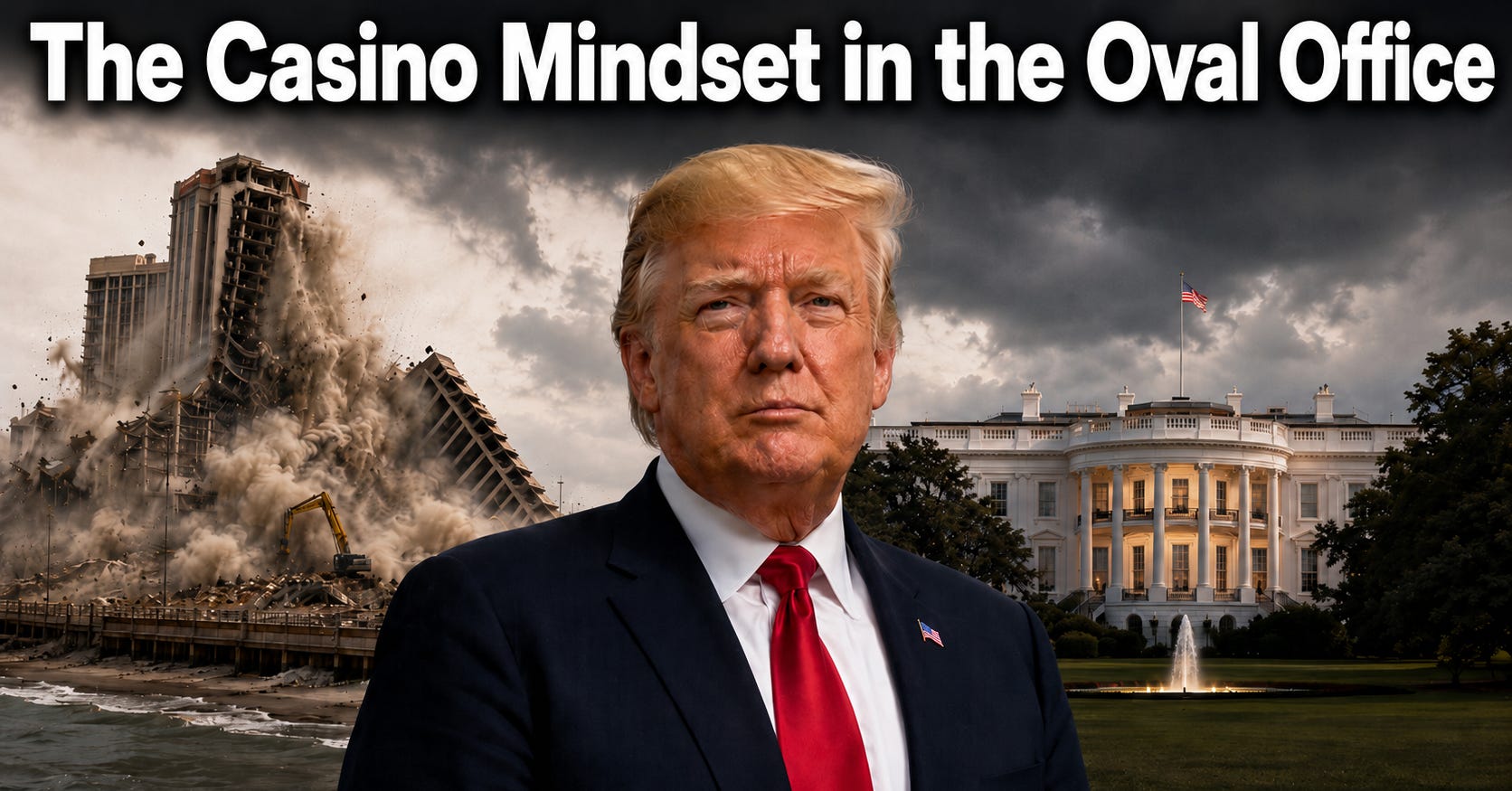
Atlantic City knows what a bright room can hide.
Long before Donald Trump turned politics into a permanent stage show, his name sat in giant letters above casino floors where everything was designed to feel like winning. The lights were bright. The promises were bigger. The buildings were meant to make people believe they were standing inside success itself.
Behind the marble, glass, carpet, and gold-colored confidence, there were people who had done real work for real invoices. Contractors supplied materials. Small businesses took jobs. Workers built the thing everyone else was being invited to admire. Then the money did not land where the promises had.
This part of the casino story gets lost when people reduce it to a punchline about bankruptcies or bad business judgment. Bankruptcy papers are cold. Balance sheets are distant. The human part is warmer and uglier. Someone ordered the work and cashed in on the image. Someone else was told to wait, settle, fight, or take the loss.
That is not a story about Atlantic City. It is a story about power.
The real lesson of Trump’s casino years was about who gets protected when the spectacle starts falling apart. The name stayed on the building. The people beneath it had to chase what they were owed.
The United States is not a casino floor, and the public is not supposed to be treated like a line of creditors waiting outside the boss’s office. A country cannot be run on lights, branding, pressure, loyalty, and the hope that someone else will absorb the losses.
At some point, every spectacle sends an invoice. The question is who gets stuck paying it.
Support independent media that follows the power.
The Coffman Chronicle is built to track who holds power, who abuses it, who profits from it, and who pays the price.
Paid supporters get full Tony Michaels Podcast episodes, deeper transcript analysis, paid columns, archives, and the reporting framework behind the show.
If you believe independent media has to survive outside billionaire platforms, corporate media, and party-approved gatekeepers, become a paid supporter today.
The Casino Was the Preview
The mistake is treating Trump’s casino history as an isolated business chapter, something sealed off in Atlantic City and useful only as a quick insult. The real issue was not that a casino failed but rather the kind of power model the casino years revealed.
Trump’s Atlantic City casinos went through four bankruptcies. A Temple University law professor who studied the record found that Trump’s casinos lost more jobs and money than competitors. The Taj Mahal story added the human evidence: hundreds of contractors who helped build the spectacle were not paid in full.
The buildings were designed to overwhelm people before they had time to ask harder questions. Everything was oversized, branded, and sold as proof of strength. The spectacle was not a decoration. It was the product. The message was simple: if Trump’s name was on it, the thing must be winning.
That image can work for a while. It can pull in investors, customers, lenders, reporters, politicians, and workers who all want to believe they are attaching themselves to success. It can make debt look like confidence and warnings sound like jealousy. It can turn ordinary risk into a public performance of power.
However, eventually, math does what math always does. It shows up. When the numbers stopped matching the sales pitch, the damage was not evenly distributed. The people at the top had lawyers, restructuring tools, name recognition, and escape routes. The people farther down the chain had invoices, payroll, equipment loans, materials already delivered, and families depending on the next payment.
That is how concentrated risk works. The promise travels downward while the protection travels upward.
The casino story shows a pattern now familiar in politics: create a spectacle, demand belief, use the brand as proof, dismiss the warnings, and, when the bill comes due, make sure somebody else is closer to the invoice.
The casino floor was never just about gambling. It was about control. The house decided the odds, managed the lights, and sold the feeling that everyone had a fair shot at winning. The house was built to protect itself first.
That instinct is dangerous in business. It is even more dangerous in government.
The Same Playbook in Government
The same instincts that shaped the casino story keep showing up in the way Trump approaches public power. The spectacle still comes first.
In business, the spectacle was marble, glass, lights, gold lettering, and the constant performance of success. In politics, it is rallies, executive orders, televised confrontations, social media declarations, oversized promises, and the same demand that everyone accept the image before they examine the numbers. The country is told it is winning because the man at the microphone says it is.
That kind of politics turns government into a show with heroes, enemies, slogans, and instant victories. It makes hard questions feel like disloyalty, and slow constitutional processes look weak compared to one man claiming he can move faster than everyone else.
However, a republic is not supposed to run on vibes. It is supposed to run on law, debate, evidence, accountability, and public consent.
That is where the casino pattern becomes dangerous. In the casino version, debt could be sold as ambition, and risk could be wrapped in confidence. In the governing version, the same thing happens when policy is sold as magic math. Tariffs are presented as free money taken from foreign countries, even though Americans bear the cost through higher prices, tighter margins, and uncertainty for small businesses.
The Congressional Budget Office estimated that Trump’s tariffs would raise inflation and reduce the purchasing power of households and businesses. The New York Fed later found that most of the tariff burden was borne by American consumers and companies. Working people do not experience a tariff as a patriotic speech. They experience it at the register, in supply costs, in thinner margins, and in another round of prices that somehow keep landing on them.
A family does not pay bills with talking points. A contractor does not buy materials with slogans. A small business owner does not keep the doors open with a campaign promise about winning.
The promise is made from the top. The pressure lands below.
The federal workforce fight fits the same model. Trump’s June order, making it easier to fire thousands of senior federal workers, was sold as a measure of reform, efficiency, and control over a resistant bureaucracy. There are real arguments to be had about waste, agency arrogance, and whether the government remembers who it serves. Nobody has to pretend every office in Washington is sacred, but reform is not the same thing as turning public service into a loyalty system.
A constitutional republic needs public servants who answer to the law, not to a personal boss. When a president strips protections from career officials who shape policy, the question is whether government is becoming accountable to the public or obedient to the Oval Office. That matters outside Washington, too. It can affect veterans waiting on services, workers depending on safety rules, communities needing disaster response, and agencies that are supposed to tell the truth even when the truth is politically inconvenient.
Those are not small differences. They are the whole fight.
A casino boss wants control of the room. A president in a republic is supposed to share power, follow the law, and accept limits written precisely because concentrated power is dangerous.
The Kitchen-Table Cost
The danger of this kind of power is that it rarely arrives at the kitchen table wearing a name tag that says “constitutional crisis.”
It usually shows up as something smaller and more familiar. A bill goes up. A job gets less secure. A service gets slower. A small business delays hiring because the numbers no longer work. A family hears a leader brag about winning and then wonders why their paycheck does not stretch as far as it did before.
That is how concentrated power hides itself. It turns national decisions into private burdens.
In Atlantic City, the damage did not stay inside a boardroom. It reached contractors who had already bought materials, workers who needed paychecks, small businesses that had trusted the promise, and a local economy that had been told the bright lights would lift everyone. When the model broke, the people with the least power had the fewest exits.
The same thing happens when the government is run like a boss’s private operation. The people at the top can call a policy strong. They can call it patriotic or “winning”. Regular people are the ones who have to live inside the fine print.
A tariff does not knock on the door and explain itself. It shows up in prices, supplies, and small business decisions about whether to raise costs, cut hours, delay an order, or stop carrying something customers need.
A loyalty purge does not feel like a civics lesson to the family waiting on a federal service. It shows up when experienced people leave, when agencies become afraid to tell the truth, and when professional judgment is replaced by political survival.
Legal chaos does not stay in Washington either. It creates uncertainty for employers, workers, schools, hospitals, contractors, local governments, farmers, veterans, and anyone else who depends on a stable system.
Families cannot budget with spectacle. Workers cannot build a future on branding. Small businesses cannot pay invoices with applause. Communities cannot survive on the promise that someday the house will share the winnings. The house rarely does.
That was the lesson of the casino floor. The room can look rich while the people underneath it are being squeezed. The lights can stay bright long after the math has gone bad. When that model is applied to government, the whole country becomes the table.
A Casino Has an Owner. A Republic Is Not Supposed To.
A casino has an owner. That is the point of the place. There is a house, a floor boss, and rules written to protect the business. There are odds designed so that the people playing can win just enough to keep believing, while the institution itself is built to come out ahead.
A republic is built on the opposite idea. The United States is not supposed to have an owner. The president is not the proprietor of the country. Congress is not supposed to function like middle management for the Oval Office. The courts are not supposed to become a security desk for executive power. Federal agencies are not supposed to be turned into personal instruments of loyalty.
You know the Article I point by now: when Congress surrenders power, the people lose power. Congress controls spending, writes laws, and holds oversight because public consent is supposed to be visible before national power is used in the people’s name.
When Congress weakens itself, the boss model fills the empty space.
Trump did not invent congressional surrender, but he understands how to exploit it. When lawmakers duck hard votes, avoid oversight, defer to executive orders, or treat their constitutional duties as partisan inconveniences, they create the exact opening a strongman personality needs.
Power does not stay vacant. If Congress refuses to act like the people’s branch, the presidency starts acting like ownership. Policy becomes command, oversight becomes harassment, and public service becomes loyalty management. Law becomes something to stretch, test, dare, or delay until the courts can no longer keep up with the speed of the abuse.
That is not a republic functioning properly. That is the house tightening control of the floor.
The casino model depends on people accepting the rules of a room they do not control. The constitutional model depends on the people having institutions strong enough to restrain anyone who tries to own the room.
The people are not tenants in their own republic. They are not customers at the president’s casino nor unsecured creditors waiting to see what is left after the insiders get paid. The people are the sovereign.
That is the word concentrated power hates most, because it means the country does not belong to the man behind the desk, the donors behind the curtain, or the party machines guarding the doors. It belongs to the people who have to live with the consequences after the cameras leave, the slogans fade, and the invoice arrives.
The House Always Wins When Congress Folds
The house is not only Trump. That’s because if this story becomes only about one man’s ego, we miss the larger system that keeps rewarding the same behavior. Concentrated power never survives on personality alone. It survives because donors, corporations, lobbyists, media figures, and party machines all learn how to profit from the room.
Ordinary people get slogans. Insiders get meetings. Voters get fundraising texts. Donors get phone calls. Workers get speeches about sacrifice. The people closest to power get carve-outs, appointments, contracts, influence, and protection. This is how the table is tilted before most people even sit down.
The more power concentrates in the executive, the easier it becomes for insiders to know where to aim their money, loyalty, and influence. Instead of persuading the public through open debate, they can chase the favor of one administration, one leader, one circle of loyalists, one gatekeeping machine. That is not government becoming more efficient. That is the government becoming easier to buy.
The people are then asked to keep betting. Bet that tariffs will punish someone else without raising costs at home, that removing independent public servants will make government more accountable instead of more obedient, and that courts will catch every abuse after it happens. That is a rigged bet.
The house wins when citizens are reduced to spectators, when Congress behaves like a commentary panel instead of a constitutional branch, and when public anger is harvested for campaigns but never converted into public power.
A republic does not repair itself by finding a better owner. It repairs itself when the people take the table back.
The Bankruptcy Mindset Is Not a Governing Philosophy
Bankruptcy itself is not always a scandal. Businesses fail. Markets shift. Debt gets restructured. Courts exist to resolve disputes over losses when a company can no longer meet its obligations. That is not the charge here.
The charge is that a bankruptcy mindset becomes dangerous when it moves from private business into public government. A company can collapse, restructure, sell assets, and leave creditors with less than they were owed. A country is not a failed casino property. The public does not get to disappear into paperwork when the deal goes bad.
Workers still need wages. Families still pay bills. Small businesses still need stability. Veterans still need services. Farmers still need predictable markets. Seniors still need the benefits they earned. Communities still need functioning institutions long after the leader who made the promise has moved on to the next performance.
The country is not a limited liability company. Public trust is not a line item to be written down. Constitutional government is not a debt vehicle in which the powerful collect the upside, and the public absorbs the losses.
When a president governs with a bankruptcy mindset, every obligation becomes negotiable except loyalty to himself. Rules become pressure points. Institutions become obstacles. Public servants become replaceable. Oversight becomes a nuisance. Debt becomes somebody else’s future. The bill is always real, but the people closest to power are rarely the ones asked to pay it first.
That is not strength. That is evasion dressed up as toughness.
America is not one of Trump’s casinos. We are not chips on the table. We are not unpaid invoices. We are not unsecured creditors waiting outside the boss’s office to learn how much of our own future we are allowed to keep.
We are the people the Constitution was written to protect.
America Is Not the House’s Property
The casino story reminds us what spectacle can hide until the invoice arrives. For a while, the lights can work. The branding can work. The promises can work. A powerful man can stand in front of the cameras and make debt look like vision, risk look like courage, and pressure look like strength. But eventually the bill comes due.
That was true in Atlantic City, and it is true in government. The difference is scale. When a casino deal goes bad, the damage can devastate workers, contractors, small businesses, investors, and the local community. When the same model is applied to a country, the damage spreads through prices, services, jobs, courts, agencies, laws, and public trust itself.
A republic cannot survive on the promise that the boss knows best, nor when public policy is treated like a private wager. It cannot survive when Congress acts like a spectator, when courts are expected to clean up every mess after the fact, and when ordinary people are told to absorb the cost of decisions they were never allowed to meaningfully shape.
The United States does not belong to the man behind the desk, to donors behind the curtain, or to party machines guarding the doors or billionaires standing behind the velvet rope. It belongs to the people.
That is not a slogan. That is the whole theory of the American republic. The people are not supposed to be managed like customers, used like chips, discarded like bad debt, or treated like unsecured creditors after the powerful get paid.
That is what Congress is for. That is what separation of powers is for. That is what public accountability is for: to make sure no single person can turn the country into his own private floor.
A casino has an owner. A republic is not supposed to. And if Congress will not remember that the people have to remind them before the house decides the final bill is ours.
Support Independent Media
If this article made the pattern clearer, consider becoming a paid subscriber to Coffman Chronicle.
We are not here to watch the house win quietly. We are here to name concentrated power, follow the invoice, and remind people that this republic does not belong to bosses, billionaires, party machines, or the man behind the velvet rope.
It belongs to us.
Paid subscriptions help keep this work independent, research-based, and accountable to readers rather than donors or advertisers. If you can afford to support it, your subscription helps us keep making the argument that Congress, the courts, and every public official need to remember: the people are not chips on the table.
Sources:
Amiti, Mary, Chris Flanagan, Sebastian Heise, and David E. Weinstein. “Who Is Paying for the 2025 U.S. Tariffs?” Liberty Street Economics, Federal Reserve Bank of New York, February 12, 2026.
“Trump Taj Bankruptcy Left Many Contractors Angry.” AP News, June 29, 2016.
Congressional Budget Office. “Budgetary and Economic Effects of Increases in Tariffs Implemented Between January 6 and May 13, 2025.” June 4, 2025.
Lipson, Jonathan C. “Making America Worse: Jobs and Money at Trump Casinos, 1997–2010.” Temple University Legal Studies Research Paper No. 2016-47. SSRN, posted September 29, 2016; last revised October 8, 2016.
“Bankruptcy Expert Studies Trump Casinos.” Temple Now, October 25, 2016.
White House. “Implementing Schedule Policy/Career in the Excepted Service.” June 3, 2026.
And we all know what happened to the Atlantic City casino The Fapweasel (Trump) had and ruined. He just did everything in the worst possible way. Some business man!
Good thing the democrats have our backs... I'm sure there's a sternly worded response being written right now concerning this, or at least there will be after one the Senator's vassals refills his ink well... Who knew it could be this easy to topple an empire? Fuck the nukes, a fucking Carnival Barker who can barely put two coherent sentences together did it by calling people childish names and pandering to the unwashed masses of the losing side of the Civil War. America land of free, home of the rubes. There's no coming back from this and maybe that's a good thing anyway.