


The Decision You Didn’t Hear About
While the country was busy choking on the daily circus — the outrage, the performative chaos, the spectacle politics designed to keep everyone looking the other way — a far more dangerous decision was made in near silence.
No announcement. No debate. No warning. Just a legal maneuver buried deep in the machinery of Washington.
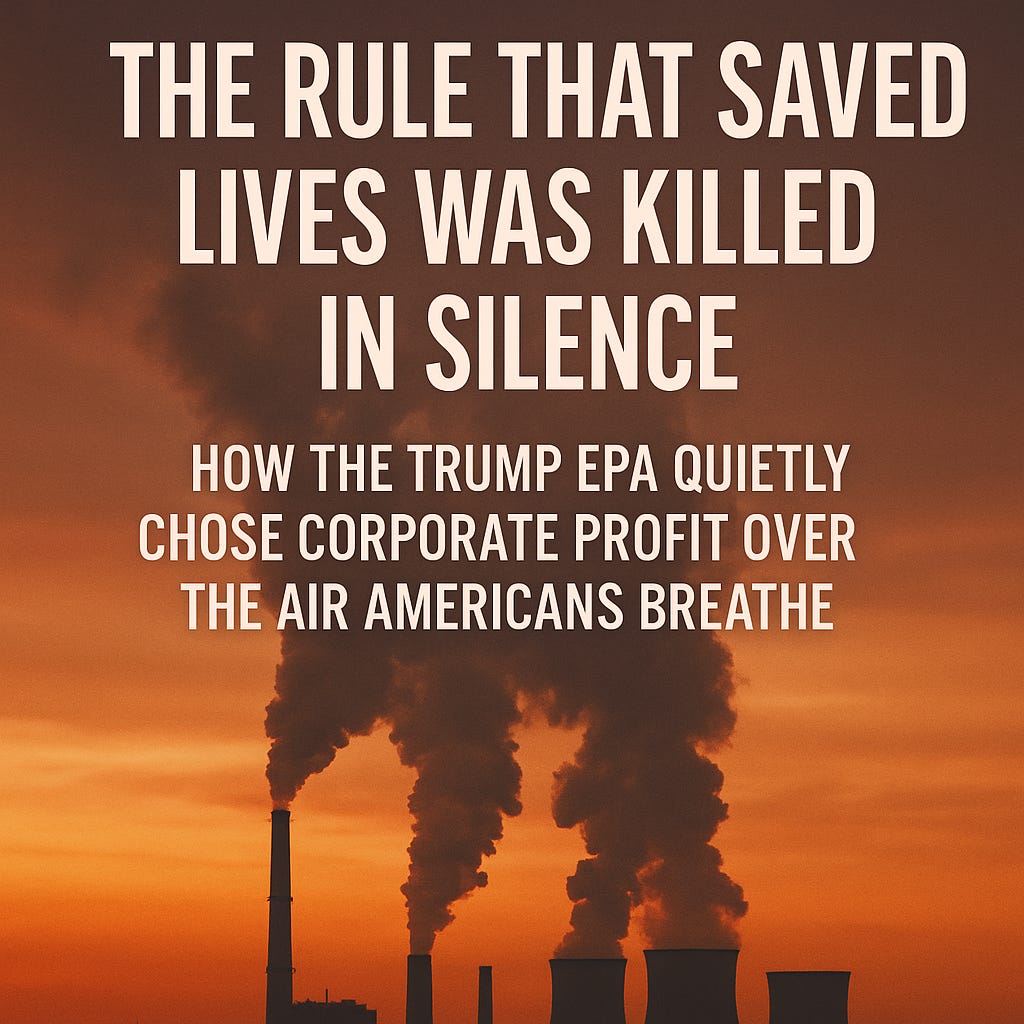
The Trump administration, through the Environmental Protection Agency, quietly asked a federal court to erase stronger air pollution standards specifically designed to keep people alive. These were standards backed by medical science, supported by career experts, and projected to prevent thousands of premature deaths every single year.
They killed them anyway— not because the science changed, not because the danger went away, but because protecting your lungs became inconvenient for the industries that profit from dirty air.
This wasn’t policy reform. This was a calculated rollback of protection, a decision that will be paid for in inhalers, emergency rooms, and shortened lives.
Fine particulate pollution — soot so microscopic it slips past your body’s defenses — has long been linked to asthma attacks, heart disease, strokes, cancer, and irreversible lung damage. Instead of strengthening those safeguards, this administration chose to weaken them in silence.
No one voted on whether your child should breathe cleaner air. No one asked your community if a higher cancer risk was an acceptable trade-off. No one held a town hall about whether profit margins matter more than oxygen.
Because this decision was never meant to withstand sunlight.
It was meant to slide through quietly, while the rest of us argued over everything else.
And in that silence, a rule designed to protect millions of Americans was transformed into a problem to be eliminated.
Want to Know Your Rights?
Download a free digital copy of the U.S. Constitution—the same document Trump is trying to bulldoze. Learn exactly what he’s breaking… and how to fight back.
What Was Just Killed And Why It Matters
The rule they moved to erase wasn’t some obscure bureaucratic footnote. It was one of the most important air-quality protections the country has.
In 2024, after years of research, public comment, and scientific review, the Environmental Protection Agency strengthened the national standard for fine particulate matter known as PM2.5, or soot. These particles are so small that they bypass your body’s natural defenses, travel deep into your lungs, enter your bloodstream, and lodge themselves in your organs.
The updated rule lowered the allowable concentration of this pollution from 12 micrograms per cubic meter of air to 9.
That three-point difference doesn’t look dramatic on paper. However, in real life, it meant fewer heart attacks, fewer asthma emergencies, fewer children missing school because they can’t breathe, and fewer families burying loved ones who died too soon.
EPA scientists projected the tighter standard would prevent thousands of premature deaths each year, along with tens of thousands of hospital visits and severe respiratory events. It was one of those rare policies that delivered exactly what government is supposed to deliver: measurable protection for the public.
And now it is being dismantled— not because it failed, not because it was unsafe, and not because it lacked evidence.
It is being scrapped because polluters didn’t like it, and this administration answered the call.
The justification being used isn’t that the science is wrong. It’s that the process wasn’t properly handled, that the rule needs “more review.” Essentially, the argument is that the legal steps weren’t orderly enough.
But here’s the truth: a rule that saves lives doesn’t become dangerous because of paperwork timing.
What’s actually happening is that the standard that made it harder to poison the air has become an obstacle to profit. So instead of strengthening enforcement, the administration chose to unwind it, conceal it, and let the consequences fall wherever they may.
And those consequences won’t show up in press releases. They’ll show up at kitchen tables in the form of inhalers, medical bills, and children learning how to manage asthma before they even learn how to ride a bike.
The Air We Actually Breathe
Air pollution isn’t an abstract concept. It doesn’t live in policy memos or regulatory charts. It lives in living rooms, schoolyards, parking lots, and playgrounds.
You don’t opt into it. You don’t vote it down. You don’t escape it just because you don’t live near a smokestack.
Fine particulate pollution moves. It drifts. It follows highways and shipping corridors. It settles over neighborhoods already burdened by traffic, industry, and aging infrastructure. It seeps through cracked windows and air vents, making itself at home in the lungs of people who never signed up to be collateral damage.
When those standards are weakened, the air doesn’t suddenly look different, but the body knows.
A child with asthma doesn’t care if the change came from a legal brief or a political talking point. Their lungs still tighten the same way. An elderly man with heart disease doesn’t get a warning that the air outside has become more dangerous again. He just feels the pressure earlier. A parent doesn’t get a government notification saying, “By the way, the risk profile for your zip code just shifted.”
What changes isn’t visible. It’s biological.
Higher levels of PM2.5 are linked to increased asthma attacks, respiratory infections, premature births, cardiac events, and strokes. These particles don’t just irritate. They accelerate decline. They shorten lifespans in ways that don’t make headlines because they spread across years instead of breaking across a single day.
And the burden is not evenly distributed.
Working-class communities, communities of color, neighborhoods near power plants, freight hubs, rail corridors, and major roadways carry the heaviest load. These are the same families already navigating health disparities, limited access to care, and economic pressure, now expected to quietly accept dirtier air on top of it all.
This is not theoretical harm. This is cumulative damage, damage that doesn’t announce itself dramatically but compounds day after day until someone ends up in an emergency room, wondering how it got this bad.
It got this bad because someone in Washington decided your lungs were negotiable.
And they made that decision without your consent.
The Legal Sleight of Hand
This isn’t how life-and-death decisions are supposed to happen.
There was no public showdown over whether Americans deserve cleaner air. No national reckoning about the health costs of pollution. No moment where voters were fully informed and asked to choose between corporate profit and public health.
Instead, this rollback arrived in the form of paperwork.
The EPA didn’t issue a dramatic repeal. It filed a request with the U.S. Court of Appeals asking judges to vacate the strengthened soot standard, not because the science was wrong, but because the process, they claim, wasn’t “rigorous” enough. In other words, the argument is not that the rule endangers the public, but rather that it followed the wrong bureaucratic choreography.
That distinction matters because this maneuver shifts the debate away from human lives and into procedural fog. It reframes a public-health decision as a technical misstep. It transforms a life-saving standard into a legal inconvenience.
This is policy by back door.
The administration knows that publicly arguing for dirtier air would never survive daylight. So instead of confronting the consequences, it attacked the process. Instead of debating science, it weaponized paperwork. Instead of protecting people, it protected polluters behind a wall of legal language.
No vote was required. No national conversation was triggered. No accountability was demanded. Just a calculated request to erase a protection most people don’t even know existed.
And here’s the most unsettling part. Even if the court eventually restores the rule, the damage of delay still matters. Every month that stronger standards are stalled is another month of higher exposure, of increased risk, where vulnerable communities breathe air that they were already told was unsafe.
This isn’t just a rollback. It’s erosion by design.
It is a slow kneecapping of safeguards through procedure, intentionally technical enough to avoid outrage, intentionally quiet enough to avoid resistance.
And that silence? That’s the strategy.
Who Pays the Price
The people who will carry the cost of this decision were never in the room.
They weren’t the ones sitting behind polished desks or drafting legal language about “procedural review.” They weren’t the donors, the lobbyists, or the corporations who suddenly find it easier to pollute. They are the people who already carry the heaviest burden in this country, and now are being asked to carry a little more.
It is children with underdeveloped lungs, elderly Americans whose hearts are already fragile, workers who spend long hours outdoors because that’s the job they have, not the one they wish they had. It is families living near highways, freight depots, refineries, and aging industrial corridors that were never designed with their health in mind.
These are the lungs now treated as expendable.
When air standards are weakened, privileged communities don’t suddenly volunteer to absorb the extra pollution. It settles where it always does, in places where zoning laws, redlining, highway placement, and economic neglect already concentrated risk long before this administration ever touched the EPA.
This rollback doesn’t arrive evenly. It targets.
Asthma rates climb. Emergency room visits increase. Children miss school. Parents miss work. Medical bills pile up. Long before anyone ever publicly connects the dots, lives become harder, shorter, more constrained.
And for what? So that companies can avoid the cost of cleaner technology? So that enforcement doesn’t cut into margins? So that compliance doesn’t inconvenience profit?
This isn’t just environmental policy. It’s a redistribution of harm, harm moved downward, toward people with the least power to resist it and the fewest resources to mitigate it.
They didn’t vote for more toxins. They didn’t ask for higher risk. They didn’t consent to become the price of doing business.
They are just being handed the bill.
Who Benefits
Follow the smoke. Follow the money. Follow the silence.
While families breathe in more poison, someone is cashing the check.
This rollback didn’t happen in a vacuum. It happened because entire industries have spent years fighting, lobbying, and pressuring to weaken environmental standards they view as obstacles to profit. Oil and gas companies. Coal interests. Heavy industrial manufacturers. Corporate polluters who see every regulation not as a safeguard for human life, but as a line item eating into quarterly returns.
Stronger air standards mean expensive upgrades, cleaner technology, operational changes, accountability, monitoring, fines, and consequences.
Rolling those standards back? That means less oversight, less investment in safety, lower costs, and higher profits.
Polluters get a cheaper balance sheet. Investors get better margins. Executives get their bonuses. And the public gets dirtier air.
This is the exchange.
You were not the constituency being protected here. Industry was.
This wasn’t about streamlining government. It was about shielding corporate donors from the inconvenience of not poisoning the public. The same corporations that show up in campaign donations, policy roundtables, and private meetings now get rewarded with looser rules while communities get rewarded with respiratory disease.
This was never a neutral policy. This was a transaction. And the people footing the bill never got a seat at the table.
The Pattern: Disaster by Design
This rollback is not a misunderstanding.
It is not a mistake, bureaucratic confusion, or poor timing.
It is part of a pattern that has been unfolding in plain sight, a slow, deliberate dismantling of public protections in favor of private power.
Environmental safeguards are weakened. Workplace protections are stripped. Consumer regulations are gutted. Oversight agencies are hollowed out and turned into rubber stamps for the industries they are supposed to regulate.
This administration has treated regulation not as a tool for public safety, but as an enemy to be neutralized. And every time a rule disappears, it follows the same predictable script:
Declare the regulation “burdensome.”
Call it “anti-business.”
Weaken or erase it quietly.
Let the damage fall on people with no power to stop it.
Air quality is just the latest front.
This isn’t deregulation in the abstract. It is governance built around the idea that harm is acceptable if the right people are making money.
And when you stack decision upon decision, rollback upon rollback, what emerges is not coincidence. It’s a worldview, a worldview where people are replaceable, health is a line item, and safety only matters when it’s profitable.
This is not chaos. This is strategy.
What This Means at Your Kitchen Table
This isn’t just happening in Washington.
It’s happening when your child coughs through the night, when your neighbor carries an inhaler everywhere they go, when a summer day feels harder to breathe than it used to, and when your doctor tells you your lungs don’t look like they should.
You don’t get to opt out of air. You don’t get to move away from every plant, every highway, every industrial zone. You don’t get a warning label when the government decides your community can handle more poison.
But you will pay.
In health.
In stress.
In money.
And sometimes, in years taken from your life.
Not because you chose this, but because someone else decided breathing clean air was optional.
What Comes Next
The court will rule. Legal challenges will unfold. States and environmental groups will push back. But make no mistake. The strategy is already moving forward.
The slow erosion of protections is harder to reverse than sudden destruction. It is quieter, more technical, and more deniable.
And that is exactly why it works. While the public fights surface-level political battles, the foundation beneath their health is being hollowed out.
And if this decision succeeds, it will not stop here. It will become the template.
Why Independent Media Matters And Why You’re Here
This story didn’t trend. It didn’t dominate headlines. It didn’t become a talking point on the nightly news.
That isn’t accidental.
Stories that expose slow, systemic harm don’t benefit the people in power. So they’re buried, replaced, forgotten.
That’s why The Coffman Chronicle exists, because someone has to track the quiet decisions. Someone has to follow the paperwork. Someone has to connect the dots between policy and pain.
If you believe the air we breathe should not be decided by corporate balance sheets, consider becoming a paid subscriber.
Support independent media. Support journalism that refuses to look away. Support reporting that keeps stories like this from staying silent.
Because the next quiet decision is already being drafted. And together, we make sure it doesn’t stay quiet.
75,000+ strong — and counting.
This Early Black Friday, become a paid subscriber for just $1 a week and help us keep the truth alive.
Join The Coffman Chronicle — $1/Week Early Access
Bibliography
Daly, Matthew. “Trump EPA Moves to Abandon Rule That Sets Tough Standards for Deadly Soot Pollution.” AP News, November 25, 2025.
“EPA Asks Court to Strike Down Fine Particulate Air Pollution Standard.” Clean Air Task Force, November 25, 2025.
“Trump’s EPA Abandons Defense of National Soot Standard That Saves Lives.” Environmental Defense Fund, November 25, 2025.
“EPA to Abandon Stricter PM2.5 Air Pollution Limits.” EOS, November 26, 2025.
“Stronger Standard for Harmful Soot Pollution Will Save Lives and Improve Public Health.” US EPA, February 8, 2024.
“Cleaning up Particle Pollution Will Save Lives.” Testimony before House Committee on Energy and Commerce, February 15, 2023. Congress.gov.
“The Trump Administration’s Attack on Environmental Protections Would Increase Cancer-Causing Pollution.” Center for American Progress, September 15, 2025.
Trump stands with corporate America. He always has and will stand for those with money.
Clean air is not up for sale!