

Donald Trump’s physical changes to the White House—some practical, others performative, many purely indulgent—reveal more than taste. They tell a story of a presidency obsessed not with preservation, but with spectacle. What begins with the loss of a tree ends in the construction of a myth.
We just hit 10,000 subscribers—thank you! We’re offering full access to The Coffman Chronicle for just $1 a week ($52/year) to celebrate.
Support truth. Stay informed.
I. A Tree Older Than the Civil War
Over the weekend, one of the most iconic symbols of presidential history was scheduled to be removed from the South Lawn: a towering southern magnolia, planted by President Andrew Jackson nearly two centuries ago.
According to historical accounts, Jackson brought seeds from his Tennessee home, The Hermitage, and planted two magnolias in memory of his late wife, Rachel. The trees flanked the South Portico, becoming enduring fixtures of the White House grounds and witnessing generations of national ceremonies. They were later recognized as “Witness Trees” by the National Park Service.
The more famous of the two trees stood immediately west of the South Portico. It appeared on the back of the $20 bill and in countless photos with world leaders. It remained upright through storms, aging, and even a 1994 plane crash on the South Lawn that damaged its structure.
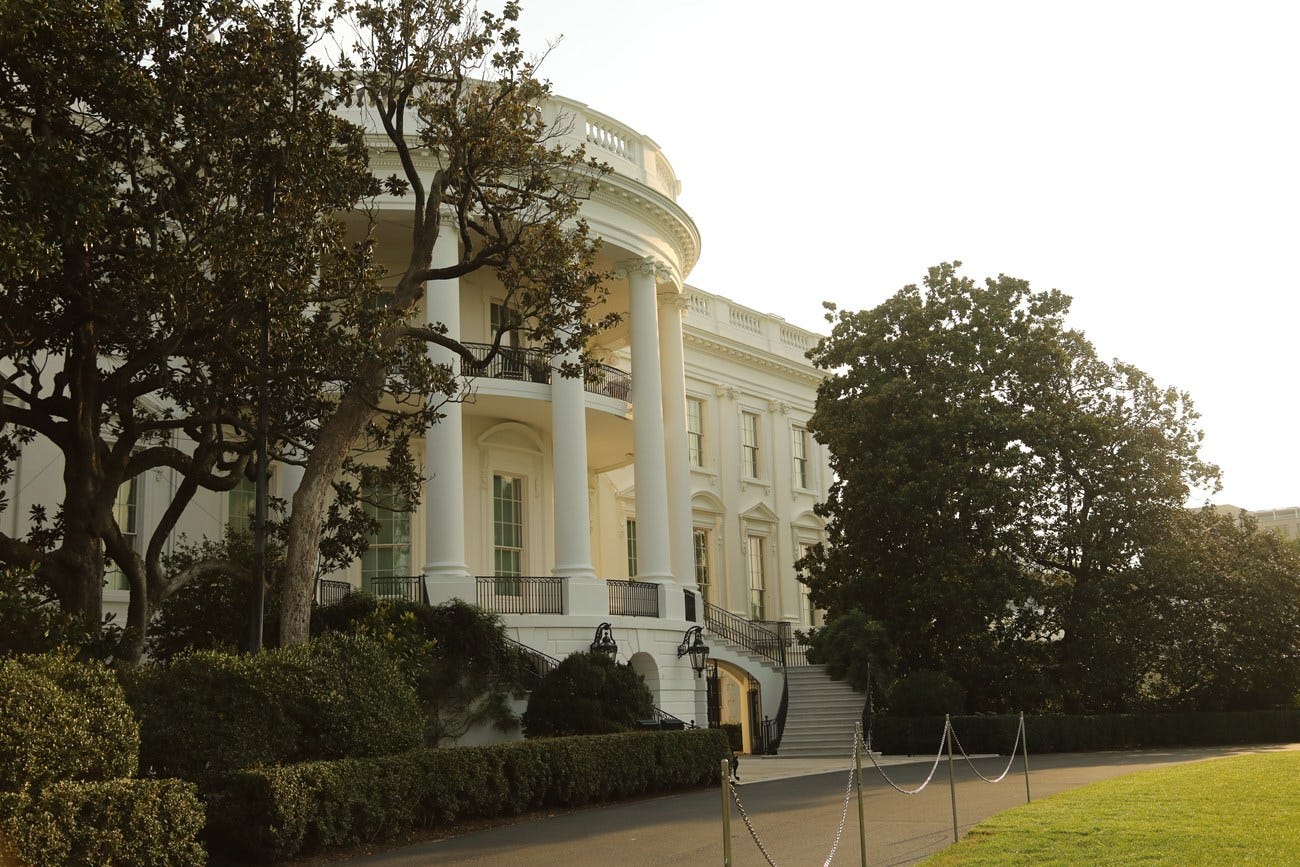
By 2017, the tree had been extensively pruned and propped up with steel cables. To preserve its lineage, its cuttings were propagated and replanted.
Finally, in 2025, under Trump, the decision was made to remove it, a judgment likely based on real safety concerns.
But Trump’s follow-up? A promise that the wood may be used for “high and noble purposes!!!”—a flourish that felt less like stewardship, and more like stagecraft.
II. A Garden Stripped of Memory
This comes after stated plans to remake the Rose Garden—again.
Under Melania Trump in 2020, the Rose Garden lost its crabapple trees, bold colors, and Kennedy-era vibrancy. The redesign drew criticism for being sterile and colorless.
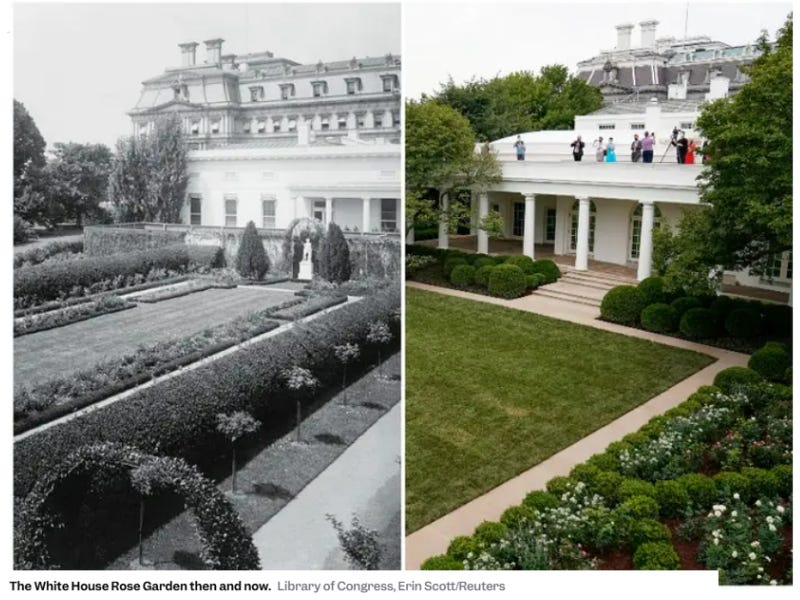
1914 versus 2020
Now, Donald Trump wants to take it further: paving over the lawn with Mar-a-Lago-style stone to make it better suited for formal events. He’s cited practical concerns like heels sinking into wet grass and the inconvenience of temporary tents.
He assures us, “The roses will stay.”
However, the garden—initially redesigned by Jackie Kennedy and later expanded with care by Michelle Obama—was never just about practicality. It was a living, flowering expression of diplomacy and grace.
Replacing it with stone might be efficient. But it flattens something delicate into something performative.
III. The Quiet Erasure of the Swedish Ivy
Inside, a smaller disappearance tells a deeper story.
The Swedish Ivy, a humble houseplant long perched on the Oval Office mantel, has quietly vanished. Believed by some to have been a gift to John F. Kennedy—or at least present since Gerald Ford’s administration—the plant stood beneath the portrait of George Washington for decades.
It didn’t make headlines. It didn’t tweet. It just sat there. Through Nixon. Through Obama. Through war, scandal, crisis, and peace.
Staffers would take cuttings home, a living souvenir of history.
It was removed in 2025. In its place: gold urns, presidential dishware previously displayed in the dining room, and various gilded urns. And underneath, on the stone hearth, mirror-image gold icons now adorn the space above the fireplace.
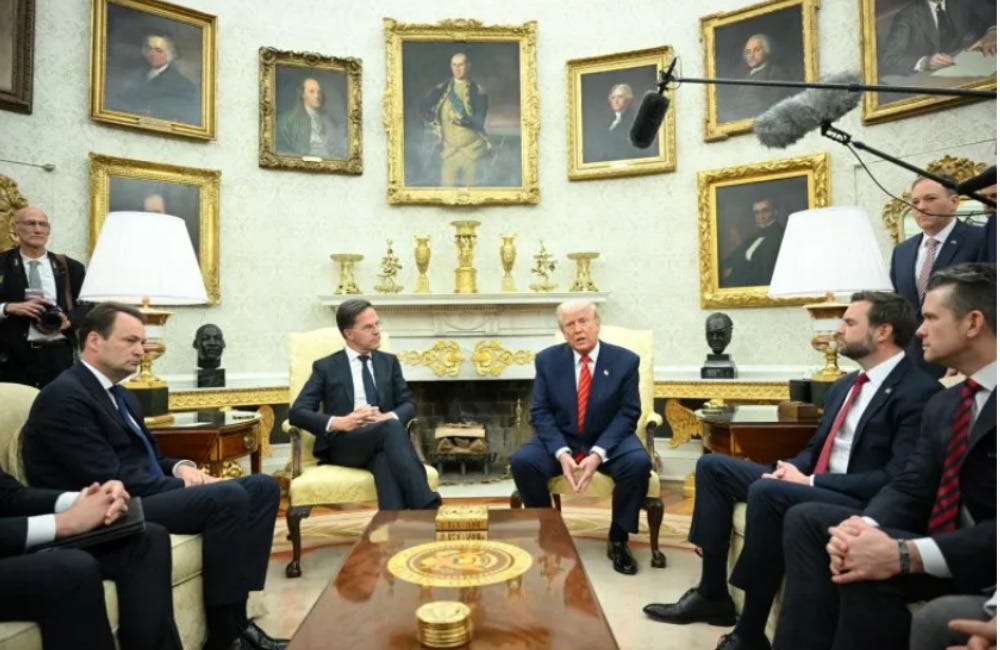
No press conference announced its departure. But like the tree, the ivy had been a quiet witness; one day, it simply wasn't there.
IV. The Gilded Oval
Trump’s Oval Office isn’t just redecorated. It’s curated like a personal showroom.
Gold cherubs from Mar-a-Lago
Golden Trump-branded coasters
Family photos of his parents, his sister Maryanne, Barron, and Tiffany
A framed copy of the Declaration of Independence, lit behind navy blue curtains
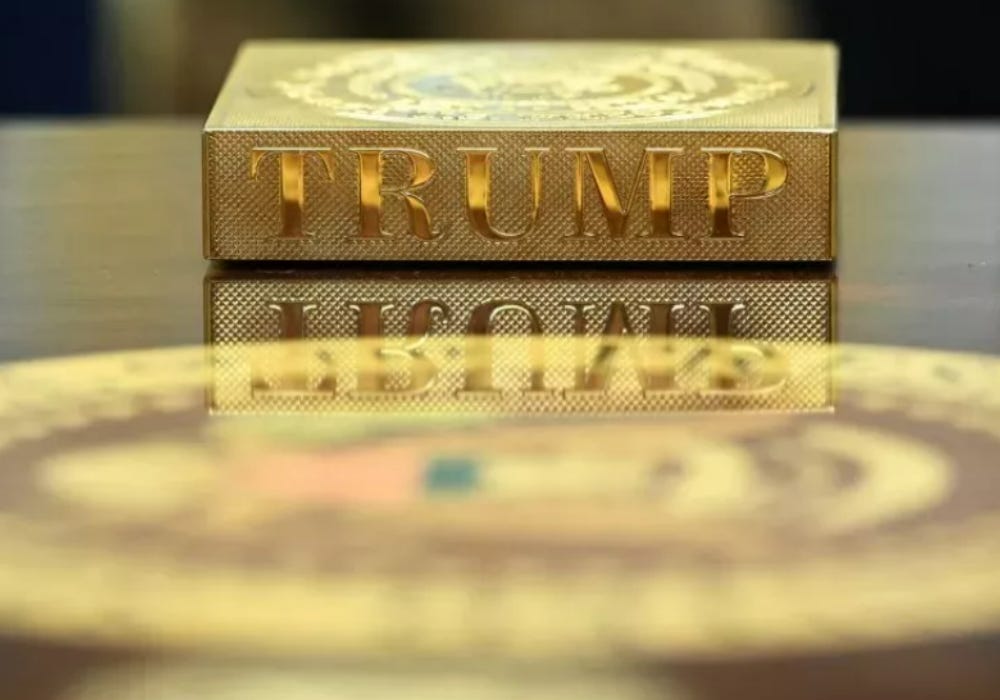
The MLK bust remains, as it did during his first term. But Trump also restored the bust of Winston Churchill, a symbol of power and Western resolve—an odd choice for a president who has grown increasingly hostile to NATO and the European alliance.
When asked about the historic portraits lining the walls, Trump remarked:
“I can live with George Washington, I can live with Thomas Jefferson, I can live with most of them. They took a very safe route… That’s a good one, I can live with [Jackson].”
“I can live with them.”
Not admiration. Not reverence. Approval. They’ve passed his test.
But it’s the Declaration of Independence that delivers the loudest irony.
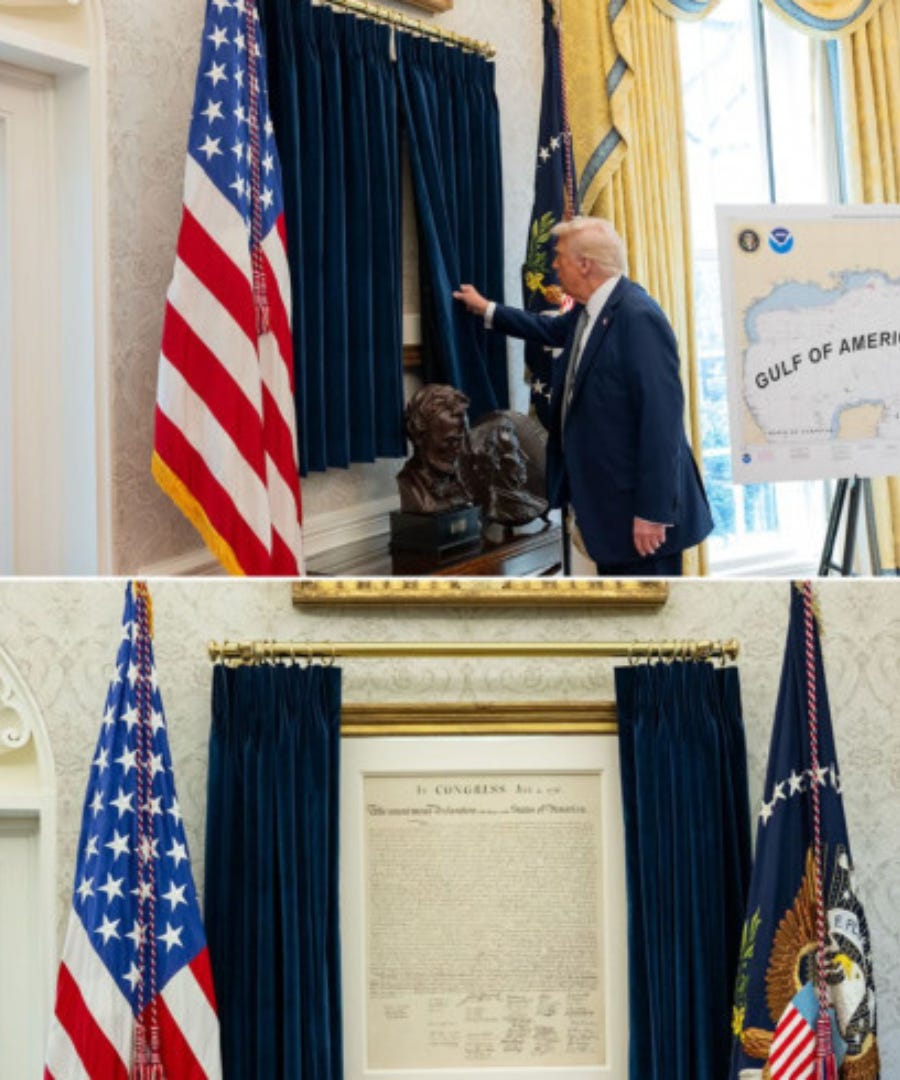
Framed and dramatically spotlighted, the document that defines liberty and checks on power has become a set piece in Trump’s office—part of the gilded aesthetic.
A president who has spent years undermining democratic institutions and consolidating personal power now displays the country’s founding ideals like a collector showing off a trophy.
The Oval Office once reflected the country.
Trump’s version reflects only himself.
See our previous reporting on the Cult of Trump here:

V. The Ballroom of the Sun King
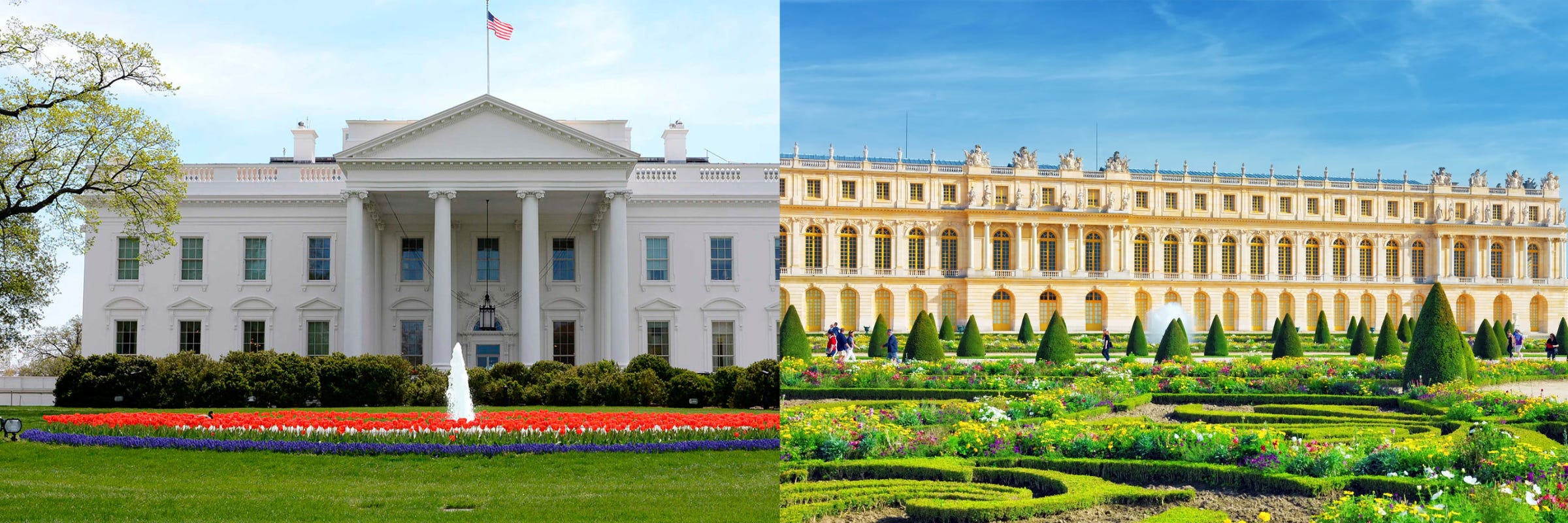
And then, the pièce de résistance: a plan to build a $100 million Versailles-style ballroom.
Trump has floated the idea since 2010, but in his second term, he claims the East Room could serve as the entrance to a new structure, a striking admission of scale.
The East Room, already the largest room in the White House, has long served as the de facto ballroom. It’s nearly 3,000 square feet—larger than most American homes—and has hosted weddings, funerals, state dinners, concerts, and addresses.
But Trump wants more. Not function: grandeur.
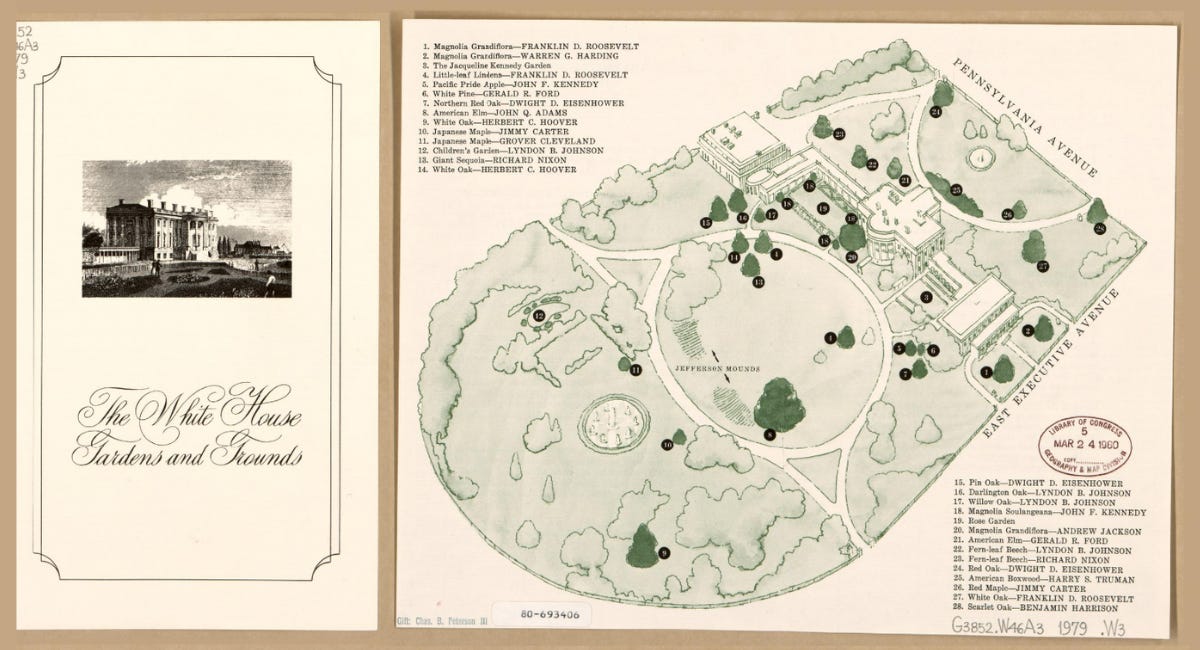
There are no blueprints, but if the ballroom were to be built off the East Terrace, it would likely destroy:
Commemorative trees, some planted by former presidents
The Jacqueline Kennedy Garden
The historical symmetry of the South Lawn
And of course, he compares it to Versailles.
The home of Louis XIV, the “Sun King.” Not a symbol of democracy, but monarchy.
Ironically, Versailles is famed not just for its gilded halls, but its gardens.
Trump wants Versailles’ mirrors, but he’s already tearing up the roses.
VI. From Stewardship to Stagecraft
To be fair: not every change is outrageous.
The Magnolia was dying. The Rose Garden might need better accessibility. Family photos on the desk are expected.
But the pattern is undeniable:
A historic tree becomes material for mythology.
A garden is flattened into a backdrop.
A plant passed between generations is quietly discarded.
A room fit for dignitaries is deemed too small.
This isn’t about governing. It’s about branding.
The White House is supposed to be a symbol of the presidency.
Trump is trying to turn it into a palace.
A throne room.
For a king.
We just hit 10,000 subscribers—thank you! We’re offering full access to The Coffman Chronicle for just $1 a week ($52/year) to celebrate.
Bibliography:
Breuninger, K. (2025, March 31). White House to cut down dangerous magnolia tree planted by Andrew Jackson, Trump says: 'Must come to an end'. New York Post.
Bailey, M. (2025, March 29). Trump eyes paving over White House Rose Garden for patio makeover. The Washington Times.
Lakritz, T. (2024, August 24). How the White House Rose Garden Has Changed Over the Years. Business Insider.
Cartwright, L. (2025, January 20). Trump decorates Oval Office with family photos, other items in White House return. New York Post.
National Park Service. (n.d.). Commemorative Tree Plantings at the White House. nps.gov.
Friedman, D. (2025, March 18). Trump plans White House makeover including Versailles-style ballroom. The Times (UK).
Laviola, E. (2025, January 22). Inside Trump’s revamped Oval Office: Family photos, gold accents, and the return of the Diet Coke button. New York Post.
National Park Service. (n.d.). Jackson Magnolia. nps.gov.
Wikipedia contributors. (n.d.). Oval Office Swedish Ivy. Wikipedia.
For fucks sake why is he destroying our history?
He is just so freaking tacky. I don't care how much money some people have They never have class.