


Editor’s note:
This piece was published before the full impact of the Court’s decision on Louisiana’s election timeline became clear. Louisiana has since suspended its congressional primary after ballot processes had begun, highlighting the kind of mid-cycle disruption the Court has previously cautioned against. We have left the original analysis intact, with this update to reflect those developments.
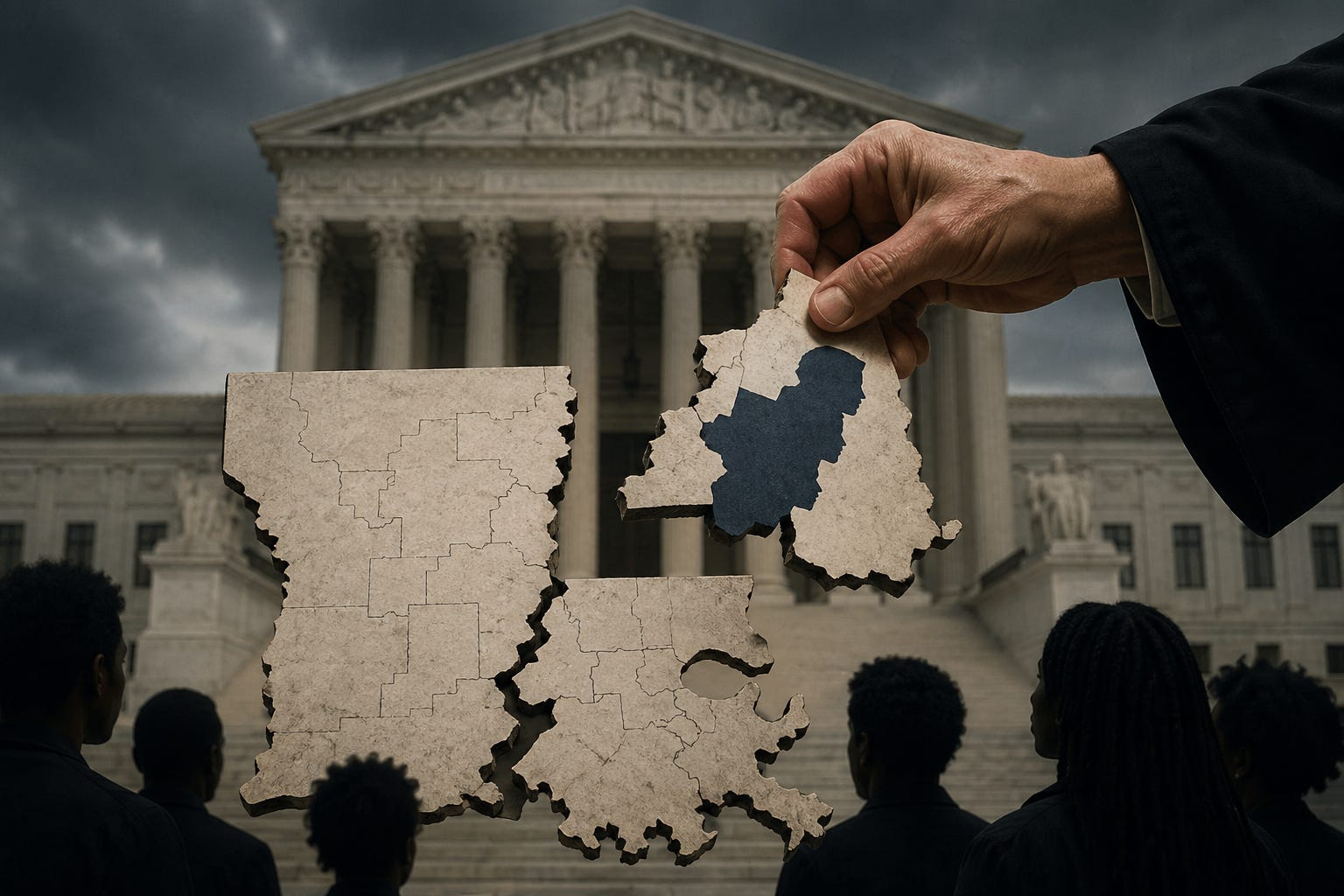
The Supreme Court of the United States has struck down Louisiana’s second majority-Black congressional district, ruling that it constituted unconstitutional racial gerrymandering. The decision does not formally overturn the Voting Rights Act of 1965, but it marks another step in a series of rulings that have narrowed how that law can be used in practice. The result is a decision that resolves one map in Louisiana while raising broader questions about whether one of the country’s most important civil rights laws can still function as intended.
This Community Is Powered by You
What started as a small circle has grown into something much bigger, and it’s all because of readers like you.
Every time you forward this email, post it on socials, or bring someone new into the fold, you’re helping build one of the most passionate, independent political communities out there.
Want to keep the momentum going?
Share this newsletter with someone who should be part of this conversation.
Thank you for being here. It means everything.
What Happened in Louisiana
A map, a lawsuit, and a second district
The dispute began after Louisiana adopted a new congressional map following the 2020 census. The state, which is roughly one-third Black, drew a map with six congressional districts but only one majority-Black district.
Civil rights groups challenged that map under Section 2 of the Voting Rights Act, which prohibits voting practices that result in minority voters having less opportunity to elect candidates of their choice. A federal district court agreed with the plaintiffs, finding that the map likely diluted Black voting power. The court ordered Louisiana to draw a new map that included a second majority-Black district.
After prolonged litigation and appeals, Louisiana ultimately adopted a revised map with two majority-Black districts. That map was then challenged again, this time by plaintiffs who argued that the state had relied too heavily on race in drawing the new district lines, thereby violating the Constitution’s Equal Protection Clause.
That second challenge is what ultimately reached the Supreme Court.
See our most recent reporting on this case here:

The majority’s ruling
In a 6–3 decision, the Court held that Louisiana’s revised map was unconstitutional because race had been used as the predominant factor in drawing the second majority-Black district without sufficient justification.
The majority reasoned that while states can consider race to comply with the Voting Rights Act, they must have a “strong basis in evidence” that such race-based action is required. In this case, the Court concluded that Louisiana had not met that standard. Because the Court found that the Voting Rights Act did not require the creation of a second majority-Black district under the circumstances, it held that the state lacked a compelling interest to justify using race in that way.
That meant the map could not survive strict scrutiny, the highest level of constitutional review.
In his majority opinion, Justice Samuel Alito said:
These and other problems convinced us that the time had come to resolve whether compliance with the Voting Rights Act can indeed provide a compelling reason for race-based districting. We now answer that question: Compliance with §2, as properly construed, can provide such a reason. Correctly understood, §2 does not impose liability at odds with the Constitution, and it should not have imposed liability on Louisiana for its 2022 map. Compliance with §2 thus could not justify the State’s use of race-based redistricting here.
Thomas and Gorush co-authored a concurring decision that said, in part:
I join the Court’s opinion in full. This Court should never have interpreted §2 of the Voting Rights Act of 1965 to effectively give racial groups “an entitlement to roughly proportional representation.” Thornburg v. Gingles, 478 U. S. 30, 93 (1986) … That interpretation rendered §2 “repugnant to any nation that strives for the ideal of a color-blind Constitution.” Id., at 905–906. Today’s decision should largely put an end to this “disastrous misadventure” in voting-rights jurisprudence.
The dissent’s response
Justice Elena Kagan, writing for the three dissenting justices, sharply disagreed. The dissent argued that the lower court had correctly applied the framework established in Thornburg v. Gingles, which governs Section 2 claims.
In a pointed rebuke, she said in part:
Under the Court’s new view of Section 2, a State can, without legal consequence, systematically dilute minority citizens’ voting power. Of course, the majority does not announce today’s holding that way. Its opinion is understated, even antiseptic. The majority claims only to be “updat[ing]” our Section 2 law, as though through a few technical tweaks. Ante, at 26, 29, 32. But in fact, those “updates” eviscerate the law, so that it will not remedy even the classic example of vote dilution given above.
Under that framework, the dissent said, the evidence showed that Black voters in Louisiana were sufficiently numerous and geographically compact to form a second district, that they were politically cohesive, and that white voters typically voted as a bloc to defeat their preferred candidates. In the dissent’s view, that meant the Voting Rights Act did require the creation of a second majority-Black district.
Kagan argued that the majority was not simply resolving a dispute about this particular map. Instead, she wrote, the Court was making it significantly harder to use Section 2 to challenge vote dilution in the future. In her words, the decision continued a pattern of rulings that, taken together, are steadily weakening the Voting Rights Act.
The Majority/Dissent Battle
The tone of the majority and dissenting opinions underscores how sharply the justices disagree, not just about the outcome, but about the framing of the case itself. At one point, Justice Samuel Alito accuses the dissent of appearing to “forget—or at least tries to lead readers to forget” that the case arises under the Fourteenth Amendment.
That exchange, as well as others, reflects a deeper divide. The majority treats the case primarily as a constitutional question about limits on race-based decision-making. The dissent sees it as a straightforward application of the Voting Rights Act’s protections against vote dilution. The difference in framing leads to very different conclusions about what the law requires.
What the Court Did Not Say and Why That Still Matters
The Court did not declare Section 2 of the Voting Rights Act unconstitutional, nor did it eliminate the legal framework established in Gingles. It also did not say that majority-minority districts are impermissible.
However, the dissent’s concern is that none of that matters if the standards for applying the law become so restrictive that plaintiffs cannot meet them.
The majority framed its decision as an enforcement of constitutional limits on race-based decision-making, while the dissent framed it as something more consequential. A law can remain on the books, the dissent suggests, while becoming increasingly difficult to use in practice. That is the space where this decision sits. This timeline is what Kagen was referencing.
The Pattern the Dissent Sees
Over the past decade, the Supreme Court of the United States has not repealed the Voting Rights Act of 1965, but it has reshaped how the law operates.
In Shelby County v. Holder, the Court invalidated the formula that determined which jurisdictions were subject to federal preclearance, effectively disabling one of the Act’s most powerful enforcement mechanisms. That provision had required certain states to obtain federal approval before changing voting laws.
Years later, in Brnovich v. Democratic National Committee, the Court addressed Section 2 of the Act, which remains the primary tool for challenging discriminatory voting practices. There, the Court introduced a set of guideposts that made it more difficult to prove that voting rules unlawfully burden minority voters.
Then in Rucho v. Common Cause, the Court closed the door to federal claims against partisan gerrymandering, removing another potential avenue for challenging maps that entrench political power.
Each of those decisions addressed a different part of the voting system. While none of them eliminated the Voting Rights Act entirely, taken together, they have narrowed the law’s reach and shifted more responsibility to states and lower courts.
Justice Elena Kagan’s dissent in the Louisiana case places this decision within that trajectory. Her concern is not only about the map at issue, but about the cumulative effect of rulings that preserve the statute while making it increasingly difficult to enforce.
The VRA’s Core Tension: Required, but Restricted
At the heart of the case is a tension that has been building for years.
The Voting Rights Act sometimes requires states to take race into account when drawing district lines in order to prevent vote dilution. At the same time, the Constitution, as interpreted by the Court, limits the use of race as a predominant factor in government decision-making.
Those two principles can point in opposite directions.
To comply with the Voting Rights Act, a state may need to draw a district that reflects racial voting patterns. However, if race becomes too central to that process, the state risks violating the Equal Protection Clause. The Court’s doctrine attempts to reconcile those competing demands by requiring a strong evidentiary basis and narrow tailoring.
The dissent’s concern is that the balance has shifted. If the bar for justifying race-conscious districting becomes too high, the Voting Rights Act may no longer function as an effective tool to address the very harms it was designed to prevent.
Race, Party, and the Line the Law Draws
This case also sits within a broader legal landscape shaped by Rucho v. Common Cause. In that decision, the Court held that claims of partisan gerrymandering are not justiciable in federal court because there are no manageable legal standards for resolving them.
That creates a sharp distinction. Racial gerrymandering and vote dilution claims can still be heard in court, while purely partisan gerrymandering claims generally cannot.
In practice, however, race and party often overlap. In states like Louisiana, Black voters tend to support Democratic candidates at high rates, while white voters are more likely to support Republicans. That means a map drawn to maximize partisan advantage can produce effects that closely resemble racial vote dilution.
The legal system requires courts to distinguish between those two explanations. The concern raised by critics of the Court’s recent decisions is that the “it’s partisan, not racial” argument may become an increasingly effective defense, even in situations where the real-world impact falls heavily along racial lines.
What Happens Next in Louisiana
The Court’s decision invalidates Louisiana’s current congressional map, but it does not dictate a specific replacement. The case will return to the lower courts, and the state will have the first opportunity to produce a new, legally compliant map.
That process is unlikely to be straightforward.
Louisiana’s legislature will need to draw and pass a new plan, potentially navigating political divisions and the possibility of a gubernatorial veto. Any new map could face additional legal challenges, either under the Voting Rights Act or under constitutional claims.
If the state cannot act quickly enough, a federal court could step in and impose an interim map, often with the assistance of a special master. That outcome is not uncommon in redistricting disputes where time is short and agreement proves difficult.
The Clock Is Ticking
Louisiana’s congressional elections typically use a fall “open primary” system, in which all candidates compete on a single ballot, and a runoff is held if no one wins a majority. That later schedule gives the state more time to redraw its map than states with spring primaries, but it does not eliminate the logistical and legal pressure created by the Court’s decision.
Candidate filings, ballot preparation, voter education, and administrative updates must still be completed on a fixed schedule, and delays in redistricting can ripple through each of these steps.
While this is not a last-minute crisis of the kind courts warn against in Purcell v. Gonzalez, it is still a situation where legal uncertainty and administrative reality begin to collide. Conflicts over the next map could lead to a tighter deadline, potentially triggering a Purcell moment.
Why Congress Can Only Do So Much
With the partisan-not-racial argument now more firmly on the table, the tools to combat gerrymandered districts have dwindled.
One potential response to the broader problem of gerrymandering is federal legislation. Congress has authority under the Elections Clause to regulate congressional elections, including the drawing of House districts. In recent years, the House has passed the For The People Act to combat partisan gerrymandering more than once. However, the Senate has routinely shut it down.
Importantly, even if Congress did manage to pass reforms, that authority has limits. Congress can set rules for congressional maps, but state legislative districts remain largely under state control. That means even robust federal reform would address only part of the problem. State courts, state constitutions, and independent commissions would continue to play a central role in regulating districting at the state level.
In other words, there is no single lever that can resolve the broader issue. More pointedly, there is no magic bullet, and there is a concerning lack of political will as well.
The Bigger Picture
This SCOTUS decision arrives in a political environment in which redistricting has become an increasingly aggressive tool for partisan advantage. Over the past decade and particularly in the last year, both parties have used control of state governments to shape maps in ways that entrench their power.
See our previous reporting here:
Note: Articles roll into the archive over time. Become a paid subscriber for full access to our extensive catalog.


The Voting Rights Act has been one of the few federal tools capable of addressing certain forms of that problem, particularly where racial vote dilution is involved. The Court’s recent decisions, taken together, suggest a narrowing of that tool’s reach.
The immediate impact of this case is clear. Louisiana’s second majority-Black district is gone, at least for now.
The longer-term question is less settled. As the legal space for race-conscious remedies becomes more constrained, the gap between what the law prohibits and what it can effectively address may continue to widen.
That gap is where the next round of redistricting battles will be fought, and if the current trajectory is any indication, the outlook isn’t good.
Decisions like this don’t just change one map. They reshape the rules of the game. If you want coverage that explains how and why, subscribe for more.
Sources:
Supreme Court of the United States — “Louisiana v. Callais,” decided April 29, 2026.
SCOTUSblog — “In major Voting Rights Act case, Supreme Court strikes down redistricting map challenged as racially discriminatory,” April 29, 2026.
SCOTUSblog — “Louisiana v. Callais (Voting Rights Act) (24-109),” updated April 29, 2026.
Reuters — “US Supreme Court guts key provision of Voting Rights Act,” April 29, 2026.
Associated Press — “Supreme Court weakens the Voting Rights Act and aids GOP efforts to control the House,” April 29, 2026.
The Guardian — “US supreme court ‘demolishes’ Voting Rights Act, gutting provision that prevented racial discrimination,” April 29, 2026.
Supreme Court of the United States — “Allen v. Milligan,” decided June 8, 2023.
SCOTUSblog — “Allen v. Milligan (21-1086),” decided June 8, 2023.
Supreme Court of the United States — “Brnovich v. Democratic National Committee,” decided July 1, 2021.
SCOTUSblog — “Rucho v. Common Cause (18-422),” decided June 27, 2019.
Justia — “Shelby County v. Holder, 570 U.S. 529 (2013),” decided June 25, 2013.
Louisiana Secretary of State — “2026 Elections,” revised April 2026.
Gerrymandering, in its best and most adaptive sense, is INTENDED to distort racial, for example balance. It's best purpose is to give voice to minorities who would otherwise be overwhelmed by the majority.
I don't think you mentioned NC. NC gerrymanders such that in a state in which the majority of registered voters are African American, 11 of 14 districts are distorted to result in Caucasian electeds. That is foul or corrupt gerrymandering.
Thank you for this article on the court decision. Somehow the way you have explained it all so well gives me hope that all is not lost in spite of their decision. Thanks again.