


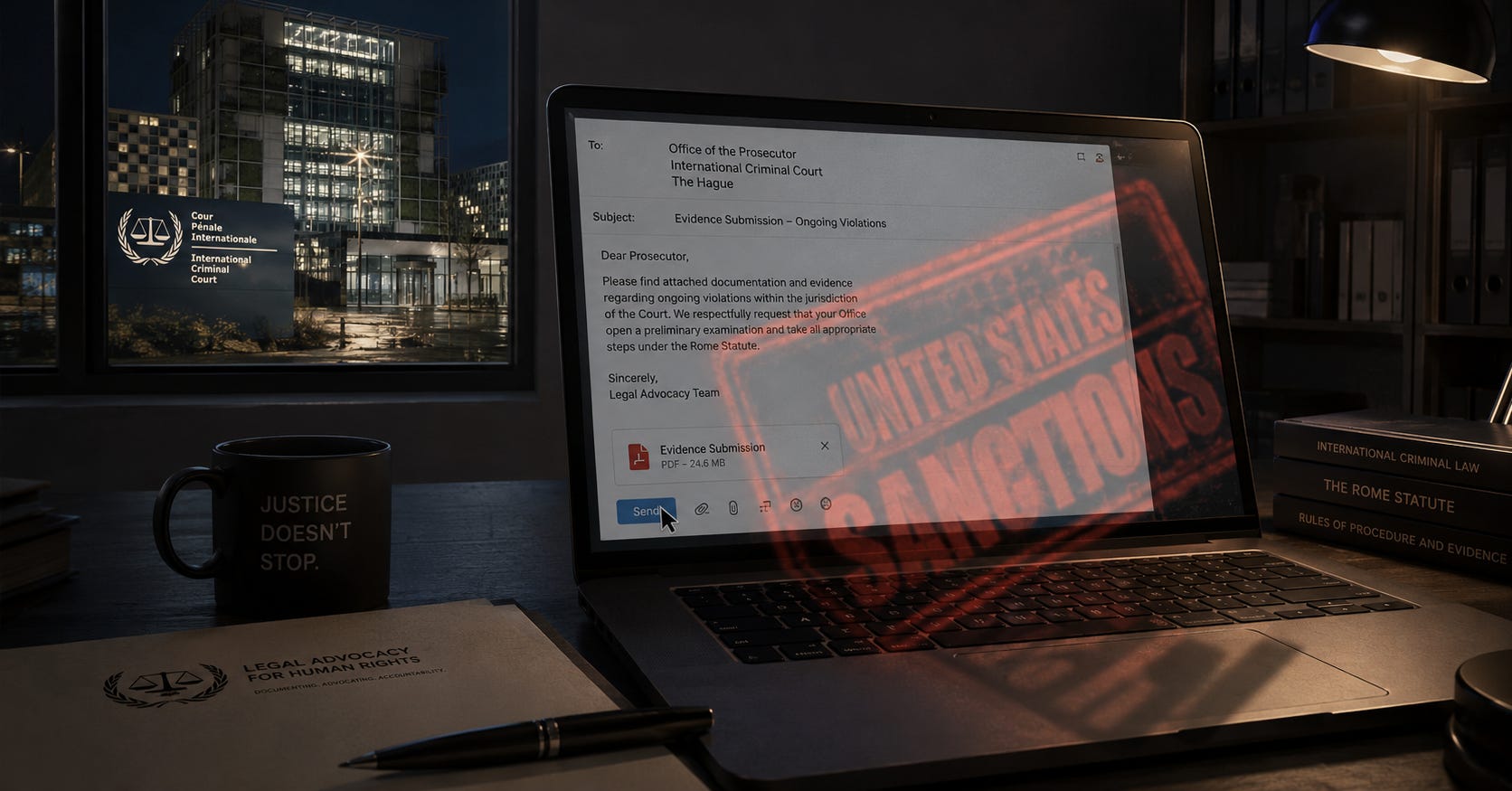
The Evidence That Was Never Sent
The document was ready. The evidence had been gathered, the legal analysis completed, the names checked and the citations verified. What remained was the simplest part of the process: attach the file, enter the address and press send. Instead, the cursor waited.
The lawyers were no longer debating whether the information was relevant. They were debating what the American government might do if they delivered it. Could sending the document be treated as providing a prohibited service? Could the organization’s money be frozen? Could an employee who exchanged legal research with the wrong person face a federal investigation? Could a bank, frightened by the risk, close the organization’s accounts before any court decided whether a law had been broken?
These were not questions asked by spies passing classified information to an enemy government. They were being asked inside American advocacy organizations by Americans conducting legal research, collecting evidence and attempting to petition an institution through established procedures.
The threat did not need to arrive as an indictment. It could arrive as a warning from counsel, a compliance notice from a bank, a grant placed on hold or an email left unanswered because the recipient had become too dangerous to contact.
That is how power can silence speech without ordering anyone to be silent. The evidence remains in the office. The email remains unsent. The court waiting to receive it sits in The Hague.
Support independent media that follows the power.
The Coffman Chronicle is built to track who holds power, who abuses it, who profits from it, and who pays the price.
Paid supporters get full Tony Michaels Podcast episodes, deeper transcript analysis, paid columns, archives, and the reporting framework behind the show.
If you believe independent media has to survive outside billionaire platforms, corporate media, and party-approved gatekeepers, become a paid supporter today.
This Is Not Merely a Refusal to Join
Two days before those organizations went to court, Secretary of State Marco Rubio described what the United States intended to do to the International Criminal Court (ICC). The government would dismantle it “brick by brick, if necessary.”
The State Department offered a more bureaucratic description. It called for a whole-of-government response designed to “systematically disable” the court’s ability to operate.
The United States has never ratified the Rome Statute, the treaty that created the ICC. Presidents from both parties have objected to parts of its jurisdiction and to its attempts to investigate people from countries that never joined it.
That history gives the government room to refuse cooperation. It can decline to surrender an American citizen, deny access to classified information, challenge warrants and ask Congress to define the limits of American participation.
However, the campaign now reaches beyond keeping the United States outside the court. It includes financial sanctions, travel restrictions, pressure on allied governments and penalties aimed at the people and institutions that allow the court to function.
There is a difference between declining to enter a courthouse and trying to cut off its electricity. One preserves a nation’s right to refuse jurisdiction. The other uses that nation’s power to decide whether anyone else’s court will be allowed to operate.
The Sovereignty Argument Deserves a Fair Hearing
The American objection is not frivolous. President Bill Clinton signed the Rome Statute in 2000 but did not submit it to the Senate for ratification. President George W. Bush later withdrew American support for the signature. Congress then restricted cooperation with the court and declared that American military personnel should be protected from prosecution by an institution the country had never agreed to recognize.
The ICC claims jurisdiction over genocide, crimes against humanity, war crimes, and the crime of aggression. It may assert jurisdiction when alleged crimes occur within a member country, even when the accused comes from a country that never joined.
Americans may reasonably ask how a treaty the Senate never ratified could expose an American soldier, intelligence officer or elected official to prosecution abroad. They may also question the court’s procedures, record and leadership. Its work has been uneven, its authority contested and its prosecutor damaged by serious allegations.
None of that should be concealed to make the administration easier to condemn. The United States has a legitimate right to protect its citizens and contest jurisdiction, but that right does not settle how far America may go against countries that made a different sovereign choice.
The United States stayed outside the court, but 125 countries ratified the Rome Statute and accepted the ICC’s jurisdiction. They granted their informed consent.
America cannot demand absolute respect for its refusal while treating others' participation as something Washington may punish or reverse. Refusing to surrender an American citizen is a defense of American authority. Sanctioning judges, restricting advocates and pressuring allied governments because they support a court they lawfully joined reaches beyond it.
The message is clear. The ICC has no authority over us, and its members may exercise only the authority we permit. Under that standard, the United States gets sovereignty. Everyone else gets permission.
American sovereignty cannot mean that America controls its own decision and everyone else’s. At some point, protection becomes coercion, and the demand to remain beyond a court’s reach begins to look less like sovereignty than immunity enforced by power.
Congress Built the Shield the President Is Turning Into a Weapon
The administration did not create American resistance to the ICC. Congress helped write it into law.
In 2002, lawmakers passed the American Servicemembers’ Protection Act, restricting cooperation with the court and declaring that the United States had an obligation to protect American personnel from prosecution by an institution the country had never joined. That law was intended as a shield against surrender.
Congress also delegated broad emergency and economic powers to the president. Under the International Emergency Economic Powers Act and the National Emergencies Act, the executive branch can freeze assets, block transactions and impose severe financial restrictions after declaring that an overseas situation presents an unusual and extraordinary threat.
The current administration has brought those powers together. The shield against surrender has become a weapon against the institution itself. The president is no longer merely saying that the United States will not hand over an American citizen. The executive branch is deciding which judges, prosecutors, advocates and organizations may be sanctioned for helping the court perform work the administration opposes.
Congress created the policy of resistance, delegated the emergency powers and left broad language for presidents to interpret. It now watches as those authorities are used not only to protect Americans from foreign prosecution, but also to disable the people capable of pursuing it.
Trump did not invent Washington’s hostility toward the ICC. He inherited a structure built across administrations and transformed it into something more aggressive. Congress built the shield. The president is turning it outward.
When Congress gives the executive emergency power without meaningful limits, the president eventually decides that accountability itself is the emergency.
When an Investigation Becomes an Emergency
The word emergency changes what government may do. It allows the executive branch to block property, prohibit transactions, restrict travel and act before targets receive the notice normally expected under law. That machinery was built for threats. The administration has now aimed it at an international court.
Under the executive order, the president may sanction people accused of participating in certain ICC investigations or materially assisting them. The prohibition can reach those who provide money, goods or services to a sanctioned person.
Sanctions are designed to isolate. Banks examine accounts. Lawyers reconsider representation. Donors become cautious. Vendors step away. Employees wonder whether exchanging information could be treated as prohibited support. The government does not need to imprison everyone involved. It simply needs to make involvement dangerous.
The same executive branch whose conduct or alliances may be examined is empowered to identify the investigators, punish those who assist them and frighten away the institutions that make their work possible.
The government may have a legitimate argument against the ICC’s jurisdiction, but once the investigation itself becomes an emergency, the president no longer has to win that argument in a courtroom. He can use American financial power to make the argument harder to hear.
The Sanctions Did Not Stop at The Hague
On July 15, 2026, two American advocacy organizations asked a federal court in Manhattan to stop the administration from using the sanctions order against their work. Democracy for the Arab World Now and the Taxpayer Alliance Against Genocide argue that the policy violates the First Amendment by restricting what Americans may say, whom they may assist and which institutions they may petition. The administration disputes those claims, and the lawsuit has only begun.
The work the organizations say they abandoned shows how far the policy’s reach extends. DAWN says it halted submissions to the ICC concerning Israel’s conduct in Gaza and stopped exchanging evidence and legal analysis with sanctioned Palestinian organizations. The Taxpayer Alliance says it refrained from submitting material intended partly for the court.
Neither organization says federal agents confiscated its files, but rather that the threat was enough.
Providing or receiving a “service” from a designated person or organization can expose someone to severe penalties. The plaintiffs argue that the term may reach filing a legal brief, sharing evidence or helping a sanctioned organization challenge its designation.
The State Department says the policy is necessary to stop ICC overreach. That defense belongs in court, but Americans considering whether to provide evidence must already calculate whether their speech could be classified as a prohibited service. Researchers must decide whether sharing information could threaten their funding or freedom. Lawyers must ask whether communicating with the wrong person could bring federal sanctions down upon them.
A similar order issued during Trump’s first administration was blocked after a federal judge concluded that the challengers were likely to succeed on their First Amendment claim. The Biden administration later rescinded it. The new case may end differently.
The constitutional warning does not have to wait. The policy presented as a shield against foreign judges is already shaping which evidence Americans feel safe delivering and which arguments they feel safe making.
The sanctions did not stop at The Hague. They followed the evidence home.
The ICC Does Not Have to Be Innocent for This to Be Dangerous
None of this requires pretending that the ICC has earned unquestioning trust. The court has been criticized for uneven enforcement, slow investigations, weak results and dependence upon governments that support international justice until scrutiny moves closer to home. Its leadership has suffered serious damage, and the allegations involving its prosecutor deserve investigation.
Those failures are part of the story, but they do not answer the question before us. Governments can challenge jurisdiction, refuse cooperation, demand reform and expose hypocrisy without granting themselves the right to financially isolate everyone connected to the institution.
The remedy for a compromised prosecutor is investigation and, when justified, removal. The remedy for a legally defective warrant is a legal challenge. The remedy for institutional bias is evidence, diplomacy, reform and public scrutiny. The remedy cannot automatically become disabling the court, threatening its supporters and frightening witnesses away from its doors.
Powerful defendants rarely need perfect institutions to escape accountability. They need institutions weakened enough that every flaw becomes a reason to stop the inquiry.
Institutional failure is an argument for accountability within the court. It is not a blank check for the most powerful government outside it to bring the building down.
The Kitchen-Table Standard
Ordinary people do not get to destroy the process because they distrust the person running it. A worker who believes a licensing board exceeded its authority still has to answer the notice. A homeowner who thinks a tax assessment is wrong still has to appeal. A small business accused of violating a regulation cannot freeze the agency’s bank accounts or threaten every lawyer willing to represent it.
A defendant may challenge jurisdiction, accuse the prosecutor of misconduct, present evidence, and appeal an unjust result. What a defendant may not do is punish the witnesses, frighten away the lawyers and make the court financially unable to hear the case.
That difference is obvious at the kitchen table because ordinary people live beneath it. They are told to comply, contest, document, appeal and wait. The process may be slow or unfair. It may be administered by people who make mistakes or abuse power, but ordinary people are not permitted to dismantle the institution examining them.
The United States may dispute the ICC’s authority, refuse to surrender an American citizen, and expose every defect in the court’s work, but this remedy reaches the judges, researchers, advocates, organizations, and governments that keep the process alive. It uses American financial power to make participation costly and silence safer.
The powerless must answer the process. The powerful are trying to destroy the process.
That is not a rule of law that applies equally. It is one standard for people who must live beneath authority and another for governments powerful enough to punish anyone who questions theirs.
Congress Cannot Call This Sovereignty and Walk Away
Congress does not have to support the ICC to investigate what the administration is doing. It does not have to endorse the court’s warrants or accept its jurisdiction over Americans. It only has to perform its constitutional duty.
Lawmakers should demand to know what the State Department means by “systematically disable,” which agencies are participating, which governments are being pressured, and what conduct may justify sanctions.
They should also require a clear answer about what counts as a prohibited service. Does it include sending evidence, sharing legal research, representing a sanctioned organization or helping someone challenge a designation? Those questions determine whether emergency economic law is protecting American sovereignty or policing American speech.
Congress should also determine whether the powers it delegated were meant to reach this far. If lawmakers believe the administration is acting lawfully, they should defend that judgment publicly. If the language is too broad, they should narrow it. If Americans engaged in lawful advocacy or petitioning need clearer protection, Congress should provide it.
What Congress cannot do is disappear behind the word sovereignty. It built the shield, delegated the power and retained the authority to hold hearings, demand records, amend the law and stop an escalation it never intended.
The president is responsible for how he uses power. Congress is responsible for the power it leaves available.
A Republic Does Not Prove Its Sovereignty by Silencing the Witness
The document remains ready. The evidence has been gathered. The people who prepared it still believe it should be examined. What changed is the cost of sending it.
An American organization must consider whether delivering evidence could be treated as providing a prohibited service. A researcher must consider whether exchanging information could threaten a career, an account or a freedom. A lawyer must consider whether helping someone reach a court could place the lawyer within reach of the same sanctions.
The government may persuade a federal judge that those fears are misplaced or that the restrictions are lawful. The ICC may lose jurisdictional disputes. Its warrants may be rejected. Its prosecutor may be disciplined or removed. The United States may never join the court. None of those outcomes requires making inquiry dangerous.
The constitutional danger begins when a government no longer limits itself to contesting an institution’s authority, but uses public power to punish the people who keep that institution capable of asking questions.
That logic will not always be aimed at a court Americans distrust. It can be turned toward journalists who receive inconvenient evidence, lawyers who represent disfavored clients, organizations that document misconduct and citizens who petition institutions a president has declared hostile. Once accountability itself can be labeled an emergency, everyone who assists it can be treated as part of the threat.
The power to defend the country is not the power to declare every examination of its conduct an attack. The authority to protect American citizens is not the authority to grant American leaders and favored allies immunity enforced through financial fear.
A republic may refuse a court’s jurisdiction. It may challenge a warrant, expose misconduct, and defend its citizens through law, but a republic does not demonstrate strength by frightening witnesses into silence, isolating advocates, or making evidence too dangerous to deliver.
The email remains unsent. That may protect the people who prepared it. It does not protect the republic.
A republic does not prove its sovereignty by making accountability impossible.
Stay Vigilant - Support Independent Media
Call your senators and representative and ask one direct question: Do you support using emergency economic powers to punish Americans for providing lawful evidence, research or legal advocacy to an international court?
Congress does not have to support the ICC to defend the First Amendment, limit presidential power and demand public answers.
Share this article with someone who believes sovereignty should protect the republic, not place powerful people beyond accountability. The Coffman Chronicle is reader-supported. If you can afford to, consider becoming a paid subscriber so this work can continue.
Sources:
“American Servicemembers’ Protection Act of 2002,” U.S. Government Publishing Office, August 2, 2002, amended through December 29, 2022.
“Human Rights Groups Sue over Trump Administration’s Sanctions on ICC for Investigations into Israel,” Associated Press, July 15, 2026.
“Imposing Sanctions on the International Criminal Court,” The White House, February 6, 2025.
“International Emergency Economic Powers,” Office of the Law Revision Counsel, U.S. House of Representatives, accessed July 15, 2026.
“National Emergencies,” Office of the Law Revision Counsel, U.S. House of Representatives, accessed July 15, 2026.
“Open Society Justice Initiative et al. v. Trump et al., Opinion and Order Granting Preliminary Injunction,” U.S. District Court for the Southern District of New York via Justia, January 4, 2021.
“President Clinton on Signing of ICC Treaty,” U.S. Department of State Archive, December 31, 2000.
“Rome Statute of the International Criminal Court,” International Criminal Court, adopted July 17, 1998, official text updated May 2024.
“Trump Administration Launches Effort to Isolate International Criminal Court,” Reuters, July 13, 2026.
“Trump Administration Vows to Dismantle the International Criminal Court,” Time, July 14, 2026.
“Trump’s ICC Order Violates Free Speech, Advocacy Groups Say in Lawsuit,” Reuters, July 15, 2026.
“U.K. Legal Watchdog Upholds Suspension of ICC Prosecutor Karim Khan,” Associated Press, July 14, 2026.
“U.S. Announces Intent Not to Ratify International Criminal Court Treaty,” American Society of International Law, May 11, 2002.
“U.S. Judge Blocks Trump Sanctions Targeting Human Rights Lawyers, War Crimes Tribunal,” Reuters, January 4, 2021.
“What Does the Trump Administration Statement on Dismantling the ICC Really Mean?” Just Security, July 14, 2026.
The Fapweasel (Trump) wants to cut out so many government programs, like Medicaid, programs that act as watchdogs for our health, protect us from being scammed, and keep American industries honest and accountable. If he wants to get rid of all of these protections, what is his government good for? Why should we pay income tax if The Fapweasel (Trump) is going to spend taxpayer money on worthless projects like his ballroom and that stupid arch? He bloated the Pentagon's budget, but our country is such a mess that our enemies don’t need to invade to destroy us. The Fapweasel (Trump) is doing that already.
It is absurd. We don't mind the ICC when it works for us. We expect non-citizens to follow our law here. Expecting our citizens to not be subject to outside jurisdiction if they violate international law, while in another country, is the height of hypocrisy.