


The Tunnel Everyone Depends On
A Tunnel Most People Never Think About
Every weekday morning, hundreds of thousands of people pass beneath the Hudson River without thinking much about it. Trains glide out of New Jersey, disappear into darkness, and re-emerge in New York on schedules tight enough to hold jobs together, paychecks on time, and entire households in balance. For most riders, the tunnel isn’t infrastructure. It’s just the way life works.
What almost no one thinks about is how old that tunnel is, how much saltwater damage it absorbed during Hurricane Sandy, or how close it already operates to failure. Fewer still realize that if those tunnels were forced out of service unexpectedly, the economic shock wouldn’t be local. It would ripple up and down the Northeast Corridor, disrupting one of the most economically dense regions in the country.
That’s why the replacement project has been discussed for decades. It’s why it finally moved forward. And it’s why most people assumed the hardest part was over once Congress approved the funding, contracts were signed, and construction began.
Approved, Funded and Still Stalled
That assumption turned out to be wrong.
In recent weeks, New York and New Jersey quietly went to federal court seeking emergency relief after the federal government froze roughly $16 billion in funding for the Hudson River tunnel project, money that had already been approved, committed, and incorporated into active construction plans. This wasn’t a proposal denied or a budget that failed to pass. It was a project that cleared every formal hurdle and then stalled anyway.
The dispute now unfolding isn’t really about concrete, steel, or rail schedules. It’s about whether federal infrastructure funding, once authorized and underway, can be paused at will by the executive branch, even after Congress has spoken and states have relied on that decision.
For the commuters passing under the river each morning, the tunnel feels permanent. In Washington, it turns out, permanence is negotiable.
WHAT CONGRESS ALREADY DECIDED
This Wasn’t a Proposal. It Was a Commitment.
To understand why New York and New Jersey went to court, and why this fight matters far beyond a single tunnel, it helps to be precise about what Congress actually did, and what it did not leave open for later negotiation.
In November 2021, Congress passed, and the President signed, the Infrastructure Investment and Jobs Act, a sweeping overhaul of federal infrastructure policy after decades of underinvestment. The law wasn’t a suggestion or a framework. It authorized specific funding streams, created new grant programs, and directed federal agencies to enter into binding funding agreements for projects that met defined criteria.
Passenger rail, particularly along the Northeast Corridor, was one of its central priorities.
Under the law, Congress didn’t simply set aside money in the abstract. It empowered agencies like the Federal Transit Administration and the Department of Transportation to execute Full Funding Grant Agreements, commit federal dollars over multiple years, and partner with states that were prepared to shoulder their share of the cost. Those agreements are not informal understandings. They are legal commitments designed to give states the certainty needed to hire workers, sign contracts, and break ground.
The Hudson River tunnel project qualified under those terms. It cleared environmental review. It secured state matching funds. It met federal cost-benefit thresholds. It advanced through the very approval pipeline Congress designed when it passed the infrastructure law.
Authorization, Appropriation, Obligation: Why the Distinction Matters
That distinction matters.
There is a meaningful difference between a project Congress debates but never funds, and one Congress explicitly bankrolls through statute and implementation. In the former case, delay is part of the political process. In the latter, delay becomes something else entirely, a disruption of settled expectations, contractual reliance, and statutory execution.
By the time construction began, the question of whether the federal government would participate had already been answered. The remaining questions were logistical: timelines, coordination, oversight. What was no longer on the table was whether the project deserved funding in the first place.
That’s why state officials argue the current freeze crosses a line. Their claim isn’t that Washington owes them a favor. It’s that Washington is backing away from a decision Congress already made after states acted on it.
In infrastructure, certainty isn’t a luxury. It’s the condition that makes long-term projects possible at all. Without it, laws lose their force not because they were repealed, but because they were quietly suspended.
That quiet suspension is what pushed this fight out of conference rooms and into federal court.
THE PROJECT ITSELF AND WHY IT MATTERS
The Hudson River tunnel project is not a standalone build. It is the most critical piece of the Gateway Program, a long-planned effort to stabilize and modernize the rail spine that runs from Washington, D.C., through New York, and into New England.
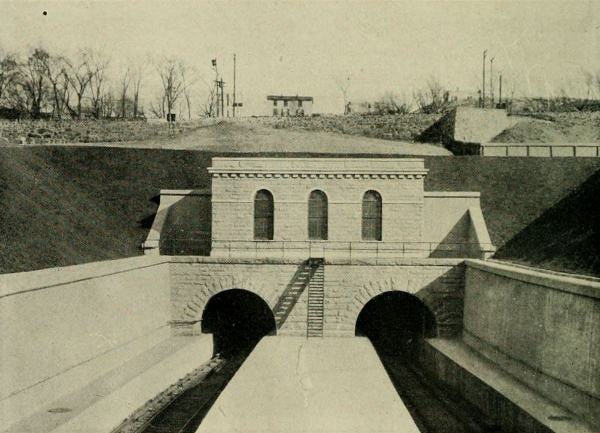
At the center of that spine are two single-track tunnels built in 1910. They carry Amtrak and NJ Transit trains beneath the Hudson River every day, serving roughly 200,000 passengers and moving a volume of economic activity that far exceeds their modest appearance. Those tunnels are more than a century old, operate at near-capacity, and were severely damaged by saltwater intrusion during Hurricane Sandy in 2012.
Two Tunnels Built for a Different Century
Since then, engineers have been blunt about the risk. The tunnels can be kept running, but only with increasingly aggressive maintenance and careful scheduling. Any extended closure of one tube would cut trans-Hudson rail capacity in half. An unplanned failure would do far more than inconvenience commuters. It would fracture one of the most productive economic corridors in the country.
The replacement plan is deliberately sequential. A new tunnel is built first, allowing traffic to shift while the existing tunnels are taken offline, repaired, and returned to service. Only after that process is complete does the system regain full resilience. Delay any part of that sequence, and the entire risk window stays open.
Delay Isn’t Neutral
This is why time matters as much as money.
Every year the project slips, construction costs rise. Labor contracts are renegotiated. Materials become more expensive. More importantly, the existing tunnels continue to age under strain they were never designed to carry for this long. Delay is not a neutral act. It compounds both cost and danger.
For riders, the consequences are easy to imagine. Missed trains mean missed shifts. Unreliable service changes where people can afford to live and which jobs they can realistically hold. Businesses cluster around predictable transportation. When that predictability erodes, so does economic stability.
For the region, the implications are broader. The Northeast Corridor accounts for a significant share of U.S. gross domestic product. It concentrates finance, education, healthcare, logistics, and government itself. A prolonged disruption under the Hudson would not stay local. It would ripple outward through labor markets, supply chains, and federal operations that quietly depend on the same rail lines as everyone else.
This is why the tunnel project survived decades of political churn. Administrations changed, priorities shifted, but the underlying reality never did. There is no alternative route with comparable capacity, and no credible plan that avoids replacing the tunnels altogether.
When funding for a project like this is frozen mid-stream, the effect isn’t just bureaucratic delay. It is a decision to keep operating on borrowed time and to push the consequences of failure onto the people least able to absorb them.
That reality is what makes the current pause so consequential. It doesn’t stop a hypothetical future project. It extends the life of an existing risk, one day at a time.
THE FREEZE AND WHY THIS ONE IS DIFFERENT
Not a Budget Cut. A Pause After Approval
Federal infrastructure projects are delayed all the time. Environmental reviews take longer than expected. Cost estimates change. Congress fails to pass a budget on schedule. When those delays happen, they are usually visible, procedural, and tied to identifiable choke points in the process.
This freeze is different.
The Hudson River tunnel project did not stall because Congress withheld funding. It did not stall because the project failed to meet statutory requirements. It did not stall because environmental approvals were incomplete or because state partners walked away. By the time the pause occurred, federal agencies had already approved the project, committed funding, and allowed construction to begin based on those commitments.
What changed was not the project. It was the federal government’s willingness to release money it had already agreed to provide.
According to filings and public statements, the administration characterized the pause as a “review”, a need to reassess compliance and internal priorities before continuing disbursements. On paper, that sounds routine. In practice, reviews of this kind typically happen before grant agreements are executed, not after states and contractors have relied on them to hire workers and mobilize equipment.
That sequencing matters.
Once federal agencies enter binding funding agreements, states are no longer planning hypotheticals. They are making real expenditures based on federal assurances. Contractors sign multi-year deals. Workers are hired. Timelines lock in. When funding is interrupted at that stage, the damage isn’t theoretical. It’s immediate and cascading.
When ‘Review’ Becomes a Veto
This is why New York and New Jersey argue the freeze crosses from oversight into something closer to unilateral veto. The administration did not ask Congress to rescind funding. It did not seek new legislation. It simply stopped releasing money that had already been promised under existing law.
In effect, the pause accomplished what a failed vote could not.
That is what makes this case unusual in modern infrastructure practice. Federal agencies retain discretion in how they administer programs, but that discretion has limits once statutory conditions are met and obligations are triggered. Otherwise, congressional appropriations lose their reliability, and long-term projects become hostage to shifting executive priorities.
States noticed that risk immediately. So did the Gateway Development Commission, the bi-state entity overseeing construction. Both concluded that waiting quietly was not an option, not because of politics, but because delay itself creates leverage. The longer funding remains frozen, the more pressure builds on states to renegotiate, scale back, or absorb costs that were never meant to be theirs.
In other words, time becomes a bargaining chip.
That dynamic explains why the response was swift and legal rather than rhetorical. This wasn’t a protest against a policy disagreement. It was a move to prevent a new norm from settling in, one where approved projects can be paused indefinitely without congressional consent, simply because an administration chooses not to carry them forward.
If that norm takes hold, it won’t announce itself loudly. It will arrive quietly, project by project, review by review, until the line between enacted law and discretionary enforcement becomes impossible to see.
And that is the line this freeze now threatens to erase.
THE LAWSUIT: WHAT NEW YORK AND NEW JERSEY ARE ACTUALLY ARGUING
What the States Say the Federal Government Can’t Do
When New York and New Jersey filed suit, they did not frame their case as a political dispute. They framed it as a breakdown in lawful process, a claim that the federal government is failing to carry out obligations that were already triggered by statute and contract.
At the center of the lawsuit is a simple assertion: once Congress authorizes funding, agencies approve a project, and binding agreements are executed, the executive branch cannot unilaterally suspend those commitments without legal cause or congressional approval.
The states are not arguing that the federal government lacks oversight authority. They acknowledge that agencies can enforce compliance, review performance, and withhold funds when statutory conditions are violated. What they challenge is the idea that funding can be frozen absent any finding of noncompliance, solely because the administration wishes to revisit priorities after the fact.
That distinction is critical.
According to the filings, the Hudson River tunnel project met every condition required for federal participation. Environmental approvals were complete. State matching funds were committed. Federal agencies had already signed off and allowed construction to proceed. In legal terms, the project had moved from eligibility to reliance, the point at which states and contractors are entitled to depend on federal promises when making irreversible financial decisions.
The lawsuit argues that freezing funds at that stage violates both the Infrastructure Investment and Jobs Act and longstanding principles of administrative law. Agencies, the states contend, cannot retroactively nullify commitments by rebranding a policy reversal as a “review” once obligations are in place.
There is also a separation-of-powers claim woven through the case. Congress controls the purse. Agencies execute Congress’s instructions. When an administration pauses congressionally approved funding without seeking legislative change, the states argue, it effectively assumes a power the Constitution assigns elsewhere.
That argument is not abstract. If upheld, it would mean that federal funding agreements are no longer dependable once political leadership changes. Any large, multi-year project could be slowed or reshaped through delay alone, without the accountability of a public vote.
The states are also seeking emergency relief, not just a ruling on the merits. That choice reflects the nature of the harm they say is already occurring. Construction schedules are disrupted. Costs escalate. Workers face layoffs. The longer the pause lasts, the harder it becomes to restore the project to its original footing, even if the states ultimately win.
Why This Landed in Court, Not Negotiations
This is why the Gateway Development Commission filed its own related action. As the entity charged with overseeing construction, it argues that the federal government is breaching agreements that were designed to ensure continuity across political administrations. Infrastructure, by definition, outlasts election cycles. The legal framework governing it is supposed to do the same.
Taken together, the lawsuits are not an attempt to force the federal government to fund something it never agreed to. They are an effort to hold it to decisions already made, decisions states relied on when they committed their own money and reputations to a project that cannot simply be paused and restarted without consequence.
In that sense, the case is less about a tunnel than about whether federal commitments mean what they say. If agencies can withdraw support midstream without statutory cause, the states argue, then the entire premise of cooperative federalism — shared responsibility backed by shared trust — begins to unravel.
And that unraveling, once it starts, rarely stays confined to a single project.
THE QUIET PRECEDENT THIS SETS
How Power Shifts Without a Vote
What makes the Hudson River tunnel dispute so consequential isn’t the amount of money involved, or even the importance of the project itself. It’s the precedent that takes shape if this kind of funding freeze becomes normal.
Congress did not fail to act here. It acted deliberately. It passed a law, established funding mechanisms, and directed federal agencies to execute them. States responded accordingly, committing their own funds and entering contracts that assumed the federal government would honor its role. The system functioned exactly as designed — until it didn’t.
If the executive branch can pause funding after that point, without congressional authorization and without a finding of noncompliance, then the balance of power quietly shifts. Laws still pass, votes still happen, but their force becomes conditional, subject to later review by an administration that disagrees with the outcome.
That kind of power doesn’t look dramatic. It doesn’t require repeal or public confrontation. It works through delay.
Delay allows an administration to achieve outcomes it could not secure legislatively. A project doesn’t have to be canceled outright to be reshaped or weakened. Construction slows. Costs rise. States face pressure to renegotiate terms or absorb gaps themselves. Over time, what was once a firm federal commitment becomes a moving target.
Delay as Leverage
The danger of that model is not limited to transit or to states currently in conflict with Washington. It applies to any long-term project that depends on federal partnership — water systems, energy grids, disaster mitigation, broadband expansion. All of them rely on the same assumption: that once Congress authorizes funding and agencies execute agreements, those commitments are stable across election cycles.
If that assumption collapses, the consequences cascade. States become more hesitant to partner on large projects. Costs increase as contractors price political risk into bids. Infrastructure planning becomes shorter-term and more fragmented, precisely the opposite of what national investment is meant to achieve.
More subtly, the line between lawmaking and law execution blurs. Congress may still control the purse on paper, but effective control shifts toward whichever administration is willing to use delay as leverage. That doesn’t abolish the legislative branch. It sidelines it.
This is why the current dispute matters even to people who will never set foot on a train under the Hudson River. The question at stake is whether federal law functions as a binding commitment, or as a provisional agreement that can be revisited after the fact through administrative discretion.
Once that door opens, it rarely closes on its own.
The normalization of conditional enforcement has a way of spreading quietly. What begins as a “temporary review” in one context becomes an accepted tool in another. Over time, what once triggered lawsuits becomes background noise, not because anyone voted for it, but because no one stopped it early.
That is the risk New York and New Jersey are trying to force into the open, not just that a tunnel might be delayed, but that a new way of governing might settle in without debate: one where laws pass, projects begin, and commitments remain perpetually revocable.
Infrastructure, like democracy, depends on continuity. When continuity gives way to discretion, stability becomes optional and trust becomes collateral damage.
KITCHEN-TABLE CONSEQUENCES
What This Looks Like Outside Washington
When funding freezes get discussed in Washington, they’re usually framed as administrative disputes, numbers on spreadsheets, timelines on briefing slides. On the ground, they show up very differently.
They show up as missed shifts.
They show up as parents recalculating whether a longer, less reliable commute still makes a job worth keeping. They show up as workers hired for a project that suddenly slows, then pauses, then quietly starts shedding positions before anyone admits what’s happening.
The Hudson River tunnel project isn’t an abstraction to the people who rely on it. For roughly 200,000 daily riders, the existing tunnels already define the limits of their schedules. Trains are full. Delays cascade quickly. There is no excess capacity waiting to absorb disruption.
When construction timelines slip, those riders don’t see a policy disagreement. They see service that grows less predictable year by year. A single breakdown can ripple through an entire workday. A sustained disruption forces people to choose between jobs farther from home and housing farther from work. Those choices compound, and they are not evenly distributed. Lower-wage workers and hourly employees feel them first and hardest.
Who Pays for Institutional Drift
The economic effects don’t stop at the platform.
Delays raise costs, and rising costs don’t get absorbed by the federal government alone. States face pressure to fill gaps. Local agencies defer other projects. Contractors price uncertainty into bids. Every month of delay makes the project more expensive than the last, not because of waste, but because time itself carries a price tag.
Those costs eventually land where they always do: in fares, taxes, and forgone services.
There is also a quieter risk that doesn’t show up on balance sheets until it’s too late. The existing tunnels are operating far beyond what their designers envisioned. Maintenance keeps them functional, but it cannot reverse age or saltwater damage. Every year the replacement is delayed is another year the region operates on infrastructure with no meaningful backup.
That is not a hypothetical concern. It is a calculated gamble, made on behalf of millions of people who have no seat at the negotiating table.
When institutional fights stretch on, the people who absorb the consequences are rarely the ones arguing over authority. They are the commuters standing on crowded platforms when trains are canceled, the workers whose projects slow through no fault of their own, and the small businesses that depend on predictable foot traffic and reliable schedules.
At the kitchen table, this doesn’t sound like a constitutional dispute. It sounds like uncertainty creeping into daily life, the sense that systems people depend on are becoming less dependable, not because they failed, but because they were allowed to drift.
That erosion is what makes funding freezes so costly even when they’re temporary. They don’t just delay construction. They delay confidence, the basic expectation that when a project is approved, it will actually be finished.
For families trying to plan work, childcare, and housing around reliable transportation, that expectation isn’t political. It’s foundational. When it breaks down, the damage isn’t dramatic, but it is persistent.
And once trust in the system erodes, it’s far harder to rebuild than any tunnel.
THIS ISN’T ABOUT A TUNNEL
Execution Becomes Optional
It’s tempting to see this dispute as a one-off, a clash between two states and a federal administration over a single, expensive project. But that framing misses what’s actually changing beneath the surface.
The Hudson River tunnel didn’t stall because Congress reversed itself. It stalled because execution became optional.
That distinction matters, because it marks a shift in how power is exercised. Laws still pass, appropriations still exist, but their effect increasingly depends on whether an administration chooses to carry them out fully, promptly, and consistently, or whether it slows them through “review,” “reassessment,” or quiet delay.
This is a subtler form of control than repeal. It doesn’t require a public fight or a recorded vote. It operates through timing, leverage, and uncertainty, and it is far harder for the public to track, because nothing is officially canceled. Everything is simply left unresolved.
Infrastructure is especially vulnerable to this kind of drift. Projects span decades. They require coordination across agencies, states, and private partners. They depend on the assumption that federal commitments will survive political turnover. When that assumption weakens, the entire model of cooperative governance weakens with it.
The same dynamic can apply anywhere federal funding meets long-term planning. Disaster mitigation projects that stall until the next storm hits. Water systems that limp along while replacement funds remain “under review.” Energy upgrades postponed until costs rise beyond reach. In each case, the harm doesn’t come from a dramatic decision, but from the slow erosion of follow-through.
Democracy by Delay
Over time, this changes how states behave. Projects become smaller and more fragmented. Ambition gives way to caution. States hedge against federal uncertainty by delaying or downsizing plans that require partnership. The result is less investment, higher costs, and infrastructure that reflects political risk rather than public need.
It also changes how democracy feels to the people living under it.
When Congress votes and funding is announced, people reasonably assume that decision means something. When projects stall anyway, trust doesn’t vanish overnight. It thins. Expectations lower. Cynicism fills the gap. The idea that “nothing ever really gets finished” becomes a self-fulfilling belief.
That belief is corrosive, because it doesn’t depend on ideology. It spreads regardless of who is in power, and it leaves institutions weaker each time it’s reinforced.
This is why the tunnel dispute matters even to communities far from the Hudson River. The question at stake isn’t whether this project deserves funding. That debate already happened. The question is whether democratic decisions retain force once they pass out of the spotlight.
If execution becomes discretionary, then accountability becomes diffuse. No one votes to cancel a project. No one officially reverses course. Responsibility dissolves into process and process becomes a shield.
That is how systems change without announcing that they’ve changed at all.
WHAT HAPPENS NEXT AND WHY IT MATTERS
A Decision With National Consequences
In the immediate term, the dispute over the Hudson River tunnel now sits where many institutional conflicts increasingly end up: in federal court.
Judges will be asked to decide whether the executive branch has the authority to pause funding that Congress has already approved and agencies have already committed, and whether doing so mid-construction crosses from administration into overreach. That decision will shape not only the future of this project, but how much certainty states can reasonably expect when they partner with the federal government on long-term investments.
If the court orders funding to resume, the project moves forward and the immediate damage may be contained, but even that outcome leaves a residue. Time lost is not fully recoverable. Costs incurred during the pause don’t vanish. And the fact that the freeze happened at all will linger in the calculations of future projects.
If the court allows the pause to stand, the implications are broader. It would signal that congressionally approved funding can be effectively suspended through administrative discretion alone, not because a project failed to meet legal standards, but because an administration chose to revisit a settled decision.
That signal would be received far beyond New York and New Jersey.
States planning infrastructure projects would have to factor in not just statutory eligibility and technical compliance, but political durability. Contractors would price uncertainty into bids. Agencies would gain leverage simply by controlling time. The balance between Congress’s power of the purse and the executive’s role in execution would tilt, quietly but meaningfully.
Normalization Is the Real Risk
There is also a longer-term consequence that is harder to quantify but easier to recognize: normalization.
If funding pauses of this kind become routine, they stop being news. Each one becomes easier to justify than the last. Over time, what once triggered lawsuits becomes background noise, just another risk states are expected to manage.
That’s how institutional shifts settle in, not through dramatic confrontations, but through repetition.
The outcome of this case will not resolve every question about federal authority, but it will clarify one critical boundary: whether laws passed by Congress retain binding force once implementation begins, or whether they remain perpetually provisional, subject to later revision through delay.
That distinction matters because infrastructure, by its nature, depends on confidence in the future. Projects are designed around timelines that extend beyond administrations. They assume that commitments made today will still matter tomorrow.
When that assumption weakens, the cost is not just measured in dollars or delays. It shows up in smaller ambitions, narrower plans, and a public that learns — slowly — to expect less from its institutions.
What happens next will tell states, contractors, and the public whether this pause was an aberration, or the beginning of a new, quieter way of governing.
IF CONGRESS VOTES, IT SHOULD COUNT
When Laws Lose Weight
There is nothing radical about expecting laws to mean what they say.
Congress debated the infrastructure bill in public. Votes were cast. Funding streams were created. Agencies were directed to execute them. States responded in good faith, committing their own resources based on that decision. Construction began. Workers were hired. Schedules were built around a promise that had already cleared every formal test of legitimacy.
What’s being challenged now is not the wisdom of that decision, but its durability.
If a project can be paused indefinitely after approval — not because it failed, not because Congress changed course, but because execution became optional — then the meaning of legislative action quietly changes. Laws still exist, but their force depends on who is willing to carry them forward. Authority shifts not through repeal, but through delay.
That may feel procedural. It is not.
Democratic governance relies on continuity as much as consent. People accept long timelines and complex processes because they believe decisions, once made, will be honored. When that belief erodes, participation becomes performative. Voting feels less consequential. Planning feels riskier. Trust thins, not in dramatic breaks, but in slow withdrawals.
The Hudson River tunnel dispute brings that erosion into focus precisely because it is so ordinary. No emergency declaration. No headline repeal. Just a pause, long enough to introduce doubt, pressure, and leverage into a system that was designed to operate on reliability.
Infrastructure exposes institutional weakness because it cannot be improvised. Bridges, tunnels, power grids, and rail lines demand long-term commitments that outlast political cycles. When those commitments become conditional, the result isn’t flexibility. It’s fragility.
This case will be decided by judges, but its implications belong to everyone who depends on public systems working as promised. The question is not whether administrations should have oversight. They should. The question is whether oversight can be used to unwind decisions after the democratic process has already concluded.
If Congress votes and nothing happens, the problem isn’t inefficiency. It’s legitimacy.
The people riding under the Hudson River every morning don’t expect permanence. They understand that infrastructure ages, systems strain, and repairs take time. What they reasonably expect is that when a solution is finally approved — after decades of delay — it won’t be quietly suspended without explanation or accountability.
That expectation is not partisan. It is foundational.
Because when laws stop counting, everything built on them becomes provisional — and a democracy that runs on provisional commitments eventually teaches its citizens to stop believing in outcomes altogether.
This fight is about a tunnel. But the stakes are much larger: whether decisions made in public still bind those tasked with carrying them out.
If they don’t, the erosion won’t announce itself.
It will simply continue, one pause at a time.
Support Independent Media
If this piece helped you understand how power actually moves — not just what happened, but how it happened — that’s the kind of reporting most outlets don’t have room to do.
The Coffman Chronicle is fully reader-supported so it can follow institutions across stories, track patterns over time, and publish without permission from the people being covered.
If you value journalism that treats accountability as a civic requirement, consider becoming a paid subscriber. Your support makes this work possible.
Support independent media.
Become a paid subscriber.
Sources:
“New York and New Jersey Sue Trump Administration Over $16B Funding Freeze for Hudson River Tunnels.” AP News, February 4, 2026.
“Commission Sues Trump Administration Over Refusal to Restore New York Tunnel Funding.” Reuters, February 3, 2026.
New Jersey Office of the Governor. “UPDATE: New Jersey, New York Sue Trump Administration for Illegally Withholding Gateway Tunnel Funding.” February 4, 2026.
New York State Office of the Governor. “New York and New Jersey Sue Trump Administration for Illegally Withholding Gateway Tunnel Funding.” February 4, 2026.
U.S. Congress. H.R. 3684 — Infrastructure Investment and Jobs Act. 117th Cong. Text, passed November 15, 2021.
“Hudson River Tunnel Project Between New York and New Jersey.” BUILD America (DOT), July 8, 2024.
Gateway Program (Northeast Corridor). Wikipedia.
North River Tunnels. Wikipedia.
“NJ & NY Sue Trump Administration for Withholding Gateway Funding.” NJBMag.com, February 4, 2026.
“NY, NJ Sue Trump Administration Over $16B Funding Freeze for Hudson River Tunnels.” CTMirror.org, February 4, 2026.
Halting this project is the result of personal pique by a vain and lawless president who cares nothing about the daily lives of Americans.
Please help your average constituents not just the wealthy campaign contributors show us some statesmanship and empathy! Working people need to have transportation options including travel through tunnels!!