


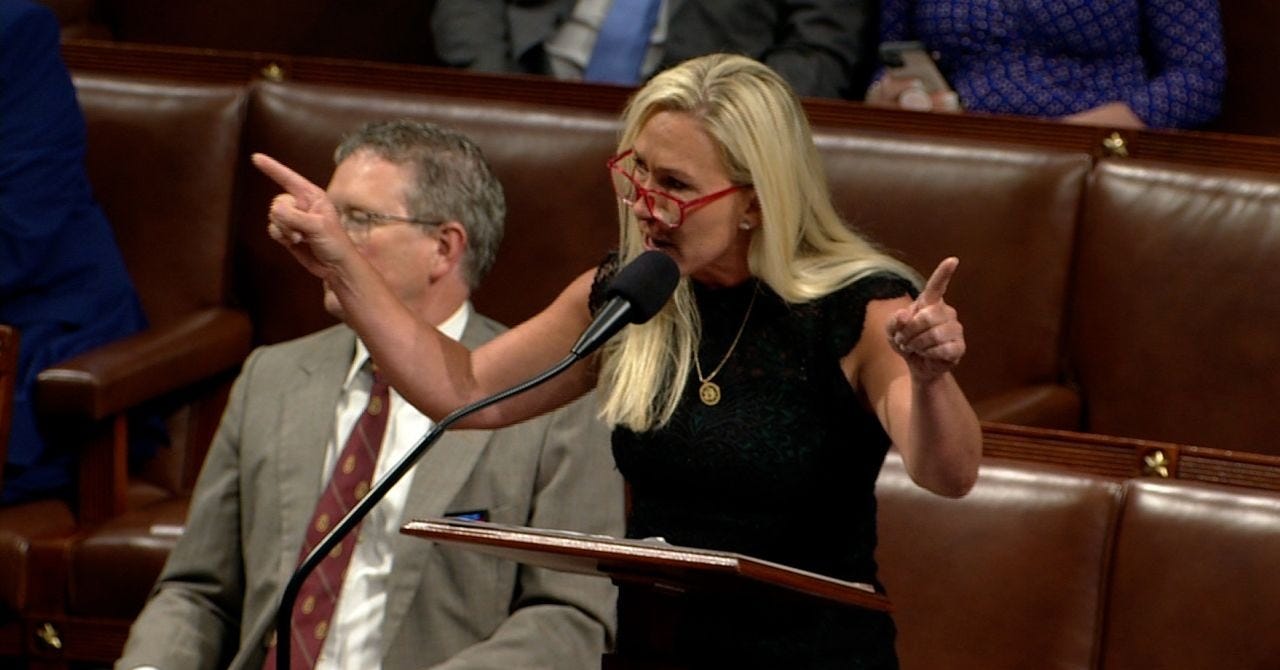
Marjorie Taylor Greene didn’t call for a tax revolt from the political fringe. She floated it from inside the governing coalition, and that’s the part most coverage missed.
When a sitting member of Congress tells her followers they are so fed up they’re considering refusing to pay federal taxes, it isn’t just anti-government theater. It’s an admission, a confession that a movement built on loyalty, power, and control no longer believes the government it dominates is legitimate enough to fund. This wasn’t a shot at Democrats. It wasn’t even really a shot at Trump. It was something more destabilizing: a signal that parts of the MAGA base are beginning to withdraw consent from the state itself.
For years, Trump-aligned politics demanded obedience to authority, to law enforcement, to the executive branch. Now one of its loudest voices is flirting with the language of financial rebellion, not against a hostile regime, but against a government their own movement helped shape. That’s not protest politics. That’s what legitimacy erosion looks like when it starts from the inside.
And when elected officials toy with the idea that paying taxes is optional, the consequences don’t land in Washington first. They land at the kitchen table in Social Security checks, rural hospitals, veterans’ services, and disaster relief that quietly keep entire counties afloat. A “tax revolt” isn’t a symbolic gesture. It’s a warning flare that a political movement is running out of ways to govern and starting to prepare its followers to opt out instead.
Want to Know Your Rights?
Download a free digital copy of the U.S. Constitution, the same document Trump is trying to bulldoze. Learn exactly what he’s breaking, and how to fight back.
100,000+ strong — and counting.
This holiday, become a paid subscriber for just $1 a week and help us keep the truth alive.
Join The Coffman Chronicle — $1/Week
The Quote That Slipped Past the News Cycle
The phrase “tax revolt” didn’t come from a manifesto or a protest rally. It appeared casually, almost offhandedly, in a post reacting to online sentiment. That’s part of why it passed with so little scrutiny.
Greene wrote that “almost every Trump voter I see on X is so fed up they are planning a 2026 tax revolt,” framing the idea not as a threat, but as an understandable response to frustration over federal spending priorities. In her telling, anger over foreign aid, overseas conflicts, and what she described as Washington’s indifference to domestic hardship had reached a breaking point.
What matters isn’t just the phrasing, but the posture. She didn’t discourage the idea. She didn’t warn against it. She validated it.
That distinction is crucial. Members of Congress complain about taxes all the time. They rail against waste, call for cuts, promise reform. What they do not typically do is normalize the idea that refusing to pay federal taxes is a legitimate form of political expression. That step, from opposition to withdrawal, is the line Greene crossed.
The remark also landed at an unusual moment. It didn’t come during divided government or Democratic control of the White House. It came amid growing frustration within the MAGA coalition itself, including dissatisfaction with Trump’s spending choices and foreign policy posture. In other words, this wasn’t anti-liberal resistance. It was intra-right disillusionment, aired in public.
Most coverage treated the comment as just another example of Greene’s incendiary rhetoric. A headline. A quote. Move on.
But, taken at face value, the statement does something more consequential. It reframes civic duty — paying taxes — as optional when a political movement feels betrayed, even by its own leadership. That is not a policy critique. It’s a shift in how legitimacy itself is discussed.
Once that shift happens, it tends not to stay rhetorical for long.
This Isn’t Loyalty to Trump
At first glance, Greene’s comments can sound like a familiar MAGA grievance, anger at Washington, foreign spending, and elites who “forgot” the base. However, that reading misses what makes this moment different.
For nearly a decade, Trumpism has been built on a simple bargain: loyalty in exchange for power. Support the leader, defend the movement, and the state will be wielded on your behalf. Courts, agencies, budgets, enforcement — all reframed as tools to reward allies and punish enemies. Civic obligation wasn’t rejected; it was weaponized.
Greene’s “tax revolt” rhetoric breaks that bargain.
By validating the idea that federal taxes themselves are illegitimate, she isn’t pressuring the system to serve MAGA priorities better. She’s signaling that parts of the movement no longer believe the system is worth sustaining, even when their preferred leaders are in charge. That’s not escalation. It’s retreat.
This is where the tension with Donald Trump becomes relevant, even if his name barely appears in Greene’s post. Trump’s political brand depends on dominance, on the promise that he alone can bend institutions to his will. A movement that stops believing institutions are legitimate is a movement he can no longer entirely control.
That’s the quiet fracture point. Trumpism requires faith that power works. A tax revolt is an admission that it doesn’t, or worse, that it isn’t worth funding anymore.
Historically, populist movements that reach this stage face a choice. They either convert grievance into governance, accepting the compromises that come with running a state, or they abandon governance altogether and shift toward symbolic resistance. Greene’s rhetoric points unmistakably toward the second path.
This also explains why the moment passed with so little national attention. Legacy political coverage is calibrated for left-right conflict, not internal legitimacy collapse. A Republican attacking taxes under a Republican-aligned government doesn’t fit the usual script. It’s easier to treat it as noise than to grapple with what it implies.
However, the implication is stark. When a governing movement begins encouraging its own supporters to disengage from the basic mechanics of the state, it is no longer arguing about policy outcomes. It is questioning the value of the state itself.
And movements that reach that point rarely reverse course without consequences.
Tax Revolt Is Delegitimization Language
Calls for a “tax revolt” rarely arise when political movements feel confident. They surface when power feels brittle, when winning elections or holding office no longer produces the outcomes a movement promised its followers.
That’s because tax refusal isn’t a standard policy argument. It’s a challenge to legitimacy itself.
In functioning democracies, taxes are not framed as optional expressions of political approval. They are the price of collective operation — roads, courts, retirement systems, disaster response, and national defense. Political movements argue about how taxes are spent, who pays more or less, and what should be prioritized. What they don’t do — at least not without crossing a threshold — is suggest that paying taxes is something citizens can selectively opt out of when they feel betrayed.
Historically, that rhetoric appears at specific moments, when movements lose faith that institutions will deliver results, when leaders can no longer translate grievance into governance, or when factions begin preparing supporters for disengagement rather than participation.
What makes Greene’s comments striking is not that they criticize federal spending. That’s routine. It’s that they normalize withdrawal while still holding office. That combination — governing from within while encouraging defiance from below — is a recipe for instability.
It also reveals a more profound contradiction within Trump-era politics. For years, MAGA rhetoric centered on “law and order,” respect for authority, and harsh punishment for those who defied state power. Tax resistance flips that script. It recasts defiance as virtue, but only when it serves the movement’s emotional needs.
Once civic obligation becomes conditional, it ceases to be civic at all. The state becomes a subscription service: pay when satisfied, cancel when angry. No modern democracy survives that logic intact.
Importantly, this rhetoric doesn’t stay symbolic. It migrates from social media to organizing spaces, from elected officials to influencers, from abstract frustration to practical justification. Even when no mass tax refusal occurs, the damage is done at the level of trust.
A movement that teaches its supporters the government is unworthy of funding is quietly teaching them something else too: that the social contract itself is disposable.
The Kitchen-Table Fallout Nobody Is Talking About
A federal “tax revolt” doesn’t punish Washington first. It punishes everyone else.
When politicians flirt with the idea that paying taxes is optional, they often talk as if the impact would be symbolic, a message sent upward, a warning shot fired at “the deep state.” That’s a fantasy. Federal revenue doesn’t sit in a pile waiting for Congress to notice a protest. It moves continuously, through programs that millions of Americans rely on without ever thinking of them as political.
The first systems hit by disrupted federal funding aren’t abstract. They’re intimate.
Social Security checks don’t arrive late because of ideology, but because money doesn’t clear. Medicare and Medicaid don’t scale down politely. Instead, reimbursements stall, providers pull back, and rural hospitals start making impossible choices about what services they can still offer. Veterans’ clinics don’t close because of culture wars. They close because staffing and procurement depend on stable federal cash flow.
Disaster relief works the same way. FEMA doesn’t respond faster because people are angry online. It responds when funding pipelines are intact. When they’re not, the delays show up at kitchen tables after floods, fires, and tornadoes, long before anyone in Washington feels discomfort.
There’s also a second-order effect that rarely gets mentioned: enforcement. When elected officials normalize tax resistance, they don’t eliminate the IRS. They harden it. Selective noncompliance doesn’t lead to leniency, but to audits, penalties, wage garnishments, and liens. The people who suffer most are not wealthy tax strategists. They’re ordinary filers without lawyers or buffers.
Therefore, the practical message being sent isn’t “take power back.” It’s “absorb the risk yourself.”
That’s the cruel twist. Movements that drift toward delegitimization rhetoric often sell it as empowerment, but the cost is always privatized. The pain doesn’t land on institutions; it lands on families who can least afford instability.
That’s the kitchen-table reality of turning civic obligation into a political weapon. It doesn’t starve a corrupt system. It starves communities that were already hanging on.
When Movements Stop Believing in the State They Control
There’s a point in the life of every political movement when rhetoric stops being aspirational and starts becoming diagnostic. Greene’s “tax revolt” moment falls squarely into that category.
Movements that expect to govern talk about reform. They argue over budgets, priorities, and tradeoffs. Movements that no longer believe governance will deliver what they promised begin talking about refusal instead. They stop asking how to run the system better and start questioning whether the system deserves to exist in its current form at all.
That shift doesn’t usually come with an announcement. It leaks out in language such as casual comments, offhand validations, phrases tested in public to see how much resistance they meet.
What makes this moment especially dangerous is that it’s happening from within power, not against it. This is not an opposition movement trying to delegitimize a hostile state. It’s a governing faction struggling to reconcile its promises with the reality of administration.
When grievance outpaces results, the temptation is to redefine failure as sabotage and obligation as betrayal.
That’s how accountability erodes— not all at once, but selectively. Taxes become illegitimate. Elections become suspect. Courts become corrupt. Laws become enforceable only when convenient. The state is no longer a shared structure, but rather an enemy to be punished when it disappoints.
This is not a sustainable posture for any democracy.
You Can’t Run a Country on Rage Forever
It’s tempting to dismiss Greene’s comments as just another provocation. That would be a mistake.
What she articulated — perhaps unintentionally — is something deeper: a growing willingness within the MAGA coalition to abandon the basic mechanics of the state when they no longer feel emotionally satisfying.
Democracies survive disagreement. They don’t survive selective participation.
When elected officials flirt with the idea that civic obligations are optional, they aren’t challenging corruption or waste. They’re loosening the bolts that hold everything else in place. And the damage doesn’t start at the top. It begins quietly, locally, at kitchen tables where people depend on systems they were told no longer deserve support.
A movement that teaches its followers to stop believing in the state it controls isn’t preparing to govern. It’s preparing to blame.
Keep This Reporting Alive
This story wasn’t written to go viral. It was written to make sense of what’s breaking.
If you want more reporting like this — independent, unscripted, and willing to say what others won’t — become a paid subscriber to the Coffman Chronicle.
Sources:
Greene, Marjorie Taylor. December 31, 2025. X (formerly Twitter)
 Rep. Marjorie Taylor Greene🇺🇸@RepMTGAlmost every Trump voter I see on X is so fed up they are planning a 2026 tax revolt. And rightfully so! It’s because Americans work their asses off, barely make ends meet, and the government consistently gives their hard earned tax dollars to foreign countries, foreign wars,12:33 PM · Dec 31, 2025 · 733K Views5.44K Replies · 7.66K Reposts · 43.8K Likes
“Marjorie Taylor Greene Calls for 2026 ‘Tax Revolt’ Over Trump Foreign Policy Agenda.” December 31, 2025. Washington Examiner
“Marjorie Taylor Greene Endorses 2026 ‘Tax Revolt’.” December 31, 2025. Newsweek
“MTG calls for a ‘tax revolt’ after accusing Trump of ditching America First: ‘So fed up’.” December 31, 2025. New York Post
“‘Almost every Trump voter planning tax revolt in 2026’: MTG Calls Out U.S. Government’s Spending Habits.” December 31, 2025. financialexpress.com

I'd never trust her as far as I can throw her, but it's a step in the right direction, rather than a far-right one. And she still owes that lad who survived a school shooting a public, face-to-face apology on camera, for hounding him in the street like he was the criminal; when she does that, I'll pay more attention to her.
Aren't you suspicious about the complete turn around of MTG? What is she running for? She has had threats but continues to defy the orange monster the WH.