


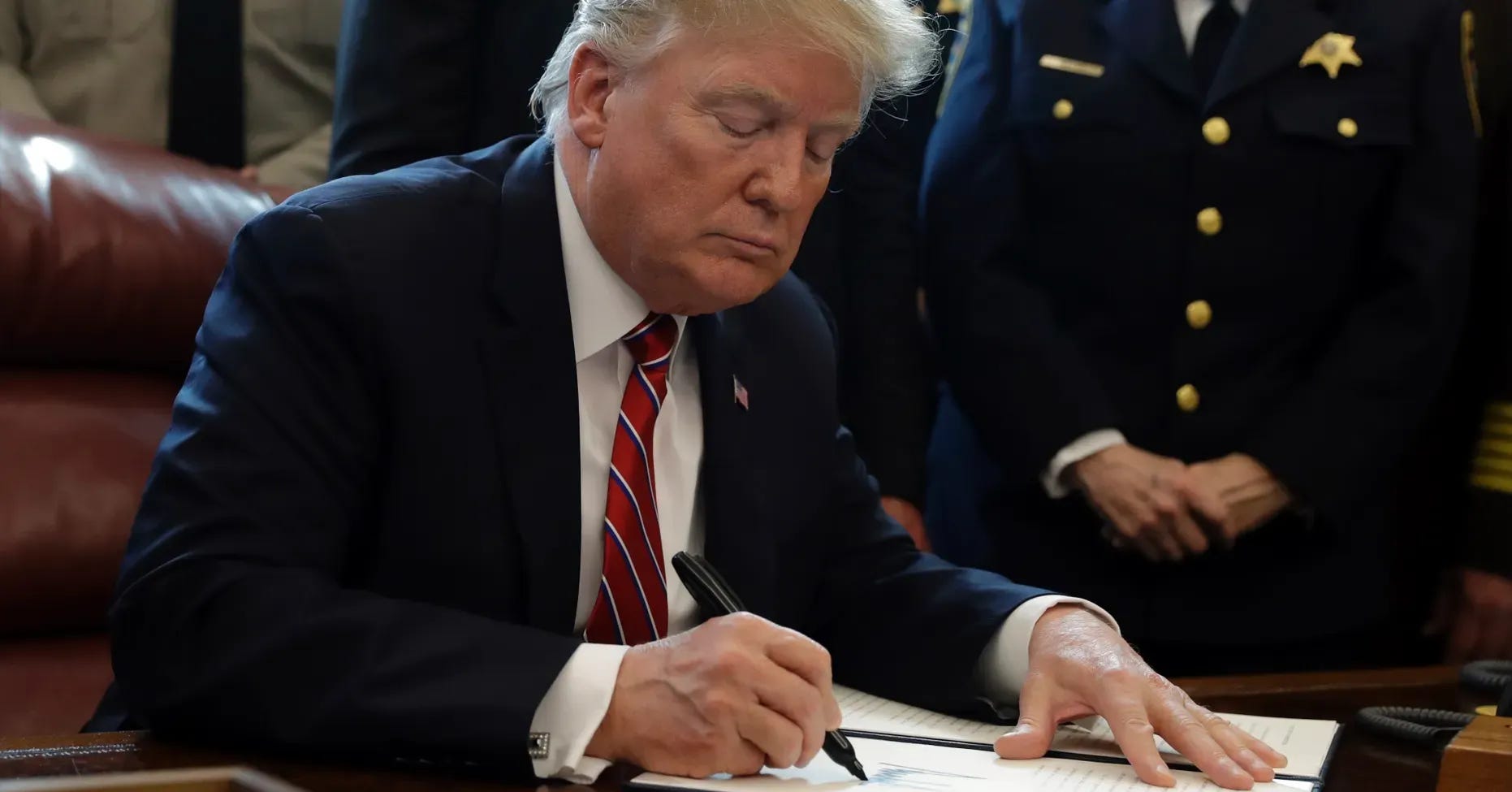
The strongest definitive sign yet of intraparty conflict of Donald Trump’s second term didn’t come in a rally speech or a social media post. It came on December 30, 2025, in a veto pen, aimed not at Democrats, but at his own party. With a stroke of his Sharpie, Trump killed Republican-backed legislation that had cleared Congress with little drama: a tribal land expansion bill and a regional water project long supported by GOP lawmakers. These weren’t symbolic fights. They were the kind of unglamorous, consensus governance bills that normally move quietly through Washington. Their sudden death wasn’t about policy disagreement. It was a signal.
Presidential vetoes are supposed to mark ideological conflict or constitutional objections. These vetoes did neither. Instead, they sent a clearer message: legislation now advances not on merit, regional need, or bipartisan work, but on alignment. When even routine Republican priorities can be nullified from the Oval Office, the power center of the party shifts decisively upward. Governance becomes conditional. Loyalty becomes policy.
That shift matters far beyond Capitol Hill. When water projects stall and tribal land agreements collapse, the consequences don’t stay in Washington. They hit towns planning for drought, farmers waiting on infrastructure, and tribal communities navigating housing and economic development. Trump’s first vetoes of his second term weren’t just about what bills failed. They revealed how governing itself is quietly being redefined, with very real costs.
Want to Know Your Rights?
Download a free digital copy of the U.S. Constitution, the same document Trump is trying to bulldoze. Learn exactly what he’s breaking, and how to fight back.
100,000+ strong — and counting.
This holiday, become a paid subscriber for just $1 a week and help us keep the truth alive.
Join The Coffman Chronicle — $1/Week
Why These Vetoes Are Different
Presidential vetoes are not unusual. What makes these different is what they targeted and what they bypassed. The bills Trump vetoed were not partisan messaging vehicles or ideological provocations. They were committee-built, Republican-backed measures that reflected regional needs and years of routine legislative work. In a functioning Congress, these are the kinds of bills that move precisely because they are boring.
That’s what makes the vetoes instructive. They did not emerge from floor fights or veto threats during negotiations. They arrived after Congress had already done its job. In effect, the veto pen was used not to resolve a dispute but to invalidate the process itself.
Historically, presidents have used vetoes to draw clear lines on constitutional concerns, fiscal objections, or deep ideological disagreement. Here, none of those explanations fully apply. The tribal land expansion carried bipartisan support and followed long-standing precedent. The water project addressed infrastructure needs Republicans have traditionally championed, especially in drought-prone states. There was no public demand for revision, no veto message outlining fatal flaws. There was simply an override.
That distinction matters. A veto grounded in policy disagreement invites negotiation. A veto deployed after consensus has already formed sends a different message that committee work does not confer legitimacy unless it aligns upward.
For Republican lawmakers, that’s a quiet but profound shift. It tells members that even faithfully advancing party priorities offers no protection if the White House does not personally embrace those priorities. Legislative authority doesn’t just weaken. It becomes provisional.
This is how power is captured without a formal rule change. Congress still passes bills. Committees still meet. Votes still occur. However, the final determinant is no longer policy merit or coalition-building. It is proximity to executive favor. Over time, that reality reshapes behavior. It results in fewer independent initiatives, more pre-clearance, and more silence when vetoes land.
Seen in that light, Trump’s first vetoes of his second term were not an opening skirmish with Democrats. They were an internal recalibration, one that subtly but decisively reorders how Republican governance is expected to function.
The Tribal Land Veto and the Collapse of “Safe” Bipartisanship
For decades, tribal land legislation has occupied a rare category in Congress: low-profile, bipartisan, and largely insulated from national political fights. These bills are often the product of years of negotiation among tribes, state officials, local governments, and federal agencies. They move not because they are politically flashy, but because they are precise, resolving jurisdictional gaps, enabling housing development, or correcting historical land-status errors that block economic activity.
That’s what made this veto so jarring.
The tribal land expansion bill Trump rejected was not a symbolic gesture or a partisan marker. It followed a familiar legislative path, including committee review, cross-party support, and backing from Republican lawmakers representing the affected region. In other words, it fit squarely within the category of legislation that has traditionally survived changes in administrations precisely because it is grounded in consensus rather than ideology.
Consensus No Longer Protects Legislation
By vetoing it anyway, Trump punctured one of Congress’s remaining assumptions: that certain issues still sit outside the loyalty economy of national politics.
This matters because tribal land bills are not abstract exercises in sovereignty. They govern whether tribes can build housing, attract investment, expand healthcare facilities, or assert clear jurisdiction over land already functionally theirs. When those bills stall, the costs are immediate and local, and include delays in development, frozen financing, and prolonged legal ambiguity that benefits no one.
What’s striking is not just that the veto happened, but that it arrived without the usual preconditions. There was no prolonged public dispute with tribal leaders, sustained fiscal argument, or clear constitutional objection. The bill was simply erased at the end of the process.
When ‘Safe’ Governance Becomes Conditional
That inversion — where consensus no longer protects legislation — has broader implications. If tribal land bills can be vetoed despite bipartisan agreement and regional Republican support, then no category of legislation is truly insulated. “Safe” no longer means negotiated. It means sanctioned.
For lawmakers who have long relied on these quiet areas of cooperation to deliver tangible outcomes to constituents, the message is unmistakable: even the most carefully built compromises are contingent. The work still happens, the votes still count, but the guarantee that good-faith legislating will be honored is gone.
This is how bipartisanship doesn’t just weaken, but collapses selectively, not through loud obstruction or floor theatrics, but through the removal of trust that consensus will be respected once achieved. When that trust disappears, lawmakers don’t just lose bills. They lose incentive.
The tribal land veto wasn’t an outlier. It was a test case, revealing how narrow the space for independent governance within the Republican Party has become, even in areas once considered politically untouchable.
The Water Project Veto and the End of Regional Republican Autonomy
If the tribal land veto shattered the assumption that bipartisan consensus still protects certain categories of legislation, the water project veto made the lesson unavoidable. This was no specialized issue. It was infrastructure, the kind Republicans have long treated as essential to regional stability, economic growth, and agricultural survival.
Water projects are not ideological abstractions. They determine whether towns can expand, whether farms can plan for drought, and whether local governments can manage growth without crisis. For decades, Republican lawmakers in Western states have treated water infrastructure as a core responsibility of governance, often working across party lines to secure federal approval for projects tailored to local conditions.
Regional Needs Lose to Central Authority
That tradition did not survive this veto.
The water bill Trump rejected had the backing of Republican members whose districts would bear the consequences of delay. It reflected regional priorities rather than national messaging. Yet it was overridden anyway, not because the project lacked merit, but because regional autonomy no longer carries independent weight.
That shift is subtle but profound. It tells lawmakers that proximity matters more than place. That expertise rooted in geography — drought cycles, water rights, agricultural timing — is secondary to alignment with centralized authority. The very logic of representative government, where members advocate for the specific needs of their constituents, becomes conditional.
For communities depending on that infrastructure, the costs are immediate. Delayed projects mean stalled planning, higher future costs, and increased vulnerability to climate stress. Farmers make decisions years in advance; municipalities budget across decades. When federal approvals become unpredictable, local risk multiplies.
What makes this veto especially telling is that it contradicts the Republican Party’s own stated commitments. Infrastructure, local control, and support for rural economies have long been pillars of GOP rhetoric. Yet here, those priorities were subordinated without negotiation or replacement.
That contradiction reveals the deeper recalibration underway. Regional Republicans are discovering that their traditional role — translating local needs into federal action — no longer guarantees results. Their authority has not been formally stripped, but it has been hollowed out.
The Quiet Erosion of Federalism
This is how centralized power erodes federalism without openly challenging it. States still exist. Districts are still represented. Yet when local needs repeatedly lose to national loyalty enforcement, representation becomes symbolic rather than functional.
Taken together with the tribal land veto, the rejection of the water project completes the picture. These were not isolated decisions. They were parallel signals aimed at different constituencies, delivering the same message: governance flows downward only with permission.
Governing by Permission: When Committees Become Advisory
The real damage of Trump’s recent vetoes isn’t confined to the bills that failed. It’s what they do to the machinery of Congress going forward. When committee-built legislation can be erased without warning or justification, the committees themselves stop functioning as centers of authority. They become advisory bodies — tolerated, but not decisive.
Congressional committees are where governance is supposed to happen. They are designed to absorb expertise, negotiate tradeoffs, and translate regional realities into national policy. When that work is respected, lawmakers invest time, political capital, and institutional memory into the process. When it isn’t, incentives collapse.
That is the quiet recalibration now underway.
By vetoing Republican-backed bills that had already cleared the internal hurdles of Congress, the White House effectively signaled that legislative legitimacy no longer originates in Congress. It originates at the executive level, after the fact. Lawmakers can deliberate, compromise, and vote, but those actions no longer guarantee relevance.
This is not obstruction. It is supersession.
Over time, this kind of dynamic reshapes behavior. Lawmakers stop advancing initiatives unless they are pre-cleared by leadership aligned with the White House. Committees stop taking risks on complex or region-specific legislation. The space for independent problem-solving shrinks, replaced by caution and silence.
The effects are cumulative. Fewer bills are introduced. More issues are deferred. Problems that require nuanced, localized solutions remain unresolved because they don’t lend themselves to centralized approval.
For Republican lawmakers, this is a particularly stark reversal. The party that has long argued for decentralization, committee authority, and legislative primacy is now operating under a model where outcomes hinge on executive favor.
Seen this way, the tribal land veto and the water project veto were not policy disputes at all. They were demonstrations.
Once that lesson is absorbed, governance adapts accordingly, not toward efficiency or accountability, but toward permission-seeking. And a Congress that governs by permission is no longer coequal. It is contingent.
See our recent reporting on how this has played out in this Congress during 2025 here:

The Kitchen-Table Cost
What looks like a procedural power shift in Washington becomes something else entirely once it reaches the ground. When governance is filtered through loyalty rather than need, the consequences don’t fall on committee chairs or White House aides. They fall on communities.
Uncertainty Is the Hidden Cost
When a water project is vetoed, it isn’t a line item that disappears. It’s a town delaying expansion, a farmer making planting decisions without certainty, and a municipal budget forced to absorb higher long-term costs.
The same is true for tribal communities. When land agreements stall, housing projects don’t break ground. Healthcare facilities remain underbuilt. Economic development plans freeze.
The hidden tax of centralized control is uncertainty.
When Planning Becomes Paralysis
Local governments plan years ahead. Infrastructure requires predictability. When federal commitments become conditional, paralysis replaces planning. And paralysis favors power.
People feel this long before they can name it. When projects that made sense suddenly don’t happen. When representatives can’t explain why. When participation no longer guarantees results.
When Loyalty Becomes Law
Power rarely announces itself when it changes form. Sometimes it arrives quietly, in which bills live and which ones die.
Trump’s first vetoes of his second term weren’t about correcting bad policy. They were about redefining authority. They demonstrated a new rule of governance: nothing moves unless it is permitted.
A government that governs by permission still functions on paper, but its substance shifts, power concentrates, and accountability diffuses.
This is not norm-breaking. It is norm replacement.
Once normalized, it becomes precedent, and precedent is hard to undo.
The question these vetoes leave behind is not whether Congress will push back. It’s whether governance can function when loyalty becomes law and permission replaces representation.
That answer won’t come from Washington. It will quietly arrive at kitchen tables across the country.
Coffman Chronicle. Support Independent Media
If this piece helped you see something daily coverage missed, that wasn’t an accident. Legacy media chases spectacle. Independent journalism traces power, especially when it moves quietly.
The Coffman Chronicle exists to connect decisions in Washington to consequences at the kitchen table. That work depends on readers who value depth over spin and patterns over narratives.
If you want more reporting like this, consider becoming a paid subscriber. Your support keeps this work independent, unsensitized, and focused on what actually matters.
Support independent media.
Become a paid subscriber to the Coffman Chronicle.
Sources:
“Donald Trump Issues the First Vetoes of His Second Term, as Rep. Lauren Boebert Warns Him ‘This Isn’t Over’.” People, December 30, 2025.
“Trump issues first vetoes of second term, targeting bills backed by GOP allies.” Scripps News (AP via Scripps), December 31, 2025.
“Trump issues first second-term vetoes for Colorado water project and Florida tribal measure.” Reuters, December 31, 2025.
U.S. House of Representatives Office of the Historian. Presidential Vetoes (Regular and Pocket Vetoes). January 23, 2025. https://history.house.gov/Institution/Presidential-Vetoes/Presidential-Vetoes/. History, Art & Archives
Presidential Vetoes — Data & Overview. The American Presidency Project
U.S. Constitution, Article I, Section 7. “Presentment Clause (Veto Power).”
U.S. Department of the Interior, Bureau of Indian Affairs. “Fee-to-Trust Land Acquisition.”
Government Accountability Office. Water Infrastructure Resilience: Agencies Could Better Assess Efforts to Assist Communities Vulnerable to Natural Disasters. GAO-25-107013, August 11, 2025.
This article describes the kind of governance we had under King George…right before the colonists revolted. Colonial legislators could pass laws based on local needs and conditions. But, if King George didn’t like a law they passed, he (or the Royal Governor he appointed over that colony) could rescind or override that law. The only difference today is that our “king” sits in the White House instead of Buckingham Palace.
Why can’t they override the veto?