


In the wake of the Supreme Court’s recent decision limiting his tariff authority, President Donald Trump took to Truth Social with a familiar intensity and an unfamiliar implication. The posts came in bursts, many written late at night, and they carried the tone that has become characteristic: capital letters, sharp denunciations, and sweeping claims about national interest. He called the ruling “wrong” and “disrespectful,” suggested that justices who ruled against him had failed in their duty, and insisted that he retained an “absolute right” to impose tariffs through other means.
The immediate reaction focused on style. That is understandable. The posts were abrasive, personal, and at times difficult to parse. Yet focusing only on tone risks missing the more important shift. What matters is not simply that a president is angry at a court. What matters is the theory of government implied in that anger.
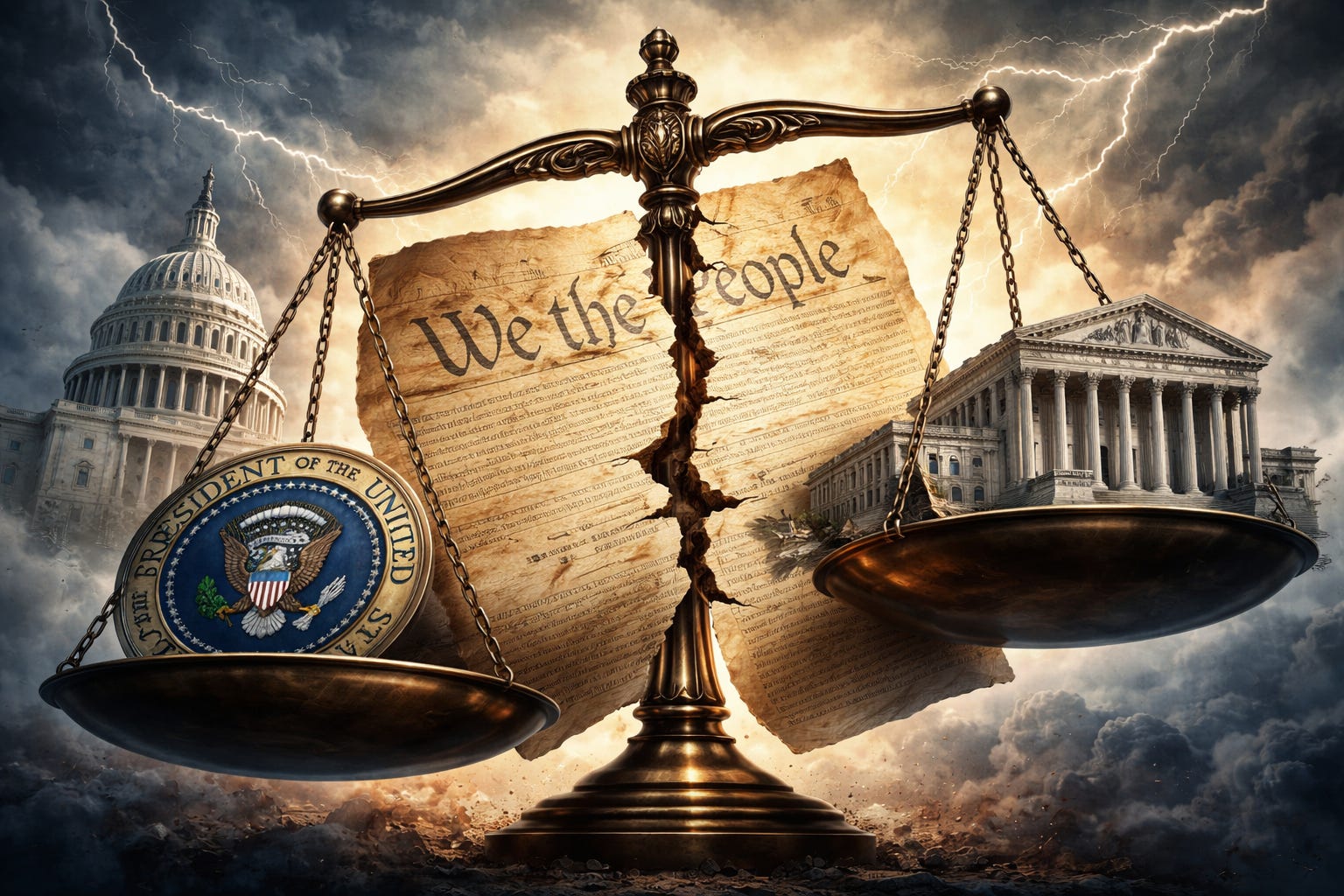
Trump’s language did more than criticize a legal decision. It suggested that the judiciary, including justices he appointed, had failed him by refusing to align with his policy goals. That is not merely disagreement. It is a reframing of what the courts are for.
This Community Is Powered by You
What started as a small circle has grown into something much bigger, and it’s all because of readers like you.
Every time you forward this email, post it on socials, or bring someone new into the fold, you’re helping build one of the most passionate, independent political communities out there.
Want to keep the momentum going?
Share this newsletter with someone who should be part of this conversation.
Thank you for being here. It means everything.
Disagreement vs. disloyalty
What presidents have always done
Presidents have long criticized the courts. They have objected to rulings, warned about consequences, and argued that decisions were wrongly decided. That is part of the constitutional system. The judiciary interprets the law. The political branches respond, sometimes forcefully, within their own spheres.
There is nothing novel about a president saying, in effect, “the Court got this wrong.”
What feels different now
The shift comes when criticism crosses into something else. Trump’s posts did not simply argue that the Court misinterpreted the law. They implied that justices who ruled against him were acting improperly by doing so. The subtext was not only that the decision was incorrect, but that it represented a kind of failure of alignment.
That is where the language of “disrespect” and the suggestion that appointed justices owe something to the president become significant. Courts are not designed to be responsive to presidential expectations. They are designed to be independent of them.
The distinction is subtle in wording and profound in meaning. A president who says, “This ruling is wrong,” is participating in constitutional debate. A president who suggests, “this ruling shows disloyalty,” is gesturing toward a different model altogether.
A short history of presidential pushback
Conflict is not new
American history offers several examples of presidents clashing with the judiciary. These moments are often cited for being exceptional, not routine.
In 1832, President Andrew Jackson resisted the Supreme Court’s decision in Worcester v. Georgia, which protected Cherokee sovereignty. His refusal to enforce the ruling remains one of the starkest examples of executive defiance.
In the late 1850s, Abraham Lincoln condemned Dred Scott v. Sandford as morally and constitutionally wrong. He argued against its broader application, yet he did not claim that the Court had no authority to decide cases.
In the 1930s, Franklin D. Roosevelt confronted a Court that struck down key elements of the New Deal. His response was to propose expanding the Court, an effort widely understood as an attempt to reshape its decisions. The plan failed politically, and it remains a cautionary episode about institutional pressure.
In 2010, Barack Obama publicly criticized Citizens United v. FEC, warning of its effects on campaign finance. His objection was direct and visible, delivered during a State of the Union address, yet it remained focused on the substance of the ruling.
What those moments share
Each of these episodes involved sharp disagreement. Some involved extreme measures. Yet they were generally framed as disputes over law, policy, or constitutional interpretation.
What they did not center on was the idea that judges were personally failing the president by refusing to support him. Even in the most aggressive cases, the argument was about what the Constitution allowed or required, not about whether the judiciary owed allegiance to the executive.
The Roberts intervention
A rare public warning
Against that backdrop, Chief Justice John Roberts’ recent remarks stand out. Speaking publicly after Trump’s attacks, Roberts drew a line between criticism of judicial reasoning and personal hostility toward judges. He described such hostility as “dangerous” and said it “has got to stop.”
Statements like this are uncommon. Chief justices traditionally avoid direct engagement with political rhetoric, particularly from sitting presidents. When they do speak, it is usually because they perceive a risk not just to a particular decision, but to the institution itself.
Why it matters
Roberts’ concern was not limited to decorum. In recent years, he has warned about threats to judicial safety, including harassment and intimidation directed at judges. The broader issue is legitimacy. Courts do not enforce their rulings through force. They rely on public acceptance and institutional compliance.
When the judiciary is framed as partisan, corrupt, or disloyal, that acceptance becomes more fragile. Roberts’ intervention can be understood as a defense of the idea that courts are independent arbiters of law, not participants in a political chain of command.
The expanding presidency
From executor to central actor
The Constitution assigns Congress the power to legislate and the president the duty to execute those laws. In practice, the modern presidency has grown far beyond a narrow administrative role. Presidents propose sweeping policy agendas, shape legislation, and increasingly rely on unilateral tools such as executive orders to drive national policy.
Executive orders themselves are not inherently problematic. They are a legitimate instrument for directing the operations of the executive branch. The concern arises when they become a substitute for legislation, particularly in contexts where Congress has delegated broad authority or has struggled to act.
Want to Know Your Rights?
Download a free digital copy of the U.S. Constitution, the same document Trump is trying to bulldoze. Learn exactly what he’s breaking, and how to fight back.
Congress and the problem of ceding power
Congress retains significant constitutional authority. It can legislate, oversee, and constrain the executive. Yet it has often ceded ground, whether through broad statutory delegations, partisan alignment, or institutional inertia.
When members of Congress prioritize party cohesion over institutional role, the balance shifts further. The system begins to resemble a parliamentary dynamic without parliamentary accountability, in which the executive leads, and the legislature follows.
This shift contributes to a growing sense among many citizens that their representatives are not fully representing them. When lawmaking appears to be driven by executive initiative and partisan coordination rather than deliberation within Congress, the connection between voters and their representatives weakens.
Polarization and the “team sport” problem
When the party replaces the institution
The rise of intense polarization has amplified these dynamics. Political behavior is increasingly organized around party identity. In that environment, the incentives for members of Congress change. Voting with the party can become more important than exercising independent judgment.
This “team sport” framing does more than affect legislative outcomes. It reshapes expectations. Voters may come to see politics as a contest between sides rather than a system of shared governance. That, in turn, reinforces the perception of the president as the leader of a team rather than the executor of laws within a constitutional structure.
Disenfranchisement and distance
For citizens who do not feel represented by either party, or who see their representatives as primarily responsive to party leadership, this dynamic can feel alienating. The more government appears to operate as a centralized, partisan enterprise, the more distant it can seem from the idea of self-rule.
Why this moment feels different
The convergence of pressures
Taken individually, none of these elements is entirely new. Presidents have always pushed against constraints. Congress has long struggled with institutional cohesion. Public trust in government has fluctuated.
What makes the current moment distinct is the convergence of these factors. Trust in institutions is low. The presidency is powerful and visible. Congress is often polarized and inconsistent in its oversight role. Judicial confirmations are increasingly heated and strongly partisan. Against that backdrop, rhetoric that questions the legitimacy of coequal branches carries greater weight.
Rhetoric as a signal
Language matters because it shapes expectations. When a president frames the judiciary as an obstacle rather than an independent branch, it signals a different understanding of constitutional roles. When that framing is repeated, it can begin to normalize the idea that independence is a problem rather than a principle.
That does not mean the system is on the brink of collapse. Courts continue to issue rulings. Congress continues to legislate, however imperfectly. Elections continue to function. Yet the combination of low trust, expanded executive power, and delegitimizing rhetoric creates a more fragile environment.
Vigilance, not panic
The United States has endured periods of intense institutional strain before. The system has shown resilience, and there are reasons to believe it can do so again. However, resilience is not automatic. It depends on norms, expectations, and public understanding.
Civic education plays a central role in that process. Citizens who understand the separation of powers are better equipped to recognize overreach and to demand accountability. They are also more likely to expect Congress to act as a coequal branch rather than an extension of the executive.
The goal is not to eliminate conflict. Conflict is built into the system. The goal is to preserve the structure within which that conflict occurs.
Trump’s attacks on the judiciary are not just a matter of tone or temperament. They reflect a way of talking about power that, if accepted, would alter the balance the Constitution was designed to maintain.
That is why this moment calls for attention. Not alarmism, but clarity. Not panic, but vigilance.
The Constitution does not enforce itself. It depends, in part, on whether those who operate within it, and those who observe it, continue to believe in the principle that no branch stands above the others.
If you made it this far, you care about more than headlines. You care about how power actually works and how it’s changing.
We write to cut through the noise, connect the dots, and defend the constitutional principles that too often get lost in the daily churn.
If that matters to you, consider subscribing.
Sources:
Reuters, “US Supreme Court’s Roberts says personal hostility aimed at judges has ‘got to stop’”, March 17, 2026
People, “Trump Says Supreme Court Justices He Appointed ‘Openly Disrespect’ Him”, March 16, 2026
The Guardian, “Trump claims he has ‘absolute right’ to impose new tariffs after Supreme Court blow”, March 16, 2026
Reuters, “Trump clashes with conservative U.S. chief justice over judiciary”, November 22, 2018
Encyclopaedia Britannica, “Worcester v. Georgia | History, Summary, & Significance”
National Archives, “Dred Scott v. Sandford (1857)”
Federal Judicial Center, “FDR’s ‘Court-Packing’ Plan”
Obama White House Archive, “President Obama on Citizens United: ‘Imagine the Power This Will Give Special Interests Over Politicians’”, July 26, 2010
Constitution Annotated / Congress.gov, “Overview of Take Care Clause”
Pew Research Center, “Favorable views of Supreme Court remain near historic low”, September 3, 2025
Annenberg Public Policy Center, “Most Americans Support Checks on Presidential Power”, April 22, 2025
Brookings, “Do eroding presidential norms undermine constitutional principles?”, March 13, 2025
Trumpty Dumpty is wrong! as usual!
Great read. Thank you. It’s curious that we discuss and debate whether or not Trump’s actions are legal, civil. correct in protocol, honest intent, good for the country, etc. Trump is interested in only one thing making money for himself, his family, and his donors. He has created an obvious pay to play society. Americans are naive and provincial if they cannot see this. The entire administration is bathed in corruption.