


There’s a stretch of East Tennessee that explains this entire fight better than any committee hearing ever will.
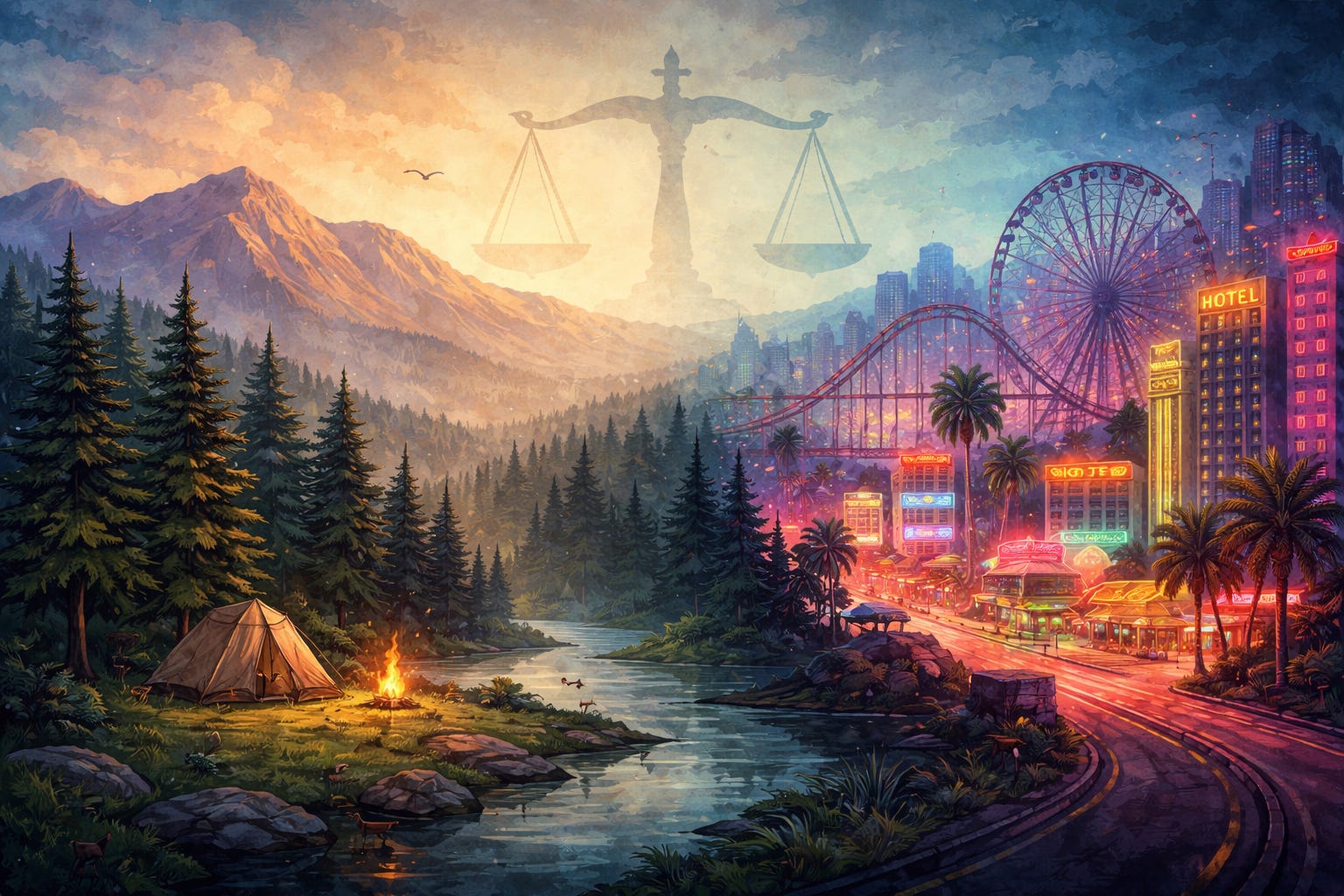
On one side, you have Great Smoky Mountains National Park: Kuwohi / Clingman’s Dome, Cades Cove, fog rolling through ancient trees, quiet trails, wildlife, and creeks. It exists because we, as a country, chose to protect it.
On the other hand, you have Pigeon Forge and its cousins: Dollywood, go-karts, Ripley’s, aquariums, pancake houses, neon mini golf, and themed dinner shows. They are places that exist because someone looked at the park and saw dollar signs.
Those two destinations are related, but they are not the same trip, and they are absolutely not the same job.
So when Donald Trump nominates Scott Socha, a hospitality and concessions executive from Delaware North, to run the National Park Service, it’s not just a bad fit. It’s a four-alarm signal about how we treat nature, capitalism, federal agencies, and the law itself.
Let’s walk through them in that order.
This Community Is Powered by You
What started as a small circle has grown into something much bigger, and it’s all because of readers like you.
Every time you forward this email, post it on socials, or bring someone new into the fold, you’re helping build one of the most passionate, independent political communities out there.
Want to keep the momentum going?
Share this newsletter with someone who should be part of this conversation.
Thank you for being here. It means everything.
Nature: You Can’t Build a New National Park
This part is simple enough that a kid could explain it.
You can build Pigeon Forge or Gatlinburg anywhere. Neon, steel, parking lots, hotels, an aquarium, a handful of chain restaurants, themed mini golf—none of that is inherently tied to a specific landscape. Give a developer a highway exit and cheap land, and they can recreate that basic product almost anywhere in America, customized to fit the local geography and history. Don’t get me wrong. I’ve spent a lot of time in both cities and enjoyed them. However, I understand that they are not the park. They exist in part because of it, but they are not the same.
You cannot build another Great Smoky Mountains National Park. You can’t build another Yellowstone, another Yosemite, another canyon carved by water over millions of years, another fragile wetland, another old-growth forest. You cannot fast-track an ecosystem.
Once you degrade a park—cut up its habitat, choke it with traffic and pollution, carve off “just one more” patch of forest for more lodging and attractions—you don’t get it back in any meaningful human timeframe. For hikers, campers, bird watchers, people who go for the quiet, the fog, and the stars, the destination is simply gone.
This, on its own, should be enough. A concessions executive running the Park Service is like putting a theme-park designer in charge of a cathedral. You’ll still have the building, but the art, history, and everything that makes it special will be stripped away piece by piece for profit.
But I’m not naïve. I know the people pushing this nomination won't be moved by an ecological argument alone. So let’s talk to them in their preferred language next.
Modern Capitalism: The Park Is the Asset, Not the Strip
If you strip all the moral language out of this and look at it as a portfolio, the logic doesn’t get better. It gets worse.
Pigeon Forge–style destination cities are fungible. You can copy-paste that business model onto almost any geography: highway + billboards + attractions + lodging + sugar. The basic formula doesn’t care where you are.
The park, on the other hand, is non-fungible. It is the unique draw. It is the thing people are flying across the country or driving for two days to see. All of the hotels, restaurants, ticketed attractions, outlet malls, and mini golf only exist in that particular place because there is a national park next door worth traveling to.
Kill the park, and you may still have a strip of neon, but you’ve quietly destroyed the core asset that gives it value. The high-value visitors—the hikers, campers, photographers, international eco-tourists—start going somewhere else. The destination city survives as a generic family entertainment zone, but the entire ecosystem of businesses that depended on a real park shrinks, stagnates, or dies.
From a purely capitalist perspective, this is insane behavior. You don’t take your most valuable, irreplaceable asset and hand it to someone whose professional instinct is to pave it, brand it, and carve it into more commercial pads. You protect the crown jewel, and you treat the strip of chain restaurants as the commodity product, not the other way around.
So on layer one, the ecological layer, the argument is don’t kill the park because it’s irreplaceable.
On layer two, the capitalism layer, the argument is don’t kill the park because it’s literally your long-term revenue engine.
Different values, same conclusion.
Yet, even if someone somehow doesn’t care about the land or the money, there’s still layer three.
All Federal Agencies: How You Break the People Who Keep Things Running
Move one step further out from the parks themselves, and this nomination becomes a story about institutions.
Even if the land somehow survives, even if the gateway economy limps along, there’s another casualty in this pattern: the people inside the agency.
If the director of the Park Service were chosen from within, they’d at least have qualifications and the respect of their peers. They’d be someone who has actually done the work—managed a park, dealt with fires and floods, balanced visitor access with preservation, handled tribal consultation and local politics. When they say, “we need to change this,” staff might not like it, but they know it’s coming from someone who understands the mission and the constraints.
What we do instead—here and across the federal government—is parachute in political appointees who have never done the job, hand them the keys, and let them “reimagine” everything every few years.
Nothing kills morale quite like that.
Nothing kills morale like someone who has never done your job jumping in, changing things for short-term political optics, and then leaving you to clean up the mess later, if you still have a job by then. You watch programs that quietly worked get blown up because they don’t fit the new narrative. You watch “signature initiatives” launched that you already know will fail. You watch the best people burn out and leave.
Multiply that across every major agency—parks, public health, environment, labor, education—and you get a federal government where the institutional memory erodes, the expertise drains away, and the people who remain learn the only real rule: keep your head down, try to minimize the damage, and hope the next boss is less bad than the last.
Layer three isn’t about trees or profits. It’s about whether we want functioning, competent agencies or demoralized husks that lurch from one political appointee to the next.
However, even that isn’t the deepest layer of this story.
Democracy Itself: When “Shall” Stops Meaning Anything
Under federal law, the director of the National Park Service is supposed to be more than a presidential whim. Congress actually wrote a qualifications clause into statute, stating the director shall have substantial experience and demonstrated competence in land management and natural or cultural resource conservation.
It does say, “it would be nice if,” or“if convenient.” Shall.
For decades, under both parties, that’s meant people with backgrounds in conservation, public land management, or closely related fields, career park people, state park leaders, tribal resource leaders, scientists, historians. They chose the people whose lives were spent stewarding places rather than monetizing them.
You can argue at the margins about who fits that mold best. However, you don’t need a law degree to recognize that a hospitality and concessions executive—someone whose career has been running hotels, restaurants, and attractions around parks—is a stretch, to put it politely.
Here’s the part that worries me far more than one bad nominee. Nothing and no one can force the United States Senate to care.
If 51 senators decide that “running concessions near public land” counts as “substantial experience in conservation,” then for all practical purposes, “shall” has been downgraded to “eh, whatever.” Courts are unlikely to intervene. There are no Qualifications Police ready to drag a nominee off the Senate floor.
Which means this isn’t just a parks story, or a money story, or even an agency morale story. It’s a rule-of-law story.
It’s about whether the words in our laws actually bind the people in power, or whether every “shall” in the U.S. Code is really just a suggestion that can be waived if it gets in the way of what a president wants to do.
Today, the test case is the Park Service. Tomorrow, it could be voting rights, civil rights enforcement, the guardrails around the Justice Department, or the process for certifying elections.
If the political system teaches itself that it can look straight at a statutory “shall,” shrug, and say, “nice requirement you’ve got there, too bad we don’t care,” then the damage doesn’t stay confined to national parks. It spreads to every part of our democracy where we rely on laws to restrain power rather than trusting that everyone will just behave. We know they don’t care. They’ve proven it again and again.
You don’t have to care about nature. You don’t have to care about capitalism. You can hate camping and never set foot in a park.
This still matters to you, because at the end of that four-step chain—nature → modern capitalism → all federal agencies → democracy itself—is a question that will outlast this nomination and this administration: Do the words in our laws still mean what they say? Or do they mean whatever the people in power decide they mean this week?
Everything else—Smoky Mountains, Pigeon Forge, Scott Socha—is just the case study that makes the answer harder to dodge.
If you want more coverage that treats confirmation fights, public lands, and democratic erosion as part of the same story, hit subscribe. It’s free, it helps the work, and it tells the algorithm you care about more than just the horse race. And if you’d like to become a paid subscriber to fuel the mission, we’d love to have you.
Sources:
“Trump nominates a hospitality executive to lead the National Park Service” – AP News, February 12, 2026.
“Trump nominates hospitality executive to lead National Park Service” – The Guardian, February 12, 2026.
“‘Zero experience’: Conservationists are losing it over Trump’s National Park Service director nominee” – SFGATE, February 12, 2026.
“Trump’s Nominee to Lead the National Park Service Is a Hospitality Executive” – Outside Online, February 12, 2026.
“UPDATE | Concessionaire Nominated To Run National Park Service” – National Parks Traveler, February 11, 2026.
“Parks Group Responds to National Park Service Director Nomination” – National Parks Conservation Association, February 12, 2026.
“Statement on nomination of Scott Socha to lead National Park Service” – Center for Western Priorities, February 12, 2026.
“Who is the new nominee to direct the National Park Service?” – Deseret News, February 13, 2026.
“Who Is Scott Socha? Trump’s New National Parks Nomination Sparks Backlash” – Newsweek, February 13, 2026.
“54 U.S.C. § 100302 – Directors and other employees” (Statutory text PDF) – GovInfo (see page 13).
For this regime, loyalty is the first and only consideration. There’s not a competent person in any cabinet position. Or for that matter, in the oval office.
I am from Tennessee so naturally I related to your post. Our problem is much bigger than Donald Trump and his pick fo this park.
We have 13 families in the world that control the world's wealth. Therefore, they spend their money to control the media, governments, hospitals, and so on. There is a common theme though. ✡️