


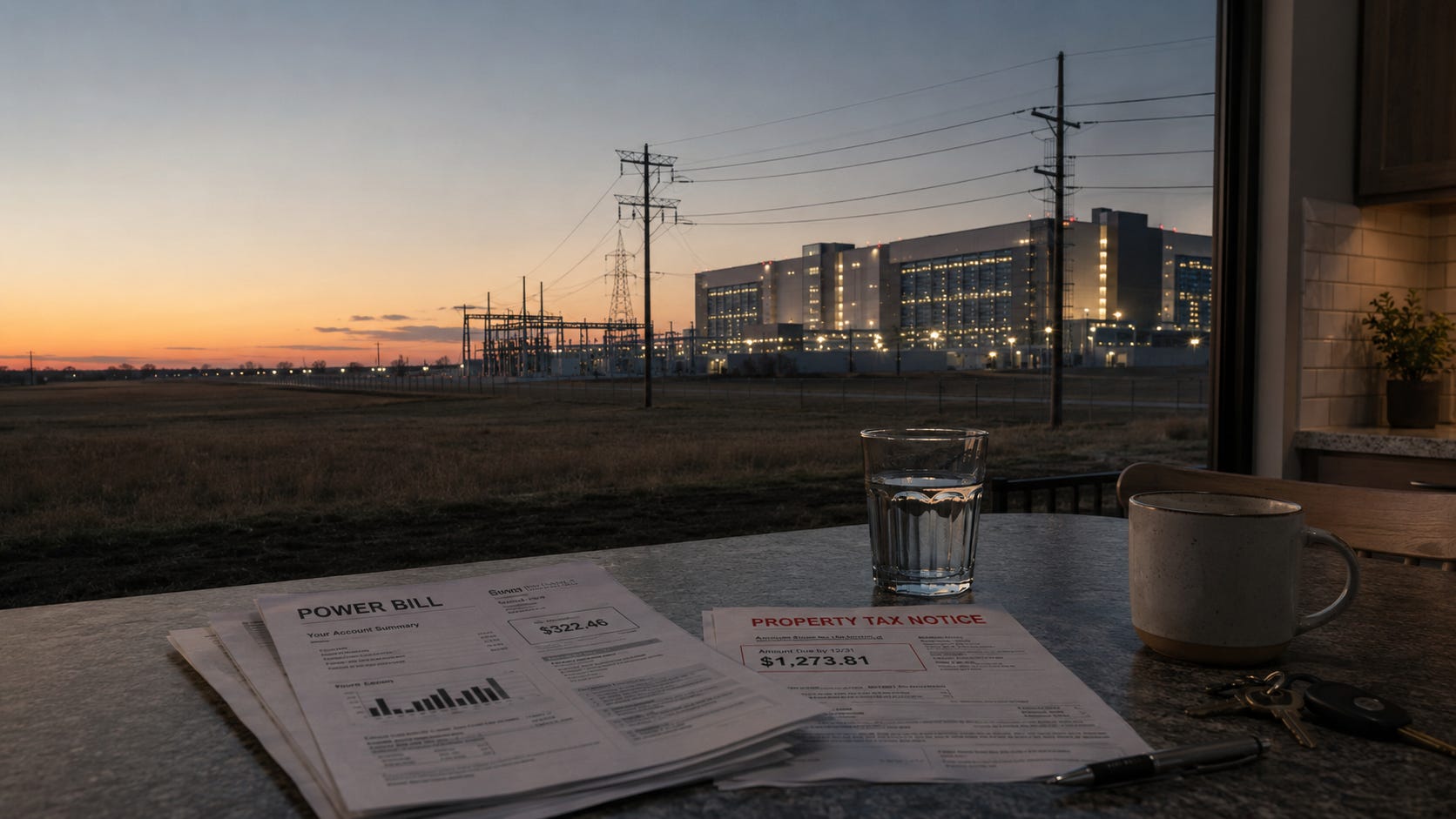
For years, Americans were told the future would be weightless.
The cloud. Artificial intelligence. Digital transformation. Innovation. These words were sold like they lived above ordinary life, somewhere beyond the reach of an electric bill, a water meter, or a zoning board.
But the cloud was never really in the sky. It was always going to land somewhere.
Now it is landing in towns, counties, suburbs, and rural communities across the country in the form of massive data centers: windowless buildings packed with servers, drawing enormous amounts of electricity, requiring cooling, demanding land, and pulling local governments into deals many residents do not fully understand until the project already has momentum.
People are asking a reasonable question: who agreed to this?
That question is not anti-technology. It is the sound of ordinary people realizing that the future they were promised as clean, sleek, and invisible has a physical footprint. That footprint may come with higher power demand, water strain, land-use disputes, noise, tax breaks, and utility costs that extend beyond the walls of a server farm.
Americans are not rejecting the future. They are rejecting being handed the costs after the future has already been negotiated.
Big Tech wants the computing power. Utilities see the demand. Developers see the land deals. Politicians see ribbon cuttings and investment headlines. Residents see their water systems, electric grids, tax codes, and local governments being pulled into the machinery of the AI economy before the public has been given a clear look at the bill.
The debate over data centers is not just about buildings. It is about concentrated power. It is about what happens when some of the richest companies on earth need public resources to build private infrastructure, and government moves faster to accommodate them than to protect the people who live with the consequences.
When the richest companies in the world need more power, they plug into politics.
Support independent media that follows the power.
The Coffman Chronicle is built to track who holds power, who abuses it, who profits from it, and who pays the price.
Paid supporters get full Tony Michaels Podcast episodes, deeper transcript analysis, paid columns, archives, and the reporting framework behind the show.
If you believe independent media has to survive outside billionaire platforms, corporate media, and party-approved gatekeepers, become a paid supporter today.
This Is Not an Anti-Technology Backlash
The easiest way to dismiss the backlash is to call it anti-progress.
That is usually how these fights begin. A community raises questions about a massive project, and suddenly, the people asking those questions are treated as if they are afraid of the future. They are told they do not understand innovation, that America has to compete, that jobs are coming, that investment is good, and that concerns can be worked out later.
However, asking who will pay for the future is not the same as rejecting it.
Most people are asking basic questions any community should ask before a billion-dollar industrial project gets planted near homes, farms, roads, and water systems.
Will this raise electric bills? How much power will it use? Who pays for new substations, transmission lines, and grid upgrades? How much water will be needed for cooling? What incentives were offered? How much public revenue is being given away? How many permanent jobs will remain after the ribbon cutting, and who gets them?
Those are not radical questions. They are kitchen-table questions.
The backlash is growing because people can feel the deal forming around them. Big Tech gets the servers. Utilities get the demand. Politicians get the announcement. Developers get the land play. The public is left uncertain and then told to be grateful for the opportunity.
That is not how public consent is supposed to work.
The Rush Before the Rules
The second mistake is treating this like a normal local development fight.
A single data center may appear as a zoning request, a utility filing, a water agreement, a tax incentive, or an economic development package. On paper, each piece looks narrow. One board handles land. One agency handles permits. One utility asks for grid upgrades. One state office talks about incentives.
However, when you zoom out, those scattered decisions become the physical buildout of the AI economy.
That is the trick of fragmented power. No one room has to admit it is deciding the future. Each room can say it is only handling its small piece of the process. By the time the public understands how the pieces fit together, the project may already have land, financing, political support, utility planning, and momentum.
Congress can hold hearings, agencies can study the issue, and politicians can make speeches about protecting ratepayers and modernizing the grid, but hearings are not guardrails. Speeches are not safeguards. Studies do not protect a household after the infrastructure has already been approved.
The buildout is moving through the levels of government where speed is easiest and public attention is thinnest: zoning boards, county commissions, state legislatures, economic-development offices, and utility regulators. That does not require a secret memo saying, “avoid Congress.” The structure already does that work.
They do not need one national law called “Let Big Tech Build Everywhere.” They can win one zoning fight, one tax incentive, one utility filing, and one land deal at a time.
A corporation can hire lawyers, lobbyists, consultants, engineers, and public relations teams to work every room in the process. A resident has a job, a family, a utility bill, and maybe three minutes at a public meeting after the project is already wrapped in the language of jobs, progress, and competition.
Big money loves fragmented government because it can negotiate one room at a time. Ordinary people have to organize one room at a time.
That is how public consent gets weakened without ever being formally abolished. The meeting still happens. The paperwork is still filed. The real question is whether the people most affected are brought in early enough to matter, or late enough to manage.
The Money Is the Map
This is where the data-center story stops being just a technology story and becomes a power story.
Data centers are not spreading only because AI needs computing capacity. They are spreading because some of the richest companies on earth can shop for cheap land, cheap power, tax exemptions, utility cooperation, weak disclosure rules, and political urgency. That is concentrated money asking public systems to rearrange themselves around private infrastructure.
The money is the map.
Big Tech brings the capital. Utilities bring the infrastructure. Developers bring the land deals. Politicians bring the permission structure. Economic development officials speak the language of jobs and investment. But the public is often brought in after the project already has momentum, when the conversation has already been framed around growth, competition, and whether a town wants to be “left behind.”
Tax breaks are the front door. States and local governments compete for data centers with incentives, exemptions, abatements, and special treatment. Public revenue can be sacrificed before the public fully understands what it is giving up. Money that could have gone to schools, roads, emergency services, water systems, or property-tax relief may instead sweeten the deal for companies that already have more money than some countries.
Utility bills are the back door. If new transmission lines, substations, power generation, or grid upgrades are needed to serve massive private electricity demand, the key question is simple: who pays? A family struggling to keep the lights on should not have to subsidize the energy appetite of a trillion-dollar company.
Then there is the jobs promise. The investment number is huge. The announcement is polished. However, data centers are usually capital-heavy, not labor-heavy. They can require enormous infrastructure while producing far fewer permanent jobs than people imagine when they hear “billion-dollar project.”
That does not mean every data center is a bad deal. It means every deal deserves scrutiny.
When the richest companies in the world need more power, they plug into tax codes, utility commissions, zoning boards, land markets, and economic-development offices. If the public does not force transparency early, the cost of the deal can be spread so widely that no one in power has to admit who is really paying.
Companies get the future. Communities get the footprint.
That is concentrated power with a server rack.
We Have Seen This Before
America has seen this playbook before.
The technology changes, the sales pitch gets updated, and the public-relations language gets cleaner, but the pattern is familiar: call it progress, promise jobs, move fast, treat local concern as obstruction, and let communities discover the full cost after the project already has momentum.
Fracking is the clearest comparison.
It was sold as energy independence, cheap energy, local jobs, and economic growth. Land leases were signed. Workers were hired. Politicians got to talk about American energy dominance.
Then came the harder questions.
What happens to the water? What chemicals are being used? Who deals with the noise, road damage, and property-value concerns? What power does a community really have once the leases are signed, the permits are moving, and the industry has wrapped itself in the language of national necessity?
That is the lesson data centers should force us to remember.
AI innovation is now being sold with the same urgency. America must compete. Communities should welcome investment. However, residents are asking the questions that always come after the sales pitch: What happens to the water? What happens to the grid? Who pays for the upgrades? How many permanent jobs will remain? Why did the public hear about the project so late?
Fracking taught Americans that “energy independence” could become a local water fight.
Data centers may teach Americans that “AI innovation” can become a local fight over power bills, water supply, and democracy.
Progress should not be a magic word that shuts down scrutiny. Innovation should not be a permission slip for secrecy. National competition should not be used as an excuse to tell communities to accept the costs first and ask questions later.
Who Benefits, Who Pays?
Every data-center fight eventually comes down to the same kitchen-table question: who benefits, and who pays?
Big Tech benefits because it gets the computing capacity it needs. Utilities benefit because massive new electricity demand means massive new business. Developers benefit because ordinary land can suddenly become valuable. Politicians benefit because they can announce investments, growth, and jobs. States benefit because they get to claim they are winning the race for the future.
The public is left with the harder side of the ledger.
If the grid needs upgrades, households want to know whether their bills will rise. If water is needed for cooling, residents want to know what happens during droughts, heat waves, or local shortages. If tax incentives are handed out, taxpayers deserve to know what public services are being traded away. If the project creates noise, traffic, or strain on infrastructure, the community deserves more than a promise that everything will work out later.
AI may be digital, but its costs are not. They show up in power plants, transmission lines, substations, water withdrawals, tax abatements, zoning fights, and utility bills.
People understand that infrastructure has to be built somewhere. What they do not accept is being treated like the last obstacle in a deal already shaped by people with more money, more access, and more time to influence the process.
Because the cost is not only financial. There is also a democratic cost.
When communities are brought in late, they are not being asked to shape the future. They are being asked to absorb it. They are handed a project already dressed up as inevitable, then told their concerns are delays and their skepticism is backward.
That is how concentrated power protects itself. It turns public scrutiny into a problem. It turns speed into virtue. It turns the demand for transparency into an attack on progress.
Asking who pays is not obstruction. It is citizenship.
If a data center needs public resources, then the public deserves public answers. If a company needs the grid, the water system, the tax code, and the local government to make its business model work, then the community has every right to demand enforceable protections before the deal is done.
The future cannot just be something powerful people announce. It has to be something the public can see, question, shape, and refuse.
Build the Future in Public
None of this means America should stop building.
That is the false choice powerful people love to offer. Either accept the deal as written, or be accused of opposing progress. Either let the project move at the speed of corporate demand, or be blamed for standing in the way of innovation. Either trust the people who negotiated the future behind closed doors, or get labeled as someone who does not understand the modern economy.
However, democracy is not anti-progress. Oversight is not obstruction. Transparency is not weakness.
If AI is important enough to reshape the electric grid, consume public resources, alter local land use, and require cooperation from governments at every level, then it is important enough to be debated in public before the deals are finalized.
Communities deserve advance notice before massive projects arrive wrapped in economic-development language. They deserve clear disclosure of power use, water demand, tax incentives, noise, land impacts, and infrastructure costs. They deserve ratepayer protections, clawbacks when job promises do not materialize, and public hearings early enough to matter, not late enough to manage anger.
Congress should not be allowed to hide behind the complexity of the issue.
If the AI economy is becoming a national priority, then the rules protecting ordinary people should not be left to scattered local meetings, voluntary corporate promises, and utility filings most residents will never see. The bigger the buildout, the bigger the need for democratic guardrails.
The country can build data centers. It can build AI infrastructure and compete technologically, but it cannot keep pretending that innovation is weightless when the costs are being carried by land, water, power grids, tax codes, and communities that were brought into the conversation too late.
Americans are saying no to a system in which the richest companies in the world get public resources, public incentives, and public infrastructure, while ordinary people are told to trust the process.
The cloud is being built on the ground. That means the people who live on that ground deserve more than a press release after the deal is done. They deserve the facts, the protections, and the power to say no before the future is poured in concrete.
The question is not whether America will have a technological future. The question is whether ordinary Americans will be citizens in that future, or just the people handed the bill.
Support Independent Media
If this story matters to you, support independent media that follows the power all the way down to the kitchen table.
The fight over data centers is not just about AI. It is about who gets the future, who pays for it, and whether ordinary people are allowed to see the deal before the concrete is poured.
That is the work we do here at Coffman Chronicle: connect the headline to the pattern, the pattern to power, and power to the consequences people feel in their bills, their towns, their water, their schools, and their daily lives.
If you can afford it, consider becoming a paid subscriber. Your support helps keep this work independent, reader-powered, and focused on the people too often left out of the room where decisions are made.
Sources:
“Denver Pauses New Data Center Development for One Year.” Axios, May 19, 2026.
“Berkeley Lab Report Evaluates Increase in Electricity Demand from Data Centers.” Berkeley Lab News Center, January 15, 2025.
“AI Data Centers: Big Tech’s Impact on Electric Bills, Water, and More.” Consumer Reports, March 20, 2026.
“Americans Oppose AI Data Centers in Their Area.” Gallup, May 13, 2026.
“Wallach v. Town of Dryden.” Harvard Law Review 128, no. 5, March 10, 2015.
“How Data Centers May Lead to Higher Electricity Bills.” Harvard Law Today, September 3, 2025.
“Extracting Profits from the Public: How Utility Ratepayers Are Paying for Big Tech’s Power.” Harvard Law School Environmental and Energy Law Program, March 5, 2025.
“Subsidizing Servers: How States Are Competing to Attract Data Centers.” NCSL, accessed May 25, 2026.
“House Bill 1834: Regular Session 2025–2026.” Pennsylvania General Assembly, accessed May 25, 2026.
“How Americans View Data Centers’ Impact in Key Areas, from the Environment to Jobs.” Pew Research Center, March 12, 2026.
2024 United States Data Center Energy Usage Report. Lawrence Berkeley National Laboratory, December 2024.
“The Data Center Regulation Bills on the Table in PA.” Spotlight PA, May 18, 2026.
U.S. House Committee on Oversight and Government Reform. “America’s AI Moonshot: The Economics of AI, Data Centers, and Power Consumption.” April 1, 2025.
The White House. “Accelerating Federal Permitting of Data Center Infrastructure.” July 23, 2025.
Because as usual big business leaves the consumer holding the bag. Keep big business out of our communities.,
The comparison with fracking feels spot-on - the profiteers don't have to live with the consequences of their deals.