


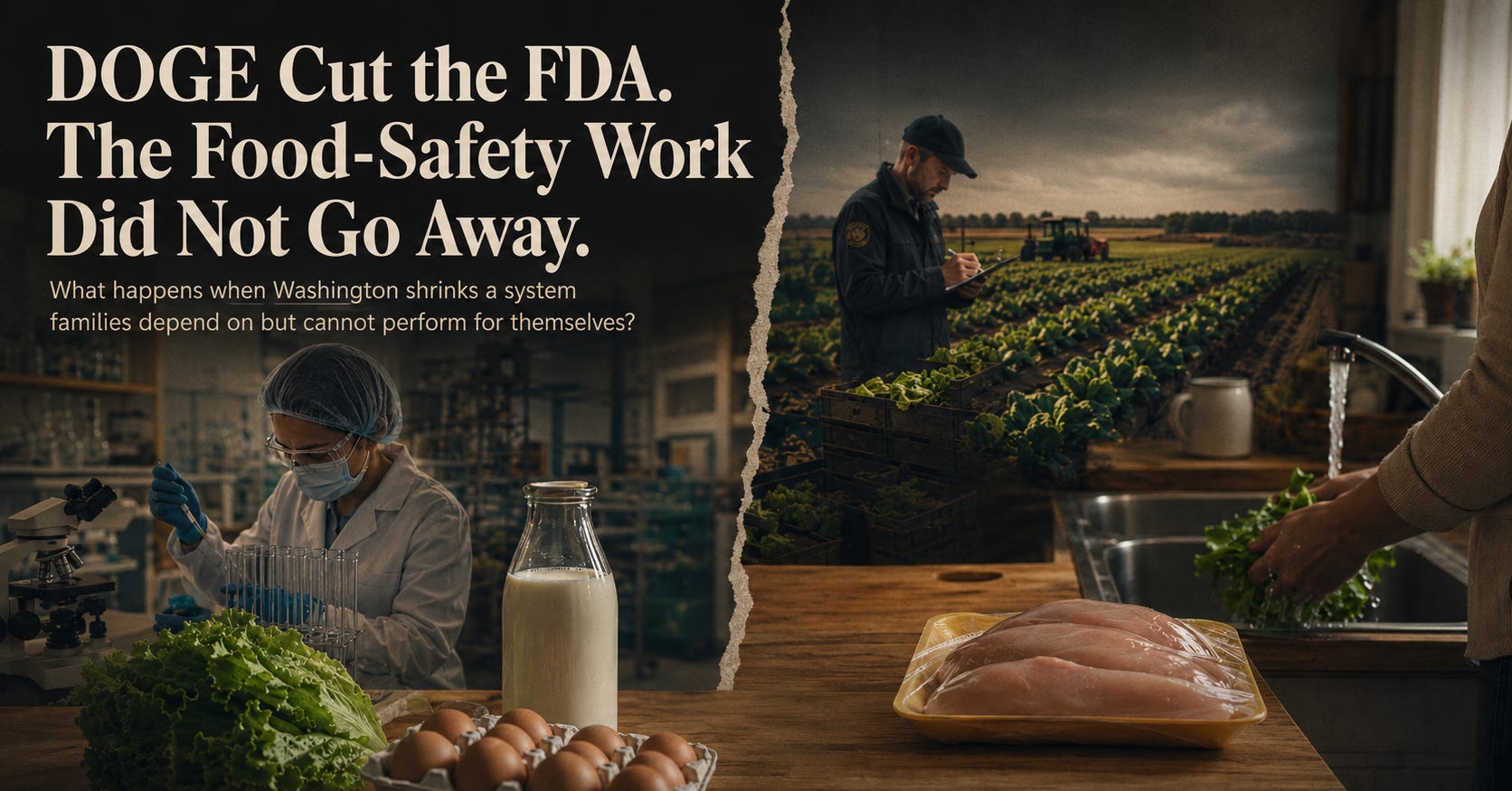
You Can Wash Your Hands. You Cannot Inspect the Farm.
A family standing in the produce aisle can make careful choices. They can wash the lettuce, refrigerate the milk, cook the chicken thoroughly, and check whether the eggs in the refrigerator have been recalled.
What they cannot do is inspect the irrigation water on a farm hundreds or thousands of miles away. They cannot walk through a processing plant with a swab kit, test a shipment for Salmonella, compare laboratory results from sick patients in several states, or trace a contaminated ingredient backward through distributors, warehouses, and suppliers. They cannot audit whether the laboratory doing that testing is producing reliable results.
Those are not failures of personal responsibility. They are tasks individual citizens simply do not have the power, access, or information to perform. That is why the United States built a food-safety system.
The farmer has responsibilities. The processor has responsibilities. The grocery chain has responsibilities. Consumers have responsibilities too. However, somewhere between the field and the dinner plate, government performs a different job: inspecting, testing, coordinating, tracing, and warning on behalf of people who cannot realistically do those things for themselves.
That makes food safety a useful test of government efficiency. It is not whether every federal job must survive forever or whether every agency deserves every dollar it has ever received. The issue is whether government can remove pieces of a system protecting the public without first knowing whether the remaining system can still do the job.
This Community Is Powered by You
What started as a small circle has grown into something much bigger, and it’s all because of readers like you.
Every time you forward this email, post it on socials, or bring someone new into the fold, you’re helping build one of the most passionate, independent political communities out there.
Want to keep the momentum going?
Share this newsletter with someone who should be part of this conversation.
Thank you for being here. It means everything.
Trump Inherited a System That Already Needed Repair
Donald Trump did not inherit a food-safety system operating at full strength. Twelve days before he returned to office, the Government Accountability Office (GAO) reported that the Food and Drug Administration (FDA) had failed to meet its domestic and foreign food-facility inspection targets every year since 2018. From fiscal 2018 through 2023, FDA averaged 8,353 domestic inspections a year but only 917 foreign inspections.
The foreign gap was especially stark. Federal law had established an annual target of 19,200 foreign food-facility inspections. The FDA’s best year was 2019, when it completed 1,727, about 9% of that target. The FDA itself considered the statutory target unrealistic, but it had never established a replacement showing how many inspections were actually necessary to protect imported food.
The agency identified limited workforce capacity as its primary obstacle. In July 2024, FDA had 432 food-safety investigators, about 90% of its authorized staffing ceiling. GAO recommended that FDA determine how large its foreign inspection workforce actually needed to be.
This did not begin with a healthy system destroyed overnight. It began with a system whose weaknesses were already documented.
Trump inherited something that needed repair. Washington chose reduction.
DOGE Chose Reduction Before It Proved Capacity Was Excess
The Trump administration did not ask agencies to look for waste. On February 11, 2025, President Trump ordered agencies to prepare for large-scale reductions in force and directed them, in consultation with their Department of Government Efficiency (DOGE) team leads, to limit hiring to no more than one new employee for every four who departed, subject to exemptions. The order said its purpose was to eliminate “waste, bloat, and insularity” across the federal bureaucracy.
The Department of Health and Human Services (HHS) followed with a restructuring plan that called for shrinking the department from about 82,000 full-time employees to 62,000. FDA was slated to lose approximately 3,500 employees. The Centers for Disease Control and Prevention (CDC) was slated to lose about 2,400 employees.
The administration offered an important assurance. HHS said the FDA reductions would focus on streamlining operations and centralizing administrative functions, and specifically said they would not affect food reviewers or inspectors.
If Washington could remove thousands of positions while preserving the capacity necessary to keep food safe, taxpayers would have every reason to welcome the efficiency, but protecting the person whose job title says “inspector” does not answer the larger question. An inspector does not operate alone.
To know whether food-safety capacity was actually protected, we have to look at the people and systems standing behind the badge.
A Badge Is Not a Food-Safety System
Protecting inspectors sounds reassuring because inspection is the part of food safety most people can picture: a federal employee entering a facility, examining conditions and checking whether the rules are being followed.
However, inspection is only one link in a longer chain. The FDA cuts removed employees who arranged international travel, visas, and security for inspectors working overseas. They also reached laboratory scientists who analyzed food samples for contamination and communications specialists responsible for warning the public about urgent recalls. Agency leaders became concerned enough about the disruption that FDA moved to hire contractors to replace some of the dismissed support personnel.
Finding a problem is not the same as solving one. A suspicious sample may need laboratory confirmation. Illnesses appearing hundreds of miles apart may have to be connected. Records must be collected and products traced backward through processors and suppliers. An overseas inspector has to reach the facility in the first place. Once dangerous food is identified, somebody has to tell the public quickly enough for families to get it out of their refrigerators. None of those functions becomes unnecessary because the person entering the plant still has a federal badge.
While the administration was entitled to ask whether FDA could perform those tasks with fewer people, preserving the inspector while removing parts of the machinery that make inspection useful does not necessarily preserve food-safety capacity.
A badge is not a food-safety system. The real test was whether the work behind that badge continued.
Then Necessary Work Started Stopping
The consequences did not remain confined to an organizational chart. In April 2025, the FDA suspended proficiency testing for the Food Emergency Response Network, a system involving roughly 170 laboratories that test food for pathogens and contaminants. The program helps laboratories demonstrate that they can produce accurate, consistent results. Reuters reported that the suspension followed the loss of a quality-assurance officer, an analytical chemist, and two microbiologists at an FDA food laboratory. Planned proficiency tests included detection of Cyclospora in spinach.
Days earlier, the FDA had also suspended work designed to improve consistency among more than 40 laboratories testing milk, cheese, and pet food for highly pathogenic avian influenza. The agency attributed that interruption to staffing losses as well.
Other cuts proved difficult to sustain. FDA moved to hire outside contractors to perform some inspection-support functions after employees handling foreign travel were dismissed. Weeks later, the agency began reinstating more than 20 travel staffers, while food scientists who tested samples for bacteria and studied hazardous chemicals were also told they would be brought back.
Though none of this proves that a staffing cut caused a later outbreak, it does show that work performed for a food-safety purpose was interrupted because the people needed to perform or support it were gone. In some cases, FDA then had to restore employees or seek outside help to recover that capacity.
That creates a straightforward test of efficiency. If removing the worker caused necessary work to stop, what evidence had established that the capacity was excess? While Washington was learning the answer, the workload confronting the food-safety system was moving in the opposite direction.
The Workload Went the Other Direction
The reductions were supposed to make government leaner. The food-safety workload did not become leaner with them.
FDA’s public Coordinated Outbreak Response and Evaluation (CORE) Investigation Table provides a useful comparison because an investigation is posted when CORE begins actively coordinating a response to an outbreak or series of adverse events. Counting investigations posted through approximately mid-August produces a clear pattern: 17 in 2022, 14 in 2023, 12 in 2024, 17 in 2025, and 21 so far in 2026.
The average for the previous four years was 15. That puts 2026 about 40% above the 2022–2025 average by this point in the calendar.
Those investigations are not interchangeable with the total number of Americans suffering foodborne illness. They measure outbreak and adverse-event investigations substantial enough for FDA’s CORE Response Teams to begin coordinating a federal response. FDA’s current table includes investigations involving products ranging from eggs and soft cheese to frozen blueberries and iceberg lettuce.
These numbers do not prove that DOGE cuts caused these outbreaks. Contaminated food has many causes, and outbreaks occurred long before the current administration. However, the numbers do establish the stewardship problem Washington now has to answer.
The government reduced parts of the infrastructure responsible for detecting and responding to food-safety problems. The demand on that infrastructure subsequently increased. Before treating that increase as evidence of anything more, however, we need to make sure Washington did not simply change the way it counts the work.
We Checked the Measuring Stick
A rising number means little if the government changed what it was counting, so the FDA measure deserves its own test.
CORE’s public Investigation Table was created in 2020 to list outbreaks being actively coordinated by a CORE Response Team. Today, FDA still describes the table as covering outbreak and adverse-event investigations primarily managed by those same Response Teams.
Adverse events are not a Trump-era addition. FDA’s 2022 annual report already counted potential outbreaks, confirmed outbreaks and adverse events, and reported 65 incidents evaluated and 28 responses initiated that year.
The organization did change. CORE became part of the broader CORE+EP structure during the FDA’s Human Foods Program reorganization in October 2024, before Trump returned to office. However, the FDA’s subsequent reports continued using the same basic measures: incidents evaluated, responses initiated, and public advisories issued. In 2023, FDA reported 69 incidents and 25 responses; in 2024, 72 incidents and 26 responses.
The FDA has changed other reporting structures, so you can't casually compare every agency statistic across administrations. However, the increase on the CORE Investigation Table does not presently appear to be the product of a new Trump-era definition of an investigation.
While that does not establish causation, it does mean the warning light cannot simply be dismissed as a bookkeeping change.
Efficiency Is a Government Duty Too
None of this means government should preserve every job simply because the job already exists. Waste is real. Duplication is real. Outdated systems are real. Taxpayers are entitled to expect agencies to modernize, eliminate unnecessary layers, end contracts that do not deliver, and stop funding programs that cannot justify their public purpose.
That is stewardship too. The Square New Deal cannot demand responsibility from corporations and citizens while treating government as exempt from the same standard. Public money belongs to the public, and spending it carelessly is a failure of duty. However, efficiency has to mean more than subtraction.
A government function becomes more efficient when it delivers the necessary service with fewer resources, lower cost, or better results. Simply reducing the number of employees does not establish efficiency if the work still has to be performed, essential functions stop, or government later has to rebuild the capacity it removed.
Headcount is easy to measure. Protection is harder. The measure of efficiency is not how many chairs government empties. It is whether the necessary service still gets delivered.
That is where the DOGE approach deserves its hardest question. Before deciding how much capacity to remove, did anyone first determine how much capacity the food-safety system needed to perform its mission?
The public record we have examined makes that question difficult to dismiss. The FDA entered 2025 with documented staffing and inspection deficiencies. Cuts followed. Necessary functions were disrupted further. Some capacity then had to be restored.
A smaller government can be a more efficient government, but smaller is not itself a measure of success. The measure is whether the job still gets done.
The Square New Deal Test: Sufficient Government
That is where the Square New Deal draws its line. The answer is not unlimited government. It is sufficient government.
Food safety distributes responsibility across the entire chain. Growers, processors, importers, distributors, and retailers have a duty to keep food safe. Citizens have duties of their own: safe storage, proper cooking, reasonable hygiene, and attention to recalls.
Government carries the responsibilities that require collective authority and national capacity. Its duty is not to replace personal responsibility or corporate responsibility. It is to perform the portion of the job neither can perform for the country as a whole.
That is the stewardship standard. The Square New Deal does not demand maximum government. It demands sufficient government. Government should be no larger than necessary to perform its legitimate responsibilities, but it must be large enough to perform them.
That turns the argument over food safety away from the sterile question of whether government should always be bigger or always be smaller. The better question is whether Americans are receiving the protection they are paying government to provide.
If the answer is yes, then efficiency deserves credit. If necessary work disappears with the people doing it, government has not yet proved efficiency. It has proved only reduction.
The People Doing Their Jobs Are Supposed to Be Invisible
Most Americans will never know the name of the microbiologist who confirmed a contaminated sample, the epidemiologist who connected illnesses across state lines, or the inspector who walked through the facility before a problem reached more families. They should not have to.
When a safety system works, much of its value is invisible. The warning arrives. The product disappears from the shelf. The outbreak is traced. The family never knows how many people stood between a contaminated field and their dinner table.
That invisibility cannot become evidence that the work is unnecessary. The grower, processor, grocer and citizen each have a duty. So does the government.
Efficiency matters, but so does capacity. Before Washington removes the people and systems protecting the public, it owes the country something more serious than a headcount target.
Support Independent Media
The Coffman Chronicle exists to follow power, expose the structure, and tell the truth about who gets protected, and who is expected to live with the consequences.
If this kind of independent journalism matters to you, share this piece. And if you can afford to, become a paid subscriber.
Your support helps keep the Chronicle independent, accountable to readers, and focused on the kitchen-table consequences of decisions that too often get buried beneath the daily political noise.
Sources:
Douglas, Leah. “FDA Suspends Program to Improve Bird Flu Testing Due to Staff Cuts.” Reuters. April 3, 2025.
Douglas, Leah. “U.S. FDA Suspends Food Safety Quality Checks After Staff Cuts.” Reuters. April 17, 2025.
Perrone, Matthew. “FDA Hiring Contractors to Replace Fired Staff Who Supported Safety Inspections.” Associated Press. April 18, 2025.
Perrone, Matthew. “FDA to Rehire Fired Staffers Who Booked Inspection Trips, but Other Workers Remain in Limbo.” Associated Press. May 1, 2025.
U.S. Department of Health and Human Services. “Fact Sheet: HHS’ Transformation to Make America Healthy Again.” Fact sheet. April 2, 2025.
U.S. Food and Drug Administration. “CORE Outbreak Investigation Table Issued.” Constituent Update. November 18, 2020.
U.S. Food and Drug Administration. “FDA Releases the CORE 2022 Annual Report.” Constituent Update. January 8, 2024.
U.S. Food and Drug Administration. CORE 2024 Annual Report: Investigations of Foodborne Outbreaks and Adverse Events in FDA-Regulated Foods. March 17, 2026.
U.S. Food and Drug Administration. “Investigations of Foodborne Illness Outbreaks.” CORE Investigation Table. Accessed August 17, 2026.
U.S. Government Accountability Office. Food Safety: FDA Should Strengthen Inspection Efforts to Protect the U.S. Food Supply. GAO-25-107571. January 8, 2025.
White House, The. Implementing the President’s “Department of Government Efficiency” Workforce Optimization Initiative. Executive Order 14210. February 11, 2025.
So, white men still exist in the same fantasy world as the guys who gave us the Titanic, leaded gasoline, and online gambling.
I've heard that smart people have doubt and stupid people have confidence, and until the average human can more easily recognize the difference, we may be stuck with these jackoffs.