


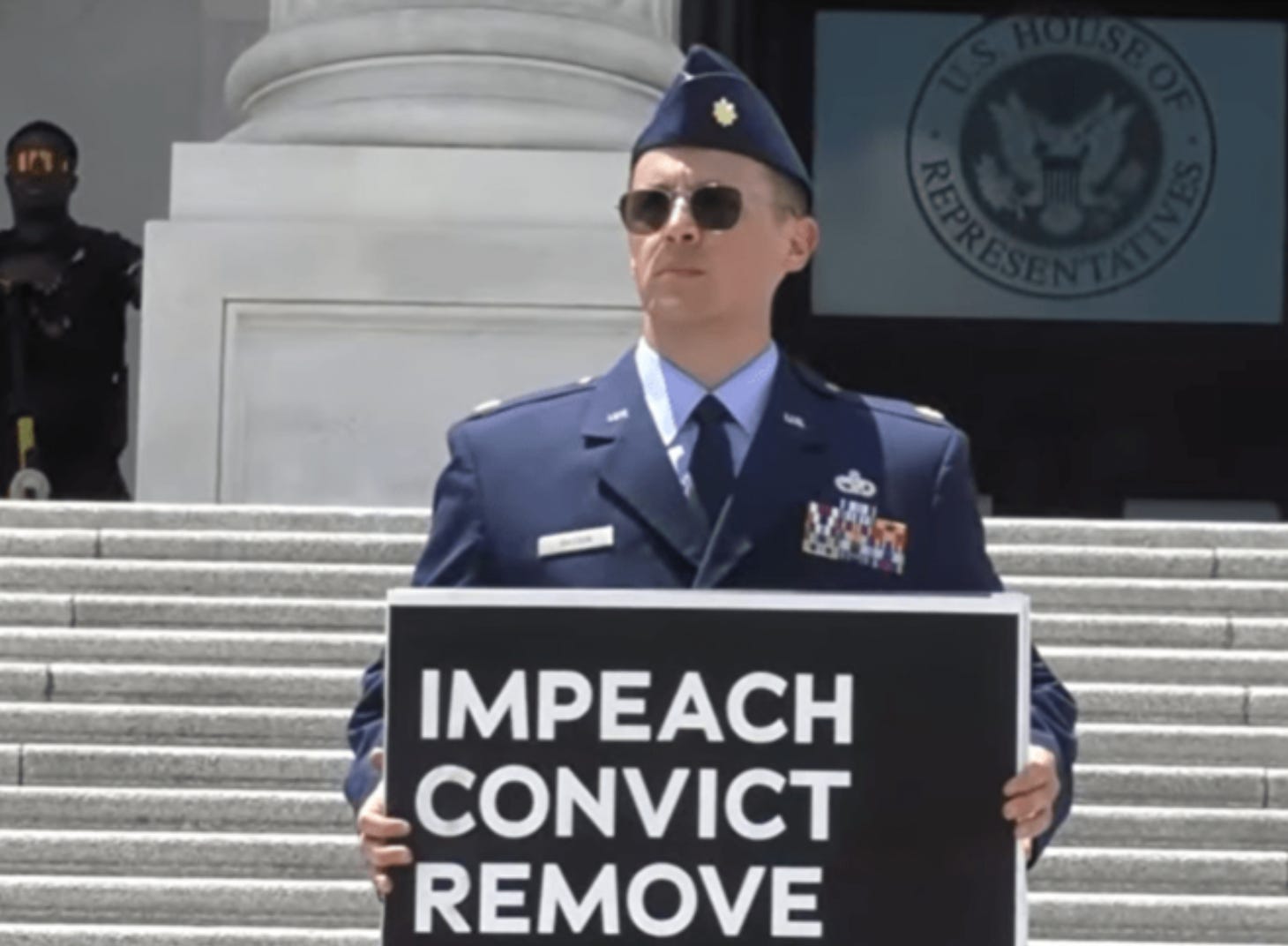
A Man in Uniform on the People’s Steps
Major Jason Watson stood on the Capitol steps in uniform. That image is supposed to make a republic uncomfortable, not because an officer’s conscience should be treated as a crime, because constitutional warnings become illegitimate when they embarrass a president, or because the commander in chief should be protected from criticism by the silence of everyone below him, but because the uniform means something. Rank means something. The armed forces are not another campaign committee, another cable-news panel, or another faction in the permanent war between parties.
That is why Watson’s protest cannot be flattened into a simple morality play. He should not be turned into a saint because he criticized Donald Trump, nor should he be dismissed because his criticism came in uniform.
The facts matter. The rules matter. Military neutrality matters. So does the warning he carried to the Capitol steps.
Watson did not stand outside a donor retreat or a television studio. He stood before Congress, the branch of government that already holds the powers he was demanding it use. That is the part Washington would rather skip. Why did an active-duty officer believe he had to risk his career to remind Congress of powers Congress already possesses?
A republic is already in danger when it needs a man in uniform to remind elected civilians of their duty. That does not make Watson above the rules, but it does make Congress harder to excuse.
Support independent media that follows the power.
The Coffman Chronicle is built to track who holds power, who abuses it, who profits from it, and who pays the price.
Paid supporters get full Tony Michaels Podcast episodes, deeper transcript analysis, paid columns, archives, and the reporting framework behind the show.
If you believe independent media has to survive outside billionaire platforms, corporate media, and party-approved gatekeepers, become a paid supporter today.
What the Headline Leaves Out
Watson publicly called for the impeachment, conviction, and removal of Donald Trump and JD Vance. Reuters reported that he was an active-duty Air Force major who appeared in uniform, denounced Trump and Vance for actions including war with Iran without congressional authorization, and held a sign demanding their impeachment, conviction, and removal. Reuters also reported that the Air Force said it would investigate the incident, and that Watson appeared aware of the risk when he said, “What matters far more than who I am is what I have to say and the price I’m willing to pay to say it.”
However, they are not the whole story.
Watson was not arrested for saying the word impeachment. Military Times reported that Capitol Police said Watson was arrested for demonstrating on the House steps without a sitting member of Congress present. Representative Al Green had escorted Watson to the steps, then left the area. Capitol Police said officers ordered Watson to stop the demonstration or face arrest, and that Watson refused. He was arrested under D.C.’s crowding, obstructing, and incommoding law.
Capitol rules treat the steps differently from ordinary public space. U.S. Capitol Police guidelines define demonstration activity as actions expressing approval or disapproval of government policy and state that it is allowed only in designated areas. The same guidelines list the steps of the United States Capitol among prohibited areas for demonstrations.
There is one question about the Capitol steps and police authority. There is another about Watson’s military status and active-duty political rules. There is a third question about whether presidents have been allowed to take military action without the public vote that the Constitution expects from Congress. Those questions should not be collapsed.
Watson may have broken rules, but Congress still has duties.
A rule violation by one officer would not prove that the president’s war powers are lawful. A lawful arrest would not prove that Congress has done its job.
The Uniform Is Not a Partisan Billboard
The uniform is significant. A military uniform is not ordinary clothing. It is not a prop or a campaign costume. It represents an institution with weapons, command structures, legal authority, and public trust. That is the point of the restriction.
Defense Department policy encourages service members to fulfill their civic obligations, including voting and expressing personal opinions, but it also says active-duty members may express those opinions only as individuals, not as representatives of the armed forces. The directive allows attendance at some political events only when service members are not in uniform and when no reasonable inference of official sponsorship, approval, or endorsement can be drawn. It also bars active-duty members from participating in partisan political rallies or speaking before partisan political gatherings.
The military cannot become another wing of the political fight. It cannot become a red team or a blue team or a faction waiting to announce which president it considers legitimate or which party it considers faithful to the Constitution.
Civilian control of the military also does not mean personal obedience to the president. A service member’s oath is not to Donald Trump, JD Vance, a party, a movement, or the political emotions of the moment. It is an oath to support and defend the Constitution.
That oath does not give an officer permission to do whatever he wants in uniform. The president also does not own the armed forces.
The Air Force may legitimately examine whether Watson violated rules governing political activity, public criticism by commissioned officers, or use of the uniform in a political demonstration. Article 88 of the Uniform Code of Military Justice prohibits commissioned officers from using contemptuous words against the president, vice president, Congress, and several other officials. Whether that article applies to Watson’s words is a question for the military process, not a social-media verdict.
Discipline must remain discipline. However, it cannot become retaliation disguised as order, a loyalty test dressed up as military professionalism. Civilian control is supposed to protect the republic from military rule, not protect a president from constitutional scrutiny.
A president cannot turn the military into his personal instrument, and an officer cannot turn the uniform into a personal political platform.
Watson’s conduct should be judged under neutral rules. His warning should be judged on its constitutional merits. Neither question permits Congress to remain absent.
The military may decide whether Watson crossed a boundary. Congress still has to decide whether the president did.
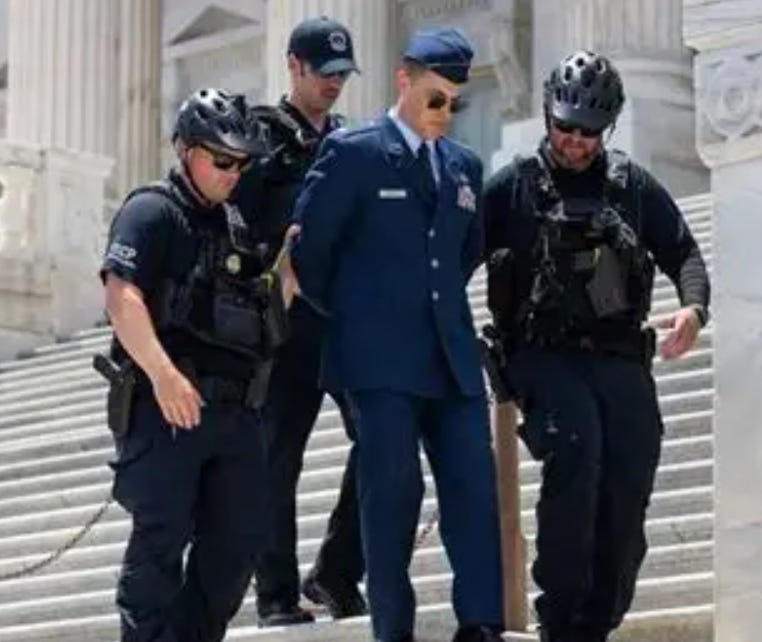
The Warning Beneath the Protest
The uniform explains why Watson’s conduct is complicated. It does not answer the warning.
Watson’s central claim was not that one officer should decide American foreign policy or that the military should stand above elected government. The warning was about power.
Presidents have been allowed to accumulate the practical ability to begin, expand, redefine, and continue military operations while Congress avoids the burden of a direct public vote. Over time, more power moves to the president while less responsibility stays with Congress.
This is not a small constitutional detail. Article I gives Congress war-related powers, including the power to declare war, raise and support armies, maintain a navy, make rules for the armed forces, and control appropriations. Article II makes the president commander-in-chief. That division has always created tension, but it does not erase Congress from the decision.
Congress can demand legal justification, hold hearings, require reporting, define objectives and limits, condition funding, cut off funding, investigate misconduct, and use impeachment if the constitutional standard is met.
None of those powers requires an officer in uniform to stand on the steps. They require lawmakers willing to place their own names on the record.
The War Powers Resolution was written to ensure that the “collective judgment” of Congress and the president applies when U.S. forces are introduced into hostilities or situations where hostilities are imminent. It requires reporting to Congress and generally directs the president to terminate the use of U.S. forces after 60 days without a declaration of war, specific authorization, extension, or inability of Congress to meet after an attack.
That does not mean every emergency waits for a committee hearing. A president can respond to sudden attacks and protect American forces from imminent danger, but emergency action is not open-ended authority. Defensive necessity is not a blank check. The power to respond does not become the power to continue, widen, or redefine a war without Congress.
That is the question Watson carried to the Capitol steps, not whether he should personally decide the answer. He asked whether Congress will.
Congress Is Choosing Not to Act
Congress should not be allowed to hide behind weakness. That excuse has become too convenient.
When party leaders want something done, Congress remembers how power works. It can schedule votes, subpoena witnesses, pass symbolic resolutions, protect presidents, punish enemies, confirm judges, write funding bills, bury amendments, and force members to choose.
The institution is not powerless. It is selective. Congress finds its hands when presidents and party leaders want something. It claims helplessness when the Constitution asks for courage.
That is the deeper failure behind Watson’s protest. The country is not suffering from a shortage of congressional authority. It is suffering from a shortage of congressional responsibility.
It is the old bargain of party politics. Defend congressional power when the other side controls the White House. Surrender congressional power when your side controls it. Call unilateral action tyranny in one administration and necessity in the next.
That is not principle. It is permission. If the power would terrify you in the other party’s hands, it should not be surrendered to your own.
When Congress refuses to vote, the refusal itself transfers power. It tells the president to act first. It tells the public to react later. It tells service members that the mission may be debated only after they are already committed.
Watson’s protest did not create that transfer of power. It exposed it. A major may have crossed a line by using the uniform in a political protest, but Congress crossed a deeper line when it learned to treat its own constitutional duties as optional.
The question is not whether Congress has power, but for whom Congress is willing to use it.
The People Who Pay for War Were Left Outside the Decision
War does not stay inside marble buildings. It enters kitchens, barracks, bedrooms, hospital rooms, airport terminals, and folded flags. It reaches the spouse refreshing the news before bed, the parent waiting for a message from overseas, and the child learning to measure time by deployments.
That is why a congressional vote matters. A vote does not make war clean, but it does force the people who authorize danger to stand where the public can see them. That is the minimum a republic owes the people who pay.
Enlisted service members carry the first risk. Their families carry the waiting, the separation, the fear, the injury, the trauma, the disability, and sometimes the knock at the door.
Working people carry the bill. They pay through taxes, debt, fuel costs, supply shocks, inflation, and postponed public investments because money went elsewhere. Roads wait. Hospitals wait. Schools wait. Housing waits. Veterans’ care waits. The kitchen table waits while Washington explains why accountability is complicated.
Civilians abroad pay too. They live with the consequences of American power when leaders decide that force is easier than debate, secrecy is easier than consent, and the public can be briefed only after the machinery has already moved.
This is why Congress’s absence is not only procedural but also moral. A major may lose his career for demanding a congressional vote while members of Congress risk almost nothing by refusing to hold one.
That imbalance should offend everyone. The people who bear the risks of war should not have to beg Congress to place its own name on the decision. Congressional war power is not a privilege lawmakers may exercise when it is convenient. It is a public trust.
Members of Congress do not own the power to authorize war. They hold it temporarily for the people who will fight, pay, suffer, and live with the consequences.
Congress is not being asked to reclaim power for itself. It is being asked to return the people to a decision from which they have been excluded.
When Congress Disappears
Constitutional disputes do not vanish when Congress refuses to touch them. They move. They move into courtrooms, military ranks, prosecutorial offices, executive agencies, street confrontations, classified memos, emergency orders, loyalty tests, and desperate acts of conscience.
That is what congressional surrender does. It does not create peace. It creates pressure. The institution designed to debate in public steps aside, and everyone else searches for a substitute.
A judge becomes the firewall. A prosecutor becomes the remedy. A general becomes the fantasy. A dissident officer becomes the warning flare. A stronger president becomes the temptation.
That is not a healthy republic, but one learning to look everywhere except the people’s branch for rescue.
Watson may be courageous. He may also have crossed a line. Either way, he cannot become the solution to the problem he exposed. The answer to presidential overreach is not a more political military.
Repair the republic, not find a better savior. A country should not require an officer in uniform, a federal worker, a local clerk, a whistleblower, a protester, or an ordinary citizen to absorb life-altering consequences before elected officials remember their own responsibilities.
Watson stood on the steps, but the duty was never his alone.
The Answer Is an Accountable Congress
On the steps, the imbalance becomes visible. Major Jason Watson may leave this episode facing consequences, including military discipline, damage to his career, benefits, reputation, or future. Congress may leave the same episode without casting a single meaningful vote on the power that he challenged.
Watson should not be immune to rules, and military officers should not become political referees. Disagreement with the president does not automatically prove a constitutional violation. That is not the scandal. The scandal is that the person who risked everything may be the only one Washington expects to pay.
Members of Congress can condemn him, praise him, ignore him, fund the mission, criticize the mission, defend the president, attack the president, raise money, post videos, and go home without accepting the burden the Constitution placed on them. They can let the president act first, the courts handle the legal debris, the military handle the discipline, and citizens handle the consequences. Then they can call themselves helpless.
However, they are not helpless. They are responsible.
Presidents must not be permitted to wage war as kings. Military officers must not become partisan political actors. Congress must not surrender its constitutional duties to either one.
Public power belongs to the people, not to the president, the party, the general, the officer on the steps, or the judge asked to clean up what Congress refused to prevent.
The people who bear the costs of war deserve representation before decisions are made, not explanations after the damage is done.
If lawmakers believe the president’s action is lawful, they should say so with their names attached. If they believe it is unlawful, they should say so with their power attached. However, they should not be allowed to hide behind one officer’s possible violation while ignoring their own surrender.
Watson should not become a substitute for the people’s branch. He should become a warning about what happens when the people’s branch disappears.
The answer is not a more political military but rather a more accountable Congress.
Support Independent Media
If you can afford to become a paid subscriber, it helps keep this work independent and makes more reporting like this possible.
The Coffman Chronicle is built for readers who believe public power belongs to the people, not presidents, parties, donors, or institutions that refuse accountability.
Thank you for reading, sharing, and helping this rebellion from home keep going.
Sources:
Capitol Police Board. Traffic Regulations for United States Capitol Grounds. Amended January 2, 2024.
Code of the District of Columbia. “§ 22–1307. Crowding, Obstructing, or Incommoding.” D.C. Law Library.
Library of Congress. Constitution Annotated: Overview of Congressional War Powers.
Reuters. “Air Force to Investigate Officer Who Called for Trump Impeachment.” July 3, 2026.
Stassis, Cristina. “Air Force Major Arrested on Capitol Steps During Protest Calling for Trump Impeachment.” Military Times, July 2, 2026.
United States Capitol Police. Guidelines for Conducting an Event on United States Capitol Grounds. January 9, 2024.
United States Congress. War Powers Resolution. Public Law 93-148, November 7, 1973. The Avalon Project, Yale Law School.
United States Department of Defense. Directive 1344.10: Political Activities by Members of the Armed Forces. February 19, 2008.
United States House of Representatives, Office of the Law Revision Counsel. “10 U.S.C. § 888: Art. 88. Contempt Toward Officials.”
This is a great article explaining all the rules and regulations for the military officer and the Congressional duties and all the important issues involved.
Thanks for your time and skill in explaining it all so well!
💙💙💙💙💙💙💙💙💙💙💙💙