


Public Inheritance
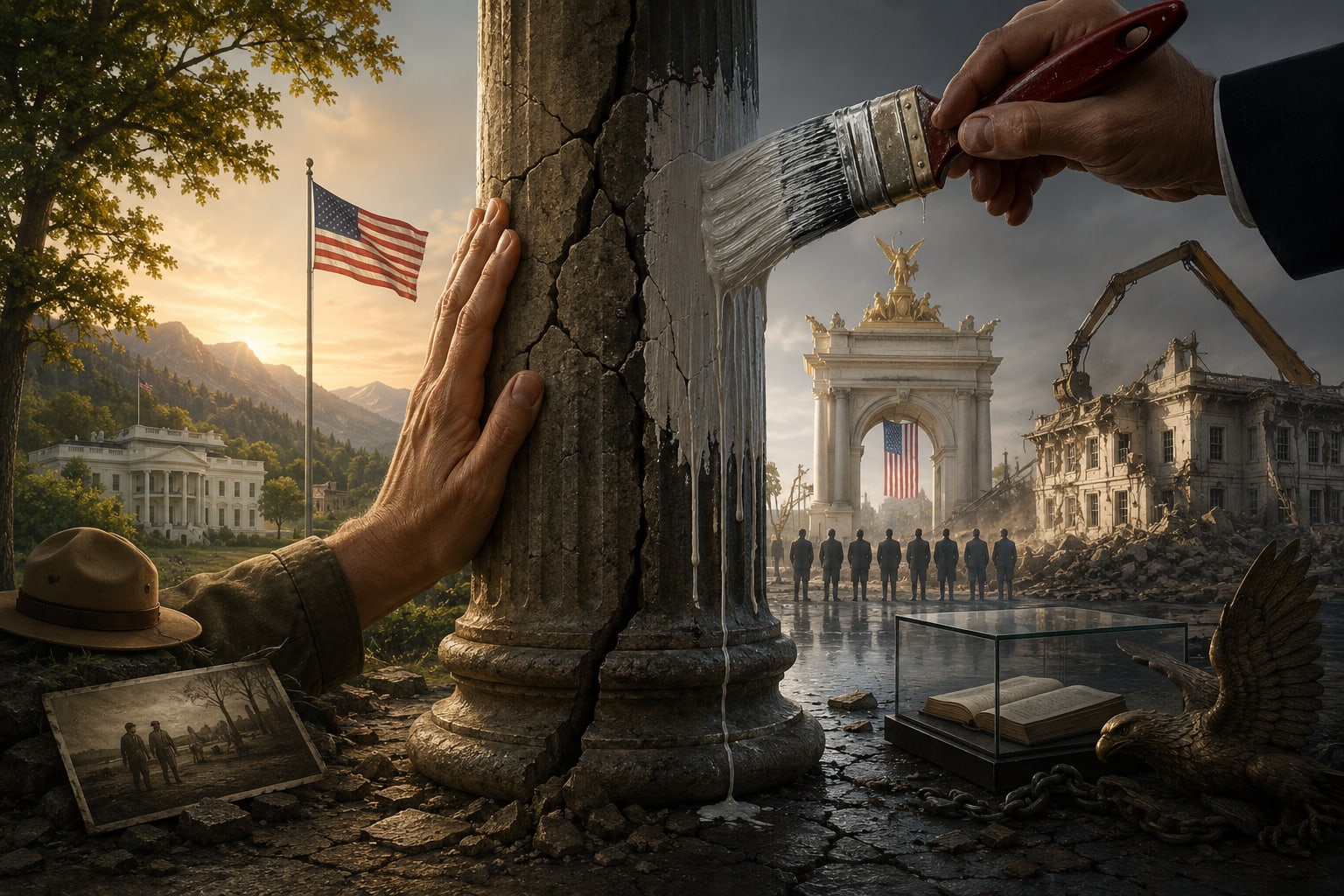
Over the last several weeks, there has been another wave of headlines that, at first glance, might seem to have little in common. The Trump administration has proposed to paint the Eisenhower Executive Office Building, the Advisory Council on Historic Preservation has voted to advance changes to Section 106 of the National Historic Preservation Act, new interpretive signs have been placed outside a Smithsonian museum, and ongoing debates over public lands have each been covered as separate stories with separate controversies. A building, a regulation, signs, and public land may feel like isolated headlines.
Together, they tell a story. These are not just a series of disputes over historic buildings, monuments, museums, or national parks, but rather a startling view into the systems built to protect America’s public inheritance, the pressures now testing those systems, and the difficult questions that follow as their weaknesses become impossible to ignore.
This Community Is Powered by You
What started as a small circle has grown into something much bigger, and it’s all because of readers like you.
Every time you forward this email, post it on socials, or bring someone new into the fold, you’re helping build one of the most passionate, independent political communities out there.
Want to keep the momentum going?
Share this newsletter with someone who should be part of this conversation.
Thank you for being here. It means everything.
A Building, a Rule, and a Question
The most recent controversy centers on the Eisenhower Executive Office Building (EEOB), the sprawling granite structure that sits immediately west of the White House. Completed in 1888, the building originally housed the Departments of State, War, and Navy. Today, it contains offices for many members of the Executive Office of the President. Its distinctive gray granite exterior has remained one of its defining architectural features for nearly 140 years.
The Evolving Reasoning
During a televised interview with Laura Ingraham on November 10, 2025, President Trump publicly unveiled artistic renderings of a white-painted EEOB. His explanation was aesthetic. He called the building "ugly," said "gray is for funerals," and argued that painting it white would better complement the White House and "bring out the detail." Four days later, the D.C. Preservation League and Cultural Heritage Partners filed suit, arguing that it could not proceed without review under the National Historic Preservation Act and the National Environmental Policy Act. By April, when the project reached the Commission of Fine Arts (CFA), the administration still focused on the aesthetic argument, but added that maintenance concerns, such as staining, grime, chips, and wear on the exterior, suggested that a silicate coating would improve long-term maintenance. On May 7th, at the National Capital Planning Commission (NCPC), the administration said it was testing a white mineral coating on similar granite and claimed the coating could help protect the granite itself. Those two proceedings produced public comments, expert testimony, and requests for additional testing. The Commission of Fine Arts conditionally endorsed the concept in April 2026, while the National Capital Planning Commission declined to approve it in May and requested more information about moisture, removability, durability, and long-term maintenance.
Preservation experts have questioned both explanations. Granite is valued in part because it is exceptionally durable. It naturally weathers over time while remaining structurally sound for centuries when properly maintained. Conservation work on granite buildings generally involves cleaning, repointing mortar joints, repairing damaged stone, and addressing water infiltration, rather than permanently altering the stone's appearance. The Eisenhower Executive Office Building also underwent a significant exterior restoration during the 2010s, leaving many preservation professionals asking what has changed in the years since that would justify such a dramatic intervention.
The building is a National Historic Landmark. That designation recognizes more than the building’s age. It acknowledges the architecture, materials, craftsmanship, and historical significance that together make the property worthy of preservation. The granite itself is part of that designation, not merely a surface covering that can be replaced or covered.
Bigger Than One Building
The debate quickly moved beyond the building itself. The dispute concerns what those proceedings did not provide. Preservation groups argue that the administration began developing the project before completing the separate historic-preservation and environmental reviews ordinarily associated with a federally owned National Historic Landmark.
Reporting indicated that responsibility for the building had shifted from the General Services Administration (GSA), the federal agency that typically manages and maintains government buildings, to the White House Office of Administration. Preservation organizations argued that the change raised significant questions about how federal preservation laws would apply and whether long-established review processes could be bypassed.
Section 106
Those concerns intensified on July 24th, when the Advisory Council on Historic Preservation (ACHP) voted to advance a Notice of Proposed Rulemaking that would revise the regulations implementing Section 106 of the National Historic Preservation Act (NHPA). To understand why that vote inflamed preservationists across the country, it helps to understand why Section 106 exists in the first place.
Congress did not create Section 106 simply to slow construction projects or add another layer of paperwork. Historic places are part of the nation’s shared inheritance. Decisions that could permanently alter or damage them should not belong solely to the federal agency carrying out the project. They should, instead, include the expertise of preservation professionals, the perspectives of Tribal Nations, state and local historic preservation officials, and the voices of the public.
That principle has always had limits. Section 106 does not require the government to choose preservation in every case, but it does require something equally important. Before an irreversible decision is made, the people charged with protecting the nation’s historic resources should have an opportunity to identify what may be lost, explore alternatives, and recommend ways to avoid or reduce harm.
The question raised by the Eisenhower Executive Office Building is not simply whether one historic building should be painted, but whether the institutions designed to ask those questions before irreversible decisions are made remain capable of doing so.
When the Guardrails Are Tested
The questions surrounding the Eisenhower Executive Office Building did not emerge in a vacuum. They follow a series of increasingly consequential disputes over historic places associated with the White House. Each involved different laws, different agencies, and different facts, and exposed questions about how America’s preservation systems function when an administration decides to push against their limits.
The Rose Garden
The Rose Garden offers an early example of how those disputes evolved. First Lady Melania Trump oversaw a major renovation in 2020 that changed plantings, widened limestone walkways, addressed drainage and accessibility concerns, and upgraded aging infrastructure. Critics objected to the removal of mature trees and alterations to Rachel Lambert Mellon’s Kennedy-era design, although the garden’s central lawn and basic form remained.
A more substantial transformation came after President Trump returned to office in 2025. He announced plans to replace the lawn, arguing that the grass remained wet and created difficulties for guests, particularly women wearing high heels. During the summer, workers removed the central grass panel and installed a paved patio reported to cost nearly $2 million. By August, the space had been furnished with tables, chairs, and yellow umbrellas reminiscent of the terrace at Trump’s Mar-a-Lago resort. The president began presenting it as a new hospitality space and referred to it as the “Rose Garden Club.”
The redesign did not end with the paving. The West Colonnade became a “Presidential Walk of Fame,” displaying portraits and later plaques about former presidents. Statues and patriotic sculptures were gradually introduced around the garden. Roses remained along its perimeter, but the central feature of Mellon’s design, an open lawn conceived as the floor of an outdoor room, had been replaced by a hardscape designed for dining and events.
The controversy was no longer principally about particular flowers or pathways, but whether a historic landscape could retain its name and some of its plantings while losing the feature that organized its design and gave the space much of its character. It also raised a question that would return with greater urgency elsewhere. What review should occur when a president proposes a lasting alteration to a place that serves as both a working environment and a nationally significant historic site?
The South Lawn
The South Lawn provided another warning. President Trump first announced plans for a White House Ultimate Fighting Championship event in July 2025. By late May 2026, crews had begun erecting a temporary arena across one of the most familiar ceremonial landscapes in the country. The structure included seating for thousands of guests, extensive lighting and broadcast equipment, and a massive support system known as “the Claw.” The fights took place on June 14th, Flag Day and the president’s 80th birthday, as part of the national celebration of the United States’ 250th anniversary.
The event left much of the South Lawn visibly damaged. Heavy construction, flooring, equipment, and foot traffic compacted or destroyed large areas of turf, leaving discolored sections and broad patches of exposed soil after the temporary structures were removed. Similar damage appeared on the Ellipse, where tens of thousands of spectators had gathered for related events. Restoration of the South Lawn had been anticipated before the fights took place, with organizers reportedly budgeting about $700,000 for repairs. ScottsMiracle-Gro later pledged $1 million in money, products, and technical assistance to help the National Park Service restore the grounds.
Grass can be replanted, of course, but the South Lawn is a historic landscape, a ceremonial setting, and part of one of the most recognizable public views in the United States. The decision to convert it into a temporary commercial sports arena demonstrated how quickly a nationally significant place could be repurposed when few binding safeguards stood in the way.
A lawsuit filed shortly before the event sought to stop it, arguing in part that officials had failed to obtain congressional authorization and that the construction threatened historic public spaces. The judge denied emergency relief on procedural grounds, including the plaintiffs’ failure to establish standing and the late timing of the challenge. The ruling did not amount to a finding that the project was harmless, yet highlighted the limitation of relying on courts to protect public inheritance after construction is already underway.
The South Lawn could be resodded. The expense could be covered by private organizations. Those facts address the repair bill, but they do not answer the institutional question. Who had the authority to decide that a historic national landscape could be placed at that level of risk, and what meaningful review occurred before the damage was done?
The East Wing
That question became far more urgent in October 2025. On October 20th, demolition crews began tearing down portions of the White House East Wing, despite earlier assurances that the planned ballroom would not interfere with the existing structure. Two days later, the administration confirmed that the entire East Wing would be removed. By October 23, satellite imagery showed the historic wing reduced to rubble. Whatever legal or institutional questions remained, they had become largely academic. The building was already gone.
See our reporting at the time here:

Preservation laws are designed to work before irreversible decisions are carried out. Consultation, environmental review, historic assessments, and public participation all exist to identify alternatives before original materials, historic buildings, or cultural landscapes are permanently changed.
The East Wing also revealed an institutional weakness that extends far beyond one project. Public criticism was widespread, and members of Congress issued statements and proposed legislation intended to strengthen oversight of White House projects. None of those efforts became law before the demolition was completed, and to date, nothing has been done to address the act.
The lesson is difficult to ignore. Once an irreversible action has occurred, oversight becomes documentation rather than prevention. Hearings may establish a public record, courts may interpret the law, and Congress may debate reforms. None of those institutions can rebuild a demolished historic wing.
That realization changed the way many preservationists viewed subsequent controversies. The proposal to coat the Eisenhower Executive Office Building, the effort to revise Section 106, and other disputes over historic places can no longer be seen as isolated events. They are part of a broader conversation about whether the nation’s preservation laws still provide meaningful guardrails before irreversible decisions are made, or whether they increasingly document those decisions after the fact.
The Guardrails Are Changing
Historic preservation has never depended on a single law, agency, or review board. America’s preservation system resembles a web more than a wall. Congress writes the laws, federal agencies carry them out, and the Advisory Council on Historic Preservation oversees the Section 106 process. State Historic Preservation Offices, Tribal Historic Preservation Offices, local governments, historians, architects, archaeologists, and members of the public all have defined roles. Courts resolve disputes when disagreements cannot be settled elsewhere.
The system is not designed to prevent every change. Historic places continue to evolve, federal buildings require repairs, and governments must sometimes balance preservation against security, accessibility, or other public needs. The goal has never been to freeze history in place, but instead to ensure that decisions affecting irreplaceable places are informed by expertise, transparent to the public, and made only after alternatives have been considered.
That is why the proposed revisions to the regulations implementing Section 106 have drawn such widespread concern from preservation organizations. The changes under consideration would not simply affect the Eisenhower Executive Office Building. They would reshape the process governing thousands of federally funded and federally approved projects across the country.
The National Trust for Historic Preservation has argued that the proposal would substantially weaken one of the nation’s most important preservation laws by reducing meaningful consultation and diminishing opportunities to avoid or minimize harm before projects move forward. State Historic Preservation Officers have warned that the proposal would shift significant authority from collaborative review toward unilateral agency decision-making. Tribal preservation organizations have expressed similar concerns, particularly regarding consultation requirements that have developed over decades through legislation, regulation, and practice.
Supporters of the proposal offer a different perspective. The Trump administration has argued that existing review requirements can unnecessarily delay housing, infrastructure, energy development, and other public projects. Officials have presented the proposed revisions as an effort to modernize an aging process, reduce duplication, and streamline federal decision-making while continuing to recognize historic resources.
The question is not whether historic preservation should exist, but instead how much independent review should remain when the federal government proposes actions that could permanently alter places held in trust for the American people.
The Arch
That broader significance becomes easier to recognize when the current debate is viewed alongside another project now moving through federal review.
The administration’s proposed triumphal arch, planned for a site near Arlington National Cemetery and the Lincoln Memorial, has prompted many of the same institutional questions. The project has generated debate over the Height of Buildings Act, the protection of historic viewsheds, the role of Section 106 consultation, and the authority of federal planning agencies. Once again, the discussion has centered not only on the structure itself but also on the rules governing how such a proposal should be evaluated.
The Height of Buildings Act limits building heights in Washington, D.C. The proposed arch, at approximately 250 feet, greatly exceeds those limits, which fall generally around 130 feet or less depending on location. Rather than proposing a shorter monument or seeking a clear statutory exemption from Congress, discussion has included whether portions of the monument could be treated separately for purposes of calculating its height. One concept that emerged during planning is to view the architectural arch itself as roughly 130 feet while treating sculptural elements above it differently. This proposed view has not yet been judged in court, and critics argue that the proposal elevates form over substance, while supporters contend the Height Act does not clearly govern a freestanding commemorative structure on federal land in this location.
Individually, the Eisenhower Executive Office Building and the triumphal arch may appear to involve different subjects. One concerns a historic building, the other a new monument. Viewed institutionally, they ask remarkably similar questions. What review is required? Who decides? How much independent expertise should inform the decision? At what point should the public have an opportunity to participate? Most importantly, what happens if those guardrails are weakened while the projects they were designed to evaluate are already underway? Preservation protects more than structures. It also protects settings, relationships, and the historic landscapes that give those structures meaning.
Beyond Buildings
Historic preservation is often associated with buildings, monuments, and archaeological sites. The nation’s shared inheritance, however, extends far beyond bricks and stone. Museums, archives, interpretive signs, and public landscapes also shape how Americans understand their history. They preserve not only places, but context.
That has become increasingly important as the administration’s attention expands beyond physical preservation and into historical interpretation.
National Park Signage
That role came under new pressure after President Trump signed Executive Order 14253 on March 27, 2025. The order directed federal historical sites, parks, and museums to reject interpretations the administration considered divisive, disparaging, or insufficiently uplifting. Its stated goal was to restore federal sites as places that emphasize national achievement, progress, and patriotism.
The order did not remain an abstract statement of policy. National Park Service staff began reviewing exhibits and interpretive materials involving slavery, Native American history, Japanese American incarceration, women’s rights, LGBTQ history, climate change, and environmental damage. Signs were removed or marked for revision at sites across the country, including Acadia National Park, Cane River Creole National Historical Park, and other parks where the interpretation of the land depended on acknowledging the people who lived there and the forces that changed it.
The President’s House Site
The most visible conflict unfolded in Philadelphia at the President’s House Site on Independence Mall. George Washington lived there while serving as president and brought nine enslaved people into the household. The outdoor exhibit, titled “Freedom and Slavery in the Making of a New Nation,” examined the contradiction between the new republic’s promises of liberty and the continued enslavement of human beings within the president’s home. It included the names and personal histories of the people Washington enslaved.
On January 22, 2026, National Park Service workers dismantled the exhibit. Crews removed panels describing the transatlantic slave trade and the lives of the nine enslaved people, in some cases using crowbars to pull the material from the site. The City of Philadelphia sued, joined by preservation and community advocates, while Pennsylvania Governor Josh Shapiro supported the challenge.
See our reporting at the time here:

A federal judge later ordered the exhibit restored, and workers began reinstalling it on February 19th. The legal dispute continued, however. An appeals court subsequently cleared the way for the administration to replace the panels, and by July the National Park Service had installed a new presentation that placed greater emphasis on Washington’s later antislavery statements and his decision to free enslaved people through his will. Critics argued that the replacement diminished the central fact that Washington held people in slavery while occupying the nation’s first executive residence.
The Philadelphia dispute was not a disagreement over an imprecise historical claim. No serious dispute exists over whether Washington enslaved people in that household. The conflict concerned emphasis, context, and the meaning visitors were expected to carry away. One exhibit centered the people held in bondage and the contradiction between slavery and the founding language of liberty. The replacement sought to place Washington’s eventual movement toward emancipation closer to the center of the story.
Historical interpretation always involves choices. No exhibit can include every fact, and responsible historians routinely revise their work as evidence and scholarship develop. The institutional question is who makes those choices. Professional interpretation begins with the historical record and subjects conclusions to research, criticism, and review. Political interpretation begins with a preferred national message and asks which facts best support it.
Additional Incidents
Other removals made the same tension visible in different settings. Materials describing the Wabanaki relationship to Cadillac Mountain and the effects of climate change disappeared at Acadia. Interpretation involving enslaved people and attempted escape was targeted at Cane River Creole National Historical Park. Signs elsewhere addressed Native dispossession, racial exclusion, environmental damage, and episodes of government abuse. Each decision involved a distinct site and a different body of evidence, yet the governing instruction was broad enough to treat discomfort itself as a reason for reconsideration.
The Smithsonian
By the summer of 2026, the dispute had expanded beyond places managed by the National Park Service. On July 4th, the White House Domestic Policy Council released a report accusing the Smithsonian Institution, particularly the National Museum of American History, of political activism and of presenting the nation’s history through an ideological lens. The report argued that museum leaders had failed to tell the American story in a manner that was sufficiently inspiring, unifying, and worthy of the country. It also suggested that Smithsonian leadership could not be trusted to correct the problem without greater outside pressure.
The report was more than a critique from outside government. It represented an official judgment by the executive branch about how an institution devoted to preserving and explaining American history should carry out its work.
Congress soon amplified that judgment. On July 21st, the House Oversight Committee’s Subcommittee on Delivering on Government Efficiency held a hearing titled “Rewriting American History: Examining the Smithsonian’s Efforts to Reshape the Past.” The hearing followed directly from the July 4th report and was framed by committee leaders as an examination of political activism within the National Museum of American History.
Anthea Hartig, the museum’s director, testified that the institution’s work is governed by standards of scholarship, accuracy, independence, and nonpartisanship. She disputed the White House report’s portrayal of the museum and explained that adding voices previously excluded from traditional narratives does not erase the national story, but rather adds evidence that earlier accounts left out.
Hartig also offered a different understanding of the museum’s civic role. She told lawmakers that the institution is at its most powerful when patriotism is “not instructed but inspired.” Her point drew a clear distinction between presenting the evidence of American history and directing visitors toward a prescribed emotional conclusion.
See our previous reporting on attacks on history here:


Three days later, on July 24th, President Trump ordered signs to be placed outside the National Museum of American History, telling visitors that some exhibits inside were inaccurate. The signs were to refer visitors to the White House report and direct them toward sources the administration described as more reliable.
The location of the signs was not accidental. The president could not easily order the Smithsonian to rewrite its exhibits or remove its leadership because the institution does not operate as an ordinary executive agency. The administration instead directed that the signs be placed on nearby sidewalks maintained by the National Park Service.
The same agency used to remove or revise historical interpretation within federal parks is now being used to challenge the interpretation of a separate national institution from the property outside its doors.
The sequence is no accident. The administration first announced a broad policy against historical interpretation it considered divisive. Federal sites then removed or revised materials. The White House issued a formal report condemning the Smithsonian’s approach, and Congress summoned a museum director to answer those accusations in public. The administration then placed its own interpretive message outside the museum.
Each step involved a different institution and a different legal authority. Together, they demonstrate how pressure can accumulate even when no single office possesses complete control.
The legal circumstances differ from those surrounding the Eisenhower Executive Office Building, the East Wing, or the proposed arch. The institutional question remains familiar. What can the executive control directly, what can it influence indirectly, and what happens when independent expertise conflicts with the history an administration wants the public to encounter?
Preserving history requires more than retaining the site where an event occurred. It also requires preserving sufficient evidence and institutional independence so that future Americans can understand what happened there. A building can remain standing while the meaning attached to it is substantially rewritten.
The Land We Leave Behind
The conversation surrounding public inheritance does not end at historic buildings or museum exhibits. It also includes the landscapes that define the country itself.
For more than a century, the United States has wrestled with a difficult balance. Public lands provide timber, minerals, grazing, recreation, wildlife habitat, clean water, and places of extraordinary natural beauty. Congress has never treated those purposes as mutually exclusive. Different administrations have emphasized different priorities, and disagreements over how federal land should be managed are as old as the National Park Service itself.
The current debate differs less in subject than in direction. Recent executive actions have placed renewed emphasis on domestic energy production, critical minerals, timber harvesting, and expedited permitting across large areas of federally managed land. Administration officials have argued that the United States cannot remain economically competitive or meet national security needs without expanding access to its own natural resources. Supporters view those policies as a necessary correction after years of regulatory delay and restricted development.
Critics note that the consequences of resource extraction often extend beyond the sites where the work occurs. Wildlife does not recognize property lines. Watersheds cross jurisdictional maps. Historic viewsheds, migration corridors, and ecosystems can be altered by activity occurring outside the borders of a national park or historic site.
The concern extends beyond any single lease or permit. It reaches the philosophy guiding federal stewardship. Conservation has traditionally asked what should be protected first, leaving development to proceed where protection is not required. The current approach increasingly begins with a different question. What public resources can be developed unless a specific law clearly prevents it?
See our recent reporting on Bear’s Ears and Escalante here:

A museum exhibit can be rewritten. An interpretive sign can be replaced. Even a historic landscape may, in some circumstances, be restored. An old-growth forest that has been logged cannot simply be recreated. A fragmented wildlife corridor may take generations to recover. Archaeological sites disturbed by mining cannot be excavated a second time. Once those resources are lost, future Americans inherit a different landscape than the one their predecessors received.
The same institutional questions raised throughout this article appear once again. Who decides that those tradeoffs are justified? What review occurs before irreversible changes are made? Which institutions speak for future generations who cannot participate in today’s public comment periods, elections, or court proceedings?
Those questions have no easy answers. Every generation must balance economic opportunity with conservation, growth with preservation, and present needs with future obligations. The challenge is not avoiding those choices, but ensuring that the institutions responsible for making them remain strong enough to distinguish between temporary political priorities and permanent public responsibilities.
A Trust, Not a Possession
The stories in this article involve different laws, agencies, and places. Individually, each should be debated. People will disagree about preservation, security, accessibility, energy production, economic development, and even how the nation’s history should be interpreted. Those disagreements are inevitable and healthy in a constitutional democracy.
Taken together, however, these stories ask something larger. Do the institutions entrusted with protecting America’s public inheritance remain capable of doing what they were created to do?
Public inheritance is not limited to the obvious. It includes the buildings that have witnessed the nation’s history, the battlefields where it was fought, the parks and landscapes that generations have set aside, the museums and archives that preserve its records, and the interpretive work that helps each generation understand what it has inherited. It also includes the institutions designed to safeguard those places. Preservation laws, independent review, public participation, congressional oversight, and judicial review are not obstacles standing between Americans and their history. They are part of the inheritance itself.
No generation receives the country in perfect condition, nor does any generation pass it forward unchanged. Historic buildings require repairs, landscapes evolve, new monuments are built, and historical scholarship uncovers new evidence and asks new questions. Stewardship has never meant freezing the nation in time.
It has meant something more demanding. Stewardship asks each generation to recognize that it is holding something it did not create. The measure of that stewardship is not whether every difficult decision is avoided, but whether those decisions are made with humility, transparency, and an awareness that the consequences will outlast the people making them.
That is why independent institutions are essential. The Advisory Council on Historic Preservation, Section 106 of the National Historic Preservation Act, the National Park Service, the Commission of Fine Arts, the National Capital Planning Commission, Congress, and the courts each exist for a reason. None was intended to exercise absolute authority, but together, they form a system of overlapping responsibilities designed to ensure that decisions affecting the nation’s shared inheritance are not made by any one person or office alone.
This is not ultimately about one administration. Every administration inherits the same constitutional structure, and every future administration will inherit the precedents established today. The questions raised by the Eisenhower Executive Office Building, the Rose Garden, the East Wing, the proposed arch, museum interpretation, and public lands will not disappear when the headlines fade. If the weaknesses they exposed remain unaddressed, they will be available to whoever occupies the White House next.
That may be the most important lesson these controversies have offered. Stress tests reveal weaknesses. They do not create them. The responsibility that follows belongs to all of us.
The public has the opportunity to participate in rulemaking, to support preservation organizations, and to insist that stewardship remain a public obligation rather than a political preference. Courts will continue to decide individual cases brought before them, interpreting the laws Congress has written. Congress alone possesses the authority to clarify those laws, close ambiguities, strengthen oversight, and decide whether the guardrails that protected yesterday’s inheritance remain sufficient to protect tomorrow’s.
The question is no longer whether the country’s institutions have been tested, because clearly, they have. Instead, the question is what we choose to do with what those tests have revealed.
The places, landscapes, records, and stories that make up America’s public inheritance never truly belong to the people temporarily entrusted with their care. They belong just as much to the generations that have not yet arrived.
One day, they will inherit the country we leave behind. The only question is whether we will have been faithful stewards of the trust placed in our hands. Perhaps most importantly, we must ask if the leaders we have now and will have in the future, both in the executive and legislative branches, can be trusted to make those decisions on our behalf.
If you value reporting that looks beyond today's headlines to the institutions, systems, and ideas shaping tomorrow, consider subscribing. We believe understanding how something happened is just as important as knowing that it happened.
Sources:
“Trump’s plan to paint the Eisenhower office building could cost at least $7.5M, the White House says,” Associated Press, May 7, 2026.
“Can Trump paint the Eisenhower building? Experts fear irreversible damage.,” The Washington Post, May 7, 2026.
“Preservationists sue Trump over plans to paint Eisenhower building,” The Washington Post, November 14, 2025.
“Federal agency approves concept for Trump’s plan for a Triumphal Arch in Washington,” Associated Press, April 16, 2026.
“ACHP Votes to Move Forward with Notice of Proposed Rulemaking,” Advisory Council on Historic Preservation, July 24, 2026.
“ACHP Considers Modification of Section 106 Regulations,” Advisory Council on Historic Preservation, July 21, 2026.
“The End of Section 106 as We Know It?,” National Conference of State Historic Preservation Officers, July 20, 2026.
“Section 106 Rulemaking: What’s Next?,” National Conference of State Historic Preservation Officers, July 24, 2026.
“President Trump Appoints New ACHP Members,” Advisory Council on Historic Preservation, January 13, 2026.
“ACHP Meets for June 2026 Business Meeting,” Advisory Council on Historic Preservation, June 5, 2026.
“Trump’s Rose Garden Club is a lavish new hangout for political allies and business elites,” Associated Press, September 24, 2025.
“Trump hosts White House dinner for GOP lawmakers at paved space he dubbed ‘Rose Garden Club’,” Associated Press, September 5, 2025.
“Trump installs new flagpoles on White House lawns,” Associated Press, June 18, 2025.
“UFC brings its trademark mayhem to the White House as President Trump celebrates 80th birthday,” Associated Press, June 14, 2026.
“Trump says ‘maybe we’ll never ever’ take down UFC arena on White House lawn,” Reuters, June 3, 2026.
“UFC will spend $700,000 replacing White House lawn,” MMA Fighting, October 2, 2025.
“White House South Lawn Damaged by UFC Event Undergoing Repairs,” The Daily Beast, June 24, 2026.
“The White House starts demolishing part of the East Wing to build Trump’s ballroom,” Associated Press, October 20, 2025.
“What to know about the $250 million ballroom Trump is adding to the White House,” Associated Press, October 22, 2025.
“AP photos show White House East Wing demolished,” Associated Press, October 23, 2025.
“A look at history from the White House East Wing,” Associated Press, October 26, 2025.
“What lawmakers are saying about Trump’s East Wing demolition,” Associated Press, October 23, 2025.
“Judge orders White House ballroom construction to halt without congressional approval,” Associated Press, March 31, 2026.
“White House says saving the East Wing was too expensive,” Associated Press, January 8, 2026.
“Trump’s Washington arch plan includes golden-winged figure, eagles, lions and ‘One Nation Under God’,” Associated Press, April 10, 2026.
“Federal agency approves concept for Trump’s plan for a Triumphal Arch in Washington,” Associated Press, April 16, 2026.
“Key federal agency approves the design plan for Trump’s Washington arch,” Associated Press, May 21, 2026.
“Administration plans intensive, year-round construction schedule for Trump’s triumphal arch,” Associated Press, June 10, 2026.
“Trump’s plan for a triumphal arch in DC wins early approval from a key federal agency,” Associated Press, July 9, 2026.
“Trump says Washington has waited 200 years for the arch he wants to build. Not quite,” Associated Press, February 4, 2026.
“From slavery to pollution, National Park employees flagged material deemed ‘disparaging’ to US,” Associated Press, September 10, 2025.
“Make Them Hear You,” National Parks Conservation Association, June 12, 2025.
“Erasing History, Silencing Science,” National Parks Conservation Association, October 1, 2025.
“Administration Censors Climate Science, Harms Visitor Experience at Historic National Park,” National Parks Conservation Association, January 22, 2026.
“Erasure of History and Science Spreads at National Parks Across the Country,” National Parks Conservation Association, January 27, 2026.
“Trump administration is erasing history and science at national parks, lawsuit argues,” Associated Press, February 17, 2026.
“Court Blocks Censorship and Erasure of American History and Science at National Parks,” National Parks Conservation Association, June 13, 2026.
“Philadelphia sues over removal of slavery exhibit at George Washington’s former home,” Associated Press, January 23, 2026.
“Judge calls Justice Department’s statements on slavery exhibit display ‘dangerous’ and ‘horrifying’,” Associated Press, January 30, 2026.
“Judge orders Trump administration to restore George Washington slavery exhibit,” Associated Press, February 16, 2026.
“Slavery exhibit removed by Trump administration is returning to Independence Mall in Philadelphia,” Associated Press, February 19, 2026.
“Slavery exhibit in Philadelphia can be replaced, court says,” Associated Press, June 18, 2026.
“Slavery references at George Washington’s Philadelphia home face changes,” Associated Press, July 3, 2026.
“Federal government replaces slavery exhibition at Washington’s home in Philadelphia,” Associated Press, July 15, 2026.
“Saving America’s Story,” The White House, July 4, 2026.
“Smithsonian history museum chief rejects White House criticism of its leaders as radical activists,” Associated Press, July 21, 2026.
“US history museum head says patriotism is at its best when it is ‘not instructed but inspired’,” Reuters, July 21, 2026.
“Hearing Wrap Up: Smithsonian National Museum of American History’s Radical Agenda to Reshape the Past,” U.S. House Committee on Oversight and Government Reform, July 21, 2026.
“Smithsonian history museum chief rejects White House criticism of its leaders as radical activists,” Associated Press, July 21, 2026.
“Trump orders new signs outside Smithsonian saying some exhibits are inaccurate,” Associated Press, July 24, 2026.
“Progress on Public Lands: BLM 2025 Trump Administration Accomplishments,” Bureau of Land Management, January 6, 2026.
“Department of the Interior Proposes Modernizing Grazing Regulations to Support Ranchers and Rural Communities,” Bureau of Land Management, June 1, 2026.
“Restoration Prioritization and Planning,” Bureau of Land Management, 2024, rescinded February 27, 2025.
“Parks Are Being Dismantled Before Our Very Eyes,” National Parks Conservation Association, March 6, 2025.
The President* has decided that he is the boss of EVERY employee in the Federal Government and the Democrats, the Courts and the Military seem to agree with him. The fact is, we have no leadership at all in America outside of Trump and the opposition party is fine with that. Their hunker down and wait plan is perfectly designed to allow them to do nothing.
Paint a granite building? How stupid is that!