


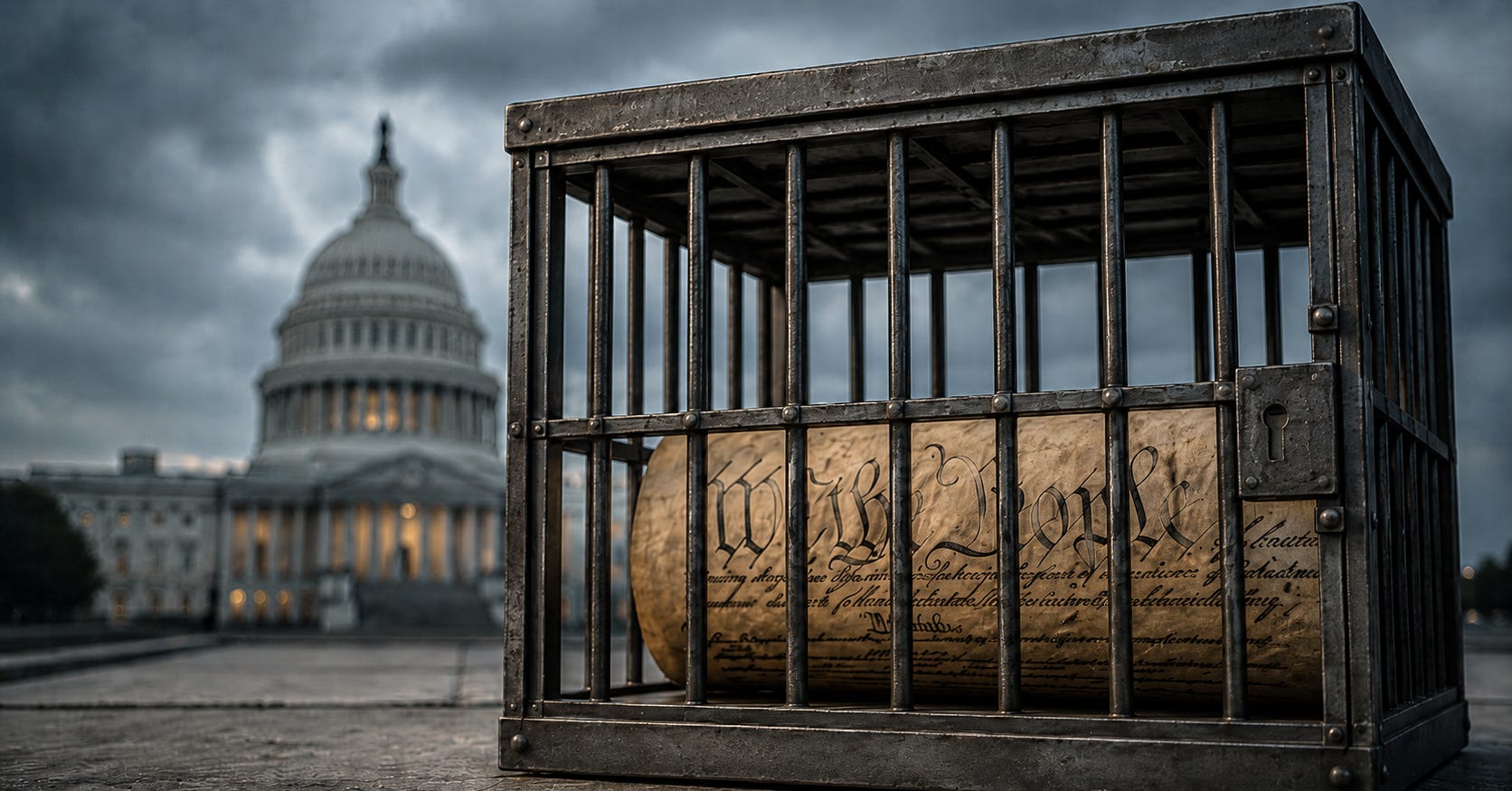
“I hate both parties, but what choice do we have?” That sentence may be one of the most powerful political traps in America.
You hear it at kitchen tables, at work, in grocery store lines, and from voters who are tired of being ignored while politicians blame each other on television. People know something is broken. They feel it in their wages, rent, hospital bills, school budgets, utility bills, and the slow disappearance of trust.
However, the Constitution never told us that we had only two choices.
The Constitution does not say we are a two-party country. It does not say political power belongs to Democrats and Republicans. It does not say representation must pass through two private political machines before the people are allowed to govern themselves. That lesson was not written by the founders. It was taught by power.
Over time, Americans were trained to treat the two-party system like a fact of nature. It is not. The two-party system is real, but it is not constitutional. It is a political structure reinforced by election rules, donor networks, media habits, party leadership, fear, and repetition. Its greatest victory has been convincing millions of Americans that no other kind of political power is legitimate. That belief is the cage.
The Constitution built a republic. The two-party system built a cage around it, and the cage does more than limit voter choice. It changes how power moves and teaches voters to surrender their voice before Election Day. It teaches candidates to seek permission from party machines and members of Congress to protect party leadership instead of the people who sent them there. When the president becomes the leader of one of those parties, it pulls Congress away from its Article I duty and toward loyalty to Article II power.
That is how a voting habit becomes a constitutional crisis. Once people believe the republic cannot function without two-party machines, they stop asking who represents them and start asking which machine they are allowed to belong to.
That is not self-government. That is dependency.
Support independent media that follows the power.
The Coffman Chronicle is built to track who holds power, who abuses it, who profits from it, and who pays the price.
Paid supporters get full Tony Michaels Podcast episodes, deeper transcript analysis, paid columns, archives, and the reporting framework behind the show.
If you believe independent media has to survive outside billionaire platforms, corporate media, and party-approved gatekeepers, become a paid supporter today.
The Constitution Does Not Belong to Two Parties
The first step out of that dependency is remembering what the Constitution actually says and what it does not say.
The Constitution begins with “We the People,” not “We the Democrats” or “We the Republicans.” Political authority does not begin with party committees, campaign consultants, national chairmen, donor networks, cable news panels, or primary calendars. It begins with the people.
The Constitution creates Congress, the presidency, and the courts. It divides power and provides a process for elections, amendments, impeachment, representation, and accountability. It does not create a Democratic branch or a Republican branch, nor does it say two parties are supposed to stand between citizens and their own political power.
Americans have been taught to confuse the system we inherited with the system the Constitution requires. Those are not the same thing. The Constitution gives the people a republic to govern. The two-party system gives the people a narrow door and then tells them it is the whole house. The people were here first. The parties came later.
That sequence is important. A political party can organize voters, build coalitions, and advance ideas. However, a party is not supposed to become the owner of the republic or replace representation with brand loyalty. It is not supposed to convince citizens that their own power is meaningless unless it is first handed over to party leadership.
The Constitution does not tell Americans to pick a team. It gives Americans a republic to govern.
Once we see that clearly, the two-party system stops looking like constitutional destiny and starts looking like what it is: a political arrangement that became powerful enough to pretend it was permanent.
The Bars Are Real
None of this means the two-party system is imaginary. The cage may not be constitutional, but the bars are real. They are built into ballot-access laws, primary systems, debate rules, campaign money, party committees, donor networks, voter data, media coverage, congressional leadership, committee assignments, and the constant drumbeat of political fear. Democrats and Republicans dominate American politics because generations of rules, habits, incentives, and institutions have made them the default machinery of power.
Saying the two-party system is not constitutional is not the same as saying it has no power. It has enormous power. It can decide who gets funded, who gets covered, who gets invited to debates, who gets treated as serious, and who gets dismissed before voters ever hear their name.
However, the machinery only works at full strength because Americans have been trained to believe it is inevitable.
The rules make it nearly impossible for independents to compete. Money makes it Herculean. The media doesn’t help. However, the belief that no one outside the two parties can win often finishes the job before the campaign even begins.
That is how power protects itself. It does not always need to ban alternatives when it can convince people that alternatives are pointless. There’s no reason to outlaw independent politics if voters have already been trained to treat it as a wasted vote.
The two-party system is enforced by rules, money, and institutions, but it survives in the American mind. That is why this trap is so powerful. The parties do not just compete for votes. They compete to define what voters think is possible.
“An Independent Can’t Win”
The most powerful sentence in American politics may not come from a president, a senator, a party chairman, or a cable news host. It may come from ordinary voters who say, “I like that candidate, but an independent can’t win.”
That sentence sounds practical and mature. It sounds like the voice of someone who understands the real world. Often, it is the two-party dependency trap speaking through the voter.
Independent candidates do not lose only because Americans reject them. They never have a chance because Americans are trained not to imagine them winning. Before the first debate, the first town hall, the first serious conversation about policy, millions of voters have already been taught to narrow the field in their own minds.
A voter may dislike both parties, distrust both parties, and feel ignored by both parties. Yet when Election Day comes, that same voter is told there are only two “realistic” choices. If they vote outside the two-party system, they are accused of helping the worst side win. If they ask why the system only offers two broken doors, they are told to grow up and pick one.
That is not political wisdom, but learned helplessness wearing a suit.
The spoiler argument is powerful because it contains enough truth to scare people. Independent and third-party candidates do face massive barriers. Winner-take-all elections punish divided coalitions. Ballot-access rules can be brutal, and campaign money follows perceived viability. Media coverage often treats independent candidates as curiosities unless they threaten one of the major parties.
However, fear cannot be the final argument in a republic. If Americans treat the spoiler problem as a reason to surrender forever, the two parties never have to earn back the public’s trust. They only have to keep voters terrified of leaving.
The two-party system starts to fade when Americans stop believing it is a constitutional destiny. Once enough people understand that the Constitution never required the two-party machine, independent politics stops looking like rebellion against the system and starts looking like a return to self-government.
That does not mean every independent candidate is good or that voters should ignore consequences or pretend the rules are fair. It means Americans have to stop allowing the two parties to define political reality before the people even enter the conversation.
The flood does not begin when one perfect independent candidate appears. It begins when millions of Americans stop asking for permission to imagine something else.
The two-party system begins to crack when Americans stop treating fear as strategy.
The Right to Build New Coalitions
The two-party system has also narrowed the way Americans think about majority and minority power.
In a republic, the people are not supposed to be permanently sorted into two political warehouses. They are supposed to be able to form majorities, minorities, coalitions, local alliances, labor blocs, rural-urban partnerships, constitutional accountability campaigns, and new political formations when the old ones no longer represent them.
Millions of Americans already live politically mixed lives. They may want higher wages, lower housing costs, clean water, protected rights, honest courts, fair taxes, strong unions, small businesses, and less corporate power, all without fitting neatly into one party’s script. The system keeps telling them they are not allowed to build mixed power.
The Constitution does not require that kind of surrender. It leaves room for persuasion, organizing, and people who were once ignored to build a coalition large enough to govern. It provides space for a minority to make its case. It leaves open the possibility of forming a majority outside the boundaries drawn by party consultants. It leaves room for people to change their minds, their alliances, and their government.
A free people do not need permission from party machines to build new political power. They were politically trained to believe they did.
When Party Loyalty Replaces Representation
Once voters are trained to surrender their power to party machines, politicians learn the same lesson from the other side. They learn that their path to office, committee power, fundraising, media attention, and future ambition often runs through party loyalty before it runs through public service.
That is where the two-party trap becomes more than a voting problem and becomes a representation problem.
The Constitution does not say members of Congress are supposed to represent a party machine. It says the people elect representatives. The modern two-party system has trained too many politicians to behave as if their first duty is to the party that helped them win, rather than to the citizens who gave them power.
They protect the party brand, leadership, and the fundraising machine. They learn which votes will make leadership angry, which investigations will embarrass the party, which donors must be kept comfortable, and which voters can be taken for granted because they have nowhere else to go.
That is management, not representation.
A representative is supposed to carry the voice of a district or a state into the national government. A party employee carries the organization’s priorities back down to the people and tells them to accept them as reality.
The Constitution gave us representatives. The two-party system gave us party loyalists.
That does not mean every politician is corrupt, but structures shape behavior. A system built around party survival will reward politicians who protect the party, punish those who embarrass it, and isolate those who put constitutional duty above party discipline.
Ordinary Americans feel the result at the kitchen table. They watch wages lag, rent climb, hospitals close, schools struggle, utilities rise, and towns get ignored while politicians perform loyalty on television. The voter asks for representation. The party asks for obedience. Too often, obedience wins.
When politicians represent the party instead of the people, the people lose more than policy fights. They lose the branch of government that was supposed to be closest to them.
How the Two-Party System Pulls Congress Into the Executive Branch
The Constitution separates legislative power from executive power for a reason. Congress is supposed to make laws, control funding, conduct oversight, investigate abuse, declare war, check the president, and represent the people. The president is supposed to execute the law, not absorb the branch that writes it.
The modern two-party system bends that design.
In today’s politics, the president is not only the head of the executive branch. He is also the political leader of one of the two major parties. That means members of Congress from the president’s party are constantly pressured to treat oversight as betrayal, investigation as disloyalty, and constitutional independence as an attack on their own team.
That is where party loyalty becomes dangerous. Congress does not need to be formally abolished for Article I's power to weaken. It can weaken when members refuse to use the power they already have. It can decay when they decide that checking a president from their own party is too politically costly. It can disappear when they treat subpoenas, hearings, appropriations, impeachment, war powers, and oversight as partisan weapons instead of constitutional tools.
That is how Article I collapses into Article II.
The collapse does not always happen with a dramatic announcement. It often happens quietly, through excuses. A war powers debate becomes a test of whether members “support the president.” A subpoena, a partisan attack. A hearing becomes a witch hunt. A funding fight, a loyalty oath. An investigation becomes something to delay until after the election, when the political cost might be lower.
However, Congress was not created to protect presidents. It was created to protect the people’s power.
When the president leads one of the two major parties, party loyalty gives executive power a shield it was never supposed to have. Members of Congress who should be checking the executive start defending them. They explain away abuses, soften investigations, block accountability, and turn constitutional questions into team loyalty tests. The result is concentrated power.
The president gains room to act because Congress chooses not to act. The executive branch grows stronger because the legislative branch grows more obedient. The people lose leverage because their representatives stop behaving like a separate branch and start behaving like staff for the president’s party.
This is not just a problem under one president or one party. Whenever a president commands enough loyalty inside Congress, the people’s branch can become a protection racket for executive power. The two-party system weakens the separation of powers by replacing constitutional loyalty with party loyalty.
When Congress protects a president because he leads their party, Article I collapses into Article II. And when that happens, the people do not just lose a policy debate. They lose one of the central protections that makes self-government possible.
This Is Not “Both Parties Are the Same”
This argument can be easy to misunderstand, so we should be clear. The point is not that both parties are the same. They are not. Their voters are not identical. Neither are their policies. Their coalitions vary. Their rhetoric, priorities, judges, donors, and governing choices are all different.
Pretending otherwise would be lazy and false, but that does not mean the two-party system is healthy. Two things can be true at the same time: the parties can be different, and the system that protects their dominance can still be a concentrated-power machine.
The issue is not that both parties are the same, but rather that both parties benefit from making themselves necessary.
That is the distinction Americans are rarely allowed to make. The moment someone criticizes the two-party structure, party loyalists rush in to demand a confession. Are you helping the other side? Are you saying both parties are the same? Are you trying to spoil the election? Are you secretly working for the enemy? Those questions are designed to shut down the deeper conversation.
A voter can make a tactical choice in one race and still refuse to worship the machinery that made the choice so narrow. A voter can oppose one party more strongly than the other and still believe the people deserve more than permanent dependency.
The two-party system survives by making Americans afraid to criticize the structure beneath the choices, but if that structure keeps concentrating power, weakening representation, and pulling Congress away from the people, then criticizing it is part of defending democracy.
Stop Mistaking Party Power for Constitutional Power
The repair does not begin with pretending the barriers are gone. The rules, money, ballot laws, media filter, and spoiler problem matter. However, the repair cannot begin with surrender.
Americans have to stop mistaking party power for constitutional power. A party may control ballot access, fundraising networks, committee assignments, voter files, and media attention, but it does not own the people’s authority, the republic, Congress, or the voter.
The first act of political independence is refusing to confuse party loyalty with constitutional duty. That starts with a different set of questions. Instead of asking only which party is worse, Americans should ask who benefits from keeping the choice this narrow, why the system is terrified of independents becoming viable, and whether their representative is loyal to the people or loyal to party leadership.
This does not require fantasy politics but constitutional seriousness.
It starts close to home. Americans can demand open debates, challenge unfair ballot-access rules, support credible independents in local races, punish politicians who treat oversight as betrayal, and build coalitions around issues before party consultants tell them which issues are allowed to matter. They can stop treating every school board race, town council seat, statehouse campaign, and congressional primary as nothing more than a proxy war for national party brands.
Most of all, Americans can stop letting fear do all their political thinking for them. Fear may explain why people make certain choices in a broken system, but it cannot be allowed to become the republic’s permanent philosophy. A free people cannot keep telling themselves that the only responsible thing to do is surrender to the same machines that keep failing them.
The republic does not need Americans to worship a better party machine. It needs Americans to remember that the power was theirs before any party claimed it.
Every serious political realignment begins before it shows up on a ballot. It begins when people stop believing the old boundaries are sacred and decide that the Constitution never gave Democrats and Republicans ownership papers over the country.
Once people remember that, the question changes. It is no longer, “Which machine gets my power?” It becomes, “Why did I ever believe my power belonged to a machine in the first place?”
The Cage Opens When People Stop Believing It Is Law
So we return to the sentence that started this whole trap. “I hate both parties, but what choice do we have?”
The answer is not simple, and anyone who says it is simple is not being honest. The machinery is real, but the Constitution never made the cage sacred.
That is the truth Americans have to recover. The two-party system is not in the Constitution. It is in the rules, the money, the media, the party machinery, and finally in our heads. That does not mean it is easy to break. It means it is not holy.
For too long, Americans have been told that political adulthood means accepting the cage. We are told to be realistic, to stop dreaming. We are told to choose between the two machines already waiting for us and call that freedom.
However, self-government cannot survive if the people are only allowed to choose which machine receives their surrender. The Constitution never told Americans they had to choose between two private political organizations. That lesson was taught by power, repeated by the media, protected by money, and accepted through fear. The parties may be powerful, but they are not sovereign. The people are.
A dependency system tells voters their power is only useful after it has been handed upward. A republic begins from the opposite premise. The power starts with the people, and every institution that receives it is supposed to answer back.
It is not about pretending tomorrow will be easy. It is not about pretending the parties will surrender power politely. It is about remembering that the country does not belong to the machines that captured its imagination.
A cage can look permanent until people realize it was never the republic. It was built around the republic. And what was built by concentrated power can be challenged by people who stop asking permission to govern themselves.
The Constitution built a republic. It is time the people stopped mistaking the cage for the country.
Support Independent Media
If this piece helped you see the two-party system differently, share it with someone who has ever said, “I hate both parties, but what choice do we have?”
That question is where the cage begins to crack.
Coffman Chronicle is built for people who still believe the Constitution belongs to the people, not party machines, donor networks, or presidents protected by congressional obedience. If you can afford to become a paid subscriber, it helps keep this work independent and growing. If you cannot, reading, sharing, commenting, and bringing more people into the conversation matters too.
The republic was never handed to two parties. It was entrusted to us.
Sources:
Commission on Presidential Debates. “CPD Applies Nonpartisan Candidate Selection Criteria for Final Presidential Debate.” October 19, 2020.
Commission on Presidential Debates. “Overview.”
Federal Election Commission. “Candidate Debates.” Federal Register 80, no. 224 (November 20, 2015): 72616.
Library of Congress. “Formation of Political Parties.” Creating the United States.
Library of Congress. “Separation of Powers Under the Constitution.” Constitution Annotated.
Levinson, Daryl J., and Richard H. Pildes. “Separation of Parties, Not Powers.” Harvard Law Review 119, no. 8 (2006): 2311–2386.
Madison, James. “Federalist No. 10 (1787).” National Constitution Center.
Madison, James. “Federalist No. 51 (1788).” National Constitution Center.
National Archives. “The Constitution of the United States: A Transcription.”
National Conference of State Legislatures. “State Primary Election Types.”
U.S. Senate. “Committee Assignments.”
Washington, George. “Washington’s Farewell Address 1796.” The Avalon Project, Yale Law School.
Now is the time to remove the Electoral College from our election process. It is, and always has been, a political aberration and a negative additional step we have been strapped with since its inception. One citizen, one vote that counts, and the person who receives the most votes amongst the population should be elected. If you look at presidential elections won by electoral votes received, without receiving the popular vote, you will note the issues that arise during their tenures. Removal of the Electoral College would bring legitimacy to our democratic republic's election processes and allow for voters' voices to be more equitably and realistically heard -Thus better aligning our presidential and congressional election processes with the Constitution.
What about advocating for ranked choice voting?