


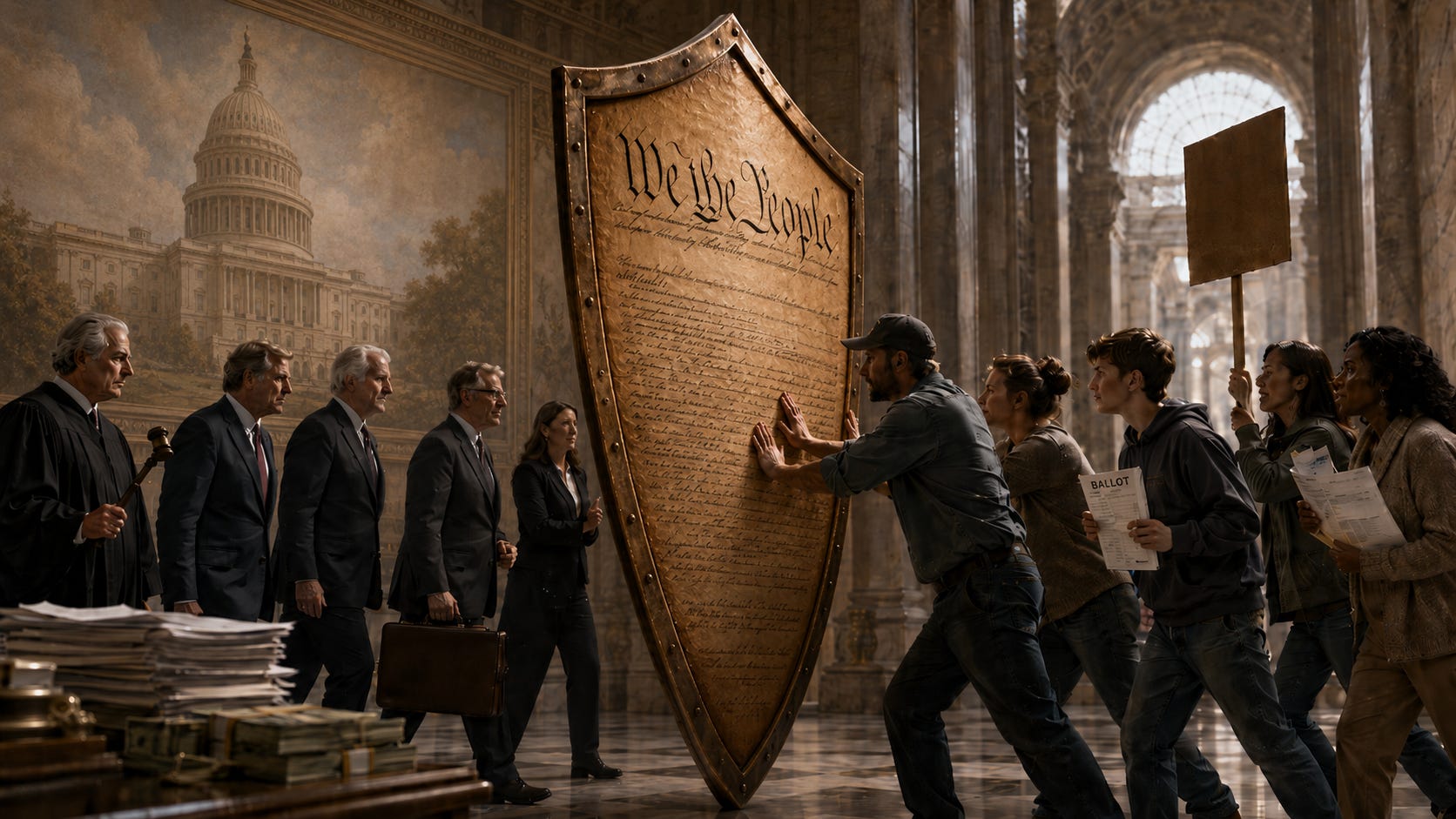
Americans are taught to see the Constitution as a shield.
In the best version of this country, that is what it is. It protects speech. It limits government. It divides power. It creates courts, elections, amendments, due process, and checks against leaders who would rather rule than answer. But there is another truth we are not supposed to sit with for very long: the Constitution was not only built to protect the people from rulers. It was also built to slow the people down when their anger becomes dangerous to the governing order.
That does not make the Constitution worthless. It makes it contested ground. Concentrated power does not always attack the Constitution from the outside. More often, it learns how to live inside it. It learns the procedures. It funds the campaigns. It hires the lawyers. It shapes the courts. It delays the hearings. It hides behind jurisdiction, standing, immunity, loopholes, maps, deadlines, and rules most ordinary people never had the money or time to master. Then it tells the public to respect the process.
That is the trick. The people are told they have rights, and on paper, they do. They have the right to vote, to speak, to petition, to due process, to challenge government abuse, to demand that power answer to the public. However, a right that takes years, lawyers, money, access, and institutional patience to enforce is not felt the same way by a billionaire, a senator, a corporation, and a working family staring at bills on the kitchen table.
For the powerful, process can be protection. For ordinary people, process can become exhaustion. Concentrated power does not have to convince Americans that they have no rights. It only has to convince them that those rights are too slow, too weak, too complicated, and too useless to bother using. Once people believe that, power does not have to defeat them. It only has to wait for them to give up. The Constitution can still be a shield for the people, but only if the people refuse to let concentrated power hold it alone.
Support independent media that follows the power.
The Coffman Chronicle is built to track who holds power, who abuses it, who profits from it, and who pays the price.
Paid supporters get full Tony Michaels Podcast episodes, deeper transcript analysis, paid columns, archives, and the reporting framework behind the show.
If you believe independent media has to survive outside billionaire platforms, corporate media, and party-approved gatekeepers, become a paid supporter today.
The Founders Feared Kings and Crowds
The men who wrote the Constitution had just broken from a king. They understood the danger of one person holding too much power. They had seen what monarchy could become when authority flowed downward, and ordinary people had no meaningful way to check it. Yet that was not the only thing they feared. They also feared the crowd.
They feared sudden public anger. They feared faction, debt rebellions, and popular majorities moving too quickly against property, courts, creditors, state governments, and the established order. They wanted liberty, but they also wanted stability. They wanted self-government, but they did not build a system of direct public rule. They built a republic full of filters.
The House was closest to the people. The Senate was originally one step removed, chosen by state legislatures rather than by direct election. The Electoral College stood between voters and the presidency. Federal judges were insulated from elections. Amendments were made difficult by design. Power was divided, slowed, checked, and forced through institutions before it could become law.
Some of that structure has real value. A republic needs guardrails. Rights should not disappear because a temporary majority gets angry. Courts should not simply obey the loudest crowd. Elections should not become mob rule. However, filters can also become choke points. The same system designed to cool public passion can also be used to freeze public accountability. The same checks meant to restrain tyranny can become hiding places for officials, donors, corporations, and institutions that know how to wait out public anger.
The founders feared concentrated power in the hands of a king. They were right to fear it, but concentrated power does not always wear a crown. Sometimes it wears a robe, a congressional pin. Sometimes it hides behind a corporate seal, a donor network, a court doctrine, a Senate rule, a procedural deadline, or a district map drawn so carefully that the public’s anger is scattered before it can become political consequence. The Constitution was built to restrain rulers, but also to restrain the ruled. The democratic fight has always been over whether that restraint serves liberty or hierarchy.
When Procedure Becomes Power
Power does not always announce itself with a command. Sometimes it arrives as a filing deadline. Sometimes it appears as a jurisdictional question. Sometimes it hides inside a committee rule, a court calendar, a standing doctrine, an immunity claim, a permitting process, a Senate custom, or a sentence buried so deep in legal language that only the people paid to read it can understand what just happened.
That is how procedure becomes power. In theory, procedure is supposed to protect fairness. Rules matter. Deadlines matter. Evidence matters. Jurisdiction matters. Courts cannot simply decide anything they want because they feel like it. Congress cannot function without rules. Agencies cannot govern without process. A constitutional republic needs structure, or power becomes arbitrary. But concentrated power understands something ordinary people are rarely taught clearly: whoever understands the procedure has an advantage over whoever only understands the principle.
The principle may say the people are sovereign, while the procedure says the people lack standing. The principle may say Congress represents the public, while the procedure lets leadership bury a bill before voters ever see where their representatives stand. The principle may say no one is above the law, while the procedure lets powerful officials delay accountability until the public has moved on, the headlines have faded, or the clock has run out.
This is one of the oldest advantages of concentrated power. Wealth and institutional access do not just buy influence. They buy time, lawyers, consultants, and lobbyists. They buy the ability to turn a simple public demand into a maze. Ordinary people usually enter the system through need. Power enters the system through preparation.
The public needs relief, protection, clean water, healthcare, fair wages, or a vote that counts. Power already has the attorney, the draft language, the lobbyist, and the court strategy. It already knows which rule matters, which deadline matters, and which office can quietly turn a public controversy into a technical dispute. That is why rights on paper are not enough.
A right that takes five years, three courts, and more money than a working family can spare is not experienced as equal justice. A public hearing held after the real decisions have been made is not experienced as an exercise of public power. A law that cannot pass because leadership refuses to bring it up is not experienced as representation. Delay is not neutral when one side can afford to wait and the other side cannot. Complexity is not neutral when one side helped write the rules and the other side is trying to survive them. Procedure is not neutral when the powerful use it as a shield and the public experiences it as a wall.
Concentrated power does not have to defeat democracy in one dramatic blow. It can drain democracy through a thousand procedural cuts: a buried bill, a narrowed lawsuit, a captured agency, a protected incumbent, a committee chair who refuses to move, or a leadership office that never lets the question reach the floor. Each piece can be defended as process. Together, they become protection.
Rights Without Access Are Not Enough
This is where the Constitution becomes real, or it does not. It is one thing to say people have rights. It is another thing to ask whether ordinary people have the power, money, time, safety, and access required to use them.
A worker may technically have speech rights, but that does not mean much if speaking out costs them their job, their health insurance, or their ability to pay rent next month. A tenant may technically have legal protections, but that does not mean much if the landlord has an attorney and the tenant has a lunch break, a stack of notices, and no idea where to start. A family may technically have due process, but due process feels very different when one side can afford years of legal battle, and the other side is trying to keep the lights on.
That is the gap where concentrated power lives. On paper, the people are sovereign. In practice, sovereignty gets filtered through access. A voter may technically have the right to vote, but that right is weakened when maps are drawn to dilute their power before they ever enter the booth. A community may technically have a voice, but that voice is weakened when a data center, warehouse, pipeline, prison, or corporate development has already been negotiated through tax breaks, zoning conversations, infrastructure promises, and private meetings before residents are invited to comment.
The people get a hearing. Power gets a head start. That is not self-government. That is managed consent.
This is how communities end up feeling like democracy is theater. They are allowed to speak for three minutes at a microphone after months of private coordination between public officials, corporate lawyers, consultants, donors, and agencies. They are told that their input matters, but the permits are already moving forward. The incentives are already drafted. The political commitments are already made. Then, when people object, they are treated as if they showed up late. But they were not late. They were left out.
The same pattern shows up everywhere. Workers are told they have rights, but union drives can be delayed and dragged through legal processes until fear does what law cannot openly do. Patients are told they have choices, but those choices are narrowed by insurance networks, hospital consolidation, pharmacy benefit managers, and corporate decisions made far away from the exam room. Voters are told their voices matter, but their districts may already have been designed to make those voices less threatening.
This is the kitchen-table version of constitutional failure. It is not always soldiers in the street. Sometimes it is a family giving up because the appeal costs too much. Sometimes it is a worker staying quiet because retaliation is too risky. Sometimes, it is a voter deciding the district was drawn before their ballot could matter. Sometimes it is a community realizing the public hearing was not the beginning of the process, but the end of it.
Rights without access become slogans. Representation without responsiveness becomes branding. Public input without public power becomes performance. Due process without the ability to endure the process becomes a privilege dressed up as a principle. A democracy cannot be measured only by what it promises on paper. It has to be measured by what ordinary people can actually do when power ignores them. Can they challenge it? Can they afford to challenge it? Can they survive long enough for the challenge to matter? That is the real test.
The Powerful Move Fast. The People Are Told to Wait.
The public is always being told to be patient. Be patient on wages. Be patient on healthcare. Be patient on housing. Be patient on voting rights. Be patient on corruption. Be patient on corporate abuse. Be patient on congressional oversight. Be patient while the courts work. Be patient while the agency reviews it. Be patient while Congress studies it.
Patience is the language power uses when it wants ordinary people to absorb the cost of delay. Yet watch how fast the same system can move when concentrated power wants something. When banks are in trouble, emergency action appears. When corporations want tax breaks, lawmakers suddenly understand urgency. When donors need access, doors open. When presidents claim emergency authority, agencies can move overnight. When lobbyists need a loophole, language can be drafted with remarkable speed. When wealthy interests need certainty, the government remembers how to act.
That is the double standard. The public gets process. Power gets priority.
That does not mean every emergency response is illegitimate or every delay is corrupt. Government should be careful. Lawmaking should be deliberate. Courts should weigh facts. Agencies should follow rules. A constitutional system should not swing wildly every time anger rises. But the pattern is impossible to ignore. Ordinary people are told that relief must move slowly because the process is sacred. Powerful people are shown that the process is flexible when the right interests demand speed.
For ordinary people, time is not neutral. Time is rent. Time is medicine. Time is wages. Time is child care. Time is a missed paycheck. Time is a shutoff notice. Time is the difference between staying afloat and falling through the floor. For concentrated power, time is often strategy.
That is why “let the process work” can mean very different things depending on who is saying it. Sometimes it is a defense of fairness. Sometimes it is a warning to the public to sit down and wait while insiders manage the outcome. The system is not incapable of speed. It is selective about who receives it. It can move quickly for capital, executive power, corporate development, donors, insiders, and emergencies defined by the powerful.
However, when ordinary people ask for wages that match the cost of living, healthcare that does not bankrupt them, voting rights that cannot be sliced up by mapmakers, clean water, safe workplaces, affordable housing, or real consequences for corruption, suddenly the system rediscovers every procedural brake ever invented. That is how the Constitution becomes slow for the public and flexible for power.
The Constitution Has Been Improved by Pressure From Below
This is the part that powerful people like to leave out of the story. The Constitution did not become more democratic because those with power woke up one morning and decided to share it. It became more democratic because people who had been excluded, exploited, ignored, and ruled over forced the country to confront the gap between its promises and its practices.
The original Constitution protected some liberties, divided government power, and created a framework that could be changed. It also protected slavery. It denied women the vote. It left the direct election of senators out of reach. It counted enslaved people for representation while denying them freedom and political rights. It created institutions that could restrain government, but it did not give equal power to everyone living under that government.
That history tells us something important about constitutional progress. It has almost never moved from the top down. It has moved because people pushed from below.
Abolition did not happen because slavery quietly reasoned itself out of power. Reconstruction did not happen because the old order voluntarily surrendered. Women’s suffrage did not happen because political leaders suddenly discovered fairness. Labor protections did not appear because employers gave up control for the common good. Civil rights did not move because segregationists accepted the moral argument the first time they heard it. Voting rights were not secured because power decided democracy should be easier for people it had spent generations excluding.
People organized, marched, struck, sued, and boycotted. People made injustice visible, silence expensive, and delay politically dangerous. That is how the Constitution has been forced to grow. The people who changed America did use courts, elections, legislation, amendments, petitions, and public pressure, but they did not wait passively for those channels to open. They forced them open. They created pressure outside the room so that the people inside could no longer pretend that nothing had to change.
That is the lesson concentrated power does not want ordinary people to remember. Power wants every generation to believe the system we inherited is the system we are stuck with. It wants people to confuse constitutional reverence with constitutional surrender. It wants citizens to treat the Constitution as a finished monument rather than a living struggle over power, rights, representation, and accountability.
However, the Constitution has never been self-correcting on its own. The people have corrected it.
That is the real tradition worth defending. The tradition worth defending is the one where ordinary people take the promises seriously enough to demand that the country live by them. That is how the Constitution becomes a shield for the people instead of armor for the powerful.
The Biggest Lie Is That the People Are Powerless
The most effective trick concentrated power ever pulled was convincing ordinary people that difficulty means defeat. It does not always have to take away the vote. Sometimes it only has to convince people that their vote does not matter. It does not always have to outlaw protest. Sometimes it only has to convince people that protests change nothing. It does not always have to destroy unions. Sometimes it only has to convince workers that organizing is impossible. It does not always have to erase constitutional rights. Sometimes it only has to make those rights feel too slow, too expensive, too technical, and too exhausting to use.
That is the psychological architecture of concentrated power. It wants voters to believe the maps are already rigged beyond repair. It wants workers to believe corporations always win. It wants communities to believe public hearings are meaningless. It wants citizens to believe courts are only for the rich, Congress is permanently bought, and corruption is just how the system works. Some of that frustration is earned. The system is tilted. Money does have too much influence. Courts are often slow. Congress does hide behind procedure. Agencies can be captured. Public meetings can feel like theater after the real decisions have already been made.
However, “tilted” is not the same as “closed”. Hard is not the same as hopeless. Slow is not the same as powerless. Concentrated power benefits when people confuse exhaustion with surrender. It wants the public cynical, scattered, and absent. It wants ordinary Americans to look at the machine’s size and conclude that showing up is pointless. Yet showing up is exactly what power fears when enough people do it together.
The people still have power through voting, organizing, lawsuits, unions, ballot initiatives, primaries, local government, public pressure, consumer pressure, independent media, and mass refusal to treat corruption as normal. None of those tools works automatically. None of them is easy. None of them guarantees victory every time. However, power has never been handed back to the public because the powerful suddenly developed a conscience. It has always had to be forced.
That is why concentrated power spends so much energy teaching ordinary people to feel small— not because the people are powerless, but because the people are dangerous when they remember they are not.
The Constitution is not magic, but neither is power. Power is organized. protected, and funded. Power shows up early, writes the rules, hires the lawyers, buys the ads, draws the maps, funds the candidates, and calls that process normal. The answer is not despair. The answer is organization.
If concentrated power can organize itself through money, courts, lobbyists, think tanks, trade groups, media networks, and political machines, then ordinary people can organize through unions, local movements, independent media, voting blocs, neighborhood pressure, primary challenges, public records requests, lawsuits, ballot campaigns, and sustained civic refusal. That does not mean the fight is fair. It means the fight is real, and a real fight is very different from having no power at all.
The Constitution Does Not Save Us. We Save the Constitution.
The Constitution can protect the people from rulers, but only if the people refuse to let rulers be the only ones allowed to define what it means. That is the fight underneath the fight. It is not enough to praise the Constitution while concentrated power captures the courts, floods elections with money, hides behind procedure, weakens Congress, manipulates maps, delays accountability, and tells ordinary people to wait their turn in a line that never seems to move.
A Constitution is not self-enforcing. Neither are right or democracy. They become real when people organize enough power to make institutions respond. They become real when public pressure becomes harder to ignore than donor pressure, when lawmakers fear the people more than they fear lobbyists, and when courts, agencies, city councils, school boards, state legislatures, and Congress are forced to answer not just to insiders, but to the public that gives government its legitimacy in the first place.
Cynicism is useful to power. It sounds smart, but too often it functions like surrender. When enough people surrender, concentrated power gets exactly what it wants: a public that is angry, but absent. The answer is not to abandon the Constitution. The answer is to stop letting concentrated power monopolize it. The answer is to treat constitutional rights not as words to admire from a distance, but as tools to use, sharpen, expand, and defend.
The Constitution is a shield, but a shield only protects the people holding it. If ordinary people set it down, concentrated power will pick it up and use it as armor. It will use free speech to protect money, procedure to protect delay, courts to protect privilege, federalism to protect evasion, and elections to protect districts designed before voters ever arrive.
If the people pick it up together, the story changes. They can use speech to expose corruption. They can use elections to remove officials who serve donors over constituents. They can use lawsuits to force disclosure and accountability. They can use unions to confront corporate power. They can use public records to drag private deals into daylight. They can use local government to stop decisions made behind closed doors. They can use primaries, ballot initiatives, state constitutions, independent media, and sustained public pressure to remind every institution that legitimacy still begins with the people.
That is the choice. The Constitution can be armor for the powerful or a shield for the public. It can be used to slow accountability, or to demand it. It can become a museum piece guarded by elites, or it can remain a living tool in the hands of citizens who refuse to be ruled quietly.
The people have been told they are powerless because concentrated power is terrified of what happens when they stop believing it. So the task is not blind faith in the system. The task is organized pressure on the system. The Constitution will not save us by itself. But a people who understand their power, organize around it, and refuse to surrender the meaning of the Constitution to those who rule over them still can.
Support Independent Media
The Constitution does not defend itself. Neither does democracy. That work depends on people who are willing to pay attention, name the pattern, and refuse to let concentrated power hide behind procedure, delay, and patriotic language while ordinary Americans are pushed farther from the room where decisions are made.
That is why independent media matters. The Coffman Chronicle is built to follow the power, expose the machinery, and bring the consequences back to the kitchen table — where politics stops being theory and starts becoming rent, wages, healthcare, voting rights, public schools, clean water, and who actually gets heard.
If this work helps you see the pattern more clearly, share it with someone who needs to hear it. And if you can afford it, consider becoming a paid subscriber. Independent media only stays independent when the people who value it help keep it that way.
Sources:
“The Federalist Papers: No. 51 — The Structure of the Government Must Furnish the Proper Checks and Balances Between the Different Departments.” Yale Law School, Lillian Goldman Law Library.
Library of Congress. “Article III, Section 2, Clause 1: Overview of Standing.” Constitution Annotated.
Library of Congress. “Article V—Amending the Constitution.” Constitution Annotated.
Madison, James. “The Federalist Papers: No. 10 — The Union as a Safeguard Against Domestic Faction and Insurrection.” Avalon Project, Yale Law School, Lillian Goldman Law Library.
Mount Vernon. “Shays’ Rebellion.” George Washington’s Mount Vernon.
National Archives. “The Bill of Rights: A Transcription.”
National Archives. “The Constitution of the United States: A Transcription.”
Trump had to create a two tiered system of justice: one for himself and his lawless cronies and one for us to keep us in check.
Very definitely should have been taught better in US schools, but is still an excellent system, in spite of having been badly subverted.