


The Paycheck Kept Coming
One worker can step away when illness makes working impossible. His salary continues. His health insurance remains in place. His job is waiting when he returns. He is given privacy, time, and the presumption that recovery matters.
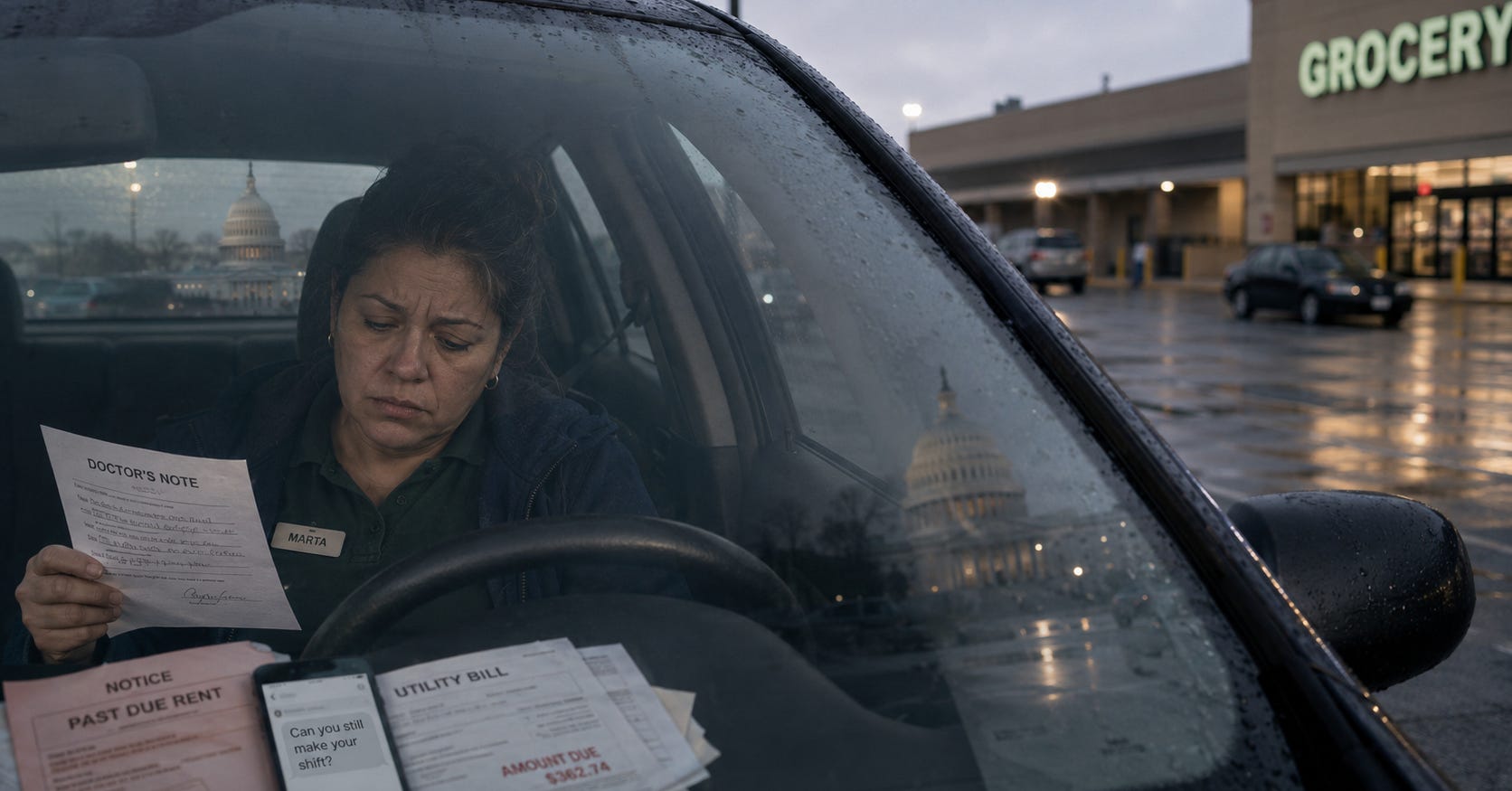
Another worker sits in a parked car outside a grocery store, warehouse, nursing home, or restaurant, knowing she should not go inside. She is sick, exhausted, and afraid that one more missed shift could cost her hours she cannot replace. Rent is due. The electric bill is already late. The credit card is carrying groceries from last week. She does not have the luxury of asking how long recovery might take. She is trying to calculate how much illness she can afford.
Both are human beings. Both can become too sick to work. Only one is protected from financial punishment when that happens.
The protected worker is Representative Tom Kean Jr. After months away from Congress, Kean disclosed that he had been hospitalized and treated for depression. His condition deserves seriousness, not ridicule. Seeking treatment was not a failure, and needing time to recover was not an abuse.
Tom Kean deserved the time he needed to heal. The scandal is that millions of Americans apparently do not.
Support independent media that follows the power.
The Coffman Chronicle is built to track who holds power, who abuses it, who profits from it, and who pays the price.
Paid supporters get full Tony Michaels Podcast episodes, deeper transcript analysis, paid columns, archives, and the reporting framework behind the show.
If you believe independent media has to survive outside billionaire platforms, corporate media, and party-approved gatekeepers, become a paid supporter today.
What Tom Kean Received
Kean last cast a vote in the House on March 5. When he returned to the Capitol on June 30, he said he had entered a hospital for medical testing, received a diagnosis of depression, and remained there on the advice of his doctors. By then, he had missed more than 100 votes during an absence of nearly four months.
His seat remained secure, his congressional office continued operating, and his salary was protected. Federal law generally requires deductions for House absences but exempts those caused by a member’s illness or the illness of a family member. Rank-and-file members of Congress receive an annual salary of $174,000.
Those protections are not the problem. Serious illness should not force a person to sacrifice income, treatment, and employment while trying to recover. Kean followed medical advice, and the institution around him gave him space to do it.
His legislative record makes that security harder to ignore. While serving in the New Jersey Senate, Kean voted against the state’s 2018 earned-sick-leave law, which required employers to provide workers with up to 40 hours of paid leave for needs including recovery from mental or physical illness. He also opposed an earlier measure creating paid family and parental leave through the state insurance system.
The problem is not that Kean received compassion. The problem is that he treated compassion as something the government could guarantee for him, but not for the people working outside the Capitol.
Two Definitions of Human Need
When powerful people become seriously ill, institutions remember that human beings are not machines. They understand that recovery can take longer than expected, that medical details may remain private, and that a person should not lose everything because the body or mind stops cooperating.
That understanding changes when the sick person works for an hourly wage. Then illness becomes a staffing problem. Recovery becomes an inconvenience. A missed day is a mark on an attendance record, and a longer absence can be grounds for replacing the worker altogether. The same need that earns patience inside Congress can earn punishment outside it.
The consequences do not remain at the workplace. A missed shift can become a late electric bill. Several missed shifts can put groceries on a credit card. A serious illness can threaten the insurance needed to treat it. By the time someone is well enough to return, the financial damage may already be waiting at the kitchen table.
Paid leave is not a workplace perk. It helps determine whether illness remains a medical crisis or becomes a financial collapse.
The working class is not a small interest group asking for special treatment. It is the economic majority that keeps stores open, patients cared for, packages moving, children taught, buildings repaired, and communities functioning. Yet the people whose labor sustains the country are often given the least room to be human when they can no longer work.
America does not lack compassion. It distributes compassion according to rank.
Depression Is Not the Indictment
Kean’s depression is not the case against him, nor is his hospitalization, his need for treatment, or the time he spent away from Congress. A serious mental-health crisis can make ordinary work impossible. Seeking help should not be treated as a weakness, and recovery should not be turned into a partisan weapon. Doing that would reproduce the same cruelty this article is arguing against.
The relevant evidence is not that Kean became ill, but rather that he accepted the protection of an institution that continued to pay him and preserve his position after he had opposed far more modest protections for workers without his power.
We should not demand that members of Congress be treated as harshly as American workers. We should demand that American workers finally be treated with the humanity Congress reserves for itself.
A Seat Cannot Quietly Go Empty
Kean’s right to medical privacy does not erase his constituents’ right to representation. For nearly four months, the people of New Jersey’s 7th Congressional District had a representative whose office remained open but whose vote was absent from the House floor. Staff could continue constituent services, but they could not vote, question witnesses, or exercise the authority voters placed in the person they elected.
Illness should not automatically force a member from office, but Congress should have clear procedures for prolonged incapacity. Voters should know when a member cannot perform essential duties, whether public statements come from the member or staff, and how the institution will preserve meaningful representation without demanding private medical records.
A member may need to disappear from public life to recover. An elected seat cannot quietly disappear with him. Medical privacy cannot become democratic invisibility.
Five Days Is Not a Safety Net
New Jersey’s earned-sick-leave law guarantees many workers up to 40 hours of paid leave each year. That is better than nothing, but five workdays are not enough to cover a hospitalization, major surgery, cancer treatment, a severe depressive episode, or the care of a seriously ill family member.
The gap is even larger for workers with no paid leave at all. Unpaid leave may protect a job on paper, but it does not protect the household depending on the paycheck. A legal right to stay home means little when using it threatens rent, groceries, electricity, or continued treatment.
Kean’s own recovery demonstrated something important. Serious illness does not fit neatly inside an employee handbook. Doctors do not schedule recovery around a set number of hours, and the mind does not become healthy just because the leave bank has run out.
A serious national standard should have two parts: paid sick days for ordinary illness and wage protection for longer medical or family leave. Anything less leaves workers with the legal right to recover but no practical way to survive it.
Employers benefit from healthy workers, functioning roads, educated communities, public investment, and customers with money to spend. Stewardship requires them to share responsibility for the people whose labor makes those benefits possible.
The government has already proven that paid recovery is possible. It has simply decided that some people are important enough to receive it.
The Protected Class Writes the Rules
Members of Congress are paid during illness for a reason. Public officials should not be forced to choose between medical treatment and financial ruin, and voters should not have their representation shaped by whether a lawmaker can personally afford to recover.
However, that logic becomes indefensible when the people writing the rules protect themselves from the consequences they impose on everyone else.
A member of Congress does not have to wonder whether hospitalization will remove him from next week’s schedule. He does not return from treatment to find his hours assigned to someone else. His health crisis does not automatically threaten the paycheck supporting his family.
Millions of workers live with exactly those risks.
This is what concentrated power looks like when it reaches the kitchen table. The people deciding how much security workers deserve are often insulated from the insecurity their decisions create. They debate paid leave as a burden on employers while living inside protections that keep illness from becoming personal bankruptcy.
The answer is not to copy every feature of congressional employment, but to establish a national floor beneath every worker: paid time for ordinary illness and real income protection when a serious condition requires more. That is the minimum.
No one should have to become powerful before the country recognizes that a human body can fail. Public office is supposed to be stewardship, not membership in a protected class.
Do Not Take Away His Leave
The worker from the parking lot does not need Congress to punish Tom Kean for getting help. She does not need his salary docked, his treatment mocked, or his illness turned into a spectacle. She needs lawmakers to recognize that her body is no less human than his.
She needs to know that a diagnosis will not cost her the rent, that treatment will not erase her paycheck, and that recovery will not leave her unemployed. She needs the same basic assurance Congress already gives its own members, that becoming sick should not mean losing everything.
This is where resentment politics gets the question backward. The answer to unequal protection is not to strip the person who received it of protection. It is to end the system that reserves security for people with power.
Tom Kean deserved the time, income, and medical care that allowed him to recover. So does the grocery clerk. So does the home-health aide. So does the warehouse worker, the cook, the teacher, and the parent caring for a sick child.
We are not angry that Tom Kean was treated like a human being. We are angry that millions of Americans are not.
Do not take away the time, privacy, income, and security that allowed a member of Congress to recover. Build a country where the need for those things no longer depends on being powerful enough to receive them.
Support Independent Media
If this work matters to you, become a paid subscriber if you can. Your support helps keep the Coffman Chronicle independent, focused on working people, and free to challenge the double standards that power protects.
If a paid subscription is not possible, sharing this article still helps.
Sources:
Brudnick, Ida A. “Salaries of Members of Congress: Recent Actions and Historical Tables.” Congressional Research Service. Updated January 21, 2026.
Cornell Law School, Legal Information Institute. “2 U.S. Code § 5306—Deductions for Absence.”
Goldstein, Luke. “Sick Leave for Me, Not for Thee.” The Lever, June 30, 2026.
LegiScan. “Roll Call: New Jersey Assembly Bill 1827, Senate Floor, Third Reading—Final Passage.” April 12, 2018.
Lu, Adrienne. “Paid Family Leave Now Law in N.J.” Philadelphia Inquirer, May 3, 2008.
National Partnership for Women & Families. “New Jersey Becomes Third State to Adopt Paid Family Leave.” May 2, 2008.
New Jersey Department of Labor and Workforce Development. “Earned Sick Leave Is the Law in New Jersey.”
New Jersey Legislature. “Assembly Committee Substitute for Assembly Bill No. 1827, First Reprint.” 2018.
New Jersey Legislature. “Senate Bill No. 786.” 2008.
Reuters. “US Representative Tom Kean Attributes Months-Long Absence to Depression.” June 30, 2026.
While he is taking paid leave to treat his depression, he is also trading stocks to make even more money. You have to wonder just how depressed he is if he is ordering stock trades.
The government didn't supply him with his salary or health care...THE TAX PAYERS DID!!! These hypocritical pricks can fuck right off!!! We deserve the same health care, in their case they're entitlements, that they get!!! FUCK THEM ALL ESPECIALLY MAGA AND CONSERVATIVE DEMOCRATS!!!