


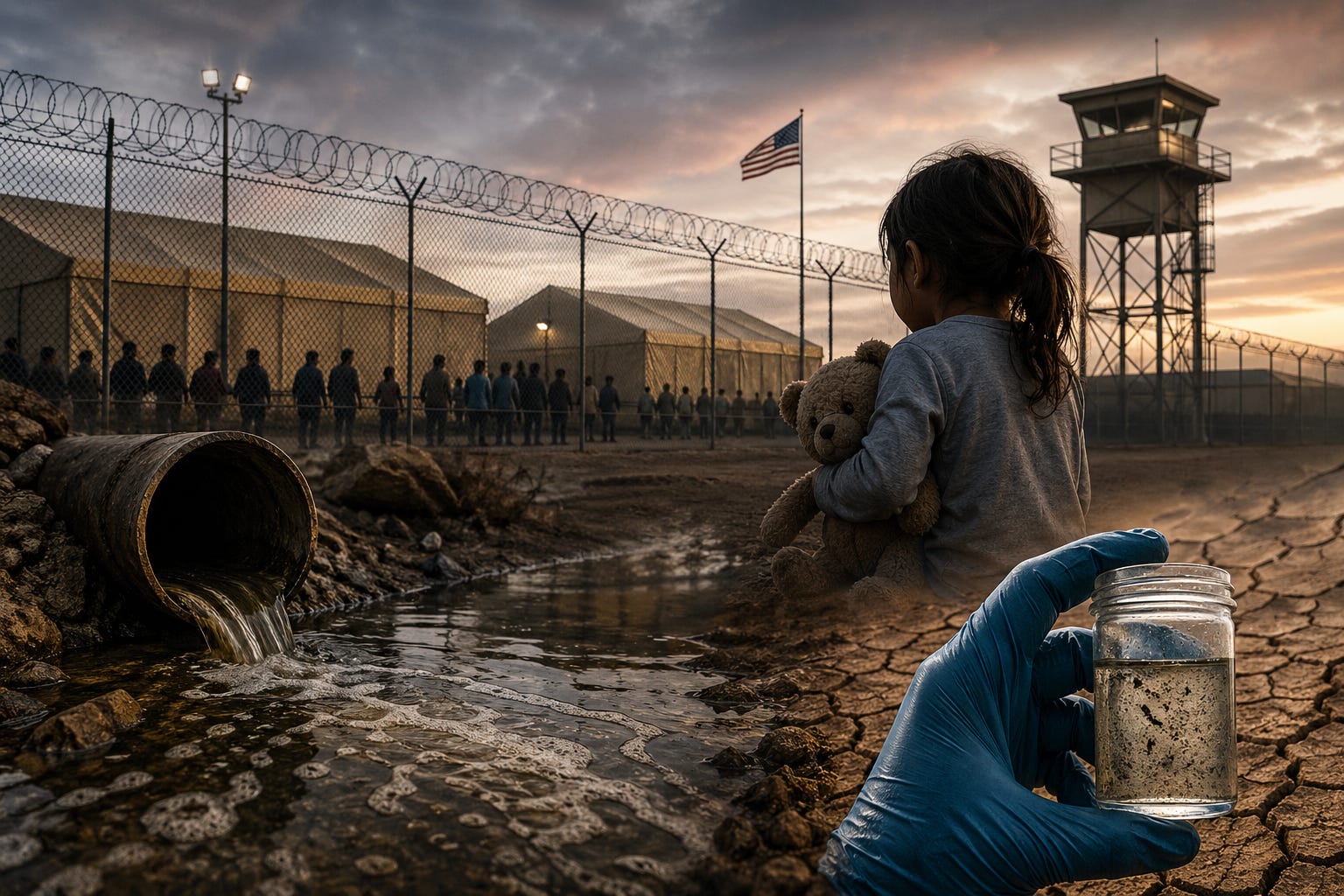
In late April 2026, The Guardian reported that federal officials are planning a new family immigration detention center at England Airpark in Alexandria, Louisiana, a former military base with documented contamination, including extremely high levels of PFAS in groundwater. The proposal is striking on its own terms. It becomes more troubling when placed in context.
Across the country, a pattern is emerging. Proposed and existing detention sites are increasingly located in places marked by contamination risks, strained infrastructure, environmental hazards, or basic questions of habitability. At the same time, the detention system itself is under growing scrutiny for unsanitary conditions, inconsistent medical care, denial of prescribed medications, and a rising number of deaths in custody. The result is a system expanding into riskier environments while struggling to meet basic standards in the ones it already operates.
This is not just about one site in Louisiana. It is about what that site reveals.
This Community Is Powered by You
What started as a small circle has grown into something much bigger, and it’s all because of readers like you.
Every time you forward this email, post it on socials, or bring someone new into the fold, you’re helping build one of the most passionate, independent political communities out there.
Want to keep the momentum going?
Share this newsletter with someone who should be part of this conversation.
Thank you for being here. It means everything.
What The Guardian Found
The proposed facility at England Airpark would house migrant families and children at a location that once served as a military installation. Like many former military sites, it carries a legacy of environmental contamination. In this case, the most concerning involves PFAS, or per- and polyfluoroalkyl substances, a class of synthetic chemicals used for decades in firefighting foam, industrial processes, and consumer products.
PFAS are often called “forever chemicals” because they do not break down easily in the environment or the human body. They accumulate over time and have been linked to a range of health risks, including certain cancers, immune system suppression, developmental issues in children, and complications during pregnancy. In 2024, the Environmental Protection Agency set extremely low limits for PFAS in drinking water measured in parts per trillion, reflecting the growing consensus that even very small amounts may be harmful over time.
At England Airpark, reported PFAS levels in groundwater are orders of magnitude above federal standards. How much? According to reporting, levels have measured up to 41 million parts per trillion. As one commentator noted, that is at least 575,000 times over the legal limit.
The proposal envisions using the site as a short-term detention facility, with officials and contractors suggesting that families would be held for only a few days before being processed and moved elsewhere. However, public reporting indicates that full environmental remediation has not been completed, and federal agencies have not provided detailed responses addressing how contamination risks would be managed.
On its own, that would raise serious questions, but it does not stand alone.
A Pattern of Risky Siting
Contamination and Hazard Proximity
England Airpark is the clearest example, but it fits into a broader pattern of siting decisions that raise environmental concerns.
In Merrimack, New Hampshire, a proposed ICE facility drew scrutiny because of PFAS contamination concerns before the plan was ultimately dropped. In Surprise, Arizona, the state has challenged a planned detention site across the street from a hazardous materials storage containing thousands of gallons of materials used in semiconductor production, raising questions about environmental review and safety. In Karnes County, Texas, an existing detention facility sits in close proximity to oil and gas activity, including flaring operations. According to some reports, it is within 100 feet of the site. Other proposed sites are located near federal Superfund sites and other extremely dangerous and hazardous land.
Each case involves different specifics—different contaminants, different industrial contexts—but the underlying issue is consistent: detention facilities placed in or near environments where exposure risks are already present.
Infrastructure Under Strain
Other proposals raise a different kind of concern. In parts of Pennsylvania and New Jersey, officials have pushed back on warehouse-to-detention conversions, citing limits on water supply, sewage treatment capacity, and wastewater infrastructure.
These are not abstract concerns. Large detention facilities concentrate hundreds or thousands of people in a single location, placing significant demand on systems that may already be near capacity. When those systems are strained, the risks include inadequate sanitation, untreated or poorly treated wastewater, and downstream environmental impacts that affect both detainees and surrounding communities.
Environmental and Resource Stress
Some sites raise concerns less about contamination and more about environmental suitability. Alligator Alcatraz in the Florida Everglades, for example, has been challenged over its potential impact on wetlands, wildlife, and water systems, though judges have alternatively halted and then reopened the operation.
At Fort Bliss in Texas, a large soft-sided detention facility has operated in a desert environment defined by extreme heat, cold nights, dust, and water constraints. The issue there is not primarily contaminated land, but whether the environment itself can support humane conditions at scale.
See our earlier reporting highlighting the concerns at Ft. Bliss here:
Note: Articles roll into our archive over time. Become a paid subscriber for full access to our extensive catalog.

Habitability and Design
Fort Bliss also highlights a broader category of concern. Certain sites are simply not suited for human confinement, regardless of contamination levels.
Tent structures on asphalt or desert ground are difficult to cool during extreme heat and difficult to warm during cold nights. Dust and wind complicate sanitation. Water must sometimes be transported in to meet demand. These are not incidental challenges. They are built into the environment. Similar concerns have been raised at long-running desert facilities in places like California and Texas, where water scarcity and extreme heat complicate large-scale detention.
These sites represent different hazards, but they share a recognizable pattern. Detention expansion is moving into places where maintaining safe and humane conditions is inherently more difficult.
The “Temporary” Defense
Supporters of these projects often rely on a single argument. The facilities, they assert, are meant for short-term use. If people are only held for a few days, the risks are limited.
That argument does not hold up well under scrutiny.
First, the timeline itself is uncertain. While officials may describe a facility as “processing” or “short-term,” data and reporting show that detention can stretch well beyond initial expectations. The Flores Settlement Agreement has been interpreted to limit how long children can be held—roughly around 20 days in many cases—but even that is a ceiling frequently approached. Some families have been detained for months.
More importantly, risk is not linear with time.
Exposure to contaminated water, poor air quality, or inadequate sanitation does not become safe simply because it is brief. For many detainees, even a short interruption in care or exposure to unsafe conditions can have serious consequences.
“Temporary” is not a safety standard. It is a timeline, and one that the system has not consistently met.
Medical Needs Don’t Wait
The short-term argument collapses even further when viewed through a medical lens.
Immigration detention does not involve only healthy adults. It includes children, pregnant people, elderly individuals, people with chronic illnesses, disabilities, mental-health conditions, and those with ongoing or emerging medical needs. For many of these individuals, care is not optional or deferrable.
Diabetes requires daily insulin management. Heart conditions require consistent medication. Seizure disorders depend on uninterrupted treatment. Mental-health conditions require monitoring and support. Infectious diseases require screening, isolation, and follow-up.
A few days without proper care can be enough to turn a manageable condition into a medical emergency.
Reports that detainees have been denied prescribed medications only intensify this concern. When basic continuity of care breaks down, the risks posed by environmental factors such as contaminated water, extreme heat, and poor sanitation become far more dangerous.
Medical needs do not operate on ICE’s timeline. Increasingly, neither does ICE.
A System Already Under Strain
These concerns would be serious in any context. They are more alarming given the current state of the detention system.
Recent reporting has documented a sharp rise in deaths in ICE custody, with 2025 marking one of the deadliest years in decades and 2026 tracking along a similar path. Many of these deaths have been described as potentially preventable, linked to delays in medical care, inadequate monitoring, or failures in basic sanitation and conditions.
This is not a system with a strong track record of managing health risks.
See our previous reporting here:
Note: Articles roll into the archive over time. Become a paid subscriber for full access to our extensive catalog.

Environmental risk is not isolated. It interacts with everything else, including sanitation practices, staffing levels, medical access, oversight, and accountability. A facility located on or near contaminated land or in a water-stressed or environmentally challenging area requires more robust systems to keep people safe, not fewer.
Yet the pattern suggests expansion is happening faster than those systems can be built or maintained.
A system already struggling to provide consistent medical care has little credibility asking the public to trust it with more complex and higher-risk environments.
More Beds, Not More Justice
Underlying all of this is a structural issue.
Expanding detention capacity does not address the core bottlenecks in the immigration system. It does not add immigration judges, asylum officers, legal representation, translators, or case management resources. It does not resolve claims faster or make outcomes more consistent.
What it does is increase the number of available beds.
Many facilities are operated by private contractors paid on a per-diem basis—per person, per day—creating a structural incentive for high occupancy. While contractors do not make detention decisions, the system as a whole is financially incentivized to fill beds.
A detention center is not a courtroom, a legal process, or medical care.
Expanding confinement capacity without expanding processing capacity risks turning the system into one defined by volume rather than resolution.
The Question That Remains
The England Airpark proposal raises a question that extends far beyond Louisiana.
If a site would raise concerns for housing, schools, workplaces, or even animal care because of contamination, infrastructure limits, or environmental risk, why is it considered acceptable for people who are detained and cannot leave?
Calling detention “temporary” does not make toxic land safe. Calling a warehouse a processing center does not ensure adequate medical care. Building more beds does not fix a system already struggling to protect the people inside it.
What these sites reveal is not just a series of questionable decisions. It is a set of priorities.
And those priorities are becoming harder to defend.
If this story raised questions, that’s the point. We track the patterns behind decisions like these and their practical implications. Subscribe to follow the full picture.
Sources:
The Guardian, “ICE planning facility for children and families on PFAS-contaminated site,” April 25, 2026.
EPA, “Final PFAS National Primary Drinking Water Regulation,” April 2024.
EPA, “Our Current Understanding of the Human Health and Environmental Risks of PFAS.”
NHPR, “Proposed location for ICE facility in Merrimack sits within PFAS contamination zone,” February 20, 2026.
Office of the Governor of New Hampshire, “DHS Will Not Move Forward with Proposed ICE Facility in Merrimack,” February 24, 2026.
Arizona Mirror, “Arizona AG sues Trump over Surprise immigration detention warehouse,” April 24, 2026.
Arizona Attorney General’s Office, “Attorney General Mayes Sues to Block Proposed ICE Detention Facility in Surprise,” April 24, 2026.
Courthouse News Service, “Arizona sues to block ICE facility near chemical warehouse,” April 24, 2026.
Deceleration, “Karnes Immigrants Forced to Breathe Fracking Fumes,” October 4, 2018.
Reuters, “New Jersey sues Trump administration over proposed ICE facility,” March 20, 2026.
Spotlight PA, “PA officials warn ICE centers could strain water, EMS, sewage systems,” February 23, 2026.
Pennsylvania DEP, “Shapiro Administration to DHS: No Schuylkill or Berks Detention Warehouses Without Complying with State Law,” March 6, 2026.
WHYY, “Pennsylvania ICE detention center plans draw environmental opposition,” April 17, 2026.
Associated Press, “ICE begins to purchase warehouses, but some owners are backing out of deals,” February 21, 2026.
Washington Post, “Judge orders pause on ICE detention center construction in Maryland,” March 11, 2026.
Associated Press / OPB, “Appeals court keeps ‘Alligator Alcatraz’ open, rejecting need for federal environmental review,” April 21, 2026.
Reuters, “Inspection finds 49 violations of detention standards at largest US migrant detention camp,” April 2, 2026.
The Guardian, “‘Psychological torture’: outcry over conditions at ICE desert detention camp,” April 15, 2026.
The Guardian, “‘Abject cruelty’: review of 911 calls from Texas ICE detention facility reveals disturbing conditions,” March 6, 2026.
The Marshall Project, “ICE Threw Thousands of Kids in Detention, Many For Longer Than Court-Prescribed Limit,” December 17, 2025.
The Marshall Project, “Kids in ICE Detention Up 10x in Trump’s Second Term,” April 6, 2026.
Reuters, “Woman, her 5 children released from longest ICE detention of a family under Trump,” April 24, 2026.
KFF, “Deaths and Health Care Issues in ICE Detention Centers Under the Second Trump Administration,” March 25, 2026.
The Guardian, “2025 was ICE’s deadliest year in two decades. Here are the 32 people who died in custody,” January 4, 2026.
The Guardian, “Judge orders US to provide California ICE detainees with medical care, attorneys and blankets,” February 11, 2026.
ACLU, “District Court Grants Preliminary Order Prohibiting Abhorrent Conditions at California City Detention Facility,” February 11, 2026.
That's Criminal and should be stopped!!!
Trump will be remembered as a POTUS with the undisciplined intention to support insurrection, profit personally and monetarily from activities while serving in elected office. He has been identified in a court of law as a convicted felon and rapist.
Trump prefers to use his POTUS power to waste US government time, and Taxes suing others in a court of law. He believes himself to be a "tough" negotiator because he is unconventional while Iran refuses to talk to him. Employing the US military he pretends he is capable of greatness. Foreign dignitaries avoid him or pander to his courage to be "different" and uneducated. Trump is a complete and total ignoramus responsible for damaging the Dept of Ed, FCC, FAA efficiency, CFPB and health care and SS intended to benefit the American voting citizen. It is the absurd notion of MAGA voters to believe Trump is patriotic, compared to bungling Biden democrats. He has been a complete disaster, lacks planning skill and is fortunate he was not assassinated twice. He is destructive to democracy and America will need serious repair to our institutions when we vote his fat ass out of office.