


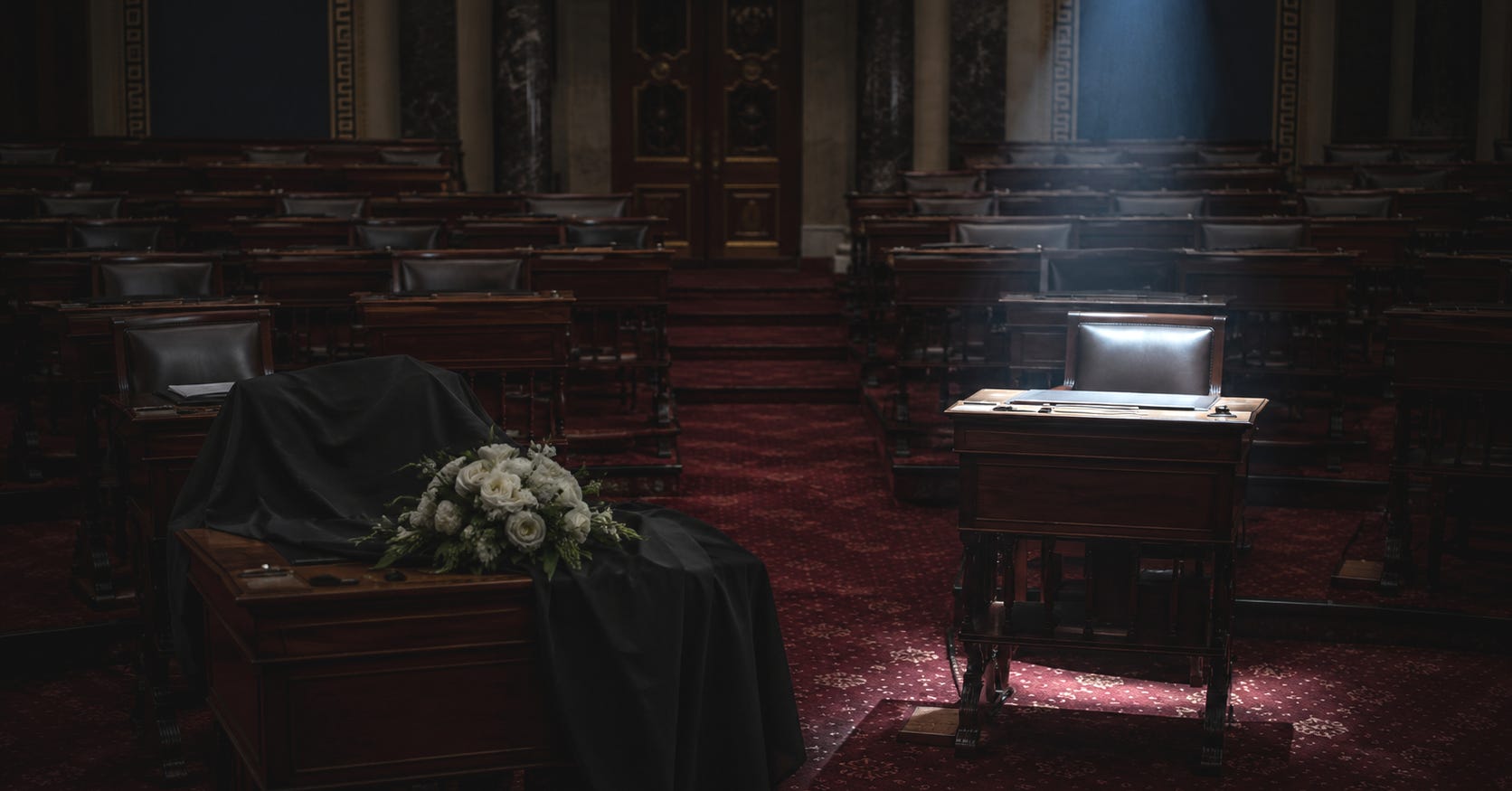
A Black-Draped Desk and an Empty One
The United States Senate returned to work Monday with one desk draped in black and another still empty. White flowers rested on the desk of Lindsey Graham. The South Carolina Republican had died suddenly at 71. A preliminary finding identified an aortic dissection—a tear in the wall of the body’s main artery—as the cause, although additional testing remained underway. Only days earlier, Graham had returned to Washington from Ukraine and was resuming his work in the office he had held for more than two decades.
His death was not the end of a long public disappearance. It was an abrupt loss that left colleagues grieving and South Carolina without one of its two elected voices in the Senate.
The other empty desk belonged to Mitch McConnell. The 84-year-old Kentucky senator had not appeared publicly since he was hospitalized in mid-June after falling at home and briefly losing consciousness. He later developed mild pneumonia and entered a rehabilitation facility. On the eve of the Senate’s return, McConnell said he continued to recover but was not yet able to return to the chamber to vote. He did not say when he would be back.
The circumstances are not the same. Graham died while still actively performing the job. McConnell is alive, recovering, and entitled to the privacy and dignity any person deserves during a serious medical ordeal, according to official sources. A sudden death does not prove someone remained in office too long, and an extended recovery does not automatically establish permanent incapacity, but the two empty desks placed an uncomfortable question in the center of the people’s branch: What happens to representation when a senator dies suddenly, or remains legally in office while physically unable to appear and cast the votes entrusted to him?
The Senate is not merely a workplace occupied by 100 politicians. Each desk carries part of a state’s constitutional voice. When one is empty, the loss belongs not only to a senator, a family, or a political party. It belongs to the people who sent that person to Washington.
This week, two empty desks forced the country to ask whether Congress has built a system capable of protecting that representation when the person holding the seat can no longer provide it.
Support independent media that follows the power.
The Coffman Chronicle is built to track who holds power, who abuses it, who profits from it, and who pays the price.
Paid supporters get full Tony Michaels Podcast episodes, deeper transcript analysis, paid columns, archives, and the reporting framework behind the show.
If you believe independent media has to survive outside billionaire platforms, corporate media, and party-approved gatekeepers, become a paid supporter today.
The Seat Stayed Close to Power
South Carolina answered one part of that question almost immediately. Two days after Graham’s death, Governor Henry McMaster appointed Graham’s younger sister, Darline Graham Nordone, to serve the remaining months of her brother’s term, which expires in January.
The appointment was lawful. The Seventeenth Amendment allows state legislatures to authorize governors to make temporary Senate appointments until voters fill a vacancy through an election. South Carolina’s Republican Party will hold a special primary on August 11th, with a runoff on August 25th if necessary. The nominee will face Democrat Annie Andrews in the November 3rd general election.
Nordone is not entirely disconnected from public service. She has worked as an optician and for South Carolina agencies involved in vocational rehabilitation, workforce development, and services for people who are blind. Graham became her legal guardian after their parents died, helping raise her while building a life and political career of his own.
That history made the appointment emotionally powerful. McMaster described the choice as an opportunity for Graham’s sister to finish her brother’s work. President Donald Trump supported the selection, and Nordone accepted the responsibility through the language of family loyalty, remembrance, and gratitude.
There is nothing shameful in that affection, but there is something democratically uncomfortable about allowing it to define the transfer of public power.
A United States Senate seat is not unfinished family business, or a memorial entrusted to the person who knew the previous senator best. It does not belong to a governor, a president, a political party, or the family of the person who occupied it. It belongs to the people of South Carolina.
Nordone may serve honorably. This is not an accusation that she stole the seat or that South Carolina created a hereditary office. Her appointment is temporary, and voters will choose who holds the seat next. The speed of her entrance nevertheless reveals something about political access.
For most Americans, entering the Senate is nearly unimaginable. A serious campaign requires money, staff, donor relationships, party support, name recognition, and the freedom to place an ordinary career on hold. Candidates can spend years trying to convince political institutions that they deserve a hearing.
Nordone moved from private citizenship to the threshold of one of the world's most powerful legislative bodies within days, not because voters had evaluated her record, but because she stood close to the person and political network that already held the seat. That does not make the appointment corrupt. It makes it revealing.
The doors of Congress can open instantly for someone standing near established power while remaining nearly immovable for millions of Americans whose lives Congress is supposed to represent.
A Congress Older Than the Country It Represents

The meme that began circulating after Graham’s death offered a blunt diagnosis: Congress is old, members are dying in office, and voters should elect younger people.
Its precise counts require caution. Congressional membership changes through deaths, resignations, appointments, and special elections. Birthdays also move members across whatever age line a meme chooses. However, the image raises a real question, even if it did not provide a complete answer.
At the beginning of the 119th Congress, the median age of voting House members was 57.5. In the Senate, it was 64.7. By comparison, the median age of the United States population reached 39.4 in 2025.
That is not a perfect comparison. The national figure includes children, while the Constitution requires representatives to be at least 25 and senators to be at least 30. Congress will naturally be older than the country as a whole. Constitutional minimums, however, do not explain a Senate in which the median member had nearly reached the traditional retirement age.
Experience has value. A lawmaker who has spent decades studying defense, agriculture, health care, or the federal budget may understand the machinery of government better than a newcomer with a viral campaign and little knowledge of the institution. The country should not discard expertise simply because the person who holds it has grown older.
The problem begins when institutional experience becomes so concentrated that it crowds out the lived experiences of everyone who came after it.
Congress represents states and districts, but those places contain people at radically different stages of life: workers entering an economy shaped by automation, parents paying for child care, renters unable to accumulate a down payment, adults supporting children and aging parents, and retirees depending on Social Security and Medicare. All of them are represented in theory, but they are not equally present in the rooms where power is exercised.
An older senator can care deeply about the struggles of a 28-year-old worker. After all, representation has always required people to act on behalf of citizens whose lives differ from their own. Still, there is a difference between receiving a staff briefing about housing costs and trying to buy a first home in the current market. There is a gap between holding a hearing about artificial intelligence and wondering whether it will eliminate the career you have only begun building. There is a void between studying child-care shortages and arranging care before a shift begins.
Those differences do not make one generation morally superior. They make lived experience politically relevant.
Congress is making decisions about artificial intelligence, housing, public debt, energy, retirement security, and the future of work that may shape American life for decades. Younger adults will live with those choices through most of their working lives, and their children may inherit them. The problem is not that older Americans are represented, but that younger Americans hold too little direct power within the institution that makes the decisions they will live with the longest.
How Political Power Ages in Place
Congress did not become older by accident. The Constitution allows a person to serve in the House at 25 and in the Senate at 30. Those are only the legal qualifications. The practical qualifications are much higher.
A serious campaign demands time, money, professional flexibility, political relationships, and the ability to risk a stable life for an uncertain result. Congressional candidates collected approximately $3.8 billion during the 2023–2024 election cycle, underscoring how much financial machinery surrounds entry into federal office.
A 29-year-old worker paying rent and carrying debt may possess the judgment required to serve but not the ability to stop earning a paycheck while campaigning. A parent may have the talent to represent a district, but no way to spend evenings at fundraisers while arranging child care. A nurse, mechanic, teacher, or warehouse worker may understand ordinary economic pressure better than many professional politicians and still be unable to enter a race structured around wealth and free time.
Once a person wins, the advantages compound. An incumbent gains name recognition, donor lists, experienced staff, party relationships, and an office capable of helping constituents navigate the federal government. Each victory makes the next campaign easier, each committee assignment creates more influence, and each year deepens the network surrounding the seat.
That does not make incumbency illegitimate. Voters may reasonably prefer someone who knows the job and has delivered for the district. However, the system does more than reward service. It protects accumulated power.
Donors prefer candidates who have proved they can win. Parties protect members whose seniority gives them influence. Challengers must persuade voters not only that the incumbent has failed but that replacing a familiar name is worth the risk. The door narrows for newcomers while the floor strengthens beneath those already inside.
This is how political power ages in place.
Younger Americans face the steepest barriers to entering Congress, while established officeholders receive the greatest advantages for remaining there. Eventually, the office and the officeholder begin to blur. The seat becomes associated with a name, a family, a donor network, or a political era. Retirement is treated as a private choice rather than a public question about representation.
Experience should carry weight in Congress, but it should not become the gate that prevents new experience from entering.
Age Is Not Incapacity, But Absence Is Still Absence
Lindsey Graham’s death does not prove that he was too old to serve. He had remained active in Senate business and had returned from Ukraine shortly before suffering the medical emergency that killed him.
Mitch McConnell’s age does not prove that either. An 84-year-old senator may be more capable, attentive, and independent than a colleague half his age. Youth is no protection against incompetence, corruption, donor control, or obedience to party leadership. A birth certificate cannot tell voters whether someone possesses the judgment required to govern.
However, the political consequences of absence still exist. McConnell has been out of public view since mid-June. That may be temporary. He may recover, return, and complete his term. Kentuckians are still entitled to ask what representation looks like until then.
See our previous reporting here:

Open the Door, and Build an Exit
The easy answer to an aging Congress is to elect younger people. There is truth inside that demand. Congress needs more members who understand modern wages, housing, technology, and family costs because they have lived those pressures recently, or are living them now.
However, youth is not a governing philosophy. A younger Congress could still be financed by the same donors, filtered through the same party machinery, and disciplined by the same leadership structures. Replacing old gatekeepers with younger gatekeepers would change the appearance of Congress without changing who controls the door.
It could also create another imbalance. Older Americans are not obstacles to representation. A chamber with little understanding of retirement, disability, caregiving, Social Security, Medicare, or long-term medical needs would fail the country just as surely as a chamber detached from student debt, first-time homeownership, and the modern labor market.
No generation should be pushed out of the people’s branch, and no generation should be permitted to possess it either. That is why mandatory age limits and term limits are incomplete answers. They may remove individual lawmakers while leaving donors, party leaders, lobbyists, and permanent political institutions with even more influence over inexperienced replacements.
The goal is not to make Congress younger for its own sake, but to make Congress more representative. That requires opening the entrance.
Running for office should not require personal wealth, a national donor list, or the ability to abandon an ordinary job for a year. Small-donor and public-financing systems deserve serious consideration. Campaign expenses should recognize child care as a legitimate cost of participation. Parties should recruit beyond lawyers, executives, celebrities, and people who have spent decades building relationships inside the political class. The people closest to the pressures Congress regulates should have a realistic path to enter it.
Congress also needs an honest exit and continuity process. No member should be forced to disclose every medical detail or submit to partisan humiliation. Illness is not misconduct, and recovery does not follow a congressional calendar. Public office, however, carries public duties. After a significant absence, constituents should receive a narrow, credible answer about whether their representative can still perform the essential work. Congress should provide clear information about attendance, missed votes, committee participation, and whether the member remains capable of making decisions and directing the office. That is not demanding a diagnosis. It is asking whether representation still exists in practice.
Temporary replacements would require constitutional safeguards to prevent governors, parties, or congressional leaders from overriding voters, but the difficulty of designing those safeguards does not excuse Congress from confronting the problem.
Under longstanding congressional practice, the personal incapacity of a living member has not created a vacancy. Members who became incapacitated and did not resign have generally remained in office through the end of their terms. Congress has repeatedly studied continuity proposals, particularly for mass-casualty emergencies, but has not created a general replacement process for an individual living member who cannot serve. A republic should not have only two choices: force a sick person from office or leave a state or district partially voiceless for an indefinite period. There must be room between cruelty and silence.
The standard should protect the person and the office, but above all, it must protect the representation that belongs to the public.
The People’s Branch Must Contain the People
Return to the Senate chamber, one desk draped in black because Lindsey Graham died while still carrying South Carolina’s authority, another empty because Mitch McConnell legally carries Kentucky’s authority despite being unable to return and cast its vote.
Graham’s seat was filled temporarily by his sister through a lawful gubernatorial appointment. McConnell’s remains legally occupied without a temporary substitute. Together, those desks ask to whom Congress belongs.
The answer cannot be the senator occupying the seat, the family standing beside him, the party surrounding him, the donors financing him, or the governor choosing a replacement. The seat belongs to the people.
That principle becomes harder to see when lawmakers remain in office for decades, seniority becomes political currency, and succession is arranged within networks most citizens can barely enter. The person begins to look indispensable. The public is asked to confuse continuity of power with continuity of representation. They are not the same.
A Congress representing the whole country should contain the whole country’s experience, not through rigid quotas or by excluding older citizens whose knowledge belongs in the chamber. It should contain Americans entering the workforce and Americans preparing to leave it, renters and homeowners, parents raising children and adults caring for parents, and people living through the technological and economic changes Congress regulates, alongside people carrying the memory of what government has tried before.
Older Americans deserve representation, but younger Americans deserve more than representation performed entirely on their behalf by people several stages removed from their lives. They deserve a realistic path to hold power themselves.
Congress does not need to wage war against age. It needs to stop allowing power to age beyond balance.
Can the people’s branch represent every generation when access to it is so restricted, departure from it is so uncertain, and so much of its power remains concentrated among those who have already possessed it for decades?
The people’s branch does not need to become young. It needs to become representative. It must carry the experience of Americans who remember where the country has been, and the voices of Americans who will live longest with where Congress takes it next.
Support the Coffman Chronicle
If this work matters to you, please subscribe and share it with someone who believes Congress should belong to the people. If you can afford it, consider becoming a paid subscriber. Your support helps keep the Coffman Chronicle independent and makes work like this possible.
Thank You
Sources:
Associated Press. “Darline Graham Nordone, Sister of Lindsey Graham, Chosen to Fulfill Remainder of His U.S. Senate Term.” July 13, 2026.
Associated Press. “Senate Returns to Washington After Sen. Lindsey Graham’s Death with an Uncertain Agenda.” July 13, 2026.
Congressional Research Service. “Incapacity of a Member of Congress.” December 15, 2006.
Federal Election Commission. “Statistical Summary of 24-Month Campaign Activity of the 2023–2024 Election Cycle.” April 23, 2025.
Pew Research Center. “Age and Generation in the 119th Congress: Somewhat Younger, with Fewer Boomers and More Gen Xers.” January 16, 2025.
Reuters. “South Carolina Governor Names Graham’s Sister as Temporary Senate Replacement.” July 13, 2026.
United States Census Bureau. “U.S. Population Aging as Nation Turns 250.” April 9, 2026.
Constitution Annotated. “Seventeenth Amendment.”
Congressional Continuity: Ensuring the First Branch Is Prepared in Times of Crisis. Hearing before the House Select Committee on the Modernization of Congress, April 6, 2022.
Great article! I agree, except would make one comment: the elderly are actually not represented, either. Though the people in power are often elderly, they are also wealthy and don’t need to worry about the cost of health care, the cost of housing, etc. They do not have life experience of the needs of the vast majority of the elderly in America. More and more they are representing only the needs and desires of the ultra wealthy.
Another great article hitting all the points we need to understand and work on! Thanks so much!