


The Room Is Not the Whole Story
The danger in Trump’s new White House ballroom is not the chandeliers. It is not the square footage, the marble, the donor plaques, or even the spectacle of a president turning part of the people’s house into a monument to his own taste. While those things matter, and tell us something about ego, power, and the way Trump understands public office, they are not the whole story.
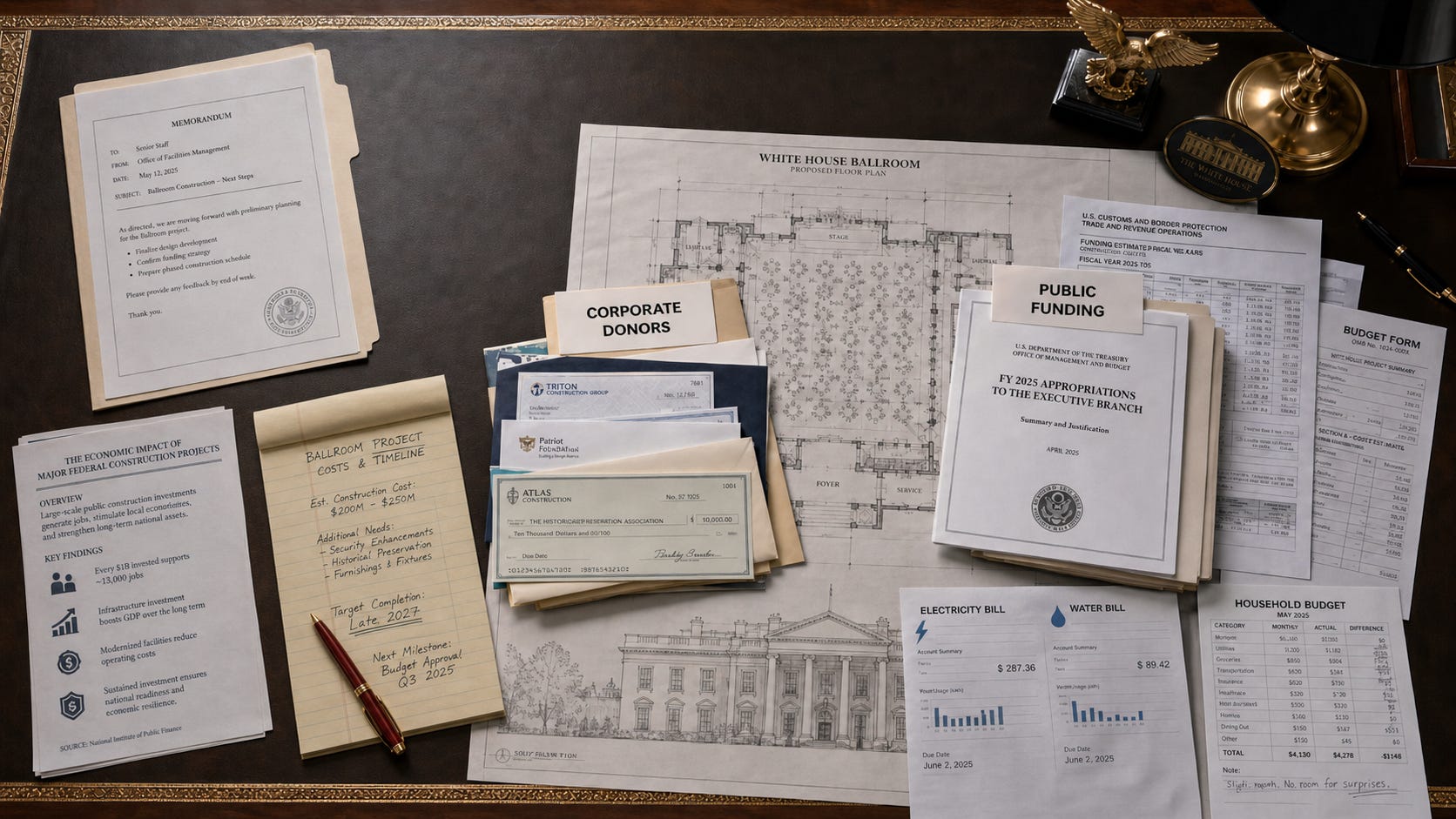
The real story begins with the donor list. Some of the companies helping fund Trump’s ballroom are not distant civic patrons writing checks out of neutral generosity. They are among the most powerful corporate interests in America: tech giants, defense contractors, crypto firms, energy players, construction-linked companies, and federal contractors with enormous business before the same government Trump controls.
This is bigger than a renovation or construction story, because when companies with business before the federal government help build the room where presidential power gathers, Americans have every right to ask a simple question: who gets heard inside that room, and who pays the cost outside it?
This Community Is Powered by You
What started as a small circle has grown into something much bigger, and it’s all because of readers like you.
Every time you forward this email, post it on socials, or bring someone new into the fold, you’re helping build one of the most passionate, independent political communities out there.
Want to keep the momentum going?
Share this newsletter with someone who should be part of this conversation.
Thank you for being here. It means everything.
A Public House, a Private Donor List
The White House is not just another government building. It is a national symbol, a public landmark, and the physical center of executive power. Presidents live there temporarily. The public owns what it represents. That is why the financing of Trump’s ballroom matters.
A privately funded project inside the White House immediately raises a question larger than construction. Who gets the privilege of helping build a president’s chosen legacy project, and what kind of access comes with that privilege? The administration can describe the ballroom as a practical addition. Supporters can argue that private funding saves taxpayers money. On paper, that may sound clean, but public corruption rarely announces itself with a simple invoice. Influence often works through relationships, visibility, gratitude, and proximity.
A donor-funded ballroom creates all four. The issue is not whether every company on the list receives a direct favor. That is not the standard the public should need before becoming concerned. The issue is that powerful interests with business before the federal government are helping finance a project personally associated with the president. They are not giving to a neutral civic fund disconnected from power. They are giving to a project attached to the most powerful political office in the country.
That changes the meaning of the room. It becomes more than a place for dinners, ceremonies, and state events. It becomes a symbol of who can afford to be seen as helpful to power. It tells ordinary Americans that the front door to government may still be public, but the side rooms are increasingly reserved for those with the money and corporate weight to enter them. That is the first warning in this story. The second is that even the “privately funded” defense is already beginning to crack.
The Private Promise Is Already Moving Toward the Public Ledger
Trump and his allies spent months presenting the ballroom as a project paid for by private donors. That was supposed to answer public concern. Do not worry about the cost, because taxpayers are not footing the bill. Now Senate Republicans are trying to change that.
Lindsey Graham and Katie Britt sponsored legislation to authorize $400 million for the ballroom and related security infrastructure, even though Trump has previously said private donors would pay for the project. Reuters reported that $332 million of the proposed funding would come from customs-fee revenue, while AP reported that Graham argued private contributions should go toward non-structural items such as “buying china and stuff like that.”
See some of our previous reporting here:
Note: Articles roll into the archive over time. Become a paid subcriber for full access to our extensive catalog.


That turns the ballroom story into something sharper than a donor-funded vanity project. It creates a potential bait-and-switch. First, the public is told that powerful private donors will cover the cost. Then, once the project is politically established, Republicans begin trying to move hundreds of millions of dollars onto the public ledger under the banner of security. That does not erase the donor problem. It compounds it.
Corporate donors get the access, the visibility, and the gratitude that come from attaching themselves to a president’s chosen White House project. Then the public may still be asked to carry the structural cost. The administration and its allies can call that security. They can cite threats against public officials and argue that presidential events require a safer venue, but even if security is part of the argument, the political effect remains obvious.
A project sold as privately funded could become publicly financed. A donor-backed room could become a federal expense. And the same companies praised for helping build it remain close to an administration making decisions that could affect their bottom lines. That is the kitchen-table turn.
Public money is never abstract. Federal funds used for a ballroom are funds that would otherwise be used elsewhere. Customs fee revenue is still public revenue. A dollar routed through a different account does not stop being public money just because politicians avoid saying the word “taxpayer.” The public was told not to worry because donors were paying. Now the question is not only who gave. It is who gets access, who gets credit, who gets policy attention, and who gets the bill when the private promise starts moving onto the public books.
This further begs the follow-up question. If this project is completed with public funding, what happens to the donor-generated funds that were promised for its construction? Is it still needed, as Graham says, for “china”? Is it returned, or does it get repurposed? That question requires further clarification.
That brings us back to the donor list, because the donors are not random.
The Donors Are Not Random
The donor list is not a collection of local philanthropists, civic clubs, or history buffs chipping in for a public restoration. It includes some of the most powerful companies in America. Reuters reported that the White House-provided list included Amazon, Apple, Google, Meta, Microsoft, Palantir, Booz Allen Hamilton, Lockheed Martin, Coinbase, Ripple, Tether America, Micron, NextEra, Caterpillar, Altria, Union Pacific, and other corporate or wealthy donors.
That is not a random cross-section of American generosity. It is a map of industries with deep interests before the federal government. Tech companies care about AI policy, cloud contracts, data-center permitting, energy availability, antitrust enforcement, privacy rules, export controls, and federal procurement. Defense and intelligence contractors care about Pentagon spending, national security contracts, surveillance tools, AI adoption, and procurement rules. Crypto firms care about regulation, enforcement, banking access, stablecoin rules, and whether Washington treats their industry as a threat or a partner. Energy and construction-linked companies care about infrastructure, permitting, land use, public contracts, and the federal government’s willingness to speed up or slow down major projects.
Many of them are regulated by the federal government, seek federal contracts, depend on federal procurement choices, lobby over federal rules, or operate in industries where Washington’s decisions can move billions of dollars. So when they help finance a president’s preferred White House project, the concern is not charity. The concern is proximity.
Influence does not always arrive as a direct order. It often arrives as a relationship, a dinner, a thank-you, a private conversation, a donor recognition, or a seat closer to the center of power than ordinary Americans will ever get. A worker whose electric bill rises because data centers are straining the grid does not get to fund a ballroom wing to make sure the president hears them. A town facing water pressure from new industrial demand does not get the same access as a tech giant. A small business trying to survive federal policy shifts does not get its name attached to a White House legacy project.
The companies with the most at stake do. That is not proof of a secret deal, but it is proof of a public imbalance, and that imbalance becomes even more important when the administration’s policy agenda is already moving in directions that could benefit many of the same industries.
The AI Plan Creates the Policy Overlap
The donor list becomes even more important when placed beside the administration’s AI agenda. Trump’s AI plan is not just a technology document. It is an infrastructure document, an energy document, a procurement document, an export document, and a deregulatory document. The White House described the plan as a package of more than 90 federal policy actions meant to accelerate American AI development, expand infrastructure, and promote U.S. AI systems abroad.
See our previous reporting on AI policy here:
Note: Articles roll into the archive over time. Become a paid subscriber for full access to our extensive catalog.


That means the benefits will not be limited to software companies. AI needs physical space. It needs data centers, chips, cloud capacity, power, and cooling. It needs transmission, permits, land, and federal contracts. It needs the government to decide whether speed matters more than scrutiny.
The administration has already moved in that direction. One executive order aims to accelerate federal permitting for data-center infrastructure. Another promotes the export of full-stack American AI technology packages to allies and partners abroad. That is where the overlap with the ballroom donors becomes difficult to ignore.
Tech giants stand to benefit from faster data-center buildout, more federal AI adoption, cloud contracts, export opportunities, and fewer regulatory obstacles. Defense and intelligence contractors stand to benefit as the federal government integrates AI more deeply into national security, surveillance, logistics, weapons systems, and procurement. Crypto firms stand to benefit from an administration that treats digital finance as an industry to accommodate rather than a threat to police. Energy and construction-linked companies stand to benefit because AI does not run on speeches. It runs on power plants, transmission lines, substations, cooling systems, concrete, steel, land, and permits.
That does not prove a quid pro quo. It proves something more basic and still deeply troubling. The same corporate world helping fund Trump’s White House project is also positioned around one of the most consequential federal policy shifts of the decade.
When the government writes rules for an AI boom, it is not merely deciding which companies get richer. It is also deciding how fast infrastructure gets built, which communities absorb the burden, which environmental reviews are shortened, which energy demands take priority, which contractors win, and which industries are treated as partners of the state. Those are public decisions and should be made in the public interest. However, when the companies closest to the policy machinery are also helping finance the president’s ballroom, the public has every reason to question whether the room is just a room or a symbol of how power is now arranged.
Shaping Policy Is the Real Red Flag
There is nothing inherently wrong with companies submitting input to the federal government. Federal agencies ask for comments all the time. Industry groups respond. Companies explain what they want. Public-interest organizations do the same. That process can be useful when it is transparent, balanced, and accountable. However, this story is not about ordinary public comment in isolation. It is about the combination.
The White House’s Office of Science and Technology Policy requested input for the AI Action Plan, asking interested parties to help shape the administration’s approach to American AI dominance, innovation, regulation, procurement, national security, and infrastructure. Microsoft submitted formal comments. Palantir submitted recommendations and later said it was proud that the substance of many of its recommendations helped shape the final plan.
Again, that is not automatically corrupt, but it is revealing. Some of the same corporate world funding Trump’s ballroom was also trying to influence one of the most important technology-policy documents of his administration. They were not just writing checks for a ceremonial room. They were participating in the policy process around AI, infrastructure, procurement, and federal deployment.
Policy influence does not have to be hidden to be dangerous. Sometimes the problem is that it is visible and still treated as normal. A company can submit comments. A company can lobby. A company can seek federal contracts. A company can benefit from deregulation. A company can help fund a presidential project. But when all of those things start to overlap, the public is no longer looking at separate facts. It is looking at a system.
And in that system, the loudest voices are not the communities that will live next to the data centers, pay the utility bills, absorb the water demand, or watch federal contractors turn public policy into private revenue. The loudest voices are the companies with lawyers, lobbyists, executives, federal relationships, and enough money to become part of the president’s legacy architecture.
That is the real red flag. The issue is not that the government heard from industry. The issue is whether the government is hearing from the public with anything like the same force. If AI policy is shaped mainly by the companies that profit from AI, then the public interest becomes something considered only after the deals, the permitting, the infrastructure buildout, the contracts, and the political credit have already been distributed. That is not democratic planning. That is private power helping write the rules for public consequences.
The Kitchen-Table Cost of AI Infrastructure
This is where the ballroom story leaves Washington. AI policy can sound abstract until the infrastructure arrives in somebody’s county, pulls power from somebody’s grid, taps somebody’s water system, changes somebody’s tax base, and turns somebody’s quiet land-use meeting into a fight over billion-dollar industrial demand.
Data centers are not imaginary. They are buildings and require land, electricity, water, cooling systems, backup power, transmission lines, substations, permits, construction crews, and local approval. They can bring jobs and investment, but they can also bring enormous pressure on public systems that were not built for that scale of private demand.
That is why the AI plan matters to ordinary people. When the federal government decides to accelerate data-center permitting, it is not only helping technology companies move faster. It may also be deciding how quickly communities are forced to absorb the consequences. When the government treats AI infrastructure as a national priority, local concerns can start to look like obstacles instead of warnings.
That is the kitchen-table cost. A family does not need to understand every detail of artificial intelligence to feel the strain of higher electricity demand. A town need not oppose technology to ask whether its water supply can handle another massive industrial user. A county need not reject economic development to question whether tax breaks for data centers are worth the strain on roads, utilities, schools, and emergency services.
The companies closest to this policy debate are not thinking small. They are planning for a future that requires staggering amounts of power, land, chips, servers, cooling, and federal cooperation. At the same time, the public is often asked to think small. People are told to focus on jobs, progress, innovation, and national competitiveness. Those things matter, but they do not answer the basic question of who pays when private growth depends on public infrastructure.
If an AI company needs more electricity, who pays for the grid upgrades? If a data center needs water for cooling, who decides whether that use takes precedence over households, farmers, or future drought planning? If federal permitting is sped up, who gets less time to object? If public land, public revenue, or public incentives are used to support private infrastructure, what does the public get back? Those are not anti-technology questions. They are democracy questions. They are exactly the kinds of questions that get buried when policy is written around the needs of the largest companies first.
The donor-funded room is in Washington, but the bill for this era of corporate access may show up somewhere else: in utility rates, water fights, local tax deals, weakened review processes, and public infrastructure built around private profit. Federal energy data already points to large computing centers as a major driver of rising electricity demand, while DOE-backed research warns that data-center load growth could double or triple by 2028. Water-use reporting adds another pressure point: medium-sized data centers can use roughly 110 million gallons of water per year for cooling, while larger facilities can use far more.
The same government asking Americans to trust that corporate donors are merely being generous is also asking communities to trust that an accelerated AI buildout will serve the public good. Trust is not a substitute for accountability. And when companies with the most to gain are standing closest to power, the public should not have to wait until the consequences arrive at their front door to ask who was in the room when the decisions were made.
Legal Is Not the Same as Healthy
The defenders of this arrangement will almost certainly retreat to the narrowest possible question: is it legal? That is the wrong place to stop. A democracy can be weakened by things that fit inside the rules. Influence does not have to be criminal to be corrosive. Public trust does not collapse only when someone violates a statute. It also collapses when people can look at the system and see, plainly, that access is easier to buy than accountability is to demand.
That is the deeper problem with Trump’s ballroom. Maybe the donations are structured through the proper channels. Maybe lawyers reviewed the arrangement. Maybe officials can point to forms, foundations, committees, or accounting practices that make the financing technically defensible. However, technical compliance does not answer the broader public question: should companies with major business before the federal government help fund a president’s preferred White House project while that same administration shapes policies that could affect their profits?
That is not a legal technicality. That is a democratic warning sign. The public should not have to prove a secret deal before it is allowed to object to visible influence. Americans should not be told to ignore the obvious because no one has produced a signed agreement stating that a donation was traded for a policy outcome. That is not how modern influence usually works.
Modern influence often operates through access, familiarity, goodwill, and repeated proximity. It works when corporate leaders know which doors open. It works when policymakers know which companies are “helpful.” It works when donors become partners, partners become advisers, and advisers become the people whose policy preferences are treated as national priorities.
That is why the ballroom isn’t just a viral headline. It blurs the line between public office and private favor. It invites corporations with business before the government to attach themselves to the president’s own legacy. It creates a setting where gratitude and policy can exist in the same political atmosphere, even if no one is foolish enough to write the exchange down. And when Republicans try to move part of the project onto the public ledger, the ethical problem grows.
The public is asked to accept the donors as evidence that the project is not a burden. Then the public is asked to accept federal funding as necessary once the project is already underway. In one version, corporate donors get the credit. In the other, public money carries the cost. In both versions, ordinary Americans are left outside the room.
That is not healthy government. Healthy government does not require citizens to trust that wealthy donors, regulated industries, federal contractors, and presidents will keep their interests cleanly separated behind closed doors. Healthy government builds walls strong enough that the public does not have to guess. This ballroom story shows the opposite. It shows a government where the wall between private money and public power is not being reinforced. It is being decorated.
The Room Most Americans Will Never Enter
The people most affected by these decisions are not likely to be invited into the ballroom. They will not be seated beside executives from the companies shaping AI policy. They will not have a donor plaque, a private reception, or a direct line to the officials who decide how quickly infrastructure gets approved. They will simply live with the consequences.
That is the imbalance at the center of this story. A rural community asked to accept a massive data center does not have the same leverage as the company building it. A family watching electricity costs rise does not have the same access as the energy interests positioned to profit from new demand. A town worried about water use does not have the same political reach as the tech giants selling AI as the next national mission.
Those people are told to trust the process, to trust that the project will bring jobs, to trust that the grid can handle it. They are asked to trust that water use will be managed, that permitting shortcuts will not cause public harm, and that federal contracts are being awarded in the public interest. They are expected to trust that corporate donors are merely being generous, but trust is exactly what this kind of arrangement destroys.
Government should not operate like a private club where the most powerful interests get proximity, and the public gets explanations after the fact. It should not require ordinary Americans to prove they were harmed before they are allowed to question who had access, who shaped the rules, and who benefited from the decisions.
That is why this story cuts deeper than Trump’s taste for spectacle. The ballroom is gaudy, but the deeper problem is structural. It shows how public power can be wrapped in private money, how private industries can attach themselves to presidential legacy, and how the people who will feel the consequences are often consulted last. Ordinary Americans are not outside this story because it is too distant from their lives. They are outside it because the system was built to keep them outside.
The room may be in Washington, but the message travels much farther: some interests get invited in before the decisions are made. Everyone else gets told what those decisions mean after the doors close.
The Donor List Was the Warning
The ballroom may be remembered as another Trump spectacle: oversized, expensive, personal, and wrapped in the language of national greatness. But the donor list tells a more important story. It shows who is close enough to attach themselves to a presidential project. It shows which industries have the money, motive, and access to stand near the center of power. It shows how easily a public building can become a stage for private influence.
This is not about opposing every ballroom, every donor, every company, or every technology project. It is about whether public policy is being made for the public. That question matters now because the AI buildout will not be confined to corporate boardrooms or White House ceremonies. It will touch land, water, power, labor, surveillance, defense, local budgets, federal contracts, and household costs. It will decide which companies become more powerful, which communities carry new burdens, and whether the public gets accountability before or after the consequences arrive.
That is why the ballroom cannot be treated as a side story. A donor-funded room inside the White House would already deserve scrutiny. A donor-funded room tied to companies with business before the administration deserves more. A donor-funded room that Republicans are now trying to move onto the public ledger deserves the full attention of anyone who still believes government should not be run as a private rewards system for those closest to power.
The scandal is not only that corporations helped pay for the room. The scandal is that the room tells us something about the government being built around it: a government where private influence is dressed up as civic generosity, where a project sold as privately funded can begin drifting toward public money, and where the companies shaping the future of AI may also be helping build the room where presidential power gathers.
Americans do not need a smoking gun to recognize a warning sign. They only need to look at the arrangement in front of them: the donors, the policies, the contracts, the infrastructure, the public funding push, and the closed-door access ordinary people will never receive.
The ballroom is the symbol, the donor list is the story, and the question now is whether the public still has the power to demand a government that serves the people outside the room, not just the interests invited inside it.
Support Independent Media
The Coffman Chronicle is built to follow power past the press release and into the places where ordinary people feel the cost. If this work helps you understand not just what happened, but who benefits and who pays, consider becoming a paid subscriber. Independent journalism only survives when readers decide that accountability is worth supporting.
And if you cannot afford that right now, keep reading, keep sharing, and keep asking the question powerful people hope we forget: who gets the room, and who gets the bill?
Sources:
“Republicans in Congress Push for Trump’s White House Ballroom After Shooting at Media Dinner.” AP News, April 27, 2026.
Environmental and Energy Study Institute. “Data Centers and Water Consumption.” June 25, 2025.
“Request for Information on the Development of an Artificial Intelligence (AI) Action Plan.” Federal Register 90, no. 9088, February 6, 2025.
Microsoft Corporation. “Accelerating American AI: Microsoft’s Response to the White House Office of Science and Technology Policy Request for Information for the AI Action Plan.” March 2025.
“America’s AI Action Plan.” Palantir Blog, July 31, 2025.
“Palantir’s Advice to White House on AI Action Plan.” Palantir Blog, March 17, 2025.
“Trump’s Ballroom Funded by America’s Biggest Companies and Wealthy Individuals.” Reuters, October 23, 2025.
“US Congress Republicans Push Legislation to Build, Fund Trump’s $400 Million Ballroom.” Reuters, April 27, 2026.
U.S. Department of Energy. “DOE Releases New Report Evaluating Increase in Electricity Demand from Data Centers.” December 20, 2024.
U.S. Energy Information Administration. “EIA Forecasts Strongest Four-Year Growth in U.S. Electricity Demand Since 2000, Fueled by Data Centers.” January 13, 2026.
White House. “Accelerating Federal Permitting of Data Center Infrastructure.” July 23, 2025.
White House. “America’s AI Action Plan.” July 2025.
White House. “Promoting the Export of the American AI Technology Stack.” July 23, 2025.
White House. “White House Unveils America’s AI Action Plan.” July 23, 2025.
You think that wasn't gonna happen. How much we paying for the basement 🤔🔥💔☠️
Did anyone actually think that donnie dementia wasn't go to make us pay for his ballroom? The grifter king intended to steal all the money from day 1. He has always stolen, he calls it fees, from anything he has been involved in. How much gold trimmed china with his face on it can you buy for $400 Million? He did the same thing with the Venezuelian oil. The oil was sold & put in an offshore Quatar account.