

Federal Review Finds 250-Foot D.C. Arch Would Harm 37 Historic Sites
The monument may still be built, but veterans, public pressure and preservation law forced the government to document its effects on Arlington National Cemetery and the nation’s capital.

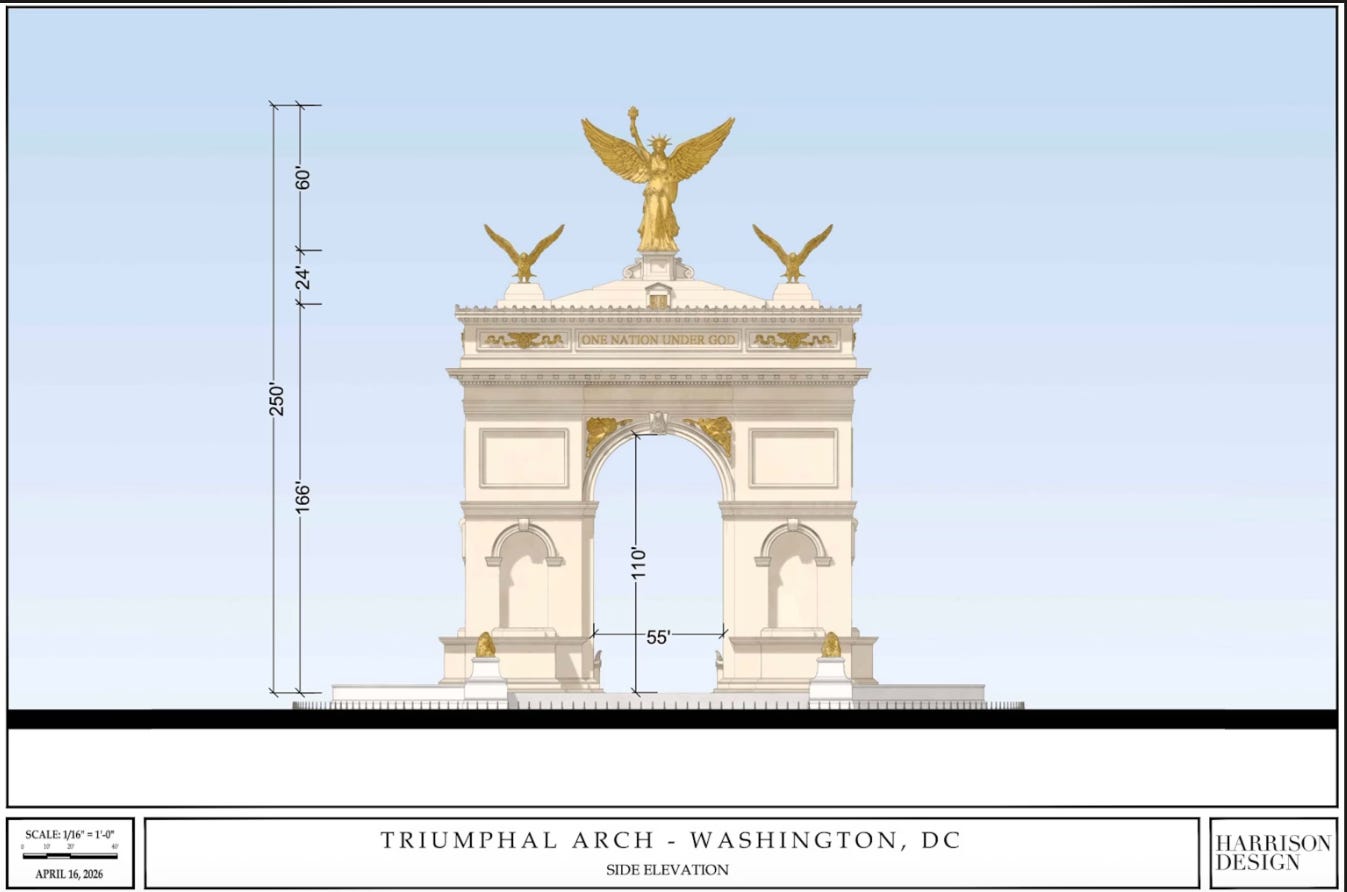
The Monument Was Supposed to Dominate
The arch was not designed to disappear into Washington. At 250 feet tall, it would rise above Memorial Circle at the western end of Arlington Memorial Bridge, crowned with a winged figure and visible across a landscape already occupied by some of the country’s most solemn monuments. Its scale would make it nearly impossible to encounter as background.
That was part of the promise. The administration described the arch as a celebration of the triumphs of the American people, a monumental gateway meant to inspire patriotism and commemorate the nation’s 250th anniversary.
However, Memorial Circle was not an empty place waiting for a president to give it meaning. The land sits within a ceremonial passage connecting the Lincoln Memorial, Arlington Memorial Bridge, and Arlington National Cemetery. Generations had already placed memory there. Architects had shaped its sightlines, funeral processions crossed its roads, and the country’s war dead waited beyond it.
A structure built to dominate that landscape could not be treated as though it were merely filling unused sky. Before the arch could become a monument, federal law required it to become a question: What would its scale overwhelm? What historic relationships would it interrupt? What would the country lose by allowing one president’s preferred symbol to command a landscape built across generations?
The administration wanted the government to approve an arch. The preservation process made the government measure its shadow.
This Community Is Powered by You
What started as a small circle has grown into something much bigger, and it’s all because of readers like you.
Every time you forward this email, post it on socials, or bring someone new into the fold, you’re helping build one of the most passionate, independent political communities out there.
Want to keep the momentum going?
Share this newsletter with someone who should be part of this conversation.
Thank you for being here. It means everything.
See some of our previous reporting on monuments and historic preservation here:


Thirty-Seven Places Had to Be Named
The federal review did not find one isolated conflict between a new monument and an old one. It identified adverse effects on thirty-seven historic properties.
The list reached across the monumental core: Arlington National Cemetery, Arlington House, Arlington Memorial Bridge, the Lincoln Memorial, the National Mall, the Washington Monument, the Jefferson Memorial, the Pentagon, the United States Capitol, and other places whose meaning depends partly on how they are approached, viewed, and connected.
Historic destruction does not always arrive with a wrecking ball. A memorial can keep every stone while losing the visual relationship its designers intended. A cemetery can remain physically untouched while the solemn approach to its gates becomes the foreground of somebody else’s spectacle.
The proposed arch would not simply occupy space near these places. Its height, mass, and location would enter the experience of encountering them. The Lincoln Memorial does not need to lose a column to be diminished, and Arlington House does not need to be demolished for the historic line between the house, the cemetery, the bridge, and the capital to be interrupted.
The administration saw open sky and imagined room for a monument. The preservation process saw a landscape already filled with intention. Thirty-seven places had to be named because presidential ambition had entered all thirty-seven of their stories.
One Hundred Thousand Submissions Entered the Record
Then the public arrived through the process. During the first comment period, the National Park Service received 100,936 submissions. Not every submission opposed the arch. Some welcomed its scale, defended its patriotic purpose, or believed the capital should receive a new monument for the country’s 250th anniversary.
However, more than one hundred thousand submissions prevented a project of national consequence from remaining a conversation among designers, political appointees, and federal commissions. Those concerns entered the official process, where the government had to receive, examine, and summarize them.
Commenters questioned the height, challenged the damage to historic sightlines, and raised concerns about traffic, safety, and construction. They defended Arlington’s solemnity and asked whether a massive new structure belonged beside a cemetery where the country buries its war dead.
A public comment is not a veto. It cannot stop a bulldozer or force an administration to abandon a favored project, but it can create something power often tries to avoid: a witness. The administration could still call the arch a symbol of national triumph and move toward approval. It could no longer pretend that the public had not objected.
One hundred thousand submissions did not settle the argument, but they prevented the government from holding it alone. The arch may still rise. It will not rise over an empty record.
Arlington Was Never Empty Ground
Some of the most consequential objections came from people who understood Memorial Circle not as a design opportunity but as part of the approach to Arlington National Cemetery. Veterans, military families, and citizens with loved ones buried there warned that the arch would introduce spectacle into a landscape defined by restraint.
They raised concerns about funeral processions, historic views, and a towering structure competing with places meant to direct attention toward sacrifice rather than power. Those objections were not arguments against monuments. Arlington is filled with them, but its meaning comes from the people buried beneath them.
Every road leading toward the cemetery carries families arriving for ceremonies they never wanted to attend. Every view toward Arlington House crosses ground shaped by war, grief, and national memory. The space does not need a new structure to become important because its importance is already present in the silence.
Some supporters saw the arch as a patriotic gateway worthy of the nation’s anniversary, and their voices belonged in the record too. However, patriotism does not relieve the government of the duty to ask what kind of patriotism a place requires.
There are places where national pride may properly reach upward and others where the country should lower its voice. Memorial Circle is not vacant federal land awaiting a president’s imagination. It is part of the threshold to a cemetery where the nation carries its dead.
Arlington was never empty ground. It was already occupied by sacrifice.
The Law Made Power Explain Itself
Section 106 of the National Historic Preservation Act did not give preservation officials the power to reject the arch with a single signature. It required something more basic.
Before the federal government could move forward, it had to identify the historic places the project might affect, examine the consequences, consult the public, and consider whether the damage could be avoided, reduced, or mitigated. That process did not guarantee the right outcome, but it guaranteed that power would have to explain itself before acting.
The administration could call the arch patriotic and argue that extraordinary scale belonged at the entrance to the capital. Political language, however, could not complete the review.
The government had to discuss height, mass, sightlines, historic associations, and the ceremonial relationship between the capital and Arlington. It had to place the president’s preferred monument beside the places required to absorb it.
Procedure is often dismissed as delay when powerful people already know what they want, but delay is not always dysfunction. Sometimes it is the time democracy creates so a decision cannot outrun the people who will inherit it.
The law did not force the president to surrender his preference. It forced his government to describe the price of satisfying it. That is what a public safeguard is supposed to do. It does not guarantee that power will choose wisely. It makes power answer before it chooses.
The Civil Servants Left the Evidence Behind
The National Park Service did not need to accuse the president of vanity or adopt the language of political opposition. Its responsibility was narrower and more durable.
The agency had to identify the places at risk, examine the sightlines, apply the preservation standards, and record what the proposed arch would change. Presidential preference can enter the government disguised as institutional judgment. An administration announces what it wants, agencies translate the desire into plans, and the finished decision begins to look independent.
An honest record interrupts that transformation. The review did not declare the arch harmless because powerful people wanted it built. It documented adverse effects on places whose history belonged to the public long before this administration arrived.
That was not partisan resistance. It was professional duty. The report did not need to shout because it measured, named, and documented.
In a government where institutions can be pressured to treat one man’s preference as settled truth, accurate documentation becomes an act of public stewardship. The civil servants did not possess the authority to end the project. They possessed the responsibility to leave evidence behind, and they fulfilled it.
Whatever decision comes next, no official can honestly claim that the government never saw the damage.
Congress Wrote the Brake
The preservation review did not appear by accident. Congress created it. The National Historic Preservation Act placed a public obligation between federal power and the historic places it might alter. It required agencies to look beyond a project’s immediate purpose and consider what the country could lose.
Congress also placed separate limits on commemorative construction in the capital. The veterans and preservation advocate challenging the arch in federal court argue that the administration cannot build it at Memorial Circle without specific congressional authorization. The court has not decided whether that argument will prevail.
However, the constitutional principle is larger than the lawsuit. A president may propose a monument. Executive agencies may develop designs, and planning commissions may review location, scale, and construction. None of those institutions transforms the capital into presidential property.
The monuments, ceremonial roads, and historic landscapes of Washington belong to the country. Decisions that permanently alter them should pass through laws and procedures durable enough to survive any one administration.
That is why Congress wrote the brake. Executive power wants to move while the person exercising it still holds office. Preservation law forces that urgency to encounter memory, consultation, and a record the president does not control.
When Congress writes enforceable conditions and federal employees follow them, presidential preference is returned to a public process. The president may decide what he wants remembered. The people’s branch decides whether public land can be permanently rewritten to satisfy him.
A Victory Is Not the Same as the End
The arch has not been defeated. Preliminary approval remains in place, final review lies ahead, and the preservation process may change the project without preventing construction. The federal lawsuit challenging the administration’s authority is also unresolved.
A public record is not an injunction. An adverse-effect finding is not a cancellation order, and 100,936 submissions do not automatically overcome an administration determined to proceed. However, the project can no longer advance under the fiction that its costs are unknown. Every official involved in the next decision now carries the findings. They know which historic places would be affected, what veterans and families said about Arlington, and that the government’s own professionals documented the harm.
Power may still choose to ignore the record, but it cannot honestly claim the record does not exist. Accountability rarely arrives all at once. Sometimes the first victory is not stopping the decision. It is stripping the decision of plausible innocence.
The preservation process has not stopped the arch, but it has stopped the government from pretending the arch costs nothing.
The Record Belongs to the People
The proposed arch was designed to dominate the landscape, and it may still do so. Political appointees may decide that its scale matters more than the memorial relationships it would overwhelm. The administration may accept mitigation instead of restraint, and a court may still have to decide whether construction can begin without Congress.
However, presidential ambition did not pass through the government without resistance, measurement, or memory. Citizens, veterans, and military families entered the record. Arlington’s funeral processions, historic sightlines, and solemn approach entered the record. Thirty-seven historic places entered the record.
The government had to describe what the project would change before power could decide whether to change it anyway. That is not the final victory, but it is proof that public law can still force concentrated power to leave evidence behind.
The president may propose the monument. He may promote it, praise it, and demand that the government make room for it. However, he does not own Arlington’s meaning, the capital’s historic landscape, or the memory carried through Memorial Circle by families on their way to bury someone they loved.
Those things belong to the American people. So does the record. The arch may still rise, but the truth about its shadow rose first.
Support Independent Media
If this work matters to you, please share this article with someone who still believes public power should answer to the public.
If you can afford it, consider becoming a paid subscriber to The Coffman Chronicle. Your support helps keep this work independent, documented, and focused on the institutions the American people are supposed to own.
Sources:
Advisory Council on Historic Preservation. “An Introduction to Section 106.” Accessed August 3, 2026.
Lemmon v. Trump. “Complaint for Declaratory and Injunctive Relief.” Civil Action No. 1:26-cv-00544. U.S. District Court for the District of Columbia. Filed February 19, 2026.
National Capital Planning Commission. “NCPC Approves New Monumental Arch Preliminary Site and Building Plans.” Media release, July 10, 2026.
National Capital Planning Commission. “New Monumental Arch: Commission Action.” July 9, 2026.
National Park Service. “Appendix D: Historic Properties and Assessment of Adverse Effects Tables.” June 2026.
National Park Service. “Triumphal Arch at Memorial Circle: Assessment of Effects Report.” June 2026.
National Park Service. “Triumphal Arch Project: Public Comment Summary Report.” July 2026.
Public Citizen. “Lemmon v. Trump.” Accessed August 3, 2026.
U.S. House of Representatives, Office of the Law Revision Counsel. “40 U.S.C. § 8903: Congressional Authorization of Commemorative Works.” United States Code. Accessed August 3, 2026.
It’s gaudy and tacky, and have they considered what would happen in a hurricane?
A monument like that I supposed to honor people who have died, and so far, The Fapweasel (Trump) is very much alive.